

What is Backtesting in Forex? A Time Machine for Traders!
Backtesting, in simple terms, is the process of testing a trading strategy on historical market data. In other words, you examine what results you would have achieved if you had traded with this strategy in the past without risking any real money. This method helps traders evaluate the profitability, strengths and weaknesses, and risk level of a strategy before implementing it in the live market. Backtesting is one of the most essential tools for optimizing trading decisions, minimizing errors, and boosting confidence in the Forex market. If you're looking for a way to evaluate and refine your strategies without financial loss, backtesting is exactly what you need.
Definition of Backtesting
Backtesting involves simulating a trading strategy on historical data. In this process, traders can analyze hypothetical trading results, including profits and losses, entry and exit points, and risk levels. If the backtesting results are positive, there is a possibility that the strategy may be successful in the future as well.
The Importance of Backtesting
Before implementing a trading strategy in the real market, it is crucial to know how that strategy has performed in the past. That is exactly what backtesting provides. By reviewing a strategy’s performance on past data, a trader can gain a better understanding of its effectiveness and potential weaknesses without any real risk. This process not only reduces common mistakes and emotional decision making but also increases the trader’s confidence in executing actual trades. Below, we will explore the most important reasons why backtesting is vital in Forex trading.
Strategy Performance Evaluation
Backtesting allows traders to evaluate the performance of their strategies in past markets. This process helps identify the strengths and weaknesses of a strategy.
Strategy Optimization
Using backtesting, traders can adjust and optimize the parameters of their strategy. This helps them discover strategies that deliver the highest returns.
Risk Reduction in Trading
By testing strategies before implementing them in the live market, traders can reduce their investment risk. This enables them to enter trades with greater confidence.
Education and Learning
Backtesting is an educational tool for traders. By analyzing the results, traders can gain a better understanding of how the market works and how different strategies impact trading outcomes.
Better Decision Making
With documented data on a strategy's past performance, traders can make more informed decisions. This is especially important in highly volatile markets like Forex.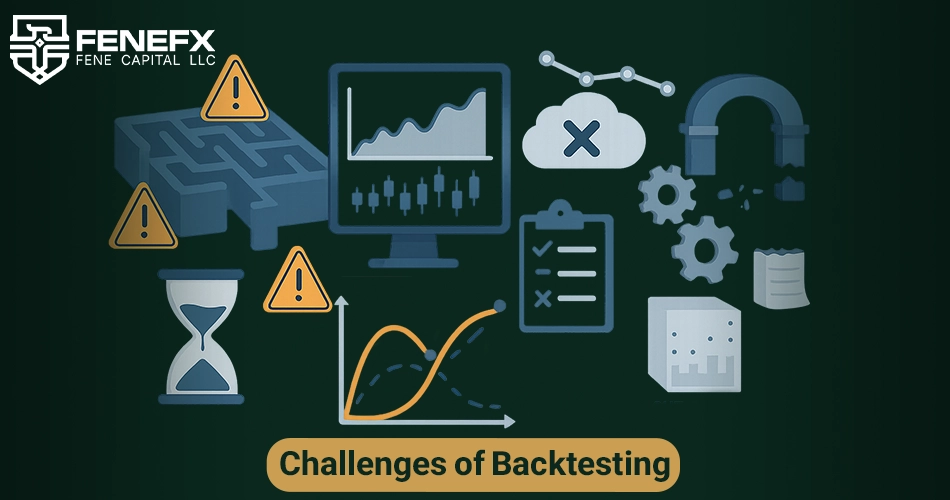
Challenges of Backtesting
Despite the many advantages backtesting offers to traders, like any analytical method, it is not without its challenges. One of the main issues is the heavy reliance on historical data. While this data can reveal useful patterns, it does not always accurately reflect current or future market conditions. Many strategies that performed well in the past may become ineffective in volatile markets or under the influence of new economic and political factors. This means that backtesting results cannot always be generalized to the future, and traders must be aware of this reality.
Another challenge is the risk of overfitting. In this case, a trader might fine tune a strategy so closely to past data that it yields seemingly excellent results, but lacks real world effectiveness. This kind of precise adjustment often only works under specific historical conditions and quickly fails in different market environments. Moreover, if the historical data is incomplete or contains errors, the backtesting results can be misleading. Therefore, to conduct successful backtesting, it is essential to use accurate data, test across varied timeframes, and apply realistic analysis in order to gain a true understanding of a strategy's potential.
Comparison of Backtesting Methods: Manual vs. Automated
Backtesting in the world of Forex trading is conducted using two main methods: manual and automated. Each of these methods has its own unique advantages and disadvantages, and the choice between them depends on the trader’s needs and skill level.
Manual Backtesting
In manual backtesting, traders personally review and analyze historical data. This process allows the trader to become more deeply familiar with market details and refine their strategies based on direct observations.
| Advantages of Manual Backtesting | Disadvantages of Manual Backtesting |
| Deeper understanding of market behavior | Very time consuming and slow |
| Ability to visually identify patterns | High risk of human error in analysis |
| Flexibility in quickly adjusting parameters | Difficult to analyze large scale data |
| Useful for educating beginner traders | Low repeatability and high need for precision |
Automated Backtesting
In this method, traders use software and algorithms to analyze historical data. Platforms such as MetaTrader 4 and ProRealTime offer powerful tools for performing automated backtesting.
| Advantages of Automated Backtesting | Disadvantages of Automated Backtesting |
| High speed in executing tests and analyzing data | Requires technical and programming knowledge |
| Greater accuracy and reduced human error | Risk of overfitting |
| Ability to run repeated tests with different parameters | Some tools and software can be costly |
| Suitable for analyzing large volumes of data | Dependent on the quality of software and input data |
The choice between manual and automated backtesting depends on several factors, including the trader’s level of experience, access to resources, and trading objectives. Beginner traders may prefer to start with the manual method to gain a better understanding of the market, while professional traders may opt for the automated method for faster and more accurate analysis.
Combining Both Methods
Many successful traders use a combination of both approaches. They may begin with automated backtesting to identify potential strategies and then apply manual analysis to make the necessary optimizations. This hybrid approach can yield the best results and help traders enter the market with greater confidence.
Ultimately, the goal of backtesting is to improve trading strategies and manage risk more effectively. By choosing the right method, traders can leverage this powerful tool to achieve greater success in the Forex market.
Backtesting Using Trading Platforms
Backtesting through trading platforms enables traders to test their strategies on historical data and analyze the results. Two popular platforms for this purpose are MetaTrader 4 (MT4) and ProRealTime, each offering unique features and capabilities.
Using MetaTrader 4
MetaTrader 4 is one of the most widely used trading platforms, offering a range of tools for backtesting. One of its most powerful tools is the Strategy Tester, which allows traders to test automated trading programs known as Expert Advisors (EAs).
One of the key features of MetaTrader 4 in the context of backtesting is the ability to run Expert Advisors on historical market data to evaluate their performance. This tool provides comprehensive analytical reports, including the profit to loss ratio, the number of winning and losing trades, drawdown levels, and other risk and return metrics. Additionally, MetaTrader 4 allows traders to adjust various strategy parameters such as stop loss, take profit values, or trade volume and assess how these changes impact backtest results. This high level of flexibility supports deeper analysis and optimization of trading strategies.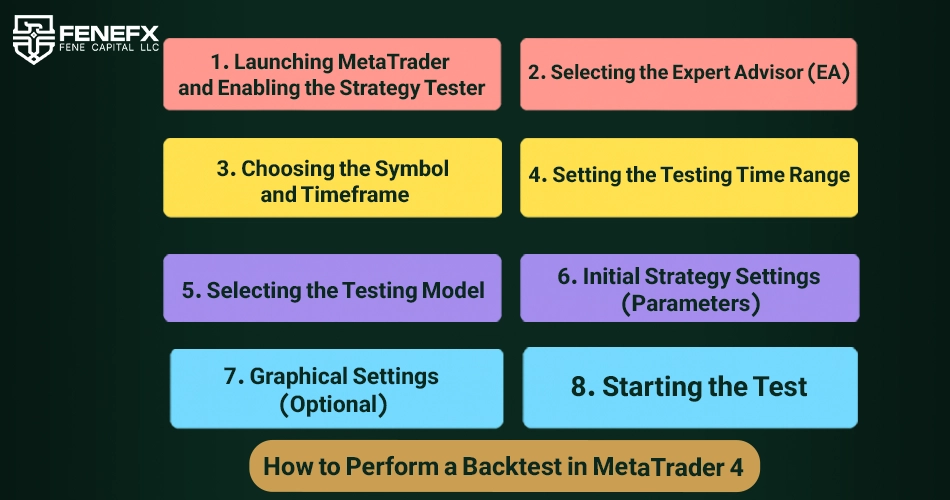
How to Perform a Backtest in MetaTrader 4 (MT4)
To perform an automated backtest on the MetaTrader 4 platform, simply follow the steps below in order. This method allows you to test the performance of a trading robot or a specific strategy on historical market data.
1. Launching MetaTrader and Enabling the Strategy Tester
First, open the MT4 platform. From the top menu, go to the View section and activate the Strategy Tester option (you can also use the shortcut Ctrl + R). This will bring up a panel at the bottom of the screen.
2. Selecting the Expert Advisor (EA)
In the Strategy Tester window, from the dropdown menu next to the phrase “Expert Advisor,” select the desired trading robot (EA). If you haven’t installed it yet, you need to copy its file into the MQL4/Experts directory and then restart the platform.
3. Choosing the Symbol and Timeframe
In the same window, under the Symbol section, select your desired currency pair or symbol (e.g., EURUSD) and choose your preferred time frame (e.g., H1 for the one hour chart).
4. Setting the Testing Time Range
Enable the Use Date option and specify the desired time range (e.g., from January 2022 to December 2023). This range should match the data that has been downloaded to your system.
5. Selecting the Testing Model
Set the Model option to Every Tick to obtain the most accurate simulation results. This mode provides the most detailed testing execution.
6. Initial Strategy Settings (Parameters)
Click on the Expert Properties button and, under the Input tab, adjust the parameters of your strategy or robot. This section is crucial for optimizing the results.
7. Graphical Settings (Optional)
If you want to see the backtest visually on a chart, check the Visual Mode option. This will display the backtest execution graphically.
8. Starting the Test
Finally, click the Start button. MetaTrader will begin the test execution and, upon completion, will display a report of the results under the Results and Graph tabs. In the Report tab, you’ll also find information such as net profit, number of trades, profit to loss ratio, and drawdown.
How to Use ProRealTime
ProRealTime is another advanced platform for backtesting that offers the ProBacktest tool. This tool allows traders to test their strategies with high accuracy and full detail.
The ProRealTime platform, through its ProBacktest tool, provides advanced features for backtesting that help traders evaluate their strategies with greater precision and depth. This tool delivers comprehensive and detailed reports on strategy performance, including analytical charts and complete statistical data, which assist in deeply analyzing past performance.
Among its key features are flexible settings that allow users to modify parameters and test strategy performance across different timeframes. Additionally, ProBacktest provides risk analysis and displays the peaks and troughs of the equity curve, helping traders determine their acceptable risk level.
Moreover, a detailed list of orders and closed positions is available, enabling users to review and analyze the entry and exit prices of each trade.
How to Use:
- Go to the Indicators and Trading Systems section.
- Select the desired trading system.
- Enter the parameters and run the test.
- Analyze the results and optimize the parameters if necessary.
Comparison of Backtesting in MT4 and ProRealTime
| Feature | MetaTrader 4 (MT4) | ProRealTime |
| User Interface | Simple, user friendly for beginners | More advanced, suitable for professional traders |
| Backtesting Tool | Strategy Tester for testing Expert Advisors | ProBacktest with extensive analytical features |
| Type of Executable Strategy | Based on EAs (automated trading programs) | Supports custom strategies with dedicated coding |
| Performance Reporting | Profit/loss ratio, winning/losing trades, basic risk analysis | Detailed statistical reports, performance charts, equity analysis |
| Parameter Flexibility | Ability to set EA input parameters | Advanced and comprehensive parameter settings |
| Risk Analysis Capability | More limited and basic | Advanced, with visual risk and performance analysis |
| Best Suited For | Suitable for beginners and users familiar with MT4 | Suitable for professional users and advanced analysts |
| Access and Cost | Free, popular, and available on most brokers | May require a subscription or fee |
Advantages and Disadvantages of Backtesting
Backtesting is an important tool in financial markets that helps traders evaluate their strategies based on historical data. This process has specific advantages and disadvantages, which we will examine below.
Advantages of Backtesting
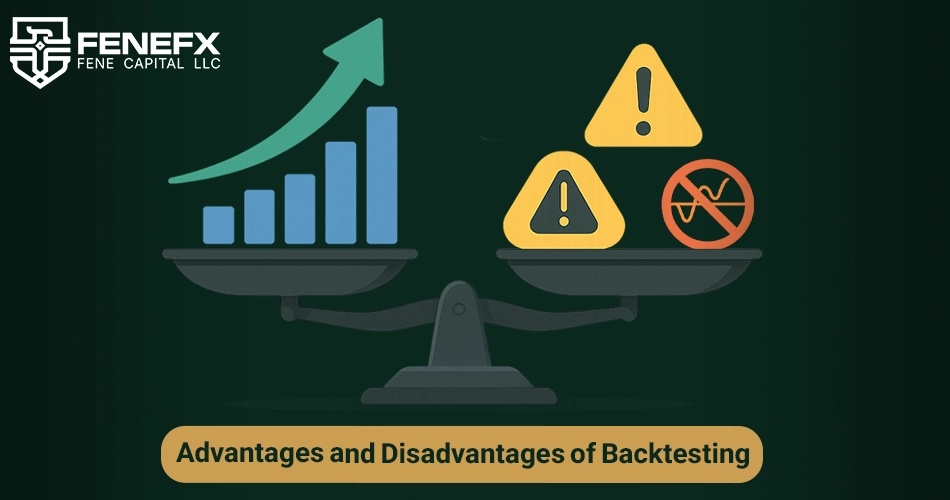
Backtesting allows traders to review and evaluate their trading strategies in historical market conditions before actual execution. This process helps the trader identify patterns and strengths in the strategy and enter trades with greater confidence. On the other hand, backtesting is an excellent tool for gaining deeper market insights, optimizing strategy parameters, and improving risk management.
Disadvantages of Backtesting
Despite its many advantages, backtesting also has limitations. One of its main drawbacks is that past results are no guarantee of future success, as market conditions are constantly changing. Additionally, manual backtesting can be time consuming and prone to error, while automated methods may lead to technical complexity and software costs. There is also a risk of overfitting when a trader overly adapts a strategy to specific data, causing it to lose effectiveness in real market conditions. Therefore, the backtest results should be analyzed with caution and along with complementary methods.
Comparison of Backtesting with Scenario Analysis and Paper Trading
In the world of trading, merely having a strategy is not enough; traders must be able to evaluate and validate their strategies. To this end, they have three important tools at their disposal: Backtesting, Scenario Analysis, and Paper Trading. Each of these methods has its own advantages and limitations, and depending on the objective, level of experience, and type of market, they can be used independently or in combination.
Backtesting is a process in which a trading strategy is executed on historical data to assess its hypothetical performance. The main advantage of backtesting is its high speed and ability to test on a large volume of data. This method is very useful for identifying patterns, weaknesses, and strengths of a strategy. However, one of its biggest limitations is that past results do not guarantee future performance. Moreover, there is the risk of overfitting, meaning the strategy is tuned to work well only with historical data but becomes inefficient in real market conditions.
Scenario Analysis examines the performance of a strategy under hypothetical and unexpected market conditions. Unlike backtesting, which relies on actual historical data, this method uses simulated scenarios to evaluate the flexibility and robustness of the strategy. For instance, one can examine the impact on a strategy if interest rates suddenly rise or the market faces an economic shock. This method provides very good insight into the potential behavior of the system in the future, but since the conditions are assumed, they do not always align with reality.
In contrast, Paper Trading is a process in which the trader tests their strategy in a live market without using real money. This method is essentially a form of forward testing that helps gain practical experience. Its main advantage is accurately simulating the market environment; however, since real trades are not being made, the trader's psychological and emotional pressure does not fully manifest at a real level.
Comparison Table of Backtesting, Scenario Analysis, and Paper Trading
| Comparison Criteria | Backtesting | Scenario Analysis | Paper Trading |
| Type of Data | Real historical data | Hypothetical and simulated conditions | Live market data |
| Accuracy Compared to Real Market | Medium (depends on data quality) | Low (assumed and unrealistic) | High (follows real market conditions) |
| Trader’s Psychological Experience | None | None | None (since no real money is involved) |
| Execution Speed | Very high | Medium | Low (requires real time execution) |
| Financial Risk | None | None | None |
| Overfitting Risk | High | None | Low |
| Best Suited For | Initial strategy optimization | Evaluating strategy under critical or unexpected conditions | Practical testing of strategy in real market environment without real capital |
| Main Limitation | No guarantee of future results; risk of overfitting | Unrealistic nature of conditions and scenarios | Incomplete experience of psychological pressure in actual trading |
Backtesting vs. Forward Testing: Differences and Similarities
Backtesting and forward testing are two complementary methods for evaluating trading strategies. Backtesting uses historical data to examine the potential past performance of a strategy and allows the trader to optimize it; however, its results are not a guarantee for the future. In contrast, forward testing evaluates the strategy’s performance in real time market conditions using live data, without financial risk.
Comments
Just remember overfitting is real. If you tweak parameters until history looks perfect, you've built a strategy for the past, not the future. Out-of-sample testing is non-negotiable imo.
Any plans for a tutorial on backtesting in MT5 specifically? The strategy tester confuses me every time I open it.
Didn't know you could test a strategy on old data before risking real money. Just tried the bar replay thing mentioned here and it's a game changer for a beginner like me.
Love the time machine analogy 😄 made me actually finish the article.
Backtested my breakout strategy over two years of data last winter and found it only worked in London session. That one discovery paid for itself many times over.