




What is risk free trading in Forex? Insuring your assets
Risk free trading in Forex means bringing the trade risk down to zero; this is done by moving the stop loss to the entry point after the price reaches the profit zone, so that if the price reverses, you neither lose your profit nor suffer a loss. In this case, the trader can stay in the trade without worrying about potential losses and has the chance to benefit from the continuation of the price movement. This method is neither a magical trick nor a guaranteed way to profit, but a very practical risk management technique that can protect your capital from sudden losses while giving you more freedom to gain greater profits.
What is Risk Free Trading and Why is it Important?
Risk free trading is a strategic method in risk management through which the trader tries to eliminate the risk of loss from a certain point onward. This is usually done when the price has moved far enough in the desired direction after entering the trade, making it technically and logically reasonable to move the stop loss to the entry point. That is, if the price reverses and the stop loss is triggered, the trader neither incurs a loss nor misses a profit. In fact, the trade becomes “neutral” or risk free.
The importance of this practice can be understood in several aspects
Reducing financial risk:The main goal of this technique is to protect the initial capital. By eliminating the risk of loss, the trader is placed in a safe position.
Reducing psychological stress:When the trader knows that even in the worst case scenario there will be no loss, their psychological pressure is reduced and they perform better.
Better profit management:One can more comfortably let the price continue its path without the fear of reversal causing an early exit from the trade.
This is part of the mental discipline and control that every professional trader must learn and practice on their path to growth.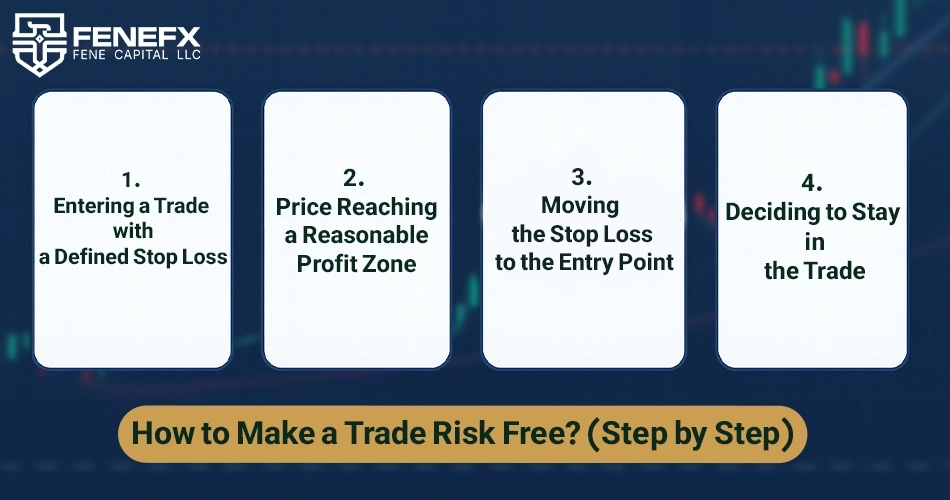
How to Make a Trade Risk Free? (Step by Step)
Below we explain the specific steps that must be taken to make a trade risk free:
Step 1: Entering a Trade with a Defined Stop Loss
First, a trade must be opened with a clearly defined stop loss. Without setting a stop loss, the concept of risk free trading essentially has no meaning. Suppose you open a buy position on the EUR/USD pair at the price of 1.0800 and set the stop loss at 1.0770.
Step 2: Price Reaching a Reasonable Profit Zone
When the price has moved far enough from your entry point and gone in the direction of profit for example, reaching 1.0850 it can be said that the market has moved in your favor. At this stage, risk free trading becomes a consideration.
Step 3: Moving the Stop Loss to the Entry Point
You can now move the stop loss from 1.0770 to the entry point, which is 1.0800. In this case, if the price reverses, the trade will be closed without profit or loss, but your capital is preserved.
Step 4: Deciding to Stay in the Trade
At this point, if your strategy allows it and the market structure is still positive, you can stay in the trade and take advantage of further price movement without worrying about losing your capital.
This method may seem simple, but you should know that executing it at the wrong time either too early or too late can limit your potential profit or even cause an incorrect exit. Precise timing is the key to successfully applying this technique.
Trailing Stop and Its Role in Risk Free Trading
Trailing Stop is one of the smart tools for making a trade risk free, which automatically updates the stop loss as the price moves. If the price moves in your favor, the stop loss also moves at a certain distance above or below the price; but if the price reverses, the stop loss remains fixed, and if it is hit, the trade is closed.
For example, suppose you set the Trailing Stop distance to 30 pips. When the price goes up by 30 pips, the stop loss is also placed 30 pips above the previous level. In fact, this tool is a kind of dynamic risk free approach that also preserves profit to some extent.
Advantages of Using a Trailing Stop
- There is no need for constant market monitoring, as the stop loss adjusts automatically.
- Your risk to reward ratio improves.
- It prevents you from closing the trade too early due to emotions.
But be cautious: in volatile markets, the Trailing Stop may be triggered too early and deprive you of a major price movement. Therefore, the set distance should be appropriate to the time frame and market volatility.
Comparing Risk Free Trading with Partial Position Closing
One of the important decisions traders face after entering profit is choosing a method for risk management: risk free trading or closing a portion of the trade volume (Partial Close). Both approaches are designed to preserve profit or prevent loss, but they have different effects on the profit and loss structure.
Risk free trading means moving the stop loss to the entry point. In this method, the trader remains in the trade with the same initial volume, but without the risk of losing capital. If the market continues in their favor, more profit will be gained. If it reverses, the trade closes without loss.
In contrast, closing part of the position means realizing part of the profit. Suppose you close 50% of one lot in profit. In this case, half of the trade has been closed with profit, and the other half remains open. This method reduces risk and locks in some realized profit, but also limits the potential to gain more from further price movement.
When choosing between these two methods, one must consider trading style, individual psychology, and overall strategy. For example, scalpers who work with small, quick profits often prefer to close part of the trade. Meanwhile, swing traders may be more inclined toward risk free trading.
Application of Risk Free Trading in Different Trading Styles
The concept of risk free trading may seem simple, but its application and effectiveness vary across different trading styles. Each style has a different level of volatility, trade holding duration, and profit targets, which influence how the risk free technique is used.
Scalping
In scalping, where trades are very short term and aim to gain a few pips, there is often not enough opportunity to apply risk free trading. This is because the profit distance from the entry point is very small. However, in certain cases where the price movement is fast and sharp, the stop loss can be moved to the entry point after reaching a certain profit threshold.
Day Trading
For day traders, risk free trading is highly practical. These traders work on mid term timeframes and usually risk free the trade after reaching a 1:1 risk to reward ratio. In this style, moving the stop loss to the entry point not only protects the capital but also gives the trader more freedom to decide whether to stay in the trade.
Swing Trading (Medium Term Trades)
In this style, where trades usually remain open for several days to several weeks, risk free trading is done gradually and along with a Trailing Stop. Traders may risk free the trade multiple times at key market levels and move the stop loss to higher levels as the price rises in order to preserve accumulated profits.
Position Trading (Long Term Trades)
For long term traders, the targets are usually large and the distance from the entry point is considerable. In this style, risk free trading is applied after a trend is confirmed and a specific profit (e.g., several hundred pips) is reached. This is often done using fundamental analysis and considering long term economic events.
Overall, risk free trading should align with the nature and timing of the trading style in order to avoid turning potential profits into zero.
Advantages and Disadvantages of Risk Free Trading
Risk free trading is one of the useful tools in risk management that allows the trader to protect capital without getting emotionally involved, while also letting the trade continue. However, just as this method has advantages, it also has disadvantages that must be understood fully before using it.
In some cases, premature risk free action can prevent the full development of a trade’s profitability. On the other hand, if this technique is executed with proper logic, it can bring long term profits to the trader without putting the initial capital at risk.
Below is a table listing the main advantages and disadvantages of this technique:
| Advantages | Disadvantages |
| Complete elimination of risk from the trade | If applied too early, it can hinder profit growth |
| Reduced psychological pressure and stress during trading | The trade may close early, missing profit opportunities |
| Better management of continued profitable trends | In volatile markets, the stop loss may be triggered prematurely |
| Increased flexibility in decision making | Requires precise timing and strong command of the trading strategy |
| Improved overall risk to reward ratio of the portfolio | May create a false sense of security |
With a proper understanding of the above advantages and disadvantages, the trader can determine in which situations it is better to use risk free trading and in which conditions this action may reduce potential profit. Awareness, testing, and experience are the key factors in this regard.
Risk Free Trading in Forex
The Forex market, due to its volatile nature, high trading volume, heavy leverage, and 24 hour activity, is considered one of the riskiest financial markets. These very features make risk free trading in Forex not only more necessary but even more critical compared to markets like stocks or cryptocurrencies.
In the stock or crypto markets, although price fluctuations can be intense, many participants in these markets tend to hold positions long term, and their daily trading is limited. In contrast, a large number of Forex traders operate short term or even use scalping strategies. In such styles, a small fluctuation can destroy the entire trade, especially when high leverage is involved.
Moreover, the unpredictable nature of economic news, banking reports, and sudden volatility in Forex exposes traders more frequently to stop outs or quick losses. Under such conditions, making a trade risk free becomes an effective tool for protecting initial profits and eliminating the risk of loss.
Therefore, although risk free trading is useful in all markets, in Forex, due to its high speed, instant volatility, and constant psychological pressure, it carries greater urgency and priority. This technique can significantly preserve the trader’s psychological and financial security.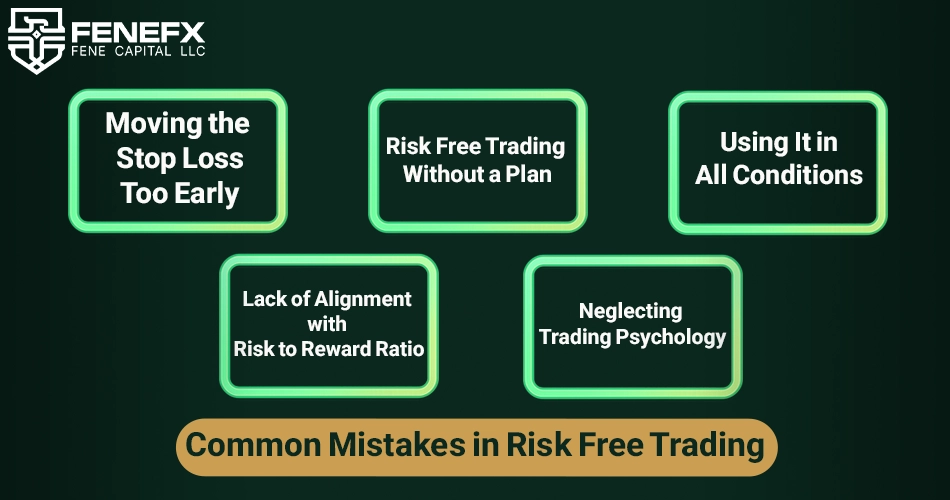
Common Mistakes in Risk Free Trading
Although risk free trading may appear to be a simple and low risk method, in practice, many traders lose potential profits or even face negative outcomes due to a misunderstanding or improper execution of this technique. Below, we examine the most common mistakes in risk free trading:
1. Moving the Stop Loss Too Early
One of the most common mistakes is quickly moving the stop loss to the entry point after gaining a small amount of profit. This may cause the trade to exit the market too soon, even though it had higher growth potential. When natural market fluctuations occur, the SL may be triggered without reason, and the trader misses out on the continuation of the trend.
2. Risk Free Trading Without a Plan
Some traders engage in risk free trading without having a clear strategy or based on emotions. This type of decision making often leads to reduced trade efficiency. Risk free trading should be part of a well defined risk management plan and aligned with the trade structure.
3. Using It in All Conditions
Risk free trading is not suitable for all styles and market conditions. Misuse of this technique in short term trades or highly volatile markets may result in an early exit from a position. A precise understanding of the market type and its price behavior is essential.
4. Lack of Alignment with Risk to Reward Ratio
When the risk to reward ratio is low (e.g., 1:1), risk free trading might make the entire profit structure illogical. If you're only trying to avoid loss at the cost of reducing profit, you’ll eventually become a low return conservative trader.
5. Neglecting Trading Psychology
Some traders risk free a trade too early just to reduce stress. In reality, instead of relying on analysis and logic, they act out of fear. This emotional approach will lead to decreased profitability in the long time.
Tips for Effectively Executing Risk Free Trading
To properly execute risk free trading and gain its real benefits in practice, certain principles must be followed. Below are important tips that can help make the application of this technique more professional and effective:
1. Wait for Initial Profit to Stabilize
Before moving the stop loss to the entry point, it is better to wait until the trade reaches a reasonable profit level (e.g., 1R or more). This allows enough room for initial fluctuations and reduces the chance of an early exit.
2. Use a Trailing Stop
In situations where there is a strong trend, using a trailing stop can be a suitable alternative to risk free trading. With this method, the stop loss is gradually adjusted based on market behavior while the trade remains in the trend.
3. Set a Defined Level for Risk Free Action
In your trading strategy, predetermine at what profit level you will apply risk free trading. This level can be based on profit percentage, support and resistance, or specific technical levels.
4. Proper Understanding of Market Structure
Before taking any action, analyze the market correctly. If the market is forming a reversal pattern, it may be better to take partial profit instead of going risk free. But if the market is continuing in a strong trend, risk free trading may be the right decision.
5. Practice on a Demo Account
Before using risk free trading on a real account, practice it on a demo account. This practice helps you understand your emotions, learn proper timing, and identify weaknesses in your strategy.
6. Document and Analyze Your Trades
After executing each risk free trade, record and review the trade. See whether the exit was done correctly or not. These analyses will help you improve your performance.
Comments
As someone who blew a small account already, this idea of protecting capital first is exactly what I needed to hear. Thank you for putting it so simply.
Good stuff, the breakeven section was worth the read alone.
Could you expand on hedging with correlated pairs? Not sure I got how that protects the account in practice.
Moved my stop to breakeven on a EURUSD long last week and the market tagged it before running 80 pips without me. There's always a tradeoff, just like the article says.
Careful with the phrase 'risk free' — hedging costs money and moving stops to breakeven too early just gets you wicked out. It reduces risk, never removes it. Otherwise decent overview.