




Understanding the Risks of Forex Trading
The Forex market, also known as the foreign exchange market, is the largest and most dynamic financial market in the world, with trillions of dollars traded daily. This market, due to its unique characteristics, attracts many traders; however, these very features can also bring significant risks. One of the primary reasons why the Forex market is considered risky is its high trading volume and liquidity. While high liquidity allows for smoother transactions, it also means that price movements can happen very quickly, making it more challenging to predict market direction. Moreover, Forex operates as a 24-hour market, meaning that trading is possible at any time of the day or night. While this is an advantage, it can also lead to hasty and irrational decision-making by traders.
Another risk factor in Forex trading is thecomplexity and variety of financial instruments. In this market, you can trade using instruments such as futures, options, or CFDs, as well as leverage. Although leverage can amplify potential profits, it can also result in substantial losses if predictions are incorrect.
Additionally, the Forex market is heavily influenced byexternal factors such as political events, economic changes, and geopolitical developments. Changes in central bank monetary policies, economic crises, or even a political speech can cause significant fluctuations in currency values. These external factors make predicting market trends more complicated and can lead to unexpected losses for traders.
In summary, while the Forex market offers numerous opportunities, its complex and unpredictable nature makes it a highly risky environment for traders. Understanding these risks is the first step toward achieving success in this market.
Types of Risks in Forex Trading
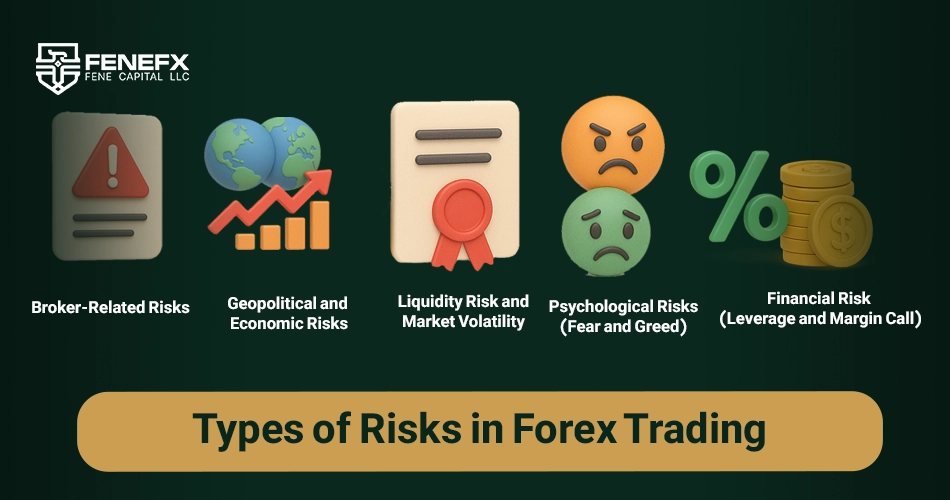
Forex trading can be profitable, but without understanding the various risks involved, it can lead to heavy losses. Below, we explore some of the most significant risks in this market:
1. Financial Risk (Leverage and Margin Call)
One of the biggest risks in Forex trading is the use ofleverage. Leverage allows you to control a larger position with a smaller amount of capital. For instance, with a 1:100 leverage, you can trade a 10,000positionwithonly10,000 position with only 10,000positionwithonly100. However, if the market moves against your position, your losses are magnified. In such cases, you may encounter amargin call, where the broker requires you to deposit additional funds to keep your account from going negative.
2. Geopolitical and Economic Risks
The Forex market is highly sensitive togovernment and central bank decisions. Changes in interest rates, monetary policies, sanctions, or political crises can cause sudden shifts in currency values. For example, geopolitical events such as wars or abrupt changes in a country’s economic policies can create significant volatility in the market.
3. Liquidity Risk and Market Volatility
At certain times, the market may experience low liquidity, especially during the release of major economic news or during off-peak trading hours. This can lead to widerspreads(the difference between bid and ask prices), making it harder to execute trades at desired prices. Furthermore, extreme market volatility can result inslippage, where your trade is executed at a price different from what you intended.
4. Psychological Risks (Fear and Greed)
One of the less-discussed risks in Forex trading ispsychological risk. Traders often make decisions driven by emotions such as the fear of losing money or greed for higher profits. These emotional responses can lead to premature entry into trades, exiting profitable trades too early, or increasing position sizes excessively.
5. Broker-Related Risks
Choosing an unreliable broker can create numerous issues. Some brokers may engage in fraudulent activities or fail to provide transparent trading conditions. Additionally, problems such as delayed withdrawals or price manipulation may arise with unregulated or questionable brokers.
Why Do These Risks Occur in the Forex Market?
The risks in the Forex market arise from various factors, which we will explore in detail below:
Impact of External Factors:
The Forex market is highly influenced by political, economic, and geopolitical events. Decisions by central banks regarding interest rates, fiscal policies, or even global crises can rapidly alter the value of a currency. These external factors are often unpredictable and can lead to significant losses.
24-Hour Nature of the Market:
The Forex market operates continuously and never closes. While this feature is appealing, it also makes constant monitoring of the market challenging. Traders may enter trades at unsuitable times or make poor decisions due to fatigue and psychological pressure.
Functionality of Financial Instruments Like Leverage:
Financial instruments such as leverage can amplify profits but can also lead to significant losses if not managed properly. Many novice traders enter the market without fully understanding how leverage works, resulting in the loss of their capital.
How to Minimize Risks in Forex Trading
While it is impossible to eliminate all risks in Forex trading, proper management can help minimize them. Below, we outline practical ways to reduce risks:
1. Using Stop Loss Orders
One of the best tools for managing risk is setting astop lossfor your trades. A stop-loss order allows you to limit the amount you are willing to lose if the market moves against your position, preventing larger losses.
2. Capital Management and Position Sizing
One of the key principles in Forex trading iscapital management. Never risk your entire capital on a single trade. As a rule of thumb, it is recommended to risk no more than 1–2% of your total capital on any given trade. Additionally, your position size should be proportional to your account balance.
3. Creating a Structured Trading Plan
Having awell-defined trading planthat includes entry and exit strategies, risk management, and trading goals can help you avoid impulsive decisions and execute trades based on logical analysis rather than emotions.
4. Choosing a Reliable and Reputable Broker
Selecting a trustworthy broker is crucial for your success in Forex trading. Ensure that the broker is regulated by a reputable financial authority and has positive feedback from users.
By applying these tips and gaining a comprehensive understanding of the risks involved, you can have a safer and more successful experience in Forex trading. Although this market is high-risk, with the right knowledge, management, and planning, you can take advantage of its opportunities.
Tips for a Safer Forex Trading Experience
The Forex market attracts many traders due to its potential for profitable opportunities; however, success in this market requires experience, knowledge, and skill. In this section, we will share key tips that can help traders minimize risk and trade more safely in this dynamic market.
1. Continuous Learning and Education
The first and most crucial step to ensuring safety in Forex trading iscontinuous learning and education. The Forex market is a dynamic and complex environment influenced by various factors such as economic changes, political events, and central bank decisions. To succeed in this market, traders must understand the principles oftechnical analysis,fundamental analysis, andrisk management.
Moreover, keeping up with economic news and learning from experienced traders can significantly enhance your decision-making ability. Staying informed will allow you to recognize market trends and make well-informed trading decisions.
2. Using a Demo Account Before Entering the Live Market
One of the best tools for starting in Forex trading is ademo account. This account allows you to practice trading strategies and understand market behavior without risking real money. Using a demo account is especially crucial for beginner traders as it provides a safe environment to identify and correct mistakes without financial consequences.
Once you gain confidence and sufficient experience in a demo account, you can gradually transition to live trading.
3. Avoiding Emotional and Impulsive Trading
Forex trading can easily become influenced by emotions. Fear of losing money or greed for greater profits can lead to impulsive and irrational decisions. To avoid emotional trading, traders should create aclear trading planand strictly follow it.
Settingstop-lossandtake-profitlevels can help you manage trades based on logic and analysis rather than emotional reactions. By setting these boundaries in advance, you can maintain discipline and reduce the risk of emotionally driven mistakes.
4. Analyzing the Market Based on Real Data, Not Rumors
One common mistake in Forex is making decisions based on rumors and unreliable information. Traders should rely onverified data and trusted analysisto inform their decisions. Utilizing reliable news sources, technical analysis tools, and fundamental insights can help traders develop a clearer and more objective view of the market.
Relying on rumors and baseless predictions can often result in substantial losses. Building decisions on credible sources minimizes risk and enables more consistent trading success.
Is Forex Trading Suitable for Everyone?
While the Forex market offers ample opportunities for profit, it is not suitable for everyone. Successful Forex trading requires specific personality traits and skills that not everyone possesses. In this section, we will explore who is best suited for Forex trading and why some individuals may find it unsuitable.
1. Required Personality Traits
Forex trading demands patience, discipline, and emotional control. Impatient individuals or those who struggle to handle losses may face serious difficulties in this market. Successful Forex traders must be able to manage stress effectively and make logical decisions in high-pressure situations.
Additionally, having confidence in your strategy, along with the flexibility to admit mistakes and learn from them, is crucial for long-term success. Traders who stay calm under pressure and stick to their trading plans are more likely to achieve consistent results.
2. Essential Skills for Forex Trading
Successful Forex traders must possess strongmarket analysisandrisk managementskills. Traders need to be capable of analyzing market movements and making informed decisions based on available data. Moreover, understanding propercapital managementtechniques and utilizing essential trading tools likestop-lossorders andleverageare critical skills for minimizing risk and enhancing profitability.
3. Is Forex Suitable for Everyone?
The truth is that Forex trading isnot suitable for everyone. Individuals seeking quick and effortless profits often fail in this market. Similarly, those who are risk-averse or unwilling to dedicate sufficient time to learning and market analysis may struggle to succeed.
Ultimately, Forex is a market that requireseffort,continuous learning, anddiscipline. Individuals who are committed to long-term success, willing to face the market's risks, and prepared to develop their trading skills have a greater chance of succeeding in Forex. Conversely, those who prefer low-risk investment options or lack the time to commit to learning should consider exploring alternative investment opportunities.
These tips are designed to help traders develop a realistic understanding of the Forex market and approach trading with better awareness and preparation.
Comments
Can you cover broker/counterparty risk in more depth? How to tell if a broker is actually regulated properly vs just claiming to be.
Good list, but I'd rank psychological risk above leverage. Most traders don't die from one bad trade, they die from revenge trading after it. Position sizing fixes half of these problems.
Refreshing to see a prop firm talk this honestly about risk. Nice one FeneFX.
Blew my first small account in three weeks because I ignored basically everything listed here. Wish I'd read something like this before depositing.
As someone just starting out, this was sobering but needed. I honestly didn't get how leverage cuts both ways until the examples here.