




What is a Gap (GAP) in Forex and its types
A gap in the forex market refers to a price gap on the chart where the price suddenly jumps from one level to another without any trading occurring in between. This gap appears when the opening price of a candlestick significantly differs from the closing price of the previous candlestick.
A Simple and Clear Definition of a Gap in Forex
Imagine that a currency pair closes at 1.1000 on Friday, but when the market reopens on Monday, it opens at 1.1050. This 50-pip difference is known as a "gap." During this gap, no trades occurred, and the price jumped directly to the new level.
Clear and Practical Examples of a Gap
Suppose the EUR/USD pair closes at 1.2000 at the end of the trading week (Friday). Over the weekend, a major news event is released that significantly impacts the market. When the market reopens on Monday, the EUR/USD suddenly opens at 1.2050. This 50-pip difference is the gap.
Gaps are common not only in forex but also in other financial markets such as stocks and commodities. However, in forex, gaps most frequently occur when the market opens after the weekend or following major economic news releases.
What Are the Types of Gaps in Forex?
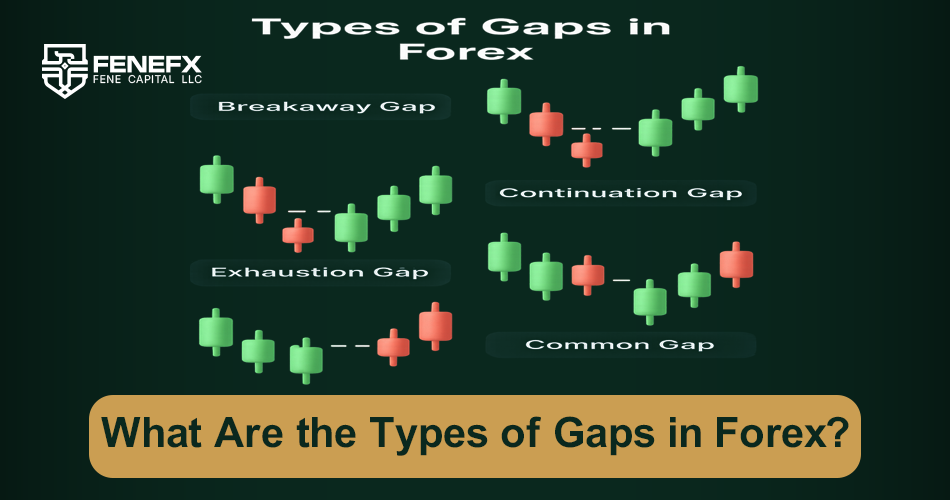
Gaps in the forex market are generally classified into four main types, each with its own characteristics and implications:
Breakaway Gap
A breakaway gap occurs when the price breaks out of a consolidation zone or a price pattern. Typically, a breakaway gap signals the start of a strong trend, and traders often use it as a signal to enter the market in the direction of the new trend. Breakaway gaps are usually accompanied by high trading volume, which adds credibility to the move.
Continuation Gap
A continuation gap appears in the middle of a strong trend and indicates that the prevailing trend is likely to continue. These gaps usually occur when the market faces significant buying or selling pressure, driving the price further in the same direction.
Exhaustion Gap
An exhaustion gap appears near the end of a strong trend and is often a sign that the trend is losing momentum and may soon reverse. Exhaustion gaps typically occur during periods of high trading volume, and experienced traders watch for these gaps as a potential warning of trend exhaustion.
Common Gap
Common gaps typically occur under normal market conditions and are not usually indicative of a major trend change. These gaps tend to fill quickly and have minimal long-term impact on the price.
What Causes Gaps in Forex?
Economic News and Events
Sudden releases of major economic news, such as central bank decisions, economic reports, or political events, can cause significant gaps in the market. Unexpected news has a strong impact on trader sentiment and can lead to sharp price movements.
Market Holidays
While the forex market operates 24 hours a day throughout the week, it closes over the weekend. During this time, major global events may occur, and when the market reopens, these events may trigger a gap.
Sudden Changes in Supply and Demand
In some cases, abrupt changes in supply and demand can result in a price gap. This often happens when traders’ sentiment shifts rapidly, causing swift price movements.
When Do Gaps Occur Most Frequently?
Weekend Gaps
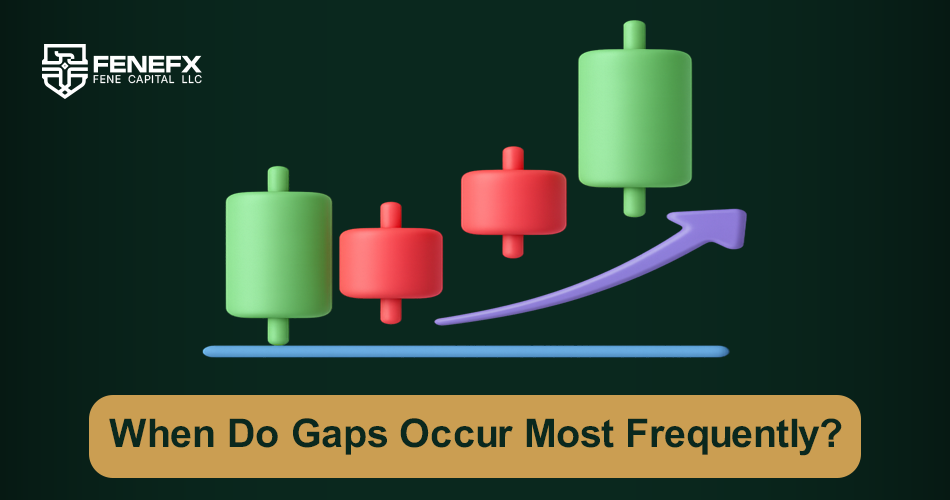
One of the most common scenarios where gaps occur in forex is at the start of the trading week. The forex market closes on Friday and reopens on Monday. During this break, significant news may emerge, causing sudden price movement at the start of the new week.
Gaps During Major Economic News Releases
During the release of key economic data such as interest rate decisions, employment reports, or speeches by central bank officials, prices may suddenly gap. These types of gaps typically occur over short time frames and tend to fill quickly.
Gaps When Different Markets Open
Global markets open and close at different times. For example, gaps may occur when the Asian or European markets open after the U.S. market has closed.
How Do Gaps Affect Forex Trading?
Impact on Trading Strategies
Gaps can serve as signals for entering or exiting trades. Breakaway gaps often indicate the start of a strong trend, while exhaustion gaps may signal the end of a trend and potential reversal.
Managing Risk During Gaps
To reduce the risk associated with gaps, experienced traders utilize stop-loss orders and adjust their position sizes accordingly. For example, placing a stop-loss order beyond the gap level can help prevent sudden exits during volatile conditions.
Profit Opportunities from Gaps
While gaps pose risks, they also present profitable opportunities. Experienced traders often develop gap-based trading strategies to enter trades in the direction of the gap fill or to capitalize on the continuation of the trend.
By understanding the nature of gaps, identifying their types, and applying appropriate trading strategies, traders can effectively use gaps as valuable tools in their trading arsenal.
How to Identify Gaps on the Chart
Gaps are often visible on price charts, but for more accurate identification and to predict price behavior after a gap occurs, traders can use technical analysis tools and indicators.
Indicators and Tools for Gap Analysis
To identify and analyze gaps in forex, there are several effective tools and methods:
- Candlestick Patterns
- Candlestick patterns are one of the best tools for identifying gaps. Gaps typically appear in candlestick charts as an empty space between two candles, where no trading activity has taken place.
- Volume Indicators
- Volume is crucial in determining the validity of a gap. Gaps accompanied by high trading volume are generally more reliable and indicate a higher probability of price continuation in the same direction. Indicators like On Balance Volume (OBV) or Volume Profile can provide important signals about the strength of a gap.
- Trend Indicators
- Tools such as Moving Averages and Bollinger Bands can be useful in identifying whether the trend is likely to continue after a gap.
- Fibonacci Retracement Tools
- In some cases, gaps appear near key Fibonacci levels. This tool helps identify support and resistance levels linked to the gap, improving the accuracy of predicting potential price movements.
How to Identify Fake Gaps (False Gaps)
Fake gaps usually occur in volatile markets and are often followed by a quick price reversal to the previous level. Key characteristics of fake gaps include:
- Gaps with low trading volume are often less reliable.
- In fake gaps, the price generally returns to its previous level shortly after the market opens.
- Fake gaps frequently occur during low-liquidity periods, such as near the end of a trading session.
Do Gaps Always Get Filled
In forex, there is a common belief that gaps will eventually be filled, but this is not always the case.
The Concept of Gap Filling
"Gap filling" refers to the process where the price returns to the level at which the gap originally formed. This process may occur quickly or take an extended period. Some gaps close within hours, while others may remain unfilled for weeks or months — or may never close at all.
When Do Gaps Remain Unfilled?
Gaps are less likely to be filled in the following situations:
- Gaps Driven by Major News: If a gap is caused by a significant economic or political event, the price may stabilize at its new level without returning to the previous one.
- Gaps in Strong Trends: In powerful bullish or bearish trends, gaps are less likely to be filled as the market momentum continues to drive the price further in the same direction.
- Gaps Near Key Technical Levels: If a gap forms near strong support or resistance levels, the likelihood of it remaining unfilled increases.
How to Use Gaps in Your Trading Strategy

Gaps in the forex market can create valuable trading opportunities if they are used with the right strategies. Below are three practical strategies for trading gaps:
Breakaway Gap Trading Strategy
The breakaway gap strategy is designed for identifying gaps that form at the start of a strong trend. This type of gap typically appears when the price breaks out of a consolidation zone or a key support/resistance level. Breakaway gaps are often accompanied by high volume, confirming the strength of the new trend. For better accuracy, traders should wait for confirmation signals, such as strong continuation candles forming in the direction of the gap. This reduces the risk of falling into fake breakout traps.
For risk management, a stop-loss should be placed slightly below the breakout point (in a bullish setup) or above the breakout point (in a bearish setup). Profit targets can be determined using key resistance/support levels or tools like Fibonacci extensions to anticipate potential price objectives.
Continuation Gap Trading Strategy
The continuation gap strategy is ideal for trading gaps that occur in the middle of a strong trend, signaling that the trend is likely to continue. These gaps often emerge when the market faces heavy buying or selling pressure, reinforcing the ongoing trend. Traders can enter positions in the direction of the prevailing trend once the price stabilizes after the gap.
To minimize risk, a stop-loss should be placed near the beginning of the gap. This protects the position in case the market unexpectedly reverses. For profit targets, traders can focus on key swing points or use trend-following indicators such as moving averages to exit at optimal levels.
Gap Fill Trading Strategy
The gap fill strategy aims to capitalize on gaps that are likely to close. This method is particularly effective for Common Gaps and Exhaustion Gaps, which tend to be filled quickly. Traders using this strategy should look for signs of weakening momentum after a gap, such as reversal candlestick patterns or declining volume.
Entry points are typically identified when the price starts moving back toward the gap. A stop-loss should be placed above (for short trades) or below (for long trades) the highest or lowest point of the gap. The profit target should be set at the original price level where the gap formed, marking the point where the gap is expected to be filled.
Pros and Cons of Trading Gaps
| Pros | Cons |
| Profitable opportunities from rapid price movements | Higher risk if the gap fails to close |
| Identifying trading opportunities with simple technical analysis | Fake gaps may mislead traders |
| The ability to enter the market at the start of strong trends | Managing gaps caused by unexpected news can be challenging |
| Strong trading signals in the case of valid gaps | Requires experience to distinguish real gaps from fake ones |
Key Tips for Risk Management During Gaps
Using Stop Loss (Stop Loss Placement)
One of the most important risk management techniques when trading gaps is placing an appropriate stop-loss. The stop-loss should be positioned at a level where, if the price reverses, losses are limited. Setting the stop-loss near major technical levels or close to key support and resistance points is a recommended approach.
Setting an Appropriate Trade Size
In volatile market conditions, especially during large gaps, the market may experience sharp movements. To manage risk effectively, reducing trade size is crucial to avoid excessive losses if the market moves against your position.
Trading Psychology When Facing Gaps
Gaps can trigger strong emotional responses among traders. Fear and greed may lead to impulsive decisions, which often result in losses. Maintaining composure and adhering to your trading strategy is vital in these situations. Avoid rushing into trades immediately after observing a gap; instead, analyze the price action carefully before making a decision.
By following these strategies and risk management principles, traders can effectively incorporate gaps into their forex trading plans and use them as powerful tools for identifying profitable market opportunities.
Comments
Clear examples, nice charts. Bookmarked.
Do you have stats on what percentage of common gaps fill within the week? A follow-up on actual gap-trading strategies would be great.
Got caught in a Sunday gap on XAUUSD once — stop loss filled 40 pips worse than where I set it. That's how I learned what slippage means, the hard way.
I never understood why my charts had those weekend jumps on gold. The section on Sunday open gaps explained exactly what I've been seeing. Thank you!
Good primer. One nuance: 'gaps always fill' is survivorship bias talking. Breakaway gaps on strong momentum can run for weeks. Classify the gap first, then decide if fading it makes sense.