


What is an Arbitrage Bot?
An arbitrage bot is an automated software designed to identify and exploit price differences in various financial markets. These bots are typically used in financial markets such as stocks, cryptocurrencies, Forex, and other tradable assets. As automated and intelligent tools, arbitrage bots analyze and execute arbitrage trades with high speed and accuracy. Using complex algorithms and up-to-date data, they can identify profit opportunities in fractions of a second and take advantage of them. FeneFX, as a comprehensive platform for Forex education and investment, opens the gateway to this highly profitable market. With free and specialized training courses from FanFX, you can take significant steps towards enhancing your knowledge and skills in Forex trading and achieve substantial profitability in this market.
Performance of an Arbitrage Bot
An arbitrage bot automatically monitors prices across various markets and executes a trade as soon as it identifies a significant price difference between two or more markets. This trading process involves buying an asset in the market where the price is lower and selling it in the market where the price is higher. This is done automatically within very short timeframes to maximize the profit from price differences
Types of Arbitrage Bots
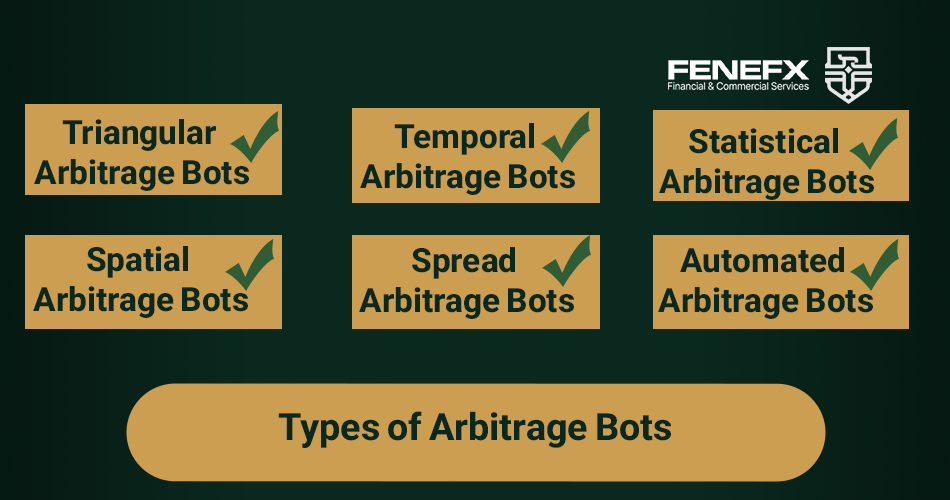
As mentioned earlier, arbitrage bots are tools that exploit price differences in various markets. These bots execute trades automatically using up-to-date, complex algorithms to make risk-free profits. Below are the different types of arbitrage bots:
Triangular Arbitrage Bots
These bots profit from price differences between three different currency pairs. For example, the bot may convert Bitcoin to Ethereum, then Ethereum to USD, and finally convert USD back to Bitcoin. The goal is to exploit the imbalance in exchange rates between these three pairs.
Spatial Arbitrage Bots
These bots take advantage of price differences of an asset in different geographic markets. For example, if the price of Bitcoin is lower in a US exchange than in an Asian exchange, the bot can buy Bitcoin from the US exchange and sell it in the Asian exchange.
Temporal Arbitrage Bots
These bots profit from price differences at different times. For example, if the price of an asset fluctuates at various times of the day, the bot can buy the asset when the price is low and sell it when the price is high.
Spread Arbitrage Bots
These bots act based on the difference between the bid and ask price in a single market. They execute trades by identifying opportunities arising from the difference between the bid (buy) price and ask (sell) price, profiting from the spread.
Statistical Arbitrage Bots
These bots use mathematical and statistical models to predict price changes and identify arbitrage opportunities. They typically operate based on complex analyses of historical data and machine learning algorithms to determine the best time to buy and sell.
Automated Arbitrage Bots
These bots operate completely automatically, requiring no human supervision. They monitor the market 24/7 and execute trades based on predefined algorithms. These bots often use a combination of multiple strategies to minimize risk and maximize profits.
Arbitrage bots are powerful tools that can generate profits in various markets, including financial markets and cryptocurrencies. Choosing the right bot depends on the target market, investment amount, and investment strategy. With advancements in technology and artificial intelligence algorithms, these bots are continually improving and becoming more efficient.
Advantages and Disadvantages of Arbitrage Bots
Here are the advantages and disadvantages of using arbitrage bots:
Advantages of Using an Arbitrage Bot
- High Speed and Accuracy:Arbitrage bots can execute trades in milliseconds. This high speed allows them to take advantage of price differences before the market reacts.
- Reduced Human Risk:Bots operate based on precise algorithms and without human emotions. This reduces the likelihood of mistakes and ensures more accurate trade decisions.
- Utilization of More Opportunities:Arbitrage bots can work 24/7, making it possible to capitalize on trading opportunities in various markets and at any time.
- Investment Diversification:Using arbitrage bots allows you to invest in various markets such as cryptocurrencies, stocks, and commodities, benefiting from different opportunities.
Disadvantages of Using an Arbitrage Bot
- High Initial Investment:Setting up and using some arbitrage bots requires a significant initial investment. In addition to development and maintenance costs, there is also a need for capital to execute trades.
- Technical Risks:Arbitrage bots rely on complex software and hardware systems. Any malfunction or failure in these systems can lead to financial losses.
- High Competition:Many traders and large companies use arbitrage bots. This results in profitable opportunities quickly disappearing and leads to fierce competition in these markets.
- Regulatory Limitations:In some countries, the use of arbitrage bots may face legal restrictions. The laws and regulations regarding automated trading and arbitrage can, in some cases, prevent the effective use of these bots.
- Market Volatility:Financial markets are constantly changing and fluctuating. Arbitrage bots may not perform optimally in unstable market conditions, potentially resulting in losses instead of profits.
- Transaction Costs:The transaction fees associated with trades can reduce the profit made from arbitrage opportunities.
How to Use an Arbitrage Bot
Here are the steps for using an arbitrage bot:
1. Choosing the Right Bot
First, you need to choose a suitable arbitrage bot. Each bot has different features and costs, so select one that matches your needs.
2. Creating an Account
Once you've chosen the bot, register on its platform and create an account. This usually involves entering personal information and verifying your identity.
3. Connecting to Exchanges
For the bot to execute arbitrage trades, it must be connected to different exchanges. This is typically done by using API keys that you obtain from the exchanges. Steps for connection:
- Go to the bot’s dashboard.
- Select the option to add exchanges.
- Enter the API keys for each exchange.
4. Bot Settings
Once connected to the exchanges, you need to configure the bot settings. These settings may include:
- Maximum usable capital:Define how much of your capital will be used for arbitrage.
- Risk limits:Specify the level of risk you are willing to take.
- Scheduling settings:Set how often the bot should check prices.
5. Start the Bot
After setting up, activate the bot, and it will start monitoring price differences and executing arbitrage trades.
6. Monitoring and Management
Although the bot operates automatically, it’s a good idea to regularly monitor its activities. This ensures the bot is performing correctly and allows you to adjust settings if necessary.
7. Withdrawing Profits
Whenever you want, you can withdraw the profits from the arbitrage trades. Go to the bot’s dashboard and request a withdrawal.
Important Tips for Using Arbitrage Bots
Although using arbitrage bots in financial markets, especially in cryptocurrency and Forex markets, can help users profit from price differences in various markets, optimal utilization of these tools requires attention to the following tips:
Choosing the Right Bot
- Research and Review:Before selecting a bot, conduct thorough research on its performance, history, and reputation. User reviews and available feedback online can assist you in this process.
- Features:The bot should have the features you need, such as the ability to adjust various parameters, provide detailed reports, and support multiple markets.
Bot Settings
- Optimal Parameters:Set the bot’s parameters to align with your trading strategy. This includes determining take-profit, stop-loss, and other settings.
- Testing and Trial:Before using the bot with your main account, test it on a demo account or with a small investment to ensure its proper performance.
Risk Management
- Capital Allocation:The capital allocated for using the bot should be a small percentage of your total capital to minimize the potential loss in case of an issue.
- Diversification:Spread your investments across different markets and tools to reduce overall risk.
Continuous Monitoring
- Performance Review:Regularly monitor the bot’s performance and update its settings if necessary.
- Support:Ensure the bot has good support so that you can get assistance from experts in case of issues.
Security
- Data Protection:Keep your account login information and API keys secure and ensure they are protected.
- Using APIs:When connecting the bot to accounts, use API keys with limited access to prevent unauthorized withdrawals if there's a potential breach.
Costs and Fees
- Check Fees:Review the costs of using the bot, including transaction fees and monthly subscription fees, to ensure that the profit gained exceeds these costs.
- Negotiation:If possible, negotiate with brokers and exchanges for lower fees.
Updates
- Software:Ensure the bot is updated, and you are using the latest version of the software to benefit from security and performance improvements.
- Market News:Stay updated on market news and, in case of significant events, adjust the bot’s settings accordingly.
Using arbitrage bots can be highly profitable, but it requires knowledge, precision, and proper management. By following these tips, you can use these tools optimally and minimize associated risks.
Comparison of Arbitrage Bots
In this section, we will compare arbitrage bots, evaluate their performance and technical capabilities, assess their security, and weigh the pros and cons of using them. Our goal is to provide comprehensive and accurate information to guide you in choosing the best arbitrage bot for your specific needs. Stay with us as we help you make an informed decision about optimizing your trading strategies with these powerful tools.
We will now explore and compare different arbitrage bots to identify their strengths and weaknesses. To compare arbitrage bots, consider the following criteria:
- Speed and Accuracy:Bots should be capable of executing trades quickly and accurately to take full advantage of arbitrage opportunities.
- Fees:Transaction fees and the costs of using the bots can significantly impact profitability.
- Support for Multiple Markets:Bots that support more exchanges and markets offer greater flexibility for users.
- Security:The security of digital assets and user information is one of the most crucial aspects when using arbitrage bots.
- User Interface and User Experience:A simple and user-friendly interface can make it easier for users to operate the bot
Comparison of Popular Arbitrage Bots
In this section, we will review the pros and cons of the most popular arbitrage bots:
Haas Bot
Pros:
- High speed and accuracy in executing trades
- Supports over 20 reputable exchanges
- Allows users to customize various strategies
- High security with the use of secure API keys
Cons:
- High subscription fees
- Requires technical knowledge for advanced settings
3Commas
Pros:
- Simple and user-friendly interface
- Supports many cryptocurrency exchanges
- Can automatically adjust strategies and risks
- Provides detailed performance analysis
Cons:
- Relatively high fees for full services
- Some limitations with complex strategies
Crypto Hopper
Pros:
- Supports over 75 exchanges
- Easy-to-understand strategy settings
- Can use artificial intelligence algorithms
Cons:
- Weaker performance in low-volatility markets
- Relatively high monthly fees
Arbi
Pros:
- Very simple and user-friendly interface
- Lower costs compared to competitors
- Supports a large number of major exchanges
Cons:
- Slower speed and lower accuracy compared to some competitors
- Limited features for advanced strategy customization
Choosing the best arbitrage bot depends on the user’s needs and experience level. For beginners, bots like 3Commas and Arbi with simpler interfaces are more suitable. Professional users looking for advanced settings and greater control may prefer bots like Haas Bot and Crypto Hopper. However, the most important factor to consider is the security and reliability of the selected bot to ensure the safety of users’ assets.
Criteria for Comparing Arbitrage Bots
Comparing arbitrage bots requires considering several important criteria to make the best choice. These criteria include performance, security, costs, and various technical features. Below is an overview of these criteria:
Performance
Performance is one of the most important criteria for comparison. It depends on the bot's ability to identify and exploit arbitrage opportunities across different markets. This includes:
- Accuracy and Speed:The bot should be able to quickly and accurately identify arbitrage opportunities and execute trades in a short time.
- Return on Investment (ROI):The profitability of the bot over specific periods can be an essential factor for evaluating its performance.
Security
Security is a primary concern when using arbitrage bots. Security criteria include:
- Encryption and Data Protection:Ensuring that user data and information are adequately protected.
- Two-Factor Authentication:To enhance account security and prevent unauthorized access.
Costs
Costs of using an arbitrage bot include both initial and ongoing expenses:
- Subscription or Purchase Fee:The cost to buy or subscribe to the bot.
- Transaction Fees:Transaction fees associated with executing trades, which can affect overall profits.
Technical Features
Technical features can significantly differentiate available options:
- Support for Multiple Exchanges:The bot should be able to connect and operate with multiple exchanges to identify more arbitrage opportunities.
- Customizability:The ability to adjust settings for different strategies.
- User Interface (UI) and User Experience (UX):A simple and understandable UI can help users operate the bot easily.
- Technical Support:Having a strong support team for troubleshooting issues.
Reputation
The bot’s reputation and the developer's track record are also important factors:
- User Reviews:Reading user feedback and reviews can provide valuable insights into the bot's quality.
- Performance History:Reviewing the bot’s historical performance over different periods.
Comparing arbitrage bots requires a thorough analysis of these criteria. Each of these factors can carry different weights depending on the user's needs and preferences. Choosing the best arbitrage bot involves careful evaluation of these aspects to select the most suitable option based on personal goals and requirements.
Best Arbitrage Bots in 2024
Arbitrage bots have gained significant popularity in cryptocurrency markets, where price fluctuations are much higher. Here are some of the best arbitrage bots in 2024:
Crypto hopper
Crypto hopper is one of the most popular arbitrage bots, attracting many users with its diverse tools and user-friendly interface. This bot can connect to most major exchanges and allows for the customization of strategies. Crypto hopper also offers various features such as back testing, trailing stop-loss, and trading signals.
Bits gap
Bits gap is a comprehensive platform for cryptocurrency trading and arbitrage that uses an advanced algorithm to identify arbitrage opportunities. This platform allows trading on over 25 major exchanges and features tools such as back testing, portfolio management, and trading signals. Its simple interface and the ability to customize strategies are other advantages of Bits gap.
Coin rule
Coin rule is a cloud-based arbitrage bot that has attracted many users due to its ease of use. The platform offers pre-built templates and the ability to customize strategies, allowing arbitrage across more than 10 major exchanges. Coin rule also features capital protection, risk management, and various analytical tools.
Haas Online
Haas Online is one of the oldest and most reputable trading bot platforms, utilizing a powerful engine to identify arbitrage opportunities. The platform can connect to over 20 major exchanges and includes tools like back testing, risk management, and custom strategies. Haas Online also has an active user community and comprehensive documentation that helps users optimize the bot's usage.
Pionex
Pionex is an exchange with built-in bots, allowing users to take advantage of arbitrage opportunities. The platform offers 12 pre-built trading bots, including arbitrage bots, enabling users to use these tools without requiring advanced technical knowledge. Pionex also offers low fees and high security, making it a popular choice.
Choosing the best arbitrage bot depends on your needs and preferences. If you're looking for a comprehensive platform with advanced tools, Bits gap and Haas Online could be good options. If you prioritize simplicity and a user-friendly interface, try Crypto hopper and Coin rule. Lastly, if you're looking for an exchange with built-in bots, Pionex is a great option. It is important to conduct proper research and set up appropriate strategies for managing risks before using any bot.
Causes of Price Differences in Cryptocurrencies
In this section, we will explore the causes of price differences in cryptocurrencies, types of cryptocurrency arbitrage, methods to profit from them, risks associated with these arbitrages, and selecting the right exchange for arbitrage. Our goal is to provide you with the necessary knowledge and tools to take advantage of arbitrage opportunities in the cryptocurrency market. Cryptocurrency prices can vary between different exchanges. These price differences occur due to several reasons, the most important of which are:
Supply and Demand
One of the main causes of cryptocurrency price differences is the variation in supply and demand across different exchanges. Each exchange has a different number of users, and these users may have different buying and selling patterns. If demand for a cryptocurrency is higher on one exchange, the price will increase, while on another exchange, where supply may be higher, the price will remain lower.
Liquidity
Liquidity refers to how easily an asset can be bought and sold without significantly affecting its price. Exchanges with higher trading volumes and more liquidity typically have more stable prices that are closer to the market average. Smaller exchanges with less liquidity may experience more price fluctuations, which leads to price differences.
Exchange Fees
The transaction fees charged by exchanges can impact the final price of a cryptocurrency. Some exchanges have higher fees, which may cause the buy or sell price to be slightly higher. This difference in fees can be one of the factors contributing to price differences between exchanges.
Geographical and Legal Restrictions
Depending on the geographical location of users and relevant financial regulations, the price of cryptocurrencies may differ. Some countries have specific restrictions on access to international exchanges, forcing users to use local exchanges, which may offer different prices. Additionally, differences in tax and financial regulations can contribute to price discrepancies.
Currency Used
Exchanges may use different currencies such as USD, EUR, JPY, etc. The fluctuations in exchange rates between these currencies can result in price differences in cryptocurrencies. Even if a cryptocurrency is priced the same on two exchanges, the differences in currency conversion rates may cause a price difference.
Transaction Processing Time
The speed of transaction processing and delays in order fulfillment can also cause price differences. On exchanges with slower processing speeds, orders may be executed with delays, leading to more price volatility.
Price differences between cryptocurrencies across various exchanges are the result of multiple factors, including supply and demand, liquidity, exchange fees, geographical and legal restrictions, the currency used, and transaction processing times. Understanding these factors can help investors identify arbitrage opportunities and profit from price differences.
Types of Cryptocurrency Arbitrage
Cryptocurrency arbitrage refers to exploiting price differences of a cryptocurrency across different exchanges to make a profit. This strategy can be carried out in several forms, each with its own advantages and challenges. Below are the types of cryptocurrency arbitrage:
Simple Arbitrage
This type of arbitrage involves buying a cryptocurrency on one exchange at a lower price and selling it on another exchange at a higher price. This process requires speed and accuracy to capitalize on short-term price fluctuations. Simple arbitrage is typically divided into two subcategories:
- Intra-Exchange Arbitrage:Buying and selling a cryptocurrency within two different markets on the same exchange.
- Inter-Exchange Arbitrage:Buying and selling a cryptocurrency between two different exchanges.
Triangular Arbitrage
Triangular arbitrage involves using price differences between three different currencies on the same exchange. For example, suppose you have Bitcoin (BTC), Ethereum (ETH), and USD. You can convert BTC to ETH, then ETH to USD, and finally USD back to BTC. If the price differences are properly analyzed, profit can be made from these consecutive conversions.
Statistical Arbitrage
This type of arbitrage is based on mathematical and statistical models that use price differences between two or more cryptocurrencies over time. Statistical arbitrage requires precise data analysis and the use of complex algorithms to identify profitable patterns. This method is usually employed by trading bots and advanced algorithms.
Temporal Arbitrage
In this type of arbitrage, time differences between markets are exploited. For example, the price of a cryptocurrency might decrease on one exchange overnight, while it remains higher on another exchange at the same time. This type of arbitrage requires time-based analysis and accurate predictions.
Derivative Arbitrage
This type of arbitrage involves using derivative financial instruments like futures contracts and options to take advantage of price differences between these instruments and the spot price of a cryptocurrency. This method is usually more complex and requires a deeper understanding of financial markets.
Covered Arbitrage
In this type of arbitrage, the investor simultaneously engages in the spot market and the derivative market to maximize the price differences between these two markets. For example, buying a cryptocurrency in the spot market and selling a futures contract for the same cryptocurrency could be an example of covered arbitrage.
Cryptocurrency arbitrage can be done in various forms, and each of these methods has its own advantages and challenges. The choice of the appropriate arbitrage type depends on knowledge and experience, available capital, and available tools. By understanding these different types of arbitrage, investors can develop strategies to profit from opportunities in the cryptocurrency market.
Methods to Make Money from Cryptocurrency Arbitrage
Cryptocurrency arbitrage is one of the popular strategies for making money in cryptocurrency markets. Here are the various ways to earn money from cryptocurrency arbitrage:
Inter-Exchange Arbitrage
This method involves buying a cryptocurrency from one exchange at a lower price and selling it on another exchange at a higher price. Success in this method requires speed and accuracy to take advantage of short-term price fluctuations. Additionally, attention should be paid to withdrawal and deposit fees and the time taken for transfers between exchanges.
Intra-Exchange Arbitrage
In this method, price differences between different trading pairs on a single exchange are exploited. For example, the price of Bitcoin in the BTC/ETH pair may differ from its price in the BTC/USDT pair. You can convert Bitcoin to Ethereum, then Ethereum to Tether (USDT), and finally Tether back to Bitcoin, profiting from the price differences.
Risk-Free Arbitrage
In this method, the investor attempts to make a profit from price differences between two markets without taking on any risk. This is also known as pure arbitrage and is very challenging to execute practically as it requires high precision and speed.
Arbitrage Using Trading Bots
Trading bots can automatically identify arbitrage opportunities and exploit them. These bots scan markets and execute transactions automatically based on predefined algorithms. Using bots can increase speed and accuracy and reduce human risks.
Cryptocurrency arbitrage is a profitable method to make money in cryptocurrency markets. By selecting the appropriate method and using advanced tools, you can take advantage of available opportunities. However, always consider the risks and costs involved and set up suitable strategies to manage them.
Choosing the Right Exchange for Arbitrage

Choosing the right exchange is one of the most important factors for success in executing cryptocurrency arbitrage strategies. Different exchanges have different features and conditions that can impact the profitability and efficiency of your trades. Here are the important criteria to consider when choosing the right exchange for arbitrage:
High Liquidity
Liquidity refers to the volume of trades in an exchange that allows for the quick buying and selling of assets without significantly affecting their price. Exchanges with high liquidity typically have more stable prices and allow you to execute trades at better prices. Larger, more reputable exchanges usually have higher liquidity.
Transaction Fees
Transaction fees include the costs that exchanges charge for each buy and sell. These fees can significantly reduce your arbitrage profits. Carefully reviewing the fee structure of exchanges and choosing those with lower fees can help increase profitability.
Transaction Processing Time
The speed of transaction processing and the time taken to transfer assets between exchanges is critical. Exchanges with faster processing times can enhance arbitrage opportunities and help avoid price fluctuations. Reviewing withdrawal and deposit times for each exchange is essential.
Support for Different Cryptocurrencies
To take advantage of arbitrage opportunities, the exchange should support a wide range of cryptocurrencies. A large selection of trading pairs can help you exploit more price differences. Exchanges that support popular cryptocurrencies typically provide better options.
Security
Security is one of the most important criteria in choosing an exchange. Exchanges with a good security track record and strong security measures such as two-factor authentication, cold storage, and continuous monitoring of transactions can reduce the risks of hacking and theft. Reviewing the exchange’s history regarding cybersecurity attacks and previous security issues is also essential.
Regulations
Exchanges operate under different laws and regulations in various countries. Ensure that the exchange you are considering complies with local regulations and has the necessary licenses. Additionally, be aware of any changes in local laws and regulations and their impact on the exchange’s operations.
Customer Support
Strong and efficient customer support can be a great help when issues or questions arise. Exchanges that offer 24/7 support and have a skilled support team can assist you in case of any problems or need for guidance.
Comments
Tried coding a simple triangular arb bot last year. Worked beautifully on paper, then fees and rate limits turned my 0.4% edge into 0.1% losses. Fun project though.
Great intro to a topic that's usually explained terribly.
Built and ran arb bots for two years. The strategy is fine, the killers are latency, API rate limits, and transfer times between exchanges. The opportunity is usually gone before your funds arrive.
Honest question: after fees, withdrawal delays and spread, is retail arbitrage even profitable anymore? Feels like the big firms ate it all.
Always wondered how people profit from price differences between exchanges. The step-by-step logic of how the bot actually works was really clear.