

What is EFT? ( Exchange Traded Fund )
An ETF, or Exchange Traded Fund, is a type of investment fund that is bought and sold on the stock exchange like a share. These funds typically consist of a collection of assets such as stocks, bonds, commodities, or cryptocurrencies, allowing investors to indirectly invest in these assets. In other words, an ETF is an investment basket that is easily tradable and enables you to access a variety of assets by purchasing a single unit of it.
ETFs differ from mutual funds in several ways. For example, unlike mutual funds which are priced only once per day, ETFs are traded on the stock exchange throughout the day at real time prices. This feature makes ETFs highly liquid and generally less costly than other types of funds. Furthermore, the investment diversification provided by ETFs reduces risk, as a single investment in an ETF gives you exposure to a range of assets. These funds are a suitable tool for investors looking for low cost investments without the need to select each asset individually.
ETF Performance
The performance of ETFs generally operates in such a way that these funds purchase a collection of assets and then sell units of the fund to investors. Each unit of an ETF represents a portion of the underlying assets held by the fund. When you purchase a unit of an ETF, you are effectively investing in a basket of assets such as stocks, bonds, or commodities. These funds usually operate passively, meaning their goal is to track a specific index such as the S&P 500 and they are typically not actively managed.
ETFs are continuously traded on the stock exchange, meaning you can buy and sell their units at any time during the trading day. The price of ETF units changes continuously throughout the day, and these changes depend on the prices of the assets held within the fund. For example, if your ETF includes shares of technology companies, its price during the day will depend on the fluctuations in the prices of those companies' stocks. As a result, ETFs are highly liquid, as they can be bought and sold at real time market prices at any moment.
In many cases, ETFs have lower costs compared to mutual funds, because they are passively managed and do not require complex oversight. Additionally, ETFs allow investors to effectively achieve diversification, since buying a single unit of an ETF gives exposure to a variety of assets, which helps reduce risk. Finally, because ETFs can be bought and sold continuously on the stock exchange, they are also suitable for short term investors and those pursuing active trading strategies.
History of ETF Emergence
The history of the emergence of ETFs (Exchange Traded Funds) dates back to 1990, when this financial instrument gradually entered the capital markets during the 1990s. Below are the key milestones in the history of ETFs:
1990: Establishment of the First ETF
The first ETF was introduced in 1990 under the name “S&P 500 Depositary Receipts” or “SPDRs” by State Street Global Advisors in the United States. This ETF functioned as a tracker for the S&P 500 index. SPDRs, traded under the ticker symbol SPY on the New York Stock Exchange (NYSE), became one of the most popular ETFs in the world.
1993: Launch of Additional Tradable Funds
In 1993, other tradable funds entered the market. Vanguard introduced the “Vanguard Total Stock Market ETF,” and Barclays Global Investors launched “iShares,” offering ETFs based on other indices.
1998: Establishment of the ETF Exchange
In 1998, the ETF Exchange was established in the United States. This exchange, organized by the American Stock Exchange (AMEX), allowed investors to trade ETFs during times when the main markets were closed (such as after hours sessions).
2000s: Rapid Growth and Increased Variety
During the 2000s, the variety of ETFs expanded significantly, and the instrument saw rapid growth in the capital market. ETFs during this period became linked to various indices, sectors, and countries. Additionally, BlackRock, through its iShares brand, became one of the largest ETF providers in the world.
2008: Impact of the Global Financial Crisis
The global financial crisis in 2008 had a significant impact on the ETF market. Rising concerns and liquidity pressures caused the prices of some ETFs to trade at a discount compared to similar mutual funds. This led to increased attention to the accuracy and selection of ETF products.
Post-2008: Steady Growth
Over time, ETFs became one of the most popular investment instruments in the world. The number and types of ETFs continue to grow daily, and investors use them to gain diversified asset exposure, reduce costs, and benefit from ease of trading.
Therefore, the history of ETFs from the launch of the first ETF in 1990 to its steady growth in recent years demonstrates that this financial instrument has been widely embraced by investors.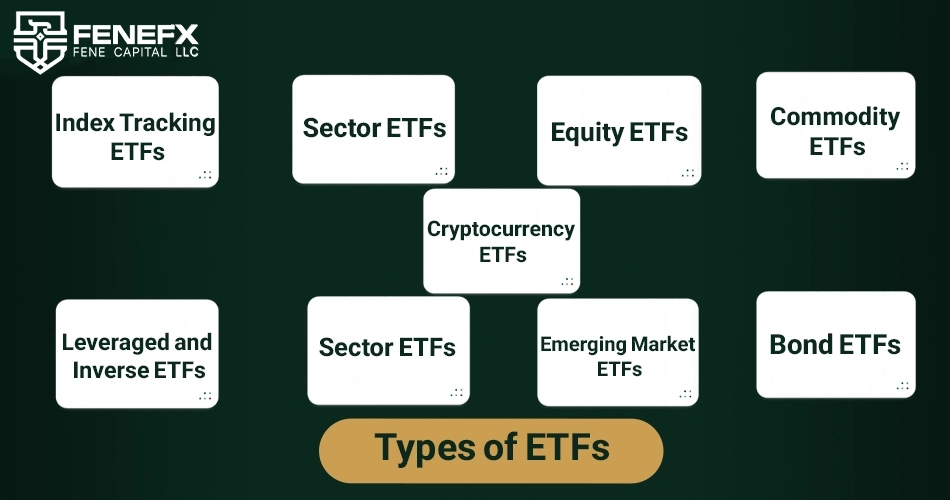
Types of ETFs
ETFs (Exchange Traded Funds) can generally include various types of assets and strategies. This diversity allows investors to select a suitable fund based on their investment goals and risk tolerance. Some ETFs are categorized based on the assets they invest in, while others are designed around specific strategies, such as targeting particular markets or using derivatives. Here are the different types of ETFs:
Index Tracking ETFs
These ETFs aim to replicate the performance of a market index, such as the S&P 500 or NASDAQ. They allow investors to experience the performance of the broader market by investing in a fund that mirrors the index.
Sector ETFs
These ETFs allow investors to invest in a specific industry or economic sector. For example, you can find sector ETFs focused on technology, energy, finance, healthcare, and more.
Equity ETFs
This type of ETF consists of company stocks and is usually designed to track a specific index, such as the S&P 500 or Dow Jones. By purchasing these ETFs, investors indirectly invest in the stocks of large and well known companies. These funds are generally suitable for those seeking diversification in their stock portfolio without buying individual shares.
Commodity ETFs
Commodity ETFs facilitate investment in commodities such as gold, silver, oil, or wheat. These funds enable investors to profit from price changes in commodities without the need to physically purchase or manage them. They are ideal for investors looking to hedge against inflation or economic volatility.
Bond ETFs
Bond ETFs allow investors to invest in government or corporate bonds. These funds may include bonds with various maturities ranging from short term to long term and different yield types (fixed or floating rate). This type of ETF is suitable for investors seeking stable income with lower risk.
Emerging Market ETFs
These ETFs enable investors to invest in developing countries and emerging markets. These markets may include countries in Asia, Africa, or Latin America. Investing in these ETFs usually carries higher risk but also higher potential returns, as emerging markets typically grow at a faster pace.
Sector ETFs
Sector ETFs allow investors to invest in a particular industry such as technology, energy, healthcare, or finance. These ETFs are suitable for those looking to focus on a specific segment of the economy. For example, technology ETFs allow you to invest in the tech sector without directly purchasing individual tech stocks.
Leveraged and Inverse ETFs
Leveraged and inverse ETFs are specifically designed for active traders who aim to profit in declining markets or under certain conditions. Leveraged ETFs typically provide higher leverage, which can lead to larger gains or losses. Inverse ETFs, on the other hand, allow you to profit when the market declines.
Cryptocurrency ETFs
These ETFs allow investors to invest in digital currencies such as Bitcoin or Ethereum without directly purchasing and holding them in digital wallets. Due to the high volatility of the crypto market, these ETFs are suitable for those looking to take advantage of cryptocurrency opportunities but must be familiar with the associated risks.
Advantages and Disadvantages of Exchange Traded Funds (ETFs)
One of the most important advantages of ETFs is their high liquidity. Since these funds are traded on the stock exchange, investors can buy and sell ETF units at any time they wish. ETFs also tend to have lower costs compared to mutual funds, as they are usually passively managed and do not require complex oversight. Another major advantage of these funds is diversification: by purchasing a single ETF unit, you indirectly invest in a variety of assets such as stocks, bonds, or commodities.
On the other hand, market volatility is one of the main disadvantages of ETFs. The price of these funds is directly tied to the fluctuations in the value of the underlying assets, and during sharp market movements, their value may decrease significantly. Additionally, some ETFs may involve hidden costs, such as high trading fees, which can negatively affect overall investment returns. Another drawback is liquidity risk in certain cases if a specific ETF has low trading volume, it may be difficult to sell it at a desirable price when needed.
Below is a table outlining the pros and cons of ETFs to help you better understand the various aspects of these funds:
| Advantages | Disadvantages |
| High liquidity and fast trading | Market volatility and rapid price changes |
| Low management fees | Hidden costs and trading commissions |
| Investment diversification | Liquidity risk in low volume ETFs |
| Easy market trend tracking | High risk in specialized ETFs |
| Passive and simple management | Limited liquidity under specific market conditions |
How to Buy and Sell ETFs
Buying and selling ETFs is generally a straightforward process, similar to trading stocks on an exchange. To get started, you need a trading account with a reputable brokerage that provides access to stock markets and ETFs. Once your account is set up, you can use the broker’s trading platform to buy or sell your desired ETFs.
To purchase an ETF, you first need to select a suitable fund. Depending on your investment goals, you can choose from various types of ETFs, such as equity ETFs, bond ETFs, commodity ETFs, or cryptocurrency ETFs. After making your selection, you can place a buy order through your trading platform. ETF purchases are usually made using either a market order (buying at the current market price) or a limit order (buying at a specified price). With a market order, you buy the ETF at the prevailing market price, whereas a limit order is executed only if the market reaches your specified price.
The selling process for ETFs follows the same steps. When you wish to sell your ETF holdings, you log into your trading platform, select the ETF, and choose whether to sell via a market or limit order. A market order executes the sale at the current market price, while a limit order allows you to set a target price for the sale.
Ultimately, one of the major advantages of ETFs is their high liquidity. You can buy and sell your ETFs at any time you wish, as these funds are continuously traded on the stock exchange. However, an important point to consider is that buying and selling ETFs may involve trading commissions, which you should be aware of so that additional costs do not negatively affect your investment return.
Are ETFs Safe?
Exchange Traded Funds (ETFs) are generally considered safe and reliable investment tools, but like any financial instrument, they come with certain risks that investors should be aware of. The safety of an ETF depends on various factors, including the type of fund, its target market, and its risk management strategy.
One key reason ETFs are usually seen as safe is investment diversification. By purchasing ETF units, investors indirectly gain exposure to a collection of assets such as stocks, bonds, or commodities. This diversification reduces risk and limits the potential for significant losses. For example, a stock based ETF might include hundreds of companies, which helps mitigate the risks associated with investing in just one or a few firms.
However, despite their diversified nature, ETFs are still exposed to market volatility. If the market or specific sector an ETF is focused on experiences turbulence, the value of the ETF can decline. For instance, ETFs that track emerging markets or specific commodities like oil can carry higher risk due to their inherent volatility.
In addition, management risk is another concern. If fund managers fail to manage the ETF effectively or make poor decisions, it may negatively impact returns. Some ETFs may also have hidden fees, which can eat into your overall profitability.
To ensure the safety of your ETF investments, it’s important to manage risk proactively and stay informed about different markets and fund strategies. Investing in ETFs from regulated providers and following sound investment strategies can enhance your security. Nonetheless, it's essential to remember that no financial instrument is completely risk free.
One of the major challenges many traders, especially beginners face is lack of capital. FeneFx Prop Trading, as the most trusted and officially funded trading platform with Persian language support, offers a unique opportunity to enter the forex trading world without needing significant initial capital. Prop trading with FeneFx is a fresh gateway into the forex markets for experienced traders eager to prove their skills.
What Is a Bitcoin ETF?
A Bitcoin ETF is a type of Exchange Traded Fund that allows investors to gain indirect exposure to Bitcoin without the need to purchase the cryptocurrency directly or store it in a digital wallet. These ETFs are typically designed to track the price of Bitcoin, providing investors with access to Bitcoin’s market fluctuations without the need to interact directly with the blockchain or manage the storage of the asset. For example, when the price of Bitcoin rises, the value of the Bitcoin ETF generally increases as well and vice versa.
One of the key advantages of a Bitcoin ETF is that it capitalizes on the volatility of the Bitcoin market. However, unlike directly buying Bitcoin, investors do not need to worry about custody, transfer, or secure storage of the digital asset. This feature makes Bitcoin ETFs an attractive option for individuals who are interested in cryptocurrency investment but prefer to avoid the technical and security complexities involved in digital asset trading.
Another significant impact of Bitcoin ETFs is that they increase access to the cryptocurrency market for traditional investors. With the introduction of these ETFs, institutional investors and large financial institutions many of whom had previously avoided digital assets due to regulatory or security concerns are now able to participate in the market. This has contributed to the broader growth of Bitcoin and the other cryptocurrencies.
However, it's important to note that Bitcoin ETFs are still subject to the inherent risks of the cryptocurrency market. The extreme price volatility of Bitcoin and regulatory scrutiny in many countries can influence the performance of these funds. Nevertheless, Bitcoin ETFs continue to gain popularity as one of the primary tools for accessing the digital currency market.
Comments
Moved my savings from single stocks to a broad index ETF two years ago. Less stress, fewer decisions, better returns than my own picks. Wish I'd started earlier.
Heads up, the title says EFT but it's ETF — Exchange Traded Fund. Also worth mentioning expense ratios compound over decades; 0.5% vs 0.05% is a massive difference on a long horizon.
What about leveraged ETFs? I heard they decay over time even if the index goes sideways — would make a great follow-up topic.
The comparison with mutual funds was what I needed — the fees and intraday trading parts finally make sense now. Cheers!
Good beginner-friendly overview of the topic.