

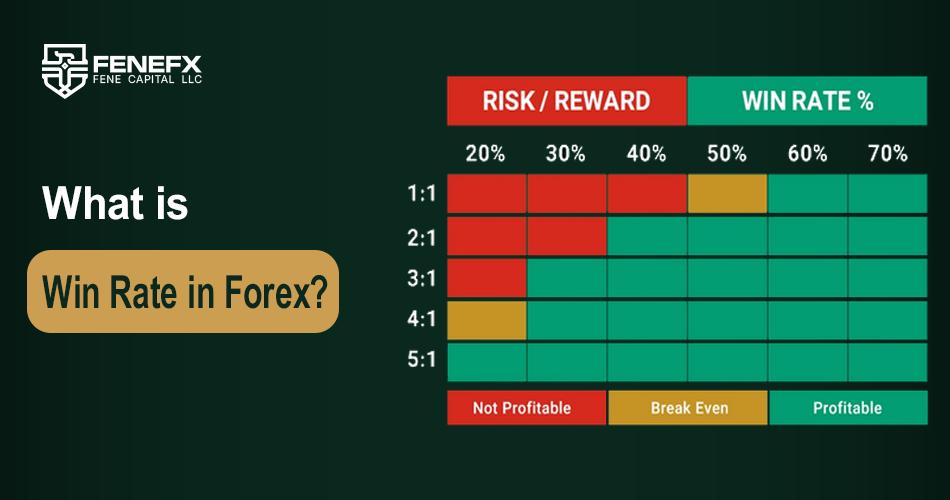
What is Win Rate in Forex?
Win Rate is a crucial metric that indicates the overall success of your trades. Win Rate refers to the percentage of successful trades in a given period or activity. This concept is used in statistical analysis, performance evaluation, and performance measurement across various fields. In its simplest form, Win Rate is the percentage of profitable trades you make over a specific time frame. For example, if you have made 100 trades and 60 of them were profitable, your Win Rate would be 60%. Successful traders often aim for high Win Rates as they represent the consistency of their strategy and trading approach.
Importance of Win Rate
Win Rate is a valuable metric for evaluating your performance as a trader. This indicator highlights the strengths and weaknesses of your trading strategy and allows you to make necessary adjustments to improve future results. Additionally, Win Rate can assist in risk management and help you set realistic expectations for your trading outcomes.
Win Rate in Forex
The Forex market (Foreign Exchange) is the largest financial market in the world, where currencies of various countries are exchanged. In this market, a massive volume of money is traded daily, and investors and traders from all around the world participate. The goal of every investor in the Forex market is to make a profit through buying and selling currencies.
What is Win Rate in Forex?
In Forex, Win Rate refers to the ratio of successful trades to the total number of trades executed by a trader or investor. In other words, this metric indicates the number of profitable trades compared to the total number of trades made. Win Rate is expressed as a percentage and shows the success rate of an individual’s or a trading strategy’s activities.
Example:Suppose a trader makes 100 trades in Forex, with 65 profitable trades and 35 losing trades. The trader’s Win Rate would be calculated as follows: Win Rate = (Profitable Trades / Total Trades) * 100 Win Rate = (65 / 100) * 100 = 65%
Importance of Win Rate in Forex
Win Rate is one of the key metrics for measuring performance and success in the Forex market. Investors and traders evaluate their performance based on Win Rate and make critical decisions such as whether to continue or change their trading strategies based on this metric. Improving Win Rate means better performance and increased profitability, while a decrease in Win Rate indicates the need for reviewing trading strategies and improving performance.
Benefits of a High Win Rate in Forex
- Increased Profitability:A high Win Rate indicates a greater number of profitable trades, leading to increased profitability.
- Reduced Risk:Traders with a high Win Rate tend to take on less risk since their number of losing trades is lower.
- Improved Confidence:A high Win Rate can boost traders’ confidence in executing trades.
Strategies for Increasing Win Rate in Forex
- Using the Right Trading Strategy:Choosing a trading strategy that aligns with your personality and risk tolerance is key to increasing your Win Rate.
- Risk Management:Using risk management tools like Stop Loss and Take Profit can help maintain a high Win Rate.
- Controlling Emotions:Successful traders do not let emotions and excitement influence their trading decisions.
- Continuous Learning:Regular study and learning in areas like technical analysis, fundamental analysis, and trading psychology can help improve Win Rate.
Factors Affecting Your Success Rate in Forex Trading
Achieving consistent success in the global Forex market is no easy task; there are many factors that determine your win rate or trading success rate.
Trading Strategy
The backbone of any trading approach in the Forex market is a comprehensive and proven strategy. Without a predetermined plan, trades will be based on guesses or impulsive reactions. A good strategy should include the following:
- Signals for entering and exiting trades: When should you open a position and when should you close it? These should be determined based on technical or fundamental analysis.
- Decisive risk management principles: Using stop-loss orders for every trade and adhering strictly to them.
MAA Strategy (Suggested)
The MAA trading strategy has been developed through trial and error from live market testing, based on over ten years of market data analysis and the Wyckoff theory. This system not only addresses the weaknesses of trading strategies based on smart money, such as ICT, RTM, and others, but also transfers the market's core principles to traders, which can significantly impact their success. The key point of MAA is not so much the technical aspect of the strategy but rather the psychology of the trader, which is the problem for all traders. It provides traders with a new perspective. The technical part of this strategy has been published in 1600 minutes of training called "Principles Zero to Thousand" by Instructor Ahangari. For more information, visit the page below.
Capital Management
Even the best trading strategies in the world will not be sustainable without solid capital management. Mastering capital management helps you to:
- Determine trade sizes: How much of your capital is involved in each trade? This percentage should be aligned with your risk tolerance.
- Prevent catastrophic losses: Never risk more than you can afford to lose in a trade. Capital management helps prevent the rapid depletion of your trading account.
- Have a realistic understanding of potential outcomes: Win rate and capital management together provide a clear picture of your long-term profitability.
Experience and Education
The Forex market is never static; its dynamics require adaptability and continuous learning. Even experienced traders are always seeking new knowledge to optimize their strategies.
- Track your trading progress: Keeping records of all trades and analyzing them to identify patterns of failure and success plays a key role in improving future trades.
- Stay up-to-date: Participate in training courses, follow the latest financial and economic news in the Forex market, and engage with other traders to exchange knowledge and experience.
Your win rate in Forex reflects your performance in these three main areas. By focusing on building a cohesive strategy, managing capital wisely, and continuous learning, you can significantly increase your chances of success in this competitive market. Mastering these principles will lay the foundation for long-term success in Forex trading.
How to Calculate Win Rate in Financial Markets
Win Rate is one of the most important metrics that traders monitor to evaluate their overall performance. Calculating Win Rate is a simple process, but mastering this process is essential to gaining a real picture of your success in trading. Let's examine the steps involved in this calculation:
- Determine the Desired Period
- Before calculating the Win Rate, you must define your time period. This period can be daily, weekly, monthly, or even yearly. The time frame chosen depends on your trading style.
- Calculate the Number of Successful Trades
- A successful trade refers to a trade in which you have made a net profit. Count all the trades that have been profitable during the specified period.
- Calculate the Total Number of Trades
- At this stage, count all the trades you have made during the selected time period, including both profitable and loss-making trades.
- Calculate the Win Rate
- Now, the final calculation is quite simple:
- Win Rate = (Number of Successful Trades / Total Number of Trades) * 100
- The result will be displayed as a percentage, representing the success rate of your trading strategy and overall approach.
Example
Suppose a trader has made 100 trades in a month, and out of those, 60 trades were profitable. The Win Rate for this trader would be calculated as follows:
Win Rate = (60 / 100) * 100 = 60%
Key Notes:
- The Win Rate is a tool for evaluating past performance, not a predictor of future results.
- Track your Win Rate over time to identify growth trends or areas requiring adjustment.
- A high Win Rate does not necessarily guarantee profitability. Proper capital management and the risk-to-reward ratio are essential for long-term success in trading.
Calculating Win Rate is an important step to understanding your overall performance as a trader. By regularly evaluating this metric, you can identify the strengths and weaknesses of your trading strategy and make more informed decisions for future trades.
Win Rate: Its Application in Individual Trades and Overall Strategies
Win Rate (or success rate) is a key statistical metric that traders use to evaluate their success. However, it's important to recognize that there are two different concepts when applying Win Rate:
- Win Rate of a Single Trade
- This metric simply tells us whether a particular trade was profitable or not. If the trade closes in profit, it counts as a "win" for that trade’s Win Rate. Conversely, if it closes in loss, it is categorized as a "failure."
- Win Rate of a Strategy
- In this case, Win Rate refers to the overall performance of a trading strategy or approach over a set time period. Here, the percentage of profitable trades relative to the total number of trades conducted in that time period is calculated. For example, if a strategy achieves 70 successful trades out of 100, the overall Win Rate of that strategy during that period would be 70%.
Why Is This Distinction Important?
- Evaluating Trades: The Win Rate of individual trades can be analyzed to identify successful or unsuccessful entry and exit points, helping to find repeatable patterns.
- Optimizing Strategy: The Win Rate of a strategy gives an overall picture of how well an approach is performing. Traders may experiment with different strategies and compare their Win Rates to select the most optimal approach based on market conditions and personal trading styles.
Consider Other Factors:
It's crucial to remember that a high Win Rate does not necessarily guarantee profitability. Other factors such as capital management, risk-to-reward ratios, and trading psychology play critical roles in long-term success.
Understanding Win Rate in both "trade" and "strategy" contexts is a valuable tool for any trader. This knowledge allows you to leverage market feedback and refine your trades for more profitable results over time.
Overall Win Rate and Its Role in Trading Success
In the world of trading, the overall Win Rate reflects the percentage of profitable trades executed by a trader or a specific trading strategy over a set period. This statistical metric is one of the most valuable tools for assessing the effectiveness of your trades. Let's explore why this metric is so important:
Why is the Overall Win Rate Important?
- Real Picture of Performance: The overall Win Rate provides a clear and unambiguous view of your success percentage in trades. Unlike evaluating individual trades, which may be influenced by large losses or random wins, the overall Win Rate gives a comprehensive assessment of your performance.
- Informed Decision Making: Tracking the overall Win Rate is essential for adjusting strategies and making the best decisions for your future trading. A low Win Rate signals the need for a thorough review of your strategy or approach to identify and fix any weaknesses.
- Better Risk Management: A correct understanding of your Win Rate helps traders set realistic expectations about their trading outcomes and select an appropriate risk level.
Important Points for Using Overall Win Rate:
- Reasonable Time Frame: The Win Rate should be calculated over a sufficiently long period to make the metric reliable. Evaluating based on only a few trades cannot provide a clear picture.
- Consistency Over the Number: While a high Win Rate is desirable, consistency in results is more important. Consistency reflects a structured and repeatable trading approach.
- Win Rate is Only One Metric: Remember that Win Rate alone is not enough to guarantee success. Factors such as proper capital management, correct trading psychology, and emotional control also play vital roles in long-term success in the markets.
The overall Win Rate is a simple yet extremely effective measure for evaluating your trading performance. By monitoring and properly utilizing this metric, you can smooth the path to consistent profitability in financial markets.
Risk of Fraud in Forex through Win Rate!
Unfortunately, the Forex market has always attracted scammers and fraudsters. One of the deceptive tactics used to gain the trust of novice traders is advertising enticing claims about unreasonably high and exaggerated win rates.
Common Forex Fraud Techniques Involving Win Rate
- Signal Sellers or Robots:
- Many individuals and channels on social media display unbelievable win rates like 90% or 100%, claiming to have extraordinary trading signals or bots. Their goal is to sell high subscription fees to unaware traders.
- Expensive Training Courses:
- Some Forex training courses may showcase unrealistic trading results with extremely high win rates. This tactic is used to gain trust and encourage the purchase of expensive courses.
- Trading Strategies with "Guaranteed Win Rates":
- Another scam is offering trading strategies with a "guaranteed win rate" to entice traders to buy these strategies at high prices.
Why Are These Methods Dangerous?
High win rates often excite novice traders, but several important points are overlooked:
- Trade Volume Matters:A high win rate for a strategy or trading bot may be misleading because, in many cases, the volume of trades involved is very small or unrealistic.
- Risk Per Trade:Some strategies with high win rates carry very high risks per trade, which could result in the complete loss of capital in one go.
- Win Rate Alone Cannot Guarantee Success:Many other factors such as risk management, trader psychology, and financial discipline play a critical role in long-term profitability in the Forex market.
How to Avoid These Scams
- Be Skeptical and Logical:If a trading offer or claim seems too good to be true, it probably is a scam.
- Ask for Documentation:Before buying any signals, bots, courses, or strategies, request sample trades and documented results.
- Consult with Trusted Communities:Engage with other traders in reputable forums and ask about their experiences.
Win rate is an important metric, but it should not be the sole benchmark or a guaranteed indicator of profitability. Always view extraordinary and unrealistic claims in Forex as a red flag that signals a scam. Awareness and logical decision-making are powerful defenses against such frauds.
Viewing Win Rate in MetaTrader PlatformWin rate or percentage of successful trades is a critical metric for evaluating your performance in MetaTrader, whether it's MetaTrader 4 or MetaTrader 5. Fortunately, MetaTrader provides the necessary tools to directly monitor win rate. Below are the steps to view this important statistic:
Ways to View Win Rate in MetaTrader:
- Trade Report:In the "Terminal" window at the bottom of MetaTrader, go to the "Account History" tab. Here, you can see a list of all the trades you have opened or closed. Right-click on any trade and select "Save as Detailed Report" to save the entire list in Excel or HTML format for a more comprehensive review. For quick access to win rate, average profit/loss, and other statistics, refer to the "Profit Trades (% of total)" column in the Trade Report.
- Performance Report:Again, go to the "Account History" tab in the "Terminal" window. Right-click on any trade and select "Custom Period" to define your desired timeframe. Now, click on the "Report" button. MetaTrader will generate a performance report that includes the win rate, total number of trades, net profit, and many other important metrics.
- MetaTrader Plugins and Scripts:In the "MetaTrader Market" software store, you can find various plugins and scripts that automatically calculate and display your win rate in graphical charts.
Monitoring your win rate in MetaTrader is one of the easiest and most effective ways to pinpoint the strengths and weaknesses of your trading approach. With this valuable data, you can gain deeper insights into your market performance and make smarter decisions for future trades.
Win-to-Loss Ratio, Risk-to-Reward Ratio, and the Key to Trading Success
In trading, win rate and risk-to-reward ratio are two key metrics that often work hand in hand to shape your long-term outcomes. Understanding these concepts and their relationship is essential for predicting and improving your trading profitability.
- Win-to-Loss Ratio or Win Rate
- Win rate represents the percentage of profitable trades you’ve made over a specific period. For example, a win rate of 60% means that out of every 100 trades, on average, 60 are profitable and 40 result in losses.
- Risk-to-Reward Ratio (Risk/Reward)
- The risk-to-reward ratio represents the profit target per unit of risk taken in a trade. For instance, a 1:2 risk-to-reward ratio means that for every dollar of risk, the potential reward is two dollars.
Relationship Between Win Rate and Risk-to-Reward Ratio
In an ideal world, traders try to maintain both a desirable win rate and risk-to-reward ratio. However, it’s important to understand that these two metrics don’t always work synchronously. In fact, their relationship often resembles a seesaw:
- High Win Rate, Low Risk-to-Reward:You can achieve a high win rate by targeting very tight stop-loss levels and small profit targets. However, this comes with the tradeoff of low risk and smaller potential returns.
- Low Win Rate, High Risk-to-Reward:To achieve a high risk-to-reward ratio with higher potential returns, you might consider having wider stop-loss levels and more ambitious profit targets. However, this results in a lower probability of success (lower win rate).
Finding the Right Balance
The key to success in trading is finding the right balance between win rate and risk-to-reward that aligns with your trading style and risk tolerance. Some traders prefer high win rate approaches, while others focus more on opportunities with exceptional risk-to-reward ratios.
Win rate and risk-to-reward ratio are both key pieces of the high-profit trading puzzle. Understanding the relationship between these two metrics will help you optimize your strategies to achieve the best possible results, tailored to your trading personality.
Final Thoughts
Win rate or success rate is a vital metric in Forex that reflects the performance and profitability of investors and traders. This metric is expressed as a percentage calculated by dividing the number of successful trades by the total number of trades. The higher the win rate, the stronger the performance and profitability.
Use win rate as an important indicator to improve performance and increase profitability. By considering this metric, you can choose more effective strategies and improve your performance in the Forex market. Success in this market requires patience, experience, and accurate analysis. If you want to professionally invest in financial markets and achieve a high win rate, first you must learn the methods of market analysis. By doing so, you will make more successful trades.
The "Zero to Thousand" course by Mohammad Ahangari is an excellent source for learning both basic and advanced technical analysis, fundamental analysis, trading psychology, profit-making, win rate, and more. This course will help you use tools and strategies like MAA to trade logically in financial markets.
Comments
Thanks for this — I finally get why my high win rate wasn't translating into profit. My losers were just way bigger than my winners.
Really clear breakdown, one of your better ones 👍
I used to brag about my 80% win rate until one oversized loss wiped a month of gains. That's when this whole risk-reward thing finally clicked for me.
Win rate on its own tells you almost nothing. I run about 42% with a 1:2.5 RR and stay comfortably profitable. New traders chase high win rates and end up cutting winners short.
Nice one. Could you cover how many trades you need before a win rate actually means anything statistically? 10 trades at 70% feels meaningless.