

6 of the Best Forex Education Books
If you are looking to learn Forex in a structured and principled way and do not know where to start, the answer is clear: without reliable educational resources, success in this market is almost impossible. Forex is not just about buying and selling currencies; rather, it is a combination of analysis, risk management, trading psychology, and practical experience. This article has been written precisely for this purpose: to show you which Forex education books are truly worth reading, how to get the most out of them, and why education, capital, and prop trading together can pave the way for you to achieve dollar based income. If you want to escape confusion and enter the market with a professional perspective, continuing this article is exactly what you need.
The Best Forex Education Books
Learning Forex without using reliable and scientific resources is like entering a battlefield without weapons. Many beginner traders turn to online courses and educational videos, but books still remain one of the best ways to gain a deep understanding of Forex principles and strengthen analytical skills. In this section, we introduce some of the top Forex education books that can be useful for both beginner and professional traders:
- Technical Analysis Financial Markets – John Murphy
- The Disciplined Trader – Mark Douglas
- High Probability Trading Strategies – Robert Miner
- Market Wizards | Jack Schwager
- Japanese Candlestick Charting Techniques | Steve Nison
- Trading Price Action | Al Brooks
Technical Analysis of the Financial Markets – John Murphy
One of the most well known books in the world of technical analysis is “Technical Analysis of the Financial Markets” written by John Murphy. This book can be considered one of the classic and essential resources for any trader who wants to identify market trends and execute successful trades using technical analysis.
Why is this book important?
- Comprehensive content: This book fully covers all the fundamental concepts of technical analysis, from chart patterns and technical indicators to trading volume and time frames.
- Simple and easy to understand language: John Murphy presents the material in a clear and fluent manner, using practical examples that make the concepts easy to understand even for beginners.
- Applicable to different markets: Although this book focuses primarily on the stock market, its concepts are fully applicable to the Forex market, cryptocurrencies, and commodities as well.
If you are looking to learn the principles of technical analysis from beginner to advanced levels, this book will be one of the best choices for you.
The Disciplined Trader – Mark Douglas
Success in Forex is not limited to technical knowledge and fundamental analysis; trading psychology plays a very important role in a trader’s performance. “The Disciplined Trader” by Mark Douglas is one of the best books in the field of emotional management and trading mindset.
Key features of this book
- Focus on market psychology: This book shows how emotions such as fear, greed, and stress can influence trading decisions.
- The mental structure of successful traders: Mark Douglas explains how professional traders possess a specific mindset that helps them achieve long term success.
- Practical exercises for emotional control: This book offers methods for developing discipline, consistency, and confidence in trading.
This book will be extremely useful for traders who have repeatedly struggled with emotional decisions or have made frequent mistakes due to fear of loss or excessive greed.
High Probability Trading Strategies – Robert Miner
Trading without a clearly defined trading strategy is like traveling on a road without a map. “High Probability Trading Strategies” by Robert Miner examines methods that increase the probability of a trade’s success.
Key points of this book
- Trade entry and exit methods: This book teaches techniques for identifying the best entry and exit points in a trade.
- Capital management strategies: Robert Miner places strong emphasis on risk control and money management, which are considered core pillars of success in Forex trading.
- Technical and fundamental analysis review: This book presents a combination of technical and fundamental analysis, which can be highly valuable for professional traders.
Studying this book will help you not only make better trades, but also design your own personal strategy to reduce risk and increase profitability.
Market Wizards | Jack Schwager
“Market Wizards” by Jack Schwager is a collection of in depth interviews with successful traders in the financial markets. This book provides a realistic view of the path to success in trading and shows that every professional trader has their own unique journey and trading style.
The value of this book lies in conveying the real life experiences of successful traders. The reader becomes familiar with the mindset, mistakes, failures, and strategies of professional traders and understands that success in Forex is the result of discipline, patience, and continuous learning. This book is inspiring and helps traders develop more realistic expectations of the market.
Japanese Candlestick Charting Techniques | Steve Nison
“Japanese Candlestick Charting Techniques” by Steve Nison is considered one of the most important educational resources for learning candlestick patterns. This book focuses specifically on analyzing price behavior through Japanese candlesticks and is highly practical for technical analysis in the Forex market.
The importance of this book lies in its precise and practical teaching of candlestick patterns such as Doji, Hammer, Harami, and Pin Bar. Steve Nison demonstrates how these patterns can identify potential trend reversals or trend continuations. The use of charts and real world examples has made this book one of the primary resources for price action traders.
Trading Price Action | Al Brooks
“Trading Price Action” by Al Brooks is one of the most specialized resources in the field of price behavior analysis. This book is suitable for traders who want to make decisions based solely on price movement, without relying on indicators.
The outstanding feature of this book is its deep and precise explanation of market structure and candlestick behavior. Al Brooks explains price action concepts in a professional manner and helps traders identify trends, corrections, and optimal entry points. This book is extremely valuable for intermediate and professional traders who are seeking a pure and precise trading style.
Characteristics of a Good Book for Learning Forex
Choosing a suitable book for learning Forex is very important, because many books have been published in this field, but not all of them are useful and practical. Some of the characteristics that a good educational book in the field of Forex should have are reviewed below:
1. Simplicity and fluency of the writing language
A good book should be written in a way that is understandable and fluent for all readers, from beginners to professionals. Many specialized books on financial markets have complex language and difficult terminology, which makes them hard to understand for novice traders. Books such as “The Disciplined Trader” and “John Murphy’s Technical Analysis” are examples of good books with simple language.
2. Comprehensive coverage of key concepts
An ideal book in the field of Forex should cover all essential topics, including:
- Fundamentals of the Forex market (basic terminology, currency pairs, how the market works)
- Technical analysis (chart patterns, indicators, price action)
- Fundamental analysis (interest rates, economic policies, the impact of news)
- Capital and risk management (loss control, risk to reward ratio, position sizing)
- Trading psychology (emotional control, increasing self confidence, managing emotions)
The book “Trading Strategies with the Highest Probability of Success” is an example of books that cover all these topics in a balanced manner.
3. A credible and experienced author in financial markets
A Forex educational book should be written by an author who has practical experience in financial markets, not merely a theorist. Authors such as Mark Douglas, John Murphy, and Robert Miner all have many years of experience in real trading, and their teachings are based on practical experience in the market.
4. Providing practical and applicable examples
A good book should include real market examples and practical analyses. Traders need to see educational concepts in practice and learn how to use them in real trades. The book “Technical Analysis of the Financial Markets” is one of the best examples in this regard, as it explains each topic with charts and real examples.
5. Providing exercises and practical tips
Learning Forex is not possible only by reading; it also requires practice and hands on experience. A good book usually includes exercises to review the taught concepts so that the reader can test their knowledge. The book “The Disciplined Trader” includes psychological and emotional control exercises that help traders strengthen their skills.
How to Get the Most Out of Forex Education Books?
Reading Forex educational books is only an initial step in the journey of learning this complex market. Many people feel that after studying a few books, they have sufficient knowledge to trade, but in practice they realize that they are still not adequately prepared. The reason for this is that reading alone is not enough; rather, the correct way of using the content is also important. In this section, we examine practical tips for making the most effective use of Forex educational books.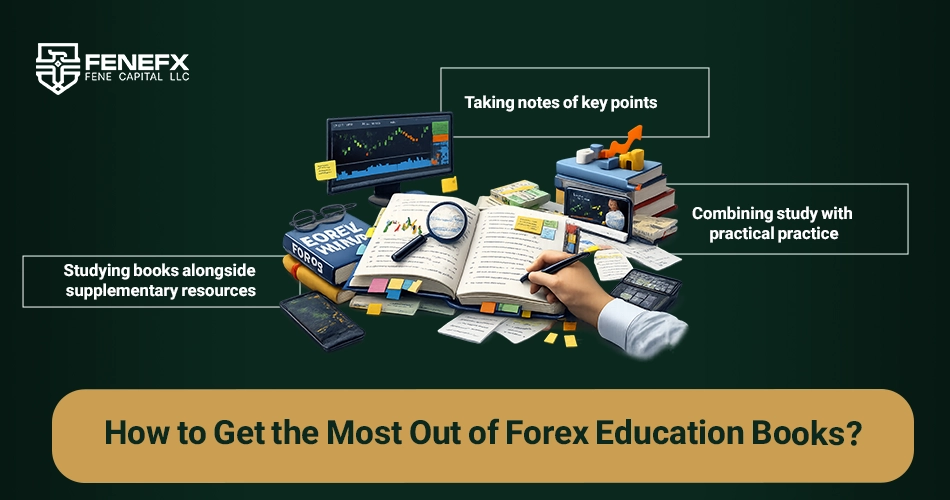
1. Taking notes of key points
When you study an educational book, you will receive a large amount of information. To prevent forgetting important points, taking notes is one of the best methods. How should this be done?
- While reading each chapter, write down the key concepts in a summarized form.
- Note formulas, strategies, and important definitions separately so that you can easily refer back to them later.
- Review examples of real trades mentioned in the book and record them in your notebook along with your personal analysis.
2. Combining study with practical practice
One of the most common mistakes made by novice traders is that they only read books but never practice in the real market. Learning Forex requires hands-on experience.
- You can use a demo account (practice account) with a reputable broker and apply the concepts you have learned in a real market environment.
- Test the strategies presented in the book on historical market data to see how effective they are.
- Record your mistakes and, by reviewing them, improve your trading methods.
3. Studying books alongside supplementary resources
Each book has its own strengths and weaknesses. No single book can cover all aspects of Forex on its own. For this reason, it is better to use books alongside other resources:
- Educational videos:If a concept in the book is unclear to you, searching YouTube or educational platforms for related videos can help improve your understanding.
- Trading communities:Participating in communities such as Forex Factory and TradingView can provide opportunities to interact with other traders.
- Supplementary books:If you are interested in a specific area such as technical analysis or trading psychology, you can turn to more specialized books.
Is it better to learn forex with books or online and video courses?
Today, traders are faced with a wide variety of educational options for learning the Forex market, ranging from classic educational books to online Forex training courses, educational videos, and webinars. Each of these methods offers a different learning style and has its own advantages and limitations. Choosing the appropriate method depends on factors such as level of knowledge, learning style, budget, and access to educational resources. In the following, we compare Forex education books with online and video courses from different aspects so that you can make a more informed choice.
Comparison Table of Forex Education Books and Online and Video Courses
Comparison Criteria | Forex Education Books | Online and Video Courses |
Type of Education | Text based and theoretical | Visual, practical, and interactive |
Educational Structure | Organized and step by step | Depends on the instructor; sometimes organized, sometimes scattered |
Access to Content | Permanent with no time limitation | Usually limited to the course duration or subscription |
Internet Requirement | Not required | Required |
Learning Speed | Relatively slower and dependent on individual study | Faster due to practical and visual examples |
Understanding Technical Concepts | Moderate, dependent on the reader’s analytical ability | High due to the display of charts and real trades |
Interaction with Instructor | None | In some courses, there is the possibility of Q&A |
Cost | Usually low and cost effective | Often high, especially professional courses |
Content Updates | Limited and dependent on new editions | Fast and aligned with market changes |
Suitable For | Beginners and those interested in in-depth learning of concepts | Visual and hands on learners interested in fast learning |
Need for Practical Practice | Very high and outside the book | Included with examples and practical exercises |
The best method for learning Forex is to use a combined approach: educational books to gain a deep understanding of concepts, courses and educational videos to observe the practical execution of trades, and finally continuous practice in the real market or on a demo account. This combination can make the learning path both faster and more structured.
Education and Capital; Two Inseparable Pillars of Success in Financial Markets
Education has always been one of the main pillars of activity in financial markets and is undoubtedly considered the first prerequisite for professional entry into markets such as Forex. Trading without sufficient knowledge is, in practice, nothing more than emotional decision making and accepting irrational risks. For this reason, learning the principles of technical analysis, fundamental analysis, risk management, and market psychology is considered an essential foundation for every trader.
However, education alone does not guarantee success. The second pillar and one of the most important prerequisites for operating in financial markets is having sufficient initial capital
Many traders, despite having proper education, fail in their trading journey solely due to a lack of capital or the psychological pressure caused by limited funds. This is where the close relationship between Forex education, capital, prop trading, and success in financial markets is formed.
Without education, activity in financial markets is practically impossible, and without reasonable initial capital, the likelihood of achieving sustainable profits and dollar based income is significantly reduced. At this point, proprietary trading firms and the prop trading model come into play. Prop firms provide trading capital to talented traders who have received the necessary training and share in the profits with them. On the other hand, these same companies, by offering professional training, seek to enhance traders’ skills so that both the trader earns more profit and the company’s profit increases. As a result, through prop trading, individuals both receive education and gain access to the required capital, making the path toward achieving dollar based income smoother for them.
Prop Fenefx; A Combination of Professional Education and Trading Capital
Prop Fenefx, as one of the best prop firms in Iran, is a successful example of this deep connection between education and capital. By publishing practical Forex educational content on its website and offering a comprehensive zero to advanced Forex course completely free of charge, Fenefx has created a valuable platform for learning trading in a structured and principled manner. This free course is considered one of the most comprehensive Forex educational programs in Iran and serves as an ideal starting point for individuals who intend to seriously enter prop trading and financial markets. Alongside education, Fenefx provides prop accounts and makes the necessary capital available to prepared traders so that they can turn their knowledge into profit and dollar based income. If you are looking for a combination of professional education and real capital, now is the best time to purchase a prop account from Prop Fenefx.
Final Conclusion
Forex education books remain among the deepest and most reliable resources for learning this market and can build a solid foundation for understanding technical analysis, fundamental analysis, and trading psychology. However, reading books is most effective when combined with practical practice, the use of supplementary resources, and access to appropriate capital. The combination of continuous education, practice in demo or real accounts, and the use of models such as prop trading is the most logical path to reducing risk, increasing skills, and achieving sustainable profits and dollar based income in Forex. Ultimately, success in this market is the result of a smart, long term choice, not an emotional and short term decision.
Frequently Asked Questions
1. Is reading books enough to learn Forex?
No, books build the foundation of knowledge, but without practical practice and market experience, they are not sufficient.
2. What is the best Forex book for beginners?
The book “Technical Analysis of the Financial Markets” by John Murphy is one of the best options for getting started.
3. Why is trading psychology so important in Forex?
Because emotions such as fear and greed directly affect trading decisions and final results.
4. How does prop trading help trained traders?
Prop trading provides the necessary capital so that traders can achieve profits and dollar based income without financial pressure.
Comments
Nice picks, no filler titles here.
Market Wizards changed how I think about losses. Read it twice, the interviews stick with you more than any textbook.
Any recommendations for books specifically on risk management? Feels like every list covers psychology and TA but nothing on position sizing.
Solid list, though I'd swap one out for Wyckoff's original work. Old but it teaches you to read price without indicators, which most modern books skip.
Just ordered Trading in the Zone because of this list. I've been struggling with exits and everyone keeps saying it's a psychology issue, so fingers crossed.