
What is a Stablecoin? Your Digital Dollar in the World of Cryptocurrencies
Stablecoins are a type of digital currency designed to maintain price stability. Unlike highly volatile cryptocurrencies such as Bitcoin or Ethereum, stablecoins are usually pegged to a stable asset like the US dollar, gold, or even other cryptocurrencies to avoid sharp price fluctuations. This characteristic makes them suitable for payments, money transfers, participation in decentralized financial protocols, and preserving asset value. Stablecoins enable users to combine the benefits of blockchain technology with relative financial stability; in other words, they are your digital dollar in the world of cryptocurrencies.
How Do Stablecoins Work?
To understand how stablecoins function, one must first become familiar with the concept of “pegging” or “price stability through linkage.” Pegging means that the value of a stablecoin is directly or indirectly tied to another asset. For example, if a stablecoin is pegged to the US dollar, each unit of that stablecoin should remain approximately equal to 1 USD. This price stability is maintained through various mechanisms.
Mechanisms for Maintaining Price Stability
Fully Collateralized:In this case, for every unit of stablecoin, an equivalent amount is held in a real asset such as dollars or gold. These assets are typically audited and stored by third party companies to enhance transparency and trust. USDT and USDC are examples of this type.
Crypto Collateralized:In this model, users lock their digital assets, such as Ethereum, in smart contracts and receive stablecoins in return. The collateral is usually greater than the value of the issued stablecoin to prevent sudden price drops. Dai is one such example of a crypto collateralized stablecoin.
Algorithmic Model:This method does not use any collateral. Algorithms manage the price by increasing or decreasing the supply in response to market demand. If the price drops, the algorithm reduces the supply to restore stability. An example of this model was TerraUSD, which failed to maintain its peg during the 2022 crisis.
The Role of Smart Contracts
In decentralized models, smart contracts automatically handle collateralization, issuance, redemption, and the management of supply and demand. This eliminates the need for a centralized intermediary and ensures transparency and traceability of all operations.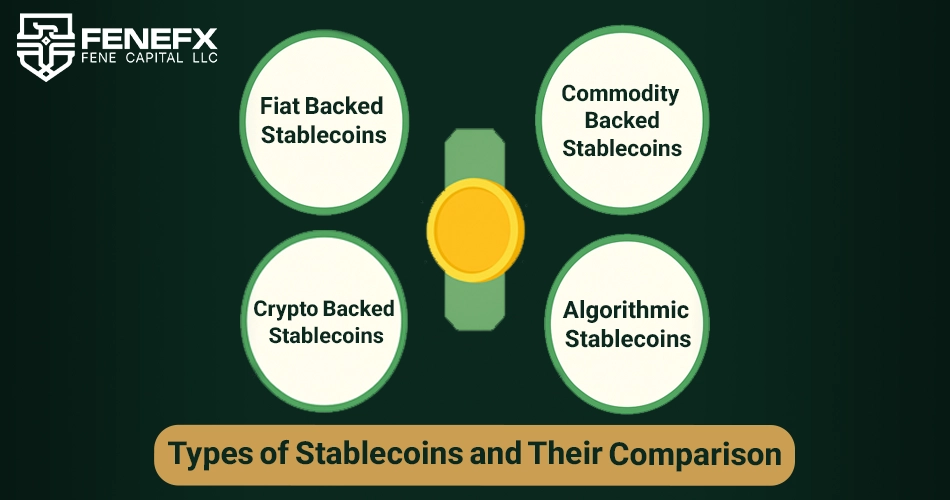
Types of Stablecoins and Their Comparison
Stablecoins can be categorized into four main types based on their collateral type and value stabilization mechanism: fiat backed, commodity backed, crypto backed, and algorithmic. Each category has its own advantages, disadvantages, and risk levels, and they are designed for different use cases. Below is a detailed look at each type and the differences between them:
Fiat Backed Stablecoins
The most common and well known type of stablecoin is backed by fiat currencies such as the US dollar, euro, or British pound. In this model, for every issued unit of the stablecoin, an equivalent amount of fiat currency is stored in a bank account. The issuing company is obligated to maintain these reserves and have them periodically audited by independent institutions.
Well known examples include USDT (Tether) and USDC, which are traded on most exchanges.
The main advantage of fiat backed stablecoins lies in their simple to understand structure and high price stability. Since they are backed by physical assets, users generally have more confidence in them. However, this model is entirely centralized, and users must trust the issuing entity. A lack of transparency or independent audits can raise concerns about the actual existence of the reserves.
Commodity Backed Stablecoins
In this type, the value of the stablecoin is pegged to stable commodities such as gold, silver, or even oil. Typically, for each unit of this type of coin, an equivalent amount of the commodity is stored in a vault. For instance, Tether Gold (XAUT) is backed by one ounce of gold. These coins allow users to benefit from commodity ownership without the need to physically store the asset.
Key advantages of this model include protection against inflation and global economic volatility. Commodities like gold usually perform better than fiat currencies during economic crises, making commodity backed stablecoins a potential safe haven in investors' portfolios. However, high storage costs and the need to trust custodial institutions remain significant challenges.
Crypto Backed Stablecoins
These stablecoins are backed not by traditional currencies or commodities, but by digital assets such as Ethereum, Bitcoin, and other cryptocurrencies. Their mechanism is based on smart contracts and overcollateralization. Users lock their crypto assets in smart contracts to receive a certain amount of stablecoins. Due to the high volatility of crypto markets, the collateral is usually worth significantly more than the issued stablecoins.
For example, in the MakerDAO system, users deposit Ethereum to generate the stablecoin Dai. This model is fully decentralized and does not require any central authority. However, extreme price swings in crypto assets expose users to liquidation risk if the value of the collateral falls, the smart contract automatically sells the assets to maintain balance. Therefore, this model requires technical knowledge and continuous monitoring.
Algorithmic Stablecoins
These stablecoins have no actual backing and rely solely on programmed algorithms. In this model, the coin's price is controlled automatically by smart contracts through adjusting supply and demand. When demand decreases and the price drops below the target, the algorithm reduces supply to restore balance, and vice versa.
A well known example is TerraUSD (UST), which was designed using the LUNA token. However, in 2022, due to a price crash, the algorithm failed to control supply and demand, leading to the complete collapse of the system. This incident exposed the serious weaknesses of algorithmic stablecoins. Although this model is innovative and does not require collateral, it remains highly risky for widespread use and requires further development.
Comparison Table of Stablecoin Types
| Type of Stablecoin | Collateral | Centralization | Risk Level | Transparency | Examples |
| Fiat Backed | USD, EUR, etc. | Centralized | Low | Dependent on audits | USDT, USDC, TUSD |
| Commodity Backed | Gold, Silver, etc. | Semi centralized | Medium | Dependent on reserves | XAUT, PAXG |
| Crypto Backed | ETH, BTC, etc. | Decentralized | High | On blockchain | DAI, sUSD |
| Algorithmic | No direct collateral | Decentralized | Very High | Algorithm dependent | UST, AMPL |
Real World Use Cases of Stablecoins
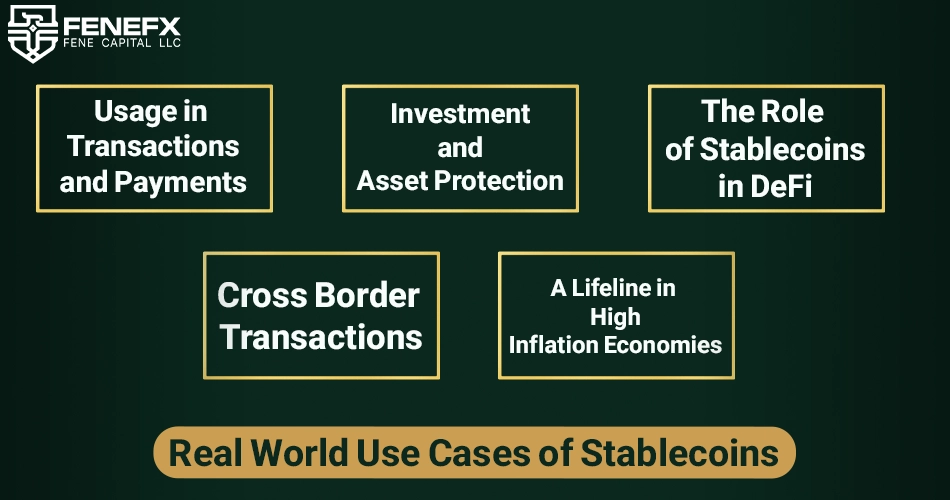
Due to their price stability and backing by clearly defined assets, stablecoins are widely used in many practical applications within the crypto space. Unlike highly volatile cryptocurrencies such as Bitcoin, they serve as lower risk instruments in trading, investing, money transfers, and decentralized finance (DeFi) systems.
Usage in Transactions and Payments
One of the primary use cases of stablecoins is for everyday payments. Many users prefer using stablecoins instead of fiat currencies or volatile cryptocurrencies to pay for services, goods, or even send money across borders. High speed, low fees, and the absence of banking intermediaries are key reasons behind their popularity in this area.
Investment and Asset Protection
During sharp downturns in the crypto market, traders convert their cryptocurrencies into stablecoins to preserve the value of their assets. This move allows them to avoid market volatility while remaining in the digital space. This practice is also referred to as "parking capital." Additionally, some investors use stablecoins to diversify their portfolios.
The Role of Stablecoins in DeFi
In the DeFi ecosystem, stablecoins are the backbone of many financial services. Users can deposit them into lending protocols to earn interest, use them as collateral to receive loans, or participate in liquidity pools and earn transaction fees. Stablecoins such as DAI, USDC, and USDT are among the key options in DeFi.
Cross Border Transactions
Stablecoins provide an easy way to send money internationally. By eliminating banking intermediaries and high international transfer fees, stablecoins become an economical and fast choice, especially for freelancers, migrants, and cross border businesses. In countries with limited access to financial services, this feature becomes even more significant.
A Lifeline in High Inflation Economies
In countries like Venezuela, Turkey, or Lebanon, where inflation rates are high, people turn to stablecoins like USDT to preserve the value of their assets. Access to physical dollars is often difficult in these regions, but through stablecoins, individuals can store their wealth in a more stable currency. These digital assets play a vital role as a digital alternative to the dollar, helping to maintain purchasing power.
Advantages and Disadvantages of Stablecoins
Stablecoins offer many advantages to users, but they are not without challenges. Below, we first provide a brief analysis of the advantages and disadvantages of these digital financial instruments, followed by a comparison table to better understand the differences.
Stablecoins are suitable tools for individuals seeking price stability in the highly volatile world of cryptocurrencies. They offer high liquidity, fast transfers, low fees, and the possibility of use in smart contracts. Moreover, due to their linkage to fiat currencies or other assets, they are considered more trustworthy than volatile cryptocurrencies.
On the other hand, there are also some disadvantages. Stablecoins that rely on centralized entities (such as USDT) require trust in the issuer and its reserves. In cases where algorithms are used to stabilize the price, there is a risk of instability or even collapse. Additionally, regulatory laws regarding stablecoins are not yet fully developed in various countries, which can create legal risks.
Comparison Table of the Advantages and Disadvantages of Stablecoins
| Advantages | Disadvantages |
| Price stability compared to other cryptocurrencies | Dependence on reserves and centralized entities |
| High speed in fund transfers | Limited transparency in some projects |
| Low transaction fees | Volatility risk in algorithmic stablecoins |
| Usability in DeFi | Lack of clear legal frameworks in some countries |
| A tool for preserving value in unstable markets | Possibility of hacks or technical issues in smart contracts |
Risks and Potential Crises
Despite the significant growth in the use of stablecoins, there are crises and risks that cannot be ignored. Market experience has shown that even these so called "stable" instruments can become unstable under certain conditions.
The Collapse of TerraUSD (UST)
One of the most well known crises in the stablecoin sector is related to the collapse of UST in 2022. This algorithmic stablecoin was stabilized through the LUNA token. When users massively sold off UST, the system was unable to maintain the balance between supply and demand, and as a result, its price rapidly dropped instead of remaining at $1. This crisis wiped out billions of dollars in user investments.
Challenges of Algorithmic Stablecoins
Despite their innovation, the algorithmic model is highly vulnerable to sudden market shocks. These types of stablecoins do not require physical collateral to maintain their value, but if user trust declines, their algorithms are incapable of managing the risk. This structural weakness has made investors approach these types of coins with greater caution.
Crisis of Trust and Hidden Volatility
Even fiat backed stablecoins are not immune to trust crises. In recent years, speculation about the insufficiency of reserves backing USDT caused temporary distrust among users. Although the issuing company attempted to demonstrate transparency through reports, the incident revealed that trust in a centralized issuer can be fragile.
The Role of Regulatory Bodies
Legal risk is another potential crisis. If governments impose strict regulations or sudden bans, stablecoins may become restricted or unusable. In recent years, regulatory bodies in the United States, the European Union, and Asia have paid increased attention to this sector, calling for more transparency, reporting, and thorough auditing.
In summary, understanding these risks is vital for users. Although stablecoins are useful tools, they are still part of a developing market that may be affected by technical, economic, and legal factors, leading to potential crises.
Regulatory and Legal Frameworks for Stablecoins
With the rapid expansion of stablecoins in global markets, regulatory bodies have increasingly focused on these emerging financial instruments. The reason for this attention lies in the hybrid nature of stablecoins they simultaneously resemble digital currencies, payment tools, and financial assets. As such, the absence of a clear regulatory framework can pose risks such as money laundering, terrorist financing, or even the bankruptcy of issuers.
In the United States, institutions like the Securities and Exchange Commission (SEC) and the Office of the Comptroller of the Currency (OCC) are working on specific regulations to oversee the activities of companies issuing stablecoins. Measures such as mandatory disclosure of reserves, periodic audits, registration as financial entities, and compliance with anti money laundering requirements are part of this framework. In Europe, with the approval of the MiCA (Markets in Crypto Assets) regulation, companies are now required to register officially, report thoroughly, and cooperate with regulatory authorities.
In contrast, some countries like China have adopted more restrictive policies, banning the use of stablecoins altogether. This approach is largely driven by governmental concerns over losing control of national currency and the direct competition with Central Bank Digital Currencies (CBDCs).
The Future Outlook of Stablecoins and the Digital Dollar
Stablecoins and the digital dollar are emerging as two key pillars of transformation in the global monetary system, with a promising outlook in the future of financial markets. Stablecoins have already played an important role in facilitating international transactions, increasing access to financial services, and supporting the DeFi ecosystem. However, the future of these currencies depends on how they interact with governments, the pace of blockchain innovation, and public adoption.
As cryptocurrencies gain wider acceptance among individuals and businesses, the need for more stable digital currencies becomes more evident. In this context, stablecoins can serve as a bridge between the traditional and digital financial worlds. They enable faster payments, lower costs, and global accessibility, but to achieve widespread adoption, they must earn public trust through transparency and legal backing.
On the other hand, the digital dollar, as an official and state backed digital currency, is currently in the pilot and evaluation stages. In the United States and other major economies, launching a CBDC could offer benefits such as improved oversight of money flows, combating money laundering, and facilitating government payments. Nevertheless, challenges like preserving user privacy, compatibility with commercial banking systems, and sound technical design remain significant obstacles on this path.
Comments
Always wondered how a coin stays at exactly $1. The explanation of collateral and pegs finally cleared it up for me, thanks a lot.
'Digital dollar' is exactly the right way to put it. Good read.
I keep part of my savings in stablecoins because of local currency swings. Not perfect, but it's saved my purchasing power more than once.
What happens to holders if a stablecoin's reserves ever come up short? Would love a deeper dive into reserve audits.
One thing missing: not all stablecoins are equally safe. Algorithmic ones have blown up before — UST holders remember. Always check what's actually backing the peg.