





The best scalping strategies for trading
Scalping is a short-term trading style that focuses on capturing small profits from rapid price fluctuations within very short timeframes usually between 30 seconds to 5 minutes. In this approach, the trader aims to enter a position quickly, secure a small gain, and exit the market just as fast.
Unlike long-term strategies that aim to catch major market trends, scalping relies on executing a high volume of small, precise trades. It requires quick analysis, instant decision-making, strong emotional control, and flawless trade execution.
Scalping is not suitable for everyone. Traders who can succeed in this style usually share these traits:
- High focus during short timeframes
- The ability to read charts visually and rapidly
- Not depending on large profits and viewing small gains as meaningful
- Patience to execute multiple trades in a single day
- Discipline in following entry and exit rules strictly
On the other hand, traders with poor emotional control, impulsive decision-making tendencies, or weak execution skills are likely to experience repeated losses with this method.
In highly liquid markets such as forex, cryptocurrency, or even certain stocks, scalping offers several advantages—including the potential to profit even in sideways markets. However, success in scalping demands precise strategies, extensive practice, and strict personal discipline.
Scalping Strategy Using EMA and Price Action
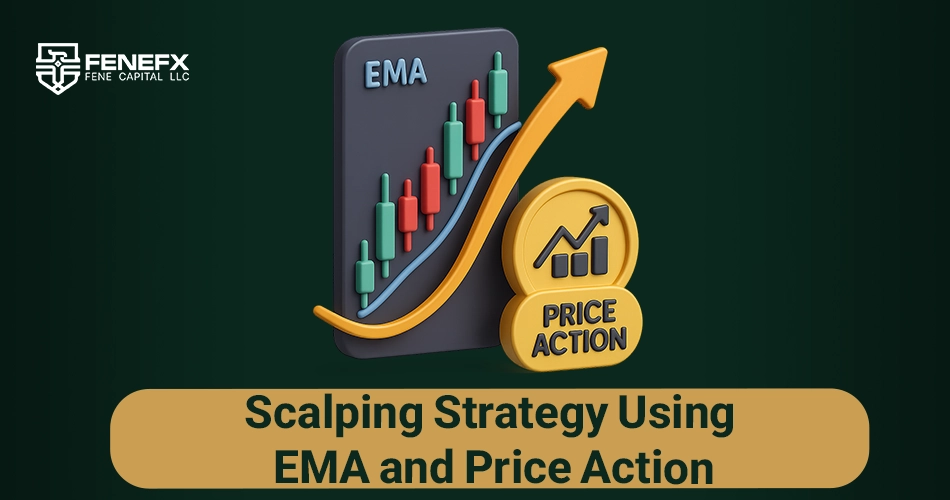
Combining Exponential Moving Averages (EMAs) with price action is one of the most accurate and yet straightforward scalping strategies. Rather than relying solely on indicators, this approach attempts to interpret price behavior around EMAs to identify short-term entry and exit points. Scalpers who seek structured setups, fast decision-making, and logical filters often turn to this combination.
The Core Structure of the Strategy and EMA Usage
This strategy typically uses two short-period EMAs—commonly the EMA 9 and EMA 21. These EMAs react quickly to price changes, helping traders detect short-term market direction. When EMA 9 crosses above EMA 21, it often signals the beginning of a bullish wave, and vice versa for bearish moves. However, the actual entry signal occurs when the price approaches one of these EMAs and simultaneously forms a reliable price action pattern.
The Importance of Candlestick Analysis Alongside EMAs
Price action plays a critical role in this strategy. A mere touch of price on an EMA line isn’t a sufficient reason to enter a trade. What makes an entry valid is the formation of a reversal or continuation candlestick pattern near the EMAs. For example, in an uptrend, if price pulls back to the EMA 21 and forms a bullish engulfing candle or a pin bar, it can be a strong buy signal. Similarly, in a downtrend, the presence of strong bearish candles at EMA 9 suggests a potential short entry.
Practical Application and Key Strengths
This strategy performs well in markets with moderate volatility—particularly in major forex pairs or highly liquid crypto assets. The combination of trend identification via EMAs with the precision of candlestick signals creates structured, fast, and low-risk entries. Risk management and exit planning are equally important. Profit targets are typically set based on recent support/resistance or market structure, while stop-loss orders are placed just beyond the confirming candle.
Scalping Strategy Using RSI and Divergence
Using the Relative Strength Index (RSI) in combination with divergence is a popular strategy among scalpers seeking to capture short-term market reversals. This approach is based on analyzing the conflict between price action and market momentum and delivers anticipatory signals that help traders enter right when the trend is beginning to shift.
The Role of Divergence in Spotting Reversals
Divergence occurs when price continues in one direction, but the RSI indicates momentum in the opposite direction. This mismatch often signals a weakening trend and potential reversal. In bullish divergence, price makes a new low, but the RSI fails to follow—indicating diminishing selling pressure. Conversely, in bearish divergence, price hits a new high, but the RSI creates a lower high , showing that buyers are losing strength.
Optimal Settings and Strategic Use Cases
For scalping purposes, setting RSI to shorter periods like 7 or 9 (instead of the standard 14) is more common, as it increases sensitivity to short-term movements. This strategy works best in ranging or corrective markets. When divergence appears along with reversal candlesticks at support or resistance levels, a high-probability entry point is formed. Waiting for a clear price action confirmation is essential to avoid premature entries.
Trade Management and Execution Challenges
Because divergence can appear early in a reversal, it’s crucial to use a tight stop-loss placed just behind the confirmation candle. Since divergence signals may sometimes delay before the actual reversal occurs, patience and restraint are key traits for executing this strategy successfully. Overall, RSI divergence scalping suits traders who prefer precise, short-duration opportunities and can analyze both price structure and momentum in tandem.
Scalping Strategy with Bollinger Bands
Scalping with Bollinger Bands is a classic and reliable method for trading in volatile market conditions. In this approach, the trader focuses on quick price reactions near the upper or lower bands areas where supply or demand pressure typically peaks, increasing the likelihood of a price reversal or breakout.
How Bollinger Bands Work in Scalping
Bollinger Bands consist of three lines: a simple moving average (usually set to 20 periods) and two outer bands that are drawn based on standard deviation from the average. This structure visualizes the level of market volatility. When the bands contract, it indicates a period of low volatility and potential for a sharp move. Conversely, when the price touches the upper or lower band, it’s often interpreted as a signal of relative overbought or oversold conditions.
Entering Trades Based on Band Reactions
This strategy typically involves two types of trading setups: reversals from the bands and breakouts beyond the bands. In the first scenario, the trader looks for signs of reversal after price touches the upper or lower band—especially if this contact coincides with a reversal candlestick or a key technical level. In the second case, a clear breakout beyond the band, confirmed by strong volume and candlestick momentum, may signal the start of a rapid directional move. In both scenarios, price action confirmation plays a crucial role in validating the entry.
Timing, Timeframes, and Risk Considerations
This strategy performs best in 1-to-5-minute timeframes, where volatility is sufficient to allow small but frequent profit opportunities. However, traders should avoid entering trades when the bands are overly compressed or when the market lacks clear direction. Setting a stop loss outside the band and selecting profit targets near the midline or opposite band are key components of effective risk management in this method.
Scalping Strategy with Renko Charts: Simplifying Noise for Precise Entries
Renko charts are one of the lesser-known yet highly practical tools in scalping. Unlike traditional candlestick or bar charts where time plays a dominant role, Renko focuses solely on price changes. This unique feature significantly reduces market noise and helps traders concentrate on actual price movements.
The Structure of Renko and Its Advantages in Scalping
Renko builds "bricks" of fixed size (e.g., 5 pips or $10), forming a new brick only when the price moves by that amount. As a result, small and insignificant fluctuations are filtered out, and only meaningful trends remain. For scalpers, this means clearer chart patterns and fewer false signals—enabling faster decision-making with reduced risk of fake entries.
Entry Methods Based on Breakouts and Reversals
With Renko charts, scalpers typically use two main approaches: following breakouts through aligned bricks after key level breaches (like support or resistance), or entering at structured reversals from recent highs or lows. In the first case, two consecutive bricks in the same direction after a breakout suggest trend continuation. In the second, a reversal pattern—such as a double top or bottom confirmed by an opposite-colored brick—signals a potential countertrend move.
Execution Challenges and Complementary Techniques
Since Renko is price-based rather than time-based, it should not be used in isolation for precise entries and exits. Many scalpers use Renko alongside traditional candlestick charts to fine-tune their entries using confirmation candles or volume analysis. Proper brick size (box size) configuration is also critical. Too small, and noise creeps back in; too large, and signals appear too late. Overall, Renko is a valuable tool for traders seeking to filter out randomness and execute well-structured, focused trades.
Scalping Strategy with Volume Profile: Trading Around Value Areas
Volume Profile is one of the most advanced analytical tools used by professional traders seeking a deeper understanding of market structure. Unlike typical indicators that measure volume across time, Volume Profile displays trading volume distributed across price levels—allowing traders to identify key demand and supply zones with precision.
Understanding Market Structure through Volume Profile
The central concept in Volume Profile is thePoint of Control (POC)—the price level at which the highest volume of trades occurred within a given time period. This level often acts as a price magnet. Zones above and below the POC, with moderate or low volume, are considered less valuable areas where price tends to pass through quickly or, if it reverses, reacts sharply.
How to Use Volume Profile in Scalping
In scalping, the focus is on how price reacts to high-volume nodes (HVNs) and low-volume nodes (LVNs). When price moves through a low-volume area and approaches a high-volume zone, the chance of reversal or at least a pause increases. A scalper can observe price behavior around the POC and confirm it with candlestick patterns or other tools such as RSI or VWAP to find low-risk entry points. Especially during pullbacks into the value area, trading in the direction of the dominant trend can yield strong results.
Competitive Edge and Professional Execution Requirements
Volume Profile requires an advanced trading platform and access to high-quality volume data. In markets like forex, where exact volume isn’t available—it’s advisable to use relative volume or broker-provided tick volume as a proxy. This strategy is best suited for focused scalpers who want to elevate their analysis beyond common indicators. By understanding how price behaves around volume distribution, traders can identify high-value areas where smart money is most active.
Scalping Strategy with Break of Structure and Liquidity: Tracking Hidden Market Flow
This strategy draws from advanced price action and liquidity concepts and is widely used by flow-based traders in highly liquid markets like forex and crypto. The core of the method lies in identifyingBreaks of Structure (BoS)and targeting hidden liquidity zones. Instead of simply following trends, the trader tries to read the underlying market mechanics—often driven by smart money attempting to trigger stops and redirect price movement.
BoS Concept and Price Behavior Around Liquidity Zones
A break of structure occurs when the market invalidates its previous trend. For example, in an uptrend, if a lower high and lower low form, this may signal a trend reversal. What makes this strategy particularly powerful is its focus on how price behaves near liquidity zones—areas filled with stop-losses, pending orders, and collective trader emotions.
Here, entries typically happen after aliquidity grab, followed by a confirmed structure break. A skilled scalper waits for price to sweep liquidity, then observes for a reversal pattern on a lower timeframe before entering in the opposite direction of the initial move.
This strategy is known for its precision and its deeper insight into market psychology. It suits traders who are less reliant on standard tools and more attuned to identifying artificial moves and manipulations within price action.
Which Scalping Strategy Is Right for You?
So far, we’ve explored several scalping strategies, each with its own analytical framework, tools, and execution style. But the key question remains:Which strategy is best suited to you?The answer depends not just on the market environment but also on your personality, level of experience, and trading preferences.
If you value structure and simplicity, the EMA + Price Action strategy offers a low-risk starting point. If you have a sharp analytical mind and fast decision-making skills, the Break of Structure and Liquidity strategy might be your best fit. And for those with a data-driven mindset who enjoy volume analysis, Volume Profile is a highly technical and insightful tool.
Ultimately, scalping demands discipline, focus, and precise execution. No strategy will lead to consistent profits without being tested, practiced, and adapted. It’s recommended to start by selecting two or three strategies, test them thoroughly in a demo account, document your results, and then choose based on both performance and personal comfort. The best strategy is the one that you can execute confidently and consistently over time.
Comments
Which pairs would you recommend for scalping a small account? And could you cover scalping prop firm challenges specifically? Rules like max daily loss change everything.
Tried scalping the London open for a few months. The setups worked but the stress didn't suit me — moved to swing trading and never looked back. Know your temperament first!
Great roundup, saving this one for later.
Honestly the strategy matters less than execution costs. I scalped profitably for years and the edge was mostly in spread + commission math, not fancy entries. Worth stressing that more.
Just getting into scalping and this gave me a proper starting point. The part about sticking to one setup instead of chasing everything was eye-opening, thank you.