

How long does it take to learn Forex?
Entering the world of Forex begins with an important question for many people: “How long does it take to learn Forex?” This market, where millions of trades are executed every day, offers great opportunities, but its complexity has made the learning path unclear and sometimes frightening for beginners. Many people start with unreliable sources and become confused and disappointed after a few months. This article is written precisely to clarify this path so you can understand how long learning Forex really takes, why this timeframe varies from person to person, and how you can significantly accelerate your learning process with a correct and structured approach. If you are looking for a clear and practical guide that explains the realities of learning Forex without exaggeration, this article can be the right starting point for you.
Why does the duration of learning Forex differ for each individual?
The duration of learning Forex varies from one person to another, and this difference depends on various factors. One of the most important factors is an individual’s financial and economic background. Those who are already familiar with economic concepts, technical and fundamental analysis, or even investing in other markets usually understand Forex concepts more quickly. In contrast, individuals who have no prior background in this field may need to spend more time learning the basics.
Another key factor is the amount of practice and time a person dedicates to learning. Someone who spends several hours a day on learning and practice will naturally progress faster than someone who studies weekly or inconsistently. Additionally, the quality of educational resources plays a crucial role. Using reliable sources, specialized books, and standard training courses can accelerate the learning process, whereas unreliable sources may cause confusion and waste of time.
In the end, an individual’s ability to learn and their perseverance are also determining factors. Some people grasp new concepts more quickly from a mental and analytical standpoint. However, this does not mean that others cannot succeed. Learning Forex requires perseverance and consistent practice, and anyone who puts in the effort can reach a high level of skill, even if it takes more time.
How can the time required to learn Forex be reduced?
To reduce the time needed to learn Forex, you must use effective and targeted approaches. The first step is choosing the right and reliable educational resources. Instead of reading scattered materials or using unreliable sources, you should focus on standard books, articles, and training courses. These resources should introduce you to Forex concepts in a comprehensive and step by step manner.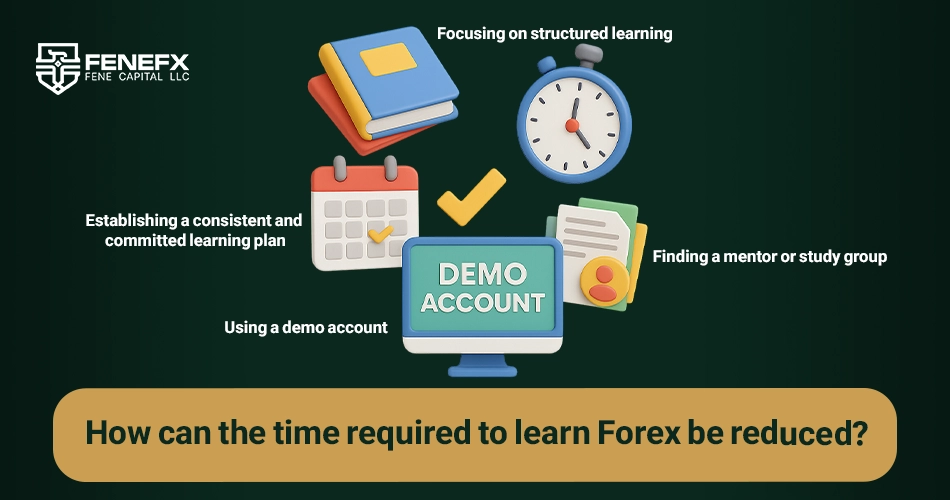
Establishing a consistent and committed learning plan
Another practical method is creating a consistent and committed learning plan. Learning Forex requires continuity and cannot be pursued in a scattered manner. For example, if you dedicate one or two hours a day to learning concepts and practicing, your progress will be faster.
Using a demo account
On the other hand, using a demo account is one of the best ways to reduce the learning time. With a demo account, you can practice in a risk free environment and improve your skills in market analysis, risk management, and trade execution. This hands on experience helps you understand the concepts better and identify and correct your mistakes without losing real capital.
Focusing on structured learning
Moreover, focusing on structured learning is very important. Instead of trying to learn everything at once, it is better to focus first on the basic concepts and then move on to more advanced topics. For example, you should start by becoming familiar with fundamental terms and concepts such as currency pairs, how to read charts, and technical analysis, and then proceed to more complex strategies.
Finding a mentor or study group
Finally, finding a mentor or an educational group can speed up the learning process. An experienced mentor can identify your mistakes and make the learning path easier for you. Additionally, learning alongside others can be motivating and encourage you to make greater progress.
How long does it take to learn the basic concepts in Forex?
The basic concepts of Forex include topics that are essential for starting activity in this market. Learning these concepts depending on how much time you dedicate daily to study and practice usually takes between one week and two months.
This stage includes becoming familiar with key terms such as currency pairs (like EUR/USD), spread, leverage, margin, and lot. It also involves understanding how the Forex market works, trading hours, and the factors that influence price changes. Additionally, learning how to read price charts and becoming familiar with basic indicators such as the Moving Average and RSI are also part of the foundational concepts.
If you study and practice daily, you can learn these concepts in a short period. The best method to master them is to first study them theoretically and then practice them in a demo account or simulation tools. The goal of this stage is to build a solid foundation for entering more advanced topics.
How long does it take to become a profitable trader?
Achieving consistent profitability in Forex is one of the most challenging stages of learning and usually takes several months or even several years. The reason for this long duration is the complexity of the market and the need to gain sufficient experience to manage emotions, identify suitable opportunities, and execute successful trades.
In the early stages, most traders may experience losses because they have not yet gained enough understanding of the market and trading strategies. However, over time and with increased experience, traders can identify their mistakes and minimize them.
Risk management
One of the key factors in achieving profitability is risk management. Many beginner traders face significant losses because they overlook risk management. Learning how to set a Stop Loss, manage position size, and adhere to the risk to reward ratio are among the essential skills you must master.
Having a clear trading strategy
In addition, having a clear trading strategy plays a very important role in becoming profitable. Many people enter the market without a defined strategy, and as a result, they face losses. Designing and testing a suitable trading strategy is time consuming and requires precise analysis and continuous practice.
Ultimately, it is important to understand that profitability in Forex occurs gradually, and you should not expect to achieve large profits in a short period of time. Patience, practice, and continuous learning are the keys to success in this market.
Examining the role of practice and experience in learning Forex
Practice and experience are two key factors in learning Forex that have a significant impact on your mastery of the market. Forex is a complex market in which learning through reading and theory alone is not sufficient. You must practically apply the concepts and strategies you have learned in the market in order to identify your strengths and weaknesses.
One of the best tools for practicing in Forex is using a demo account. A demo account allows you to execute trades without the risk of losing real capital and become familiar with how the market works. This method helps you test different strategies and learn how to use trading tools such as indicators and charts. Additionally, using a demo account gives you the opportunity to become familiar with market psychology and analyze price behavior under different conditions.
Does learning Forex require training courses?
One of the common questions among those who intend to start learning Forex is whether participating in training courses is necessary or if it is possible to learn this skill through self study. The answer to this question depends on your circumstances and goals.
Self study
Self study is one of the common methods for learning Forex. If you have access to reliable educational resources, enough time, and the ability to research and analyze information, you can learn Forex on your own. The internet is full of articles, videos, and free educational books that can guide you along your learning journey. However, one of the drawbacks of self study is that due to the lack of a structured learning path, you may encounter scattered and sometimes incorrect information, which can lead to confusion. Additionally, self learners usually spend more time mastering concepts because they must identify their mistakes on their own.
Specialized training courses
On the other hand, specialized training courses help you learn within a structured path and under the guidance of an experienced mentor. These courses usually have a more organized structure and can keep you away from common mistakes. Additionally, a mentor can answer your questions and teach you more practical strategies. However, training courses can be costly, and choosing the right course can also be challenging, as some courses lack the necessary quality.
Among the Persian language Forex training courses, the “Zero to Thousand” course by Master Ahangari is one of the best options, which is provided to users for free. This course covers all aspects of Forex trading from basic concepts to advanced strategies and is presented in a practical and understandable manner. With his several years of experience in the Forex market, Master Ahangari teaches complex concepts in simple language and clearly explains risk management techniques and trading psychology, making this course a comprehensive resource for those interested in Forex.
Challenges of learning Forex and how to overcome them
Learning Forex comes with multiple challenges that, if not managed properly, can hinder your progress. One of the most important of these challenges is managing emotions. The Forex market is highly dynamic and volatile, and this characteristic can trigger emotions such as fear, greed, anxiety, and even discouragement in traders. To overcome this challenge, you must learn to control your emotions and make trading decisions based on logic and analysis not on impulses. Using a clear trading plan and setting stop loss and take profit levels for each trade can help you in this regard.
Difficulty in market analysis
Another common challenge is difficulty in market analysis. Many beginner traders do not know how to use technical and fundamental analysis tools or how to find a suitable trading strategy. To overcome this challenge, you need to dedicate enough time to learning and practicing analysis. It is also better to use reliable educational resources and focus on mastering one or two trading strategies.
Another important challenge is maintaining motivation and perseverance throughout the learning journey. Learning Forex is time consuming, and many people may become discouraged midway, especially if they face consecutive losses. To maintain your motivation, you should set realistic goals and regularly evaluate your progress. Also, remember that making mistakes is part of the learning process, and each failure can teach you valuable lessons.
How can we measure progress in the Forex learning journey?
Measuring progress in learning Forex is very important because it helps you identify your strengths and weaknesses and optimize your learning path. One of the best methods for evaluating progress is analyzing past trades. By reviewing your previous trades, you can determine whether your strategies have been effective and what mistakes you have made. Recording all your trades in a trading journal can be extremely helpful in this regard. In this journal, write down details such as the reasons for entering the trade, entry and exit points, and the outcome of the trade.
Reduction of trading mistakes
Another metric for measuring progress is the reduction of trading errors. If you notice that over time you are making fewer mistakes and making more logical decisions, it indicates that you are on the right path.
Improvement in risk management
In addition, improvement in risk management is also one of the signs of progress. If you have been able to improve the risk to reward ratio of your trades and manage your capital more effectively, it means you are advancing.
Ultimately, one of the key indicators is the sense of confidence in your trades. If you feel more assured in your decision making and remain committed to your strategies, it shows that your skills are strengthening. Remember that learning Forex is a long journey, and gradual progress is a natural part of this process.
Final Conclusion
Learning Forex is a time consuming but completely achievable journey that with the right resources, consistent practice, and emotional management can lead you to sustainable profitability. No one becomes a professional trader overnight, and success in this market is the result of persistence, a structured learning process, practical experience, and the use of reliable educational materials. If you are looking to shorten this path and learn in a proper and structured way, choosing a standard and trustworthy course such as Master Ahangari’s “Zero to Thousand” training can play a very important role in your growth. Ultimately, becoming a successful trader is the result of years of purposeful effort, and with perseverance and proper planning, you too can reach that point.
Frequently Asked Questions
How long does it take to learn the basic concepts of Forex?
Usually between one week and two months, depending on the amount of practice and time you dedicate.
Can Forex be learned without a training course?
Yes, but the learning process will take longer and the likelihood of confusion will be higher.
How long does it take to achieve consistent profitability?
Generally, it takes several months to several years to reach sustainable profitability, depending on practice, experience, and risk management.
What is the best method for learning Forex faster?
Using reliable resources, continuous practice with a demo account, and following a structured educational path are the best methods for learning Forex more quickly.
Comments
Refreshingly honest take, no get-rich-quick nonsense.
Was honestly getting discouraged after months of mediocre results. Good to read that the learning curve is normally measured in years, not weeks. Feeling less behind now.
The timeline's fair, but I'd add that demo-only learning plateaus fast. Six months of demo taught me less than three months risking tiny real money — emotions are half the curriculum.
Took me about two years to stop losing consistently, and that was with daily screen time. Anyone promising profitability in a month is selling something.
What would a realistic weekly study plan look like for someone with a full-time job? A structured roadmap article would be a great follow-up.