

How Much Is One Lot in Forex?
If you have entered the world of Forex trading even once, chances are one of the first terms that caught your attention was “lot.” A word that seems simple, yet understanding it correctly draws the line between a professional trader and an unstructured beginner. Many people simply hear the phrase “one lot equals 100,000 units of the base currency” and move on. But the truth is that a lot is not just a number; it is the measurement language of money in Forex and without understanding it, risk management, proper position sizing, and even calculating profit and loss become practically impossible. If you want to enter trades with real accuracy instead of guesswork, understanding what a lot is and the concept behind it is the first essential step one that strengthens the foundation of all your trading analysis and decisions.
Everything about Lots in Forex
When we enter the world of Forex trading , the first important term we encounter is“lot.”On the surface it may seem like a simple word, but in reality it forms the backbone of all Forex transactions. A lot is a standardized unit used to measure trade size, determining how much of the base currency in a currency pair a trader has bought or sold.
This is exactly like what we deal with in everyday life for example, when we say we bought one kilogram of rice, we express the quantity using a standard unit. In Forex, instead of kilograms or liters, the unit of measurement isthe lot.
Why the Lot Unit Is Used
In the international currency market, trades typically involve very large sums of money amounts so big that if they were displayed directly as raw numbers, they would not only be long and confusing but would also make profit and loss calculations more difficult. For this reason, the concept of thelotwas introduced, allowing traders to discuss trade size more easily and enabling trading systems to process information efficiently.
When we say we have traded one lot, it means that not only is the currency type specified, but its quantity is also predefined and standardized. This standardization allows all traders to communicate in a unified language, regardless of the country they are in or the platform they use.
In common market definition,one standard lot equals 100,000 units of the base currency. Therefore, if you are trading the EUR/USD pair and you buy one lot, you are essentially trading100,000 euros. At first glance, this might make some people think they need to have 100,000 euros in cash to trade one lot but that’s not the case.
Forex trading usesleverage, which allows a trader to open a position worth one lot with far less capital. In reality, a lot representsthe actual size of the trade in the market, not the amount of money sitting in the trader’s account.
Why Is Lot Size Important in Forex?
Understanding the concept of the lot is one of the first and most essential skills every Forex trader must learn, because the lot size directly determines the amount of profit or loss in each trade. When the trade size is large, even the smallest price movement can have a significant impact on the account balance; conversely, if the trade size is small, price fluctuations will have a much more limited effect.
For this reason, understanding lots is not merely a theoretical topic it has a direct and decisive role in risk management and overall trading performance. Any trader who wants to achieve consistent, professional results in Forex must first know how trade size is selected and what consequences this choice has for the trading account.
Reasons Why Lots Are Important in Forex:
- Risk Management:The lot size directly determines the level of risk you take in each trade. Using smaller lots for small accounts or for more conservative traders helps prevent large losses.
- Calculating Profit and Loss:By knowing the lot size, you can calculate exactly how much profit or loss is generated by each pip of price movement.
- Trading Flexibility:The availability of different lot sizes allows each trader to choose a position size suitable for their strategy and account balance.
- Proper Execution of Trading Strategies:Many trading strategies are designed based on position sizing, and without understanding lots, they cannot be executed correctly.
In summary, a lot is not just a number or a term; it is the unit that defines risk level, potential profit, possible loss, and even the structure of your trading plan. Therefore, understanding lots correctly plays a direct role in a trader’s professional growth and actual performance in the Forex market.
Types of Lots in Forex: Micro, Mini, and Standard
To give traders with different account sizes easier access to the Forex market, lots are divided into several main categories: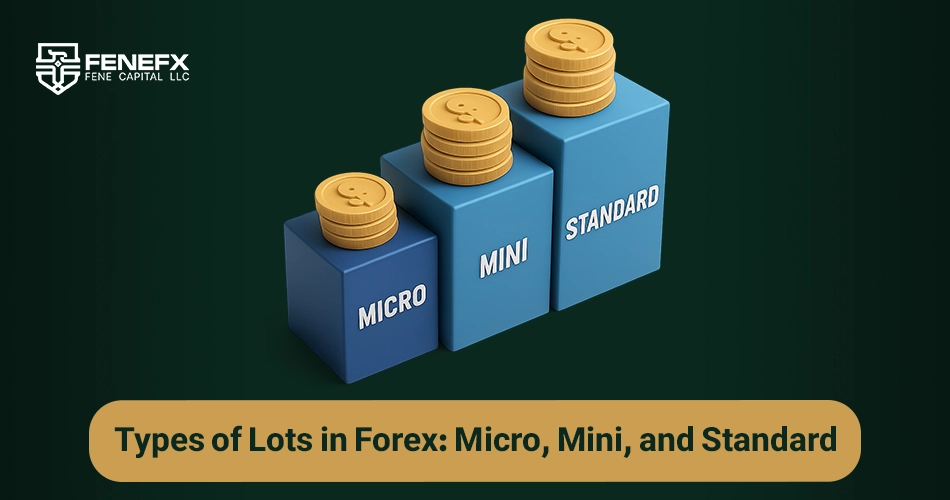
Standard Lot:
This is the largest lot size in Forex and equals100,000 units of the base currency. This means that if you trade a standard lot, every 1 pip movement in price results in a$10profit or loss. Standard lots are mostly used by professional traders and those with larger capital.
Mini Lot:
A mini lot isone tenth of a standard lot, equal to10,000 unitsof the base currency. In this case, every 1 pip change is worth$1. This type of lot is more suitable for intermediate traders or beginners with moderate capital.
Micro Lot:
A micro lot is the smallest commonly offered lot size and equals1,000 unitsof the base currency. Here, every 1 pip movement corresponds to$0.10. This type of lot is very popular among beginners or traders who enter the market with smaller capital.
Nano Lot:
Some brokers also offer nano lots, which equal100 unitsof the base currency. This type of lot is ideal for those who want to trade with minimal capital and minimal risk.
These different lot sizes give traders the flexibility to manage risk more accurately and choose a trade size appropriate for their account balance and experience.
Why Is This Classification Important?
Every trader enters the market with a different level of experience and capital. This classification helps traders adjust their position sizes according to their risk tolerance and account balance.
For example, if you are a beginner and do not want to take on excessive risk, using a micro lot or mini lot is a much better choice.
How Does Lot Size Affect Your Profit and Loss?
The lot size directly determines the amount of profit or loss you experience in each trade. The larger your trade size, the more significant the impact of even small price movements on your account will be.
Example:
Suppose you are trading the EUR/USD pair:
- If you trade one standard lot, each 1 pip change equals $10.
- If you trade one mini lot, each 1 pip change equals $1.
- If you trade one micro lot, each 1 pip change equals $0.10.
This shows that choosing a larger lot size dramatically increases both your potential profit and potential loss. Therefore, selecting the right lot size depends on your risk tolerance and account capital.
How to Calculate Lot Size and Pip Value
Calculating the value of each pip is one of the most important skills every trader must know. This calculation helps you understand how price changes will affect your account balance.
Formula for Calculating Pip Value:
Pip Value = (Lot Size × 1 Pip) ÷ Exchange Rate
Example 1:
Suppose you are trading one standard lot (100,000 units) on the EUR/USD pair, and the exchange rate is 1.2000.
The pip value is calculated as follows:
Pip Value = (100,000 × 0.0001) ÷ 1.2000 = 8.33 USD
Therefore, each 1 pip movement in price equals $8.33.
Example 2:
If you trade one mini lot (10,000 units) on the same currency pair:
Pip Value = (10,000 × 0.0001) ÷ 1.2000 = 0.83 USD
In this case, each 1 pip movement equals $0.83.
Why Are These Calculations Important?
These calculations help you understand how much profit or loss you are exposed to in each trade, allowing you to choose the appropriate lot size based on your risk tolerance and account balance.
The Role of Lot Size in Risk Management and Trading Strategies
Risk management is one of the most important principles in Forex trading, and the lot size has a direct impact on how effectively you manage that risk. The larger your trade size (lot size), the greater your potential profit or loss will be.
For example, if you trade one standard lot, each 1 pip movement equals $10. But if you trade one micro lot, this amount drops to $0.10.
This allows you to choose a trading strategy that matches your risk tolerance and account size. Professional traders usually risk only a small percentage of their capital on each trade (for example, 1–2%), and by selecting the appropriate lot size, they adhere to this essential rule.
How to Choose the Right Lot Size for Your Trades?
Selecting the appropriate lot size depends on several key factors:
- Initial Capital:
If your capital is small, it is better to use mini or micro lots so you can manage risk more effectively.
- Risk Tolerance:
Traders with lower risk tolerance should choose smaller lot sizes.
- Trading Strategy:
Some strategies require larger trade sizes, while others are designed around smaller positions.
High leverage allows you to trade larger lots, but caution is essential because potential losses increase proportionally.
To choose the right lot size, you must first determine your acceptable risk level and then calculate which lot size aligns with that level of risk.
The Relationship Between Pips and Lots: How Important Is a Pip in Your Trades?
A pip is the smallest unit of price movement in Forex, and its value depends on the lot size. For example:
- In a standard lot (100,000 units), each pip is worth $10.
- In a mini lot (10,000 units), each pip is worth $1.
- In a micro lot (1,000 units), each pip is worth $0.10.
This relationship shows that the lot size determines how much price movements affect your profit or loss. Therefore, understanding this connection is essential for risk management and trade planning.
The Relationship Between Lots and Spread: The Hidden Cost of Trading
The spread is the difference between the Ask (buy) price and the Bid (sell) price, and it is considered the cost of executing a trade. The lot size has a direct impact on the total spread cost.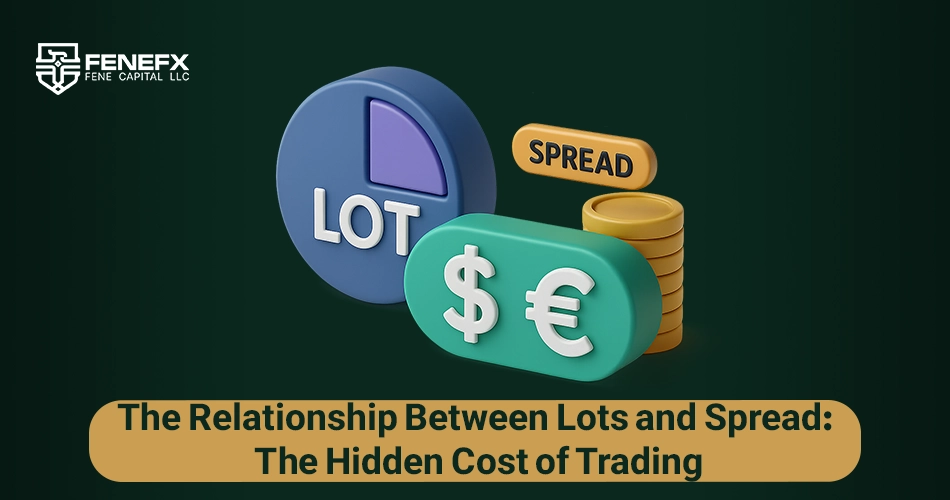
For example:
- If the spread on a currency pair is 2 pips and you trade one standard lot, your spread cost will be $20.
- But if you trade one mini lot, the spread cost drops to $2.
This highlights the importance of choosing the right lot size, because if the spread costs are high and you trade with large lots, these costs can significantly reduce your net profit.
How Can You Use Lot Size to Improve Your Trading Performance?
A proper understanding of lot size helps you enhance the quality and consistency of your trading. Some effective ways to use lot sizing to your advantage include:
- Adjusting position size based on risk tolerance:
- Always ensure that your chosen lot size matches your capital and your ability to handle risk.
- Scaling into positions:
- Instead of using one large lot, you can divide your trade into several smaller lots to gain more flexibility in managing your positions.
- Controlling the impact of spreads:
- By choosing an appropriate lot size, you can reduce the negative effect that spreads may have on your overall profitability.
On the journey to becoming a professional trader, learning theoretical concepts alone is not enough you must also gain real trading experience with real capital, and ideally without risking your own money. This is exactly where the Prop service of Fenefx steps in as the most reliable and professional prop trading platform for Persian speakers.
Fenefx, with its transparent challenges, logical rules, and fast profit withdrawals, provides an environment where traders can turn their skills into real profit and trade on high capital accounts. If you feel it’s time to take the next step with your current knowledge and experience, entering the world of prop trading and starting the Fenefx challenge can be your best next move. Begin your professional growth journey today by purchasing a prop account.
Final Conclusion
A lot is the simplest term that has the greatest impact on Forex trading. On the surface, it is just a measurement unit, but in practice it controls your profit, loss, risk, and even your psychological pressure in a trade.
Any trader who deeply understands the concept of the lot can wisely choose their trade size, stay away from emotional decisions, and enter the market with a logical and controlled plan instead of reckless risk taking.
Ultimately, success in Forex depends not only on strategy and analysis, but also on proper capital management and choosing the right position size and all of this begins with understanding lots correctly.
Frequently Asked Questions (FAQ)
1. Can you trade Forex without understanding what a lot is?
Yes, it is possible, but the chances of large losses and poor risk management will be very high.
2. Is the concept of the lot used only for currency pairs?
No. Lots are also used for other Forex instruments such as gold, oil, indices, and cryptocurrencies.
3. Do brokers always define the exact same lot size?
No. In some symbols or CFD contracts, the base lot size may differ depending on the broker.
4. Is it possible to trade with a lot size smaller than 0.01?
Yes, in some brokers it is possible, but it depends on the account type and the trading instrument.
Comments
Fat-fingered a full lot instead of 0.10 in my second week of trading. Closed it in panic within a minute. Now I triple-check the volume box every single time.
Standard, mini, micro — I kept mixing these up for weeks. The dollar-per-pip examples finally made it stick. Much appreciated.
How does lot sizing work on cent accounts? Might be worth a short follow-up for those of us starting really small.
Good basics. Worth stressing that pip value shifts on cross pairs and metals — a lot of newbies assume $10/pip everywhere and size positions completely wrong on gold.
The lot size comparison table alone is worth bookmarking.