

The Dow Jones symbol in Forex and how to trade it
"The Dow Jones Index (Dow Jones Industrial Average - DJIA) is one of the oldest and most well known stock market indices in the United States, and in Forex it is usually displayed with symbols such as DJI, US30, or WALLST30. Traders can trade the Dow Jones through CFDs, Futures contracts, or ETFs; each has its own advantages and limitations. In this guide, you will learn step by step how to find the Dow Jones symbol on MetaTrader and TradingView platforms, execute a sample trade with position size and stop loss calculation, and implement scalping, day trading, and swing trading strategies with practical examples."
What is the Dow Jones (DJIA)? Difference Between the Dow, the S&P 500, and the Nasdaq
The Dow Jones Index (Dow Jones Industrial Average) is one of the oldest and most well known indices in the U.S. stock market, which reflects the performance of 30 large and influential American companies. This index was first created in 1896, and today it is recognized as one of the most important indicators of the health of the U.S. economy. An important point about the Dow Jones is that it is a price weighted index, meaning that the weight of each stock is determined based on its price, not its market capitalization. For this reason, stocks with higher prices have a greater impact on the index’s movements.
However, many traders compare the Dow Jones with the two other major indices, the S&P 500 and the Nasdaq , because all three are considered among the most important financial indices in the world. The S&P 500 Index includes 500 large American companies and, due to its broader coverage, provides a more accurate representation of the overall market. This index is market cap weighted, meaning larger companies have a greater weight in the index, and for this reason many analysts consider it the primary benchmark for the condition of the U.S. stock market.
On the other hand, the Nasdaq Index focuses more on technology companies. Although various types of symbols are included in it, technology giants such as Apple, Microsoft, Nvidia, and Amazon have the greatest influence. Therefore, Nasdaq’s volatility is usually higher than that of the Dow Jones and the S&P, and its behavior is closely related to the conditions of the technology sector and interest rate policies.
Overall, the Dow Jones provides a view of the performance of 30 stable and large companies, the S&P 500 represents the entire market, and the Nasdaq offers an accurate picture of the U.S. technology sector. Traders who understand the differences among these three indices can have a more precise analysis of market behavior and trading opportunities.
How to Trade the Dow Jones (DJIA) with CFDs, Futures, and ETFs
Trading the Dow Jones Index is possible through various methods, and each trader can choose the best instrument depending on their style, capital, and level of risk tolerance. The three common ways to trade this index include CFDs, Futures contracts, and ETFs, each of which has different advantages and structures. CFDs are considered one of the most popular methods among retail traders because they allow leveraged trading and do not require actual ownership of the asset. Dow Jones Futures contracts are more suitable for professional traders since they are standardized, transparent, and based on official exchanges, offering opportunities for hedging or long term trading. On the other hand, Dow Jones based ETFs are considered a simpler and lower risk option for indirect investment in this index. Understanding the differences among these instruments helps traders choose the best strategy for entering the Dow Jones market.
CFD (Contract for Difference)
This method is the most common way to trade the Dow Jones in Forex. In this approach, traders can speculate on the price movement of the Dow Jones whether it goes up or down without needing to directly purchase the underlying stocks. Using leverage in CFD trading allows traders to open larger positions with a smaller amount of capital.
Futures
Dow Jones futures trading allows investors to enter into a contract to buy or sell the index at a specific date in the future. This method is mostly used by professional traders and institutional investors and has high liquidity.
ETF (Exchange Traded Funds)
Some investment funds , such as the SPDR Dow Jones Industrial Average ETF (DIA), provide the possibility of indirect investment in the Dow Jones. This method is more suitable for long term investors who intend to invest in the entire index.
What Factors Affect the Dow Jones Index? Key Drivers Behind Dow Movement
The Dow Jones Index is heavily influenced by economic data, financial news, and macroeconomic policies. Traders must closely monitor these factors in order to make better trading decisions.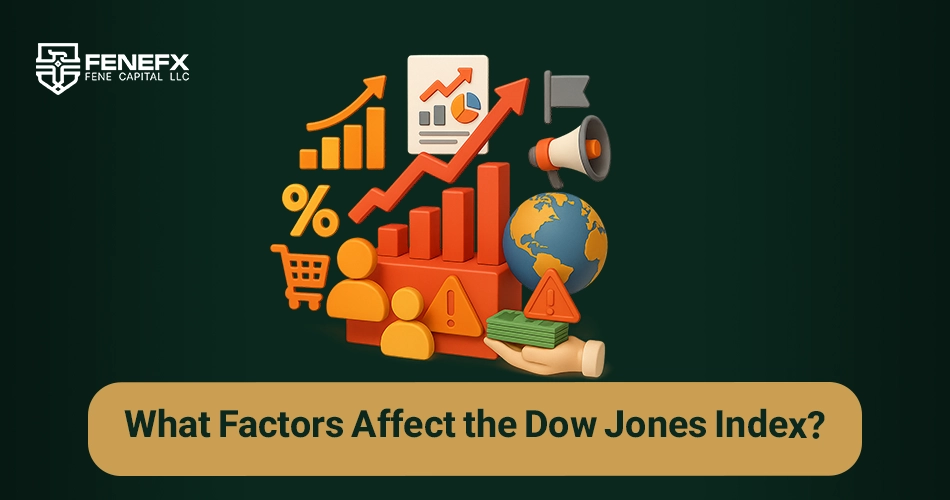
1. Impact of economic news, employment data, and Federal Reserve interest rates
One of the most important factors that cause fluctuations in the Dow Jones is the decisions of the U.S. Federal Reserve regarding interest rates. An increase in interest rates reduces the attractiveness of stocks and puts pressure on the Dow Jones, while a decrease in interest rates leads to stock market growth.
Employment data (NFP) and inflation (CPI) also have a significant impact on the Dow Jones. If employment levels rise and inflation is under control, the index grows. But if the unemployment rate increases, the stock market and the Dow Jones will decline.
2. Impact of financial reports of companies included in the Dow Jones Index
Since the Dow Jones consists of 30 major industrial companies, the financial reports of these companies have a strong effect on the index. If companies like Apple, Microsoft, or Boeing show strong financial performance, the Dow Jones strengthens. However, in the case of weak earnings reports, the index may drop.
3. The role of macroeconomic trends and global financial crises in Dow Jones volatility
Economic crises, wars, trade policies, and other global factors can have a significant impact on the Dow Jones. For example, the 2008 financial crisis caused a sharp decline in this index, while the U.S. government stimulus packages during the COVID period led to a substantial rise in the Dow Jones.
How to view and analyze the Dow Jones in Forex Trading
For Forex traders, accessing Dow Jones data and analyzing it is possible through trading platforms.
Popular platforms for trading the Dow Jones
Traders can view and trade the Dow Jones on the following platforms:
- MetaTrader 4 (MT4) and MetaTrader 5 (MT5): suitable for Forex traders who are interested in CFD trading.
- TradingView: equipped with advanced tools for technical analysis and reviewing price patterns.
- ThinkorSwim and NinjaTrader: options for professional traders and those who trade futures.
2. How to use technical charts and key indicators
To analyze the Dow Jones, traders use indicators such as Moving Averages (MA), Bollinger Bands, MACD, and RSI. These tools help identify trends, entry and exit points, and determine support and resistance levels.
Best trading strategies for the Dow Jones in Forex
To trade the Dow Jones, three main strategies are commonly used: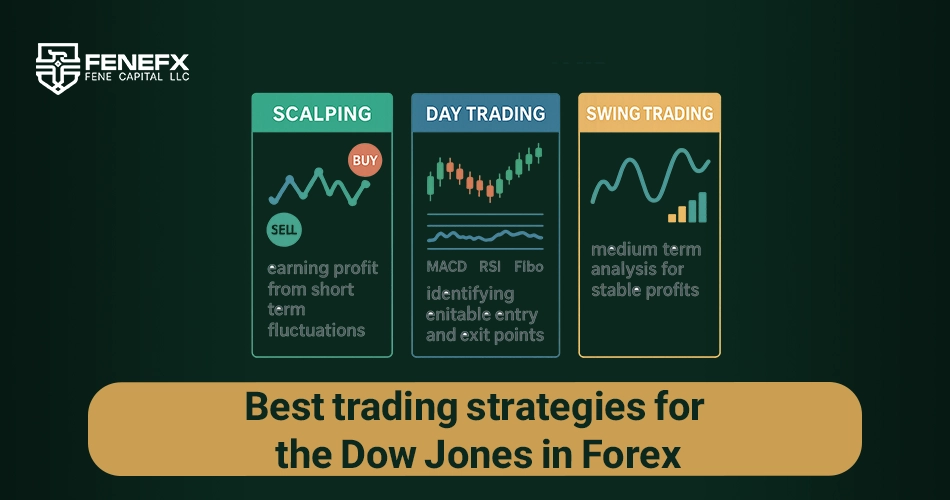
1. Scalping: earning profit from short term fluctuations
In scalping , traders seek small profits within short timeframes (from a few minutes to a few hours). Quick entry and exit points, the use of short timeframes such as 1 or 5 minutes, and a focus on high liquidity are characteristics of this style.
2. Day Trading: identifying suitable entry and exit points
In day trading, traders open and close their positions within the same day and try to profit from the daily fluctuations of the Dow Jones. Technical analysis and the use of indicators such as MACD, RSI, and Fibonacci are very important in this strategy.
3. Swing Trading: medium term analysis for stable profits
In this method, traders keep their positions open for several days to several weeks and take advantage of medium term market trends. Price patterns, trading volume, and fundamental analysis play a key role in this style.
How to Manage Risk management in Dow Jones Forex Trading
Trading the Dow Jones in Forex, due to its high volatility and its rapid reaction to U.S. economic news, requires a precise risk management plan. The first principle is setting a fixed and non negotiable stop loss, because stock indices can fluctuate hundreds of points within just a few minutes, and even the slightest emotional decision can destroy an account. It is better to set the stop loss based on market structure (such as previous highs and lows or liquidity zones), not based on emotions like ‘how much loss I can tolerate.
Controlling position size
Another important point is controlling position size. Dow Jones traders especially in CFDs often enter large lots quickly due to high leverage. The simple rule is that in index trading you should not risk more than 1 to 2 percent of your capital per trade. Even professional traders use lighter position sizes when trading the Dow Jones to stay protected from sudden volatility.
Sensitive trading hours
It is also essential for the trader to recognize sensitive trading hours. The Dow Jones becomes highly volatile during the U.S. market open, the release of data such as NFP and CPI, and Federal Reserve speeches. If your strategy is not based on breakouts and fast movements, it is better to avoid trading during these times or reduce your position size.
In the end, having an exit plan is just as important as having an entry plan. Many traders focus only on the entry point, whereas for an index like the Dow Jones, you must know before entering under what conditions you will exit the trade both in profit and in loss. Using partial take profit levels, break even stop loss adjustments, and recording results in a trading journal are among the most essential actions for controlling risk in this market.
Emotional control in Dow Jones trading
One of the most common reasons traders lose money in financial markets is emotional decision making. Many traders, after a few losing trades, experience stress and anxiety and emotionally enter new trades that are usually outside their trading strategy.
To control emotions in Dow Jones trading, traders must adhere to their trading plan and have logical and technical reasons for every trade before entering it. Additionally, using a trading journal and reviewing past trades can help improve decision making and reduce mistakes.
By following these simple yet vital principles, a trader can better manage the fast and sometimes unpredictable behavior of the Dow Jones and increase their chances of long term success.
Best Time to Trade the Dow Jones : Optimal Hours and Trading Days
Knowing the best trading times for entering and exiting the Dow Jones market can help traders identify the most profitable opportunities. The Dow Jones behaves differently at various times of the day and on specific days of the week, and traders must recognize these patterns in order to make the most out of market movements.
Best trading hours for the Dow Jones
The most active trading hours for the Dow Jones are when liquidity and trading volume are at their highest. These times usually include the opening of the New York market and its overlap with other financial markets.
- 15:30 to 18:30 (New York market open): These hours typically have the highest trading volume and volatility. Day traders and scalpers are more active during this period because there are many opportunities for quick entries and exits.
- 20:00 to 23:00: During this period, volatility decreases but the established market trends continue. This time is ideal for medium term and swing traders.
- 02:00 to 04:00: Due to the overlap of the Asian and European markets, these hours may offer limited opportunities; however, overall, volatility is lower during this time.
2. Best trading days for the Dow Jones
Identifying the best trading days for the Dow Jones is one of the key factors in improving the accuracy and efficiency of strategies, especially for those who operate in prop trading environments and must trade with minimal risk and maximum discipline. Depending on economic conditions and market liquidity flow, the Dow Jones shows more orderly and predictable volatility on certain days; therefore, traders seeking consistent performance often
time their trades based on these weekly patterns. Examining market behavior across different days of the week helps determine when the likelihood of valid opportunities is higher and on which days it is better to take smaller positions or even avoid trading altogether. This awareness, particularly for prop traders facing strict risk limits, is considered a significant competitive advantage.
- Monday: usually the least volatile day of the week, as traders are evaluating new trends.
- Tuesday to Thursday: these days have the highest trading volume and offer the most profitable opportunities.
- Friday: significant volatility occurs on this day because traders close their positions before the market closes. This day can be both an opportunity and a high risk period.
3. Impact of economic events on Dow Jones trading times
The Dow Jones is heavily influenced by economic news and macroeconomic data. Some of the most important reports that can create strong volatility in this index include:
- Federal Reserve interest rate decisions: an increase in interest rates usually causes the Dow Jones to decline, as borrowing costs for major companies rise.
- Employment Report (NFP): employment and unemployment data have a direct impact on the performance of the U.S. economy and can cause significant fluctuations in the Dow Jones.
- Earnings reports of Dow Jones companies: if large companies such as Apple, Microsoft, and Boeing release positive financial reports, the Dow Jones will rise, but weak reports can push the index downward.
- Inflation and Consumer Price Index (CPI): rising inflation may worry investors and lead to a decrease in the value of the Dow Jones.
For this reason, traders should always review the economic calendar and avoid entering the market or changing their strategy during major news releases to stay protected from unexpected volatility.
If you intend to make the most of the best trading hours and days of the Dow Jones, operating in professional prop trading environments can be a great advantage. In prop accounts, maintaining trading discipline and controlling risk are even more important, and knowing the right times for entry and exit can multiply your chances of success. In this regard, Fenefx Prop, by offering flexible conditions, simple rules, and access to high capital accounts, is an excellent option for traders who want to apply their analytical skills in the Dow Jones market in a real manner. If you want to take the first step toward becoming a professional on this path, get your desired account right now through the purchase of the Fenefx Prop account.
Final Conclusion
Trading the Dow Jones Index is one of the most attractive opportunities for traders seeking consistent volatility and numerous opportunities in financial markets. However, success in this market depends on a precise understanding of the index structure, the best trading hours and days, the impact of economic news, and proper risk management. Choosing the right trading instrument such as CFDs, Futures, or ETFs also plays an important role in the quality of your performance. Any trader who combines technical knowledge, fundamental analysis, and emotional control can use the Dow Jones as a targeted market to develop their skills and increase their profitability.
Frequently Asked Questions
Is the Dow Jones suitable for beginner traders?
Yes, but only if the trader is familiar with risk management principles and the rapid volatility of stock indices.
What is the best time to trade the Dow Jones?
The 15:30 to 18:30 window is considered the best time due to the highest trading volume and the formation of strong price movements.
Do economic news releases have a significant impact on the Dow Jones?
Yes, data such as NFP, CPI, and Federal Reserve decisions can create sharp and rapid volatility.
Is trading the Dow Jones better through CFDs or Futures?
For retail traders, CFDs offer more flexibility, while for professionals, Futures provide higher transparency and standardization.
Comments
How does US30 compare to NAS100 in terms of volatility and spread costs? A comparison article between the major indices would be great.
Nice breakdown, especially the trading hours section.
Solid intro. I'd add that the first 30 minutes after the NY open are pure chaos on US30 — spreads widen and stops get hunted. I personally wait for the initial range to form before touching it.
Didn't even realize you could trade an index like a currency pair. The CFD explanation cleared up a lot — I always assumed I'd need to buy actual shares.
Held a US30 position through a CPI release once. Two hundred points against me in seconds. The economic calendar has been sacred to me ever since.