
What is Prop Trading?
Financial markets have always provided individuals with opportunities for income and investment. Among them, Prop Trading (Proprietary Trading) is an innovative method that has recently attracted the attention of many financial trading enthusiasts. To define prop trading, it refers to a model in which traders use the capital of specialized firms instead of their own personal funds to engage in trades across markets such as stocks, Forex, futures, or cryptocurrencies.
Prop trading meaning
Theprop trading definitioncenters on the idea that trading firms deploy internal capital and allow selected traders to manage it professionally. If we break it down further, theprop full form in businessis “Proprietary Trading,” where “proprietary” signifies ownership meaning the firm trades with its own money rather than managing external client assets.
To provide a clearer perspective,prop trading explainedmeans a performance based trading arrangement where traders receive a share of profits instead of a fixed salary. This structure aligns incentives between the trader and the firm while maintaining strict internal risk management controls.
Compensation is typically performance driven. Rather than earning a guaranteed salary, traders receive a percentage of the profits they generate, reinforcing accountability and disciplined execution.
Regulation of prop trading
In the aftermath of the 2008 financial crisis, regulators in several regions moved to curb proprietary trading within traditional banking institutions.
In the United States, the Volcker Rule was introduced to restrict banks that hold customer deposits from engaging in certain speculative trading activities, aiming to reduce systemic risk and protect depositor funds. Independent proprietary trading firms, however, do not take deposits and are therefore generally subject to different regulatory requirements.
Business models of prop trading
Proprietary trading operates through different structures, most commonly within independent trading firms or regulated banks, with key differences shaped by regulatory oversight, market access, and internal risk controls. In the retail segment, independent firms typically evaluate traders through simulated or funded accounts before allocating capital, granting successful candidates access to firm funds under a profit sharing arrangement.
What is Volcker Rule on Proprietary Trading
The Volcker Rule is a U.S. regulation introduced after the 2008 financial crisis to limit proprietary trading by banks. It prohibits deposit taking institutions from using customer funds to engage in speculative trading for their own profit. The rule aims to reduce systemic risk and prevent banks from taking excessive risks with insured deposits. However, it does not apply in the same way to independent proprietary trading firms that do not hold customer deposits.
Review of Hedge Fund vs. Prop Trading
Feature | Hedge Funds | Proprietary Trading Firms |
Source of Capital | Invest capital provided by external clients and investors. | Trade using the firm’s own capital. |
Primary Objective | Generate returns for clients and earn management/performance fees. | Increase the firm’s own profits and strengthen its balance sheet. |
Accountability | Accountable to investors and subject to fiduciary responsibilities. | Accountable only to the firm’s management or owners. |
Risk Exposure | Risk is taken with client funds, requiring stricter oversight. | Risk is taken with internal capital, allowing greater strategic flexibility. |
Regulatory Oversight | Typically subject to investment management regulations and certain trading restrictions. | Not client facing; regulatory exposure depends on structure and jurisdiction. |
Who Benefits from Profits | Clients receive investment returns; the fund earns fees. | The firm retains profits, often sharing a portion with traders. |
How Does Proprietary Trading Work?
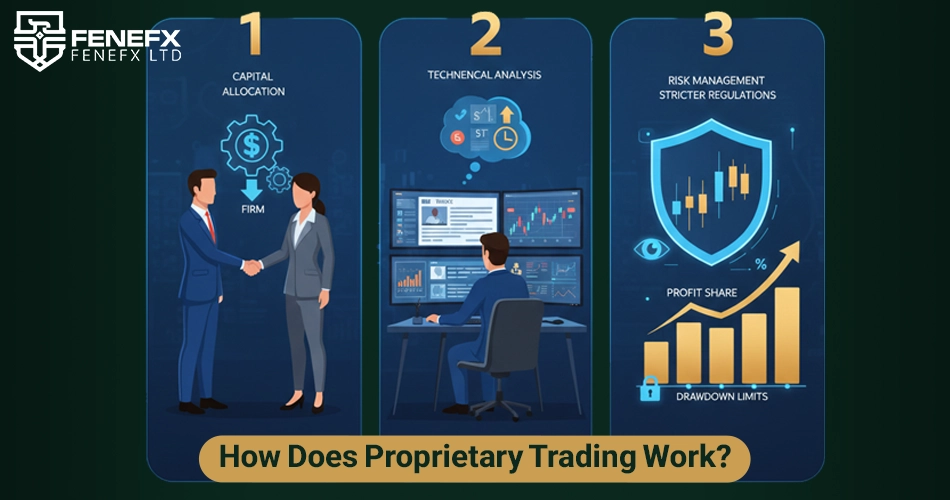
When a trader joins a proprietary trading firm, they are granted a defined capital allocation to operate in the financial markets, with their profit share determined by experience and track record. Prop traders apply diverse trading strategies, including short term trading, swing trading, and position trading, using fundamental analysis, technical analysis, or a combination of both to identify opportunities and manage positions. While risk management remains essential, trading under a prop firm structure involves stricter regulations and heightened scrutiny to control capital exposure and limit potential losses in adverse market conditions.
Advantages and Disadvantages of Proprietary Trading
Advantages of Proprietary Trading | Disadvantages of Proprietary Trading |
Access to significant capital allocation without risking personal funds. | Strict risk management rules and tight drawdown limits reduce flexibility. |
Attractive profit sharing structure with scalable earning potential based on performance. | High performance pressure due to continuous evaluation and scrutiny. |
Ability to apply diverse trading strategies (short term trading, swing trading, position trading). | Limited autonomy compared to independent trading due to firm regulations. |
Structured environment with defined risk parameters and performance metrics. | Profit split means traders do not retain 100% of generated returns. |
Opportunity to build a verified track record within an institutional framework. | Capital allocation may be reduced or revoked after poor performance. |
Access to professional tools, data feeds, and trading infrastructure. | Strict compliance requirements and internal oversight can constrain strategy execution. |
Reduced personal financial liability compared to trading own capital. | Income instability, as compensation depends entirely on trading performance. |
Potential for scaling capital allocation after consistent profitability. | Psychological pressure from managing firm capital rather than personal funds. |
How to get started with prop trading
- Research and Choose a Reputable Prop Firm:Select a well established firm with transparent rules, strong credibility, and positive industry reputation.
- Understand the Evaluation Process:Review the firm’s evaluation challenge, including profit target requirements, loss limits, drawdown restrictions, and risk management rules.
- Pay the Evaluation Fee:Submit the required upfront evaluation fee, which varies based on account size and typically ranges from $100 to over $1,000.
- Trade the Evaluation Account:Demonstrate consistent performance by meeting the profit target while strictly respecting drawdown limits and risk management guidelines.
- Get Funded:Upon successfully passing the evaluation, gain access to a funded account (e.g., $25,000 or $50,000) and trade the firm’s capital under defined rules.
- Manage Risk and Grow:Maintain disciplined risk management, apply proper position sizing, and aim for steady profitability to qualify for capital scaling plans.
What is a prop firm?
A Prop Firm (short for Proprietary Trading Firm) is a type of trading company that operates in financial markets using its own capital. These companies seek talented and skilled traders to utilize their knowledge and expertise for profit by providing significant trading capital.
For example, imagine you are an experienced trader looking for an opportunity to trade with high capital and without the need for an initial investment. In this situation, you can approach Prop Firms and collaborate with them.
How do prop firms work?
To clarify how prop firms operate, consider a hedge fund analogy.
Hedge funds manage capital on behalf of clients who allocate funds to the firm. Fund managers are accountable to these investors, who typically receive around 60–80% of the profits generated from trading and investment activities.
In contrast, prop firms do not accept external investors. Instead, they deploy their own capital to trade in the financial markets. This structure provides greater operational flexibility and enables the firm to retain a larger share of the profits generated.
Types of Prop Trading Firms
Prop trading firms differ based on their structure and business model. The main types include:
1) Online Funded Account Providers
The most widespread model today, allowing traders worldwide to participate. Traders pay an evaluation fee, pass a challenge, and receive a funded account if successful, making prop trading broadly accessible.
2) Hybrid Firms
These firms combine traditional prop trading with online funding models, operating in house teams while also offering remote funded accounts to global traders.
3) Traditional In House Prop Firms:
Established firms typically based in major financial centers such as New York, London, or Chicago. Traders work on site, trade instruments like futures, options, or stocks, and are often compensated through salary plus performance based bonuses.
4) Remote Prop Desks:
Fully online trading teams that emphasize collaboration, mentorship, and shared strategies. Traders operate remotely while benefiting from community tools, educational resources, and structured growth opportunities.
Common Beginner Mistakes When Joining Prop Firms
- Underestimating risk management rules, especially maximum drawdown and daily loss limits.
- Focusing only on hitting the profit target while ignoring consistency requirements.
- Overleveraging positions in an attempt to pass the evaluation quickly.
- Ignoring the firm’s trading restrictions on news trading, lot size, or holding over weekends.
- Choosing a prop firm based solely on low evaluation fees rather than credibility and payout reliability.
- Treating the funded account like a demo account instead of respecting real capital exposure.
Common Prop Firm Marketing Tactics and Promotional Hooks
- Promoting large funded account sizes (e.g., $100,000 or more) to attract attention.
- Highlighting high profit splits such as 80%-90% to appeal to ambitious traders.
- Advertising “no experience required” to lower psychological entry barriers.
- Using limited time discounts on evaluation fees to create urgency.
- Showcasing payout proofs and trader success stories to build social proof.
- Emphasizing fast track funding models to appeal to traders seeking quick results.
Why Prop Firms Are Psychologically Appealing to New Traders
- The opportunity to trade significant capital allocation without risking personal savings.
- The structured evaluation process provides a clear, goal oriented pathway.
- The promise of high profit sharing creates strong income potential appeal.
- The professional identity of being a “funded trader” enhances confidence and status.
- Reduced personal financial liability lowers the emotional barrier to entry.
- The perception of institutional backing increases trust and motivation.
Summary
Overall, prop trading is a professional trading model that allows traders to operate with a firm’s capital without risking their own personal funds, while sharing in the profits generated. Alongside the opportunity for capital growth, this structure requires strong discipline, precise risk management, and a thorough understanding of evaluation rules.
If you are serious about entering the financial markets and building a professional trading career, choosing a reputable and transparent prop firm is critically important. In this regard, Fenefx Prop Trading can be a noteworthy option to consider. I recommend taking the time to learn more about its conditions, rules, and advantages to determine whether it aligns with your goals.
1) What is Prop Trading?
Prop Trading (Proprietary Trading) is a model where traders use a firm’s own capital to trade financial markets instead of risking personal funds. In return, traders receive a share of the profits they generate.
2) How is a prop firm different from a hedge fund?
A prop firm trades with its own internal capital, while hedge funds manage money from external investors. In prop trading, profits are shared between the firm and traders, not outside clients.
3) How do you get funded by a prop firm?
Most prop firms require traders to pass an evaluation challenge by reaching a profit target while respecting strict drawdown and risk management rules. After passing, traders receive a funded account to trade the firm’s capital.
4) What are the main advantages and risks of prop trading?
The key advantage is access to significant capital without personal financial risk. However, traders face strict risk limits, performance pressure, and income instability tied entirely to results.
5) Who is prop trading suitable for?
Prop trading is suitable for disciplined traders with proven strategies and strong risk management skills. It’s ideal for those seeking to scale capital without investing their own money while operating under structured rules.
Comments
Best plain-English explanation of prop trading I've read.
Worth mentioning that not all prop firms are equal — some have consistency rules and news-trading bans that quietly kill your edge. Always read the fine print first.
How do payouts actually work tax-wise? Would be great to see an article about handling prop income in different countries.
Failed my first challenge on day 3 by overleveraging. Passed on the second try once I treated it like risk management practice instead of a race.
So THAT'S how funded accounts work. I always thought prop firms were just brokers with extra steps. Thanks for spelling it out.