
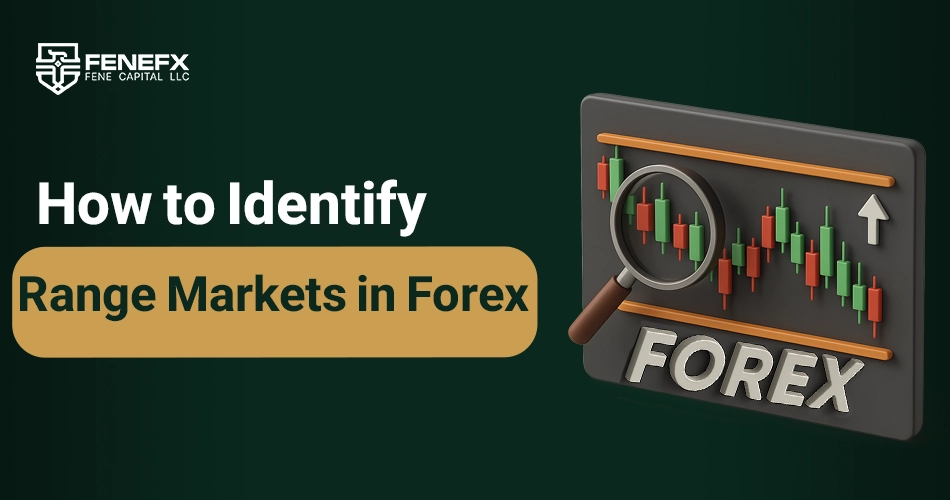
How to Identify Range Markets in Forex
A proper understanding of market structure is one of the most fundamental skills every professional trader must master. The market constantly shifts between two primary phases: trend and range. Failing to distinguish between these phases can lead to poor decision-making and potential trading losses. In a range phase, price fluctuates within a defined zone where a temporary balance between supply and demand exists; whereas in a trending phase, one side of the market clearly dominates the other. This article provides an analytical approach to identifying range-bound markets using price structure and practical tools while helping traders avoid common mistakes in the process.
Structural Difference Between Range Markets and Trending Markets
Some analytical mistakes occur when traders don't properly understand the difference between range and trending markets. Despite the seemingly simple appearance, these two phases differ completely in terms of movement structure, dominant market sentiment, and decision making approach.
In a trending market, price typically creates new highs and lows that are higher or lower than previous ones. This state is characterized by a specific movement angle and usually accompanied by strong, consistent candles. Momentum is high in this phase, and key area breakouts typically occur with volume and strength.
In contrast, a range market tends to keep price within a specific area. In these conditions, breakouts are often unsuccessful, and price quickly returns inside the range. Candles become more shadowy, movements are more irregular, and a sense of indecision is visible in the price structure.
Also, the behavior of market participants differs significantly in these two phases. In a trending market, either buyers or sellers dominate and drive price movements forward. But in a range market, supply and demand are in temporary balance, which means there's no strong pressure for movement in a particular direction.
In terms of volume, trading volume typically decreases in a range phase, and with a sudden increase in volume, the probability of starting a new phase or breaking the range increases. Therefore, accurate understanding of these differences helps traders avoid wrong decisions and choose strategies appropriate to the market phase.
Tools That Help You Identify Range Markets
Identifying a range with a trained eye and price action alone is possible, but using complementary tools can increase analysis accuracy, especially for traders who are still in the early stages of mastering the market.
ATR (Average True Range) Indicator
One useful tool is the ATR (Average True Range) indicator that measures price volatility. When the ATR value is decreasing, it indicates a reduction in volatility, which can be one sign of the market entering a range phase. However, this indicator should not be the sole basis for decision making but analyzed alongside price structure.
Bollinger Bands
Bollinger Bands are also a suitable tool. When the distance between the upper and lower bands noticeably decreases, the probability of a range phase increases. In this state, price typically oscillates between the two bands, and incomplete or deceptive breakouts occur in the bands.
Flat Moving Average
A flat moving average is another indicator. When a 20 or 50 period MA on the chart becomes completely horizontal and price constantly crosses it, it shows that the market is in a directionless or range state.
In addition, using oscillators such as RSI or Stochastic in identifying overbought and oversold conditions in range markets is very effective. In a range phase, these oscillators move more in the middle or between overbought areas without leading to strong movements.
The key point in using these tools is to avoid complete reliance on them. The goal is to obtain confirmation for structural analysis, not to replace analysis. Traders should be able to interpret the signals of these tools in the context of price movement for more accurate identification and more confident decision making.
The Role of Timeframe in Accurate Range Market Identification
Timeframes are one of the key factors in correct or incorrect identification of range markets. The time period in which you look at the chart can make a fundamental difference in understanding market structure. The market may be in a range on a one hour timeframe but in a downtrend on a four hour timeframe.
Higher Timeframe Range Within Lower Timeframe Movements
One common mistake among traders is a single timeframe view of market structure. Although selecting a main timeframe based on trading style is necessary, range structure analysis should be done across multiple timeframes. For example, if you trade on a 15 minute timeframe, a large range on a 4 hour timeframe might appear as an apparent trend in the lower timeframe. This leads to decision making errors.
For accurate range identification, you should first examine the higher timeframe to see if the market is in a directionless structure. Then check the lower timeframe to see if price behavior aligns with that structure soYou need to perform what is called a multi–timeframe analysis.
Hidden Range or Micro Ranges
Another type of range market consists of structures that might initially appear trending but are actually oscillating between two specific limits in the lower timeframe. These ranges typically form after a sharp movement and are known as "micro ranges" or "hidden ranges."
In these types of ranges, attention should be paid to how price reacts to local highs and lows. Usually, a number of small bodied candles, symmetrical shadows, and slow movements indicate that the market is still in an indecisive state, even if the outer structure appears trending.
Common Mistakes in Identifying Range Markets
Misidentifying a range market can lead to serious losses, especially if the trader enters a trade instead of waiting for structure confirmation. In this section, we address some of the most common errors that occur in this process.
Assuming a Range Based on Just Two Points
One of the most common mistakes is identifying a market as a range based solely on seeing two price reactions to highs and lows. However, to properly consider an area as a range, we should have at least three or four valid reactions on each side of the price area to ensure the structure is established.
Ignoring False Breakouts
In range markets, false breakouts or fake breaks are natural. Traders who interpret these breakouts as the beginning of a new trend usually fall into the trap of early entry. If price breaks without high volume, a strong candle, or confirmation from a higher timeframe, there's a high probability that price will return to the range.
Disregarding Momentum and Volume
One of the important diagnostic tools in the range phase is attention to momentum and trading volume. In many cases, decreased volume and candle size coinciding with price oscillation between two levels indicate the market's entry into a directionless state. Ignoring these signs, especially in lower timeframes, leads to wrong decisions.
How Not to Enter; Position Management in Range Phase
Contrary to the mindset often held by novice traders, an important part of professional trading skill relates to knowing when not to enter the market. Range market is one of the phases where trading decisions should be very cautious.
Identifying Worthless Areas for Trading
When the market is in a range state, the middle areas of the range are particularly unsuitable for trading. In this area, the risk to reward ratio is very low due to close proximity to both sides of the range. Trading in this section is usually without logical justification and happens more based on feeling or entry anxiety. Traders should learn to consider the central area of the range as a no trade zone and only make decisions when reaching clear edges of the range.
Patience as a Strategy
In a range market, sometimes the best strategy is not to trade and to wait for a valid breakout. Being patient doesn't mean being passive but is a type of inactive trading focused on capital preservation and waiting for clearer opportunities. Traders who can't control themselves in this phase often get caught in uncertain fluctuations instead of finding opportunities.
Non Entry Checklist
To prevent incorrect entry in a range market, having a personal checklist can be very useful. This checklist might include items such as:
- Is the distance between high and low enough to provide an acceptable R/R?
- Has the recent breakout been confirmed or fake?
- Is trading volume decreasing?
- Is the higher timeframe also in a range phase or not?
Having this checklist reduces emotional entries, and trades in the range phase are only executed when the probability of success is truly high.
Can You Trade in a Range Market? Smart Strategies in Range
One common question among traders is: "Should we stand aside in a range market, or can we profit from it too?" The realistic answer is that it depends on your experience, strategy, and risk management. Range markets may be risky for some traders but provide an opportunity for precise and controlled entries for others.
Trading at the Edges, Not in the Middle
The most important principle for trading in a range market is to only trade at the edges of the range; that is, near established resistance and support levels. Entry in the middle of the range will likely result in an unfavorable risk to reward ratio and place the stop loss too close to the price.
At the edges of the range, if price hits a key level with a strong candle or with confirmation from multiple timeframes, you can enter with a stop loss behind that level and, if the movement is successful, set the target toward the opposite side of the range.
Using Combined Confirmations
In range markets, fake breakouts are very common. Therefore, relying solely on price hitting a level is not enough. Combining different confirmations can increase the probability of trade success. For example:
- Candlestick confirmation like pin bar or inside bar patterns
- Confirmation in oscillators (e.g., divergence in RSI)
- Confirmation in lower time frames (like false breakout in M15 before reversal in H1)
The more confirmations, the higher the credibility of the reversal signal in the range market.
Scalping in Narrow Ranges
If you have enough experience and are aware of market risks, you can engage in scalp trading in short term and narrow ranges. In this case, the movement range is limited, but the number of price hits to levels is high. Quick entry, quick exit, controlled volume, and reaction to clear candles are the main principles in this style.
Scalping in range markets requires high mastery of price action, quick decision making, and instant recording of information and is not recommended for novice traders.
Breakout Strategy at the End of a Range
Sometimes the best opportunity arises not within the range but at the moment of exiting it. If price, after several reactions to a level, breaks a level with high volume and a strong candle, entering following the breakout (Breakout Entry) or after a pullback to the broken level (Breakout Pullback Entry) can be profitable.
In this method, you should carefully examine whether the breakout is real or another false breakout. Confirmation in higher timeframes and simultaneous increase in volume can be a sign of a valid exit from the range.
If you’re ready to turn your market structure analysis and range-trading skills into real profits, FeneFx Prop Firm is the perfect place to start. Take the next step in your trading journey today by buying a prop account.
Identifying the End of a Range; Signs That the Market is Ready to Exit
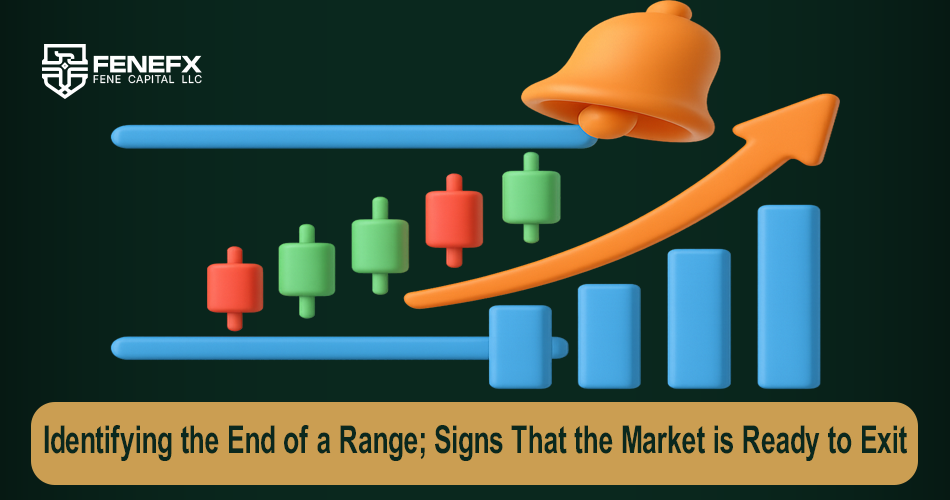
One of the most important skills a trader should have is the ability to recognize when the market is ending its range phase and entering a trending phase. These moments often mark the beginning of a powerful and profitable movement, but if recognized too late, the opportunity is lost or the trade is executed at the wrong point.
Change in Price Behavior
The first sign to pay attention to is a change in the candle movement pattern. If shadowy, small, and uncertain candles were present in the range, but suddenly a strong candle with high volume appears, it could indicate the beginning of an exit from the range.
Specifically, a candle that breaks the entire range and closes with a full body is a serious warning for the end of the neutral phase. In such conditions, it should be checked whether this breakout is also accompanied by confirmation in the higher timeframe.
Increase in Trading Volume
One of the key tools in identifying the end of a range is volume (trading volume). Usually in a range market, volume decreases, but near the end of the range and before the start of a trend, volume suddenly increases.
If the volume increase is accompanied by a breakout of a key level and immediately after that, the price doesn't return to the range (meaning it's not a false breakout), the probability that the market has entered a trending phase increases. This signal is stronger when volume also increases in the higher timeframe.
Divergence in Indicators
At the end of some range markets, divergence is seen in oscillators like RSI or MACD. For example, if price reaches the previous range low but RSI doesn't make a lower low, this divergence could be a sign of seller weakness and the possibility of a bullish exit.
In this case, it's better to combine this divergence with other confirmations and not use it alone as a basis for decision making. Divergences play more of a warning role, not a definitive signal.
Price Behavior After Initial Breakout
Sometimes the initial breakout of a range is accompanied by doubt. But if after this breakout, a pullback to the broken level occurs and the price moves again in the same direction, the probability that the market has entered a new phase increases.
At this stage, examining the price reaction to this pullback is very important. If the returning candles are weak and the main momentum is maintained, the breakout is valid. But if price quickly returns inside the range, the market may still remain in an indecisive phase.
Conclusion
Accurately identifying a range-bound market is the foundation of informed decision-making and professional risk management. Many trading losses occur not because of a wrong directional bias, but due to a failure to recognize a neutral or directionless market.
Combining structural analysis, volume behavior, candlestick interpretation, and multi-timeframe confirmation can significantly enhance the accuracy of range detection.
Ultimately, a successful trader is not only the one who knows when to trade, but also the one who knows when to stay out of the market.
FAQ
1. How can we identify if the market is in a range?
When the price moves back and forth between a fixed support and resistance level without creating new highs or lows, the market is considered to be in a range phase.
2. Can trading in a range-bound market be profitable?
Yes, but trades should only be taken at the range boundaries—near support or resistance levels—while avoiding entries in the middle zone to maintain a proper risk-to-reward ratio.
3. Which timeframe is best for identifying ranges accurately?
It’s best to start with a higher timeframe to identify the overall structure and then use lower timeframes for confirmation. Multi-timeframe analysis always yields more accurate results.
Comments
Underrated topic, covered really well here.
ADX below 20 is my quick filter, but honestly equal highs and lows on a clean chart tell you faster. Also, ranges on majors respect Asian session boundaries surprisingly often.
Do you judge the range on the timeframe you trade or the one above it? I keep getting mixed signals between H1 and H4. Follow-up article maybe?
Most of my losses used to come from forcing trend trades inside ranges. Once I learned to just sit out choppy weeks, my equity curve finally smoothed out.
This explained why my breakout strategy keeps failing — half the time the market isn't even trending! Really clear write-up, thanks.