




Comparison of Scalping vs. Swing Trading
Scalping and swing trading are two different trading styles in financial markets, each with its own characteristics, advantages, and limitations. Scalping focuses on short term trades and quick reactions to market fluctuations, requiring constant presence, high concentration, and real time risk management. In contrast, swing trading holds trades over medium term timeframes and is suitable for those who have the ability to be patient, perform precise analysis, and manage emotions over time. The choice of the best style depends on the trader’s needs, personality, and lifestyle. If you are capable of staying continuously at the chart and making fast decisions, scalping may bring you higher short term returns but comes with greater psychological pressure. If you prefer to trade with more time flexibility and less stress, swing trading is the right choice, offering the potential for sustainable profitability over time. In fact, the answer is that neither style has absolute superiority over the other; a deep understanding of yourself and combining strategies can bring you the best results.
What Is Scalping and How Does It Work?
Scalping is one of the short term strategies in financial and crypto markets, aimed at taking advantage of the smallest price fluctuations within short timeframes. This trading style allows traders to execute multiple trades throughout the day and gain profit from rapid price changes. Scalping requires high concentration, quick decision making, and precise capital management. Unlike long term methods, scalpers focus on minor price movements rather than following the overall market trend, seizing short term opportunities instead.
Timing and Speed of Trades
One of the main features of scalping is the high speed of trades. Traders usually hold positions for only a few minutes or even seconds. Success in this style depends on the ability to identify opportunities quickly and react instantly to market changes. Since the trades are short term, even small price changes can generate significant profits, but this approach requires extreme accuracy and constant presence at the chart.
Tools and Charts Used in Scalping
For scalping, the use of precise technical analysis tools is essential. Short term candlestick charts, fast moving averages, RSI, and volume indicators are among the most common tools for identifying entry and exit points. Many scalpers use trading platforms that provide fast order execution and real time data, enabling them to make optimal decisions.
Risk and Capital Management in Scalping
Risk in scalping is high because trades take place within short timeframes and face rapid price fluctuations. Capital management and setting a stop loss for each trade are especially important. Traders usually allocate only a small percentage of their capital to each trade so that, in case of error, the loss remains limited. Following a strict risk management strategy, using stop losses, and performing continuous market analysis are essential requirements for success in this trading style.
What Is Swing Trading and How Does It Work?
Swing trading is a medium term trading style designed around short to medium term price trends. In this style, traders typically hold positions for several days to a few weeks in order to profit from larger market swings. Swing trading relies heavily on accurate trend analysis and the use of technical tools, making it suitable for individuals who cannot monitor the markets all day but still want to capture meaningful profits from medium term movements.
Trade Duration in Swing Trading
In swing trading, each trade may last from a few days to several weeks. This longer duration allows traders to take advantage of more visible market trends and reduces the need for instant reactions. Unlike scalping, short term fluctuations have less impact on decision making, while the focus remains on technical analysis and broader market trends.
Technical Analysis and Essential Tools
Swing trading requires a broader set of technical analysis tools. Trendlines, support and resistance levels, long term moving averages, and volatility indicators such as Bollinger Bands and MACD are among the most important tools. A trader must be able to identify trends and reversal points in order to optimize their trades. Unlike scalping, swing traders have more time to analyze and make decisions.
Risk Management and Planning
Risk management in swing trading is especially important, as longer trades are exposed to larger market swings. Using stop losses, setting profit targets, and creating a trading plan for each position are essential. A trader must be able to tolerate short term fluctuations and have the patience to reach medium term goals in order to achieve consistent profitability.
Comparing Profitability and Risk in Scalping vs. Swing Trading
A comparison of profitability and risk between the two styles shows that each suits different goals and trader personalities. Scalping offers quick returns but with higher risk, while swing trading provides medium term returns with better risk control. Understanding these differences is essential for choosing the right style.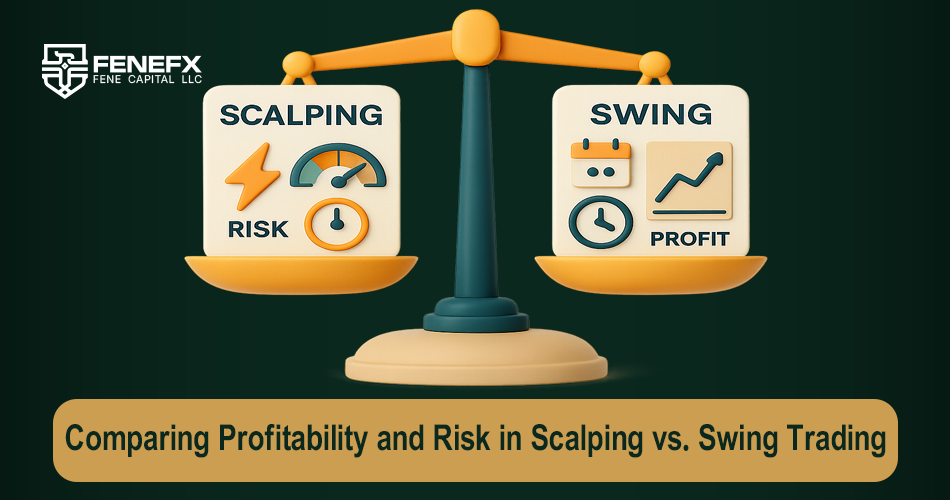
Short Term vs. Medium Term Returns
Scalping allows traders to gain small but frequent profits from short term price movements. While these gains can add up to significant returns, they require a high volume of trades and constant presence at the charts. Swing trading, on the other hand, leverages larger market trends to deliver substantial profits over periods of several days to weeks, with less dependence on moment to moment fluctuations.
Risk Levels and Volatility
The risk in scalping is high due to the speed of trades and instant market volatility, but it can be controlled with proper capital management. Swing trading involves fewer short term fluctuations; however, because trades last longer, there may be higher overall risk when facing potential market reversals.
Comparison Table: Scalping vs. Swing Trading
| Feature | Scalping Trading | Swing Trading |
| Trade Duration | A few seconds to a few minutes | Several days to a few weeks |
| Speed & Focus | Requires constant presence and quick decision making | Requires periodic analysis and trend evaluation |
| Analytical Tools | Short term charts, volume indicators, RSI | Trendlines, support & resistance levels, MACD, Bollinger Bands |
| Risk Management | Small capital per trade, tight stop losses | Longer term stop losses, patience to reach medium term targets |
| Psychological Pressure | High, requires moment to moment focus | Moderate, requires patience and detailed analysis |
| Profitability | Small but frequent gains | Larger, medium term profits |
| Best Suited For | Traders with plenty of free time and high concentration | Traders with other jobs or commitments who can stay patient |
Time and Lifestyle: Which Style Fits Which Trader?
The choice betweenscalping tradingandswing tradinglargely depends on a trader’s lifestyle, free time, and ability to stay focused. Scalping requires constant monitoring of the charts and making split second decisions, while swing trading offers more flexibility, allowing traders to analyze and manage positions at specific times. For success in either style, one must consider lifestyle, time commitment, and psychological capacity.
Constant Presence and Focus
Scalping, due to its high speed and short timeframe, requires the trader’s full attention at the charts. A trader must be able to track moment to moment market changes and make decisions within seconds. This style is suitable for individuals who can maintain prolonged concentration and react quickly to volatility. Even a few minutes of inattention can result in missed opportunities or losses. Therefore, scalping heavily depends on time management skills and psychological focus.
Flexibility and Free Time
Swing trading allows traders to hold positions over longer periods and profit from medium term market swings. This style is ideal for individuals with other jobs or commitments who cannot monitor the charts all day. The greater time flexibility of swing trading enables traders to perform analysis and manage positions during specific hours, without the immediate stress and pressure caused by short term volatility.
Best Markets for Scalping or Swing Trading
Choosing the right market for scalping or swing trading is one of the key factors for success. Scalpers are usually attracted to markets with high liquidity and predictable volatility, since their short term trades require quick entries and exits. Markets such as Forex and cryptocurrencies, with high trading volume, low spreads, and instant price movements, provide ideal opportunities for scalpers.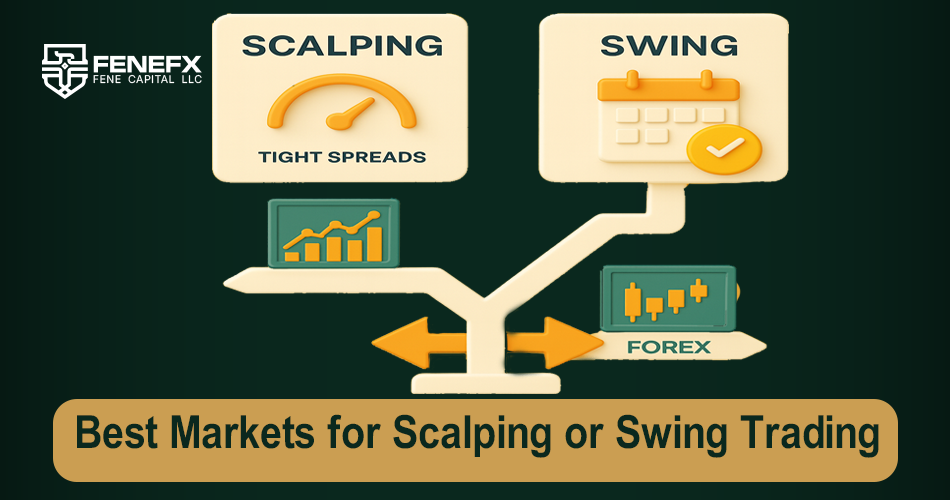
On the other hand, swing traders focused on medium to long term perspectives prefer markets with clear and sustainable trends. Stock markets, indices, and certain currency pairs with more analyzable trends and lower short term volatility are generally more suitable for swing trading.
Psychology and Emotion Control in Each Trading Style
Each trading style requires a different level of psychological control. Trading psychology is one of the key factors that determines success in financial markets, and failing to manage emotions can lead to serious losses. Understanding the psychological demands of each style helps traders choose the one that fits them best and develop an effective emotion management strategy.
Psychological Pressure in Scalping
Scalping, due to its high speed trades and need for rapid decision making, puts a great deal of psychological pressure on traders. Watching moment to moment fluctuations and reacting instantly can cause anxiety. A trader must be able to manage stress and make rational decisions under pressure. To reduce psychological strain, it is essential to adjust trade sizes, follow a strict risk management strategy, and take regular breaks between trades.
Patience and Decision Making in Swing Trading
In swing trading, trades last longer and require patience and precise analysis. A trader must be able to tolerate short term fluctuations and avoid emotional reactions to minor market changes. Decisions in this style are based more on trend analysis and technical tools, with less stress from immediate reactions. The ability to manage emotions, stay patient until targets are reached, and stick to a trading plan are the keys to success in swing trading.
Choosing the Best Trading Style for You: Practical Tips and Guidance
To select the right trading style, you must carefully evaluate your personality traits, available time, and psychological capacity. No single style is suitable for everyone, and understanding your own strengths and weaknesses leads to an optimal choice. In addition, combining strategies can help traders benefit from the advantages of both scalping and swing trading.
Tools and Hybrid Strategies
Many successful traders use a combination of scalping and swing trading. For example, a small portion of capital can be allocated to short term scalping trades, while the rest is invested in swing positions. This approach allows traders to take advantage of both short term fluctuations and medium term trends simultaneously. A variety of technical analysis tools such as short term charts, trendlines, moving averages, and indicators are applied in this hybrid method, enabling traders to shift between styles depending on market conditions.
Starting Small and Progressing Gradually
When starting out, it is best to trade with small volumes and build experience step by step. Beginner traders should first practice with demo accounts or limited capital to become familiar with the characteristics of each style. With increased experience and confidence, they can then scale up to larger trades. This method reduces risk and strengthens confidence in trading decisions.
Consistent learning, analyzing past performance, and adapting strategies to real market conditions are essential for progress in any style. Combining practical experience with theoretical knowledge helps traders choose the most suitable style based on their personality and available time, ultimately optimizing their performance.Summary
Scalp trading and swing trading are two distinctly different trading styles, each suited to specific trader personalities, experience levels, and lifestyles. Scalping requires high speed, constant focus, and staying actively engaged with price charts, generating small but frequent profits. Swing trading, on the other hand, demands patience, trend analysis, and less screen time, offering larger profits over days or weeks. Choosing between these styles depends on a trader’s mental capacity, available time, experience, and risk tolerance. Some traders successfully combine both methods to balance their portfolios and benefit from various market conditions.
Frequently Asked Questions
1) Who is scalp trading suitable for?Scalp trading is ideal for individuals who have enough free time, high concentration, and the ability to react quickly to rapid price movements.2) Does swing trading require constant chart monitoring?No. Swing trading only needs periodic chart reviews and does not require continuous or real-time monitoring.3) Which style carries more risk: scalping or swing trading?Scalping generally has higher risk due to its fast execution and rapid market fluctuations. Swing trading also carries risk but tends to have lower psychological pressure.4) Is it possible to use both scalping and swing trading together?Yes. Many professional traders combine both strategies to benefit from short-term price movements as well as medium-term trends.
Comments
One nuance: spreads and commissions matter way more for scalpers than this suggests. A strategy that works on paper can be net negative once you account for costs on 20+ trades a day.
Good breakdown, the comparison table alone is worth a bookmark.
What about day trading as a middle ground? Would be great to see this comparison extended to intraday styles.
Tried scalping for three months while working full time. Total disaster. Switched to swing and finally stopped checking charts every ten minutes at work.
Really helpful, thanks. I couldn't figure out why scalping felt so exhausting compared to holding trades for days — turns out it's just not my temperament.