





What is a target in forex?
Take Profit (TP) in Forex refers to a predetermined price level at which a trader decides to close a trade in order to secure profits. Essentially, TP is a specified point at which the trading platform automatically closes the trade once the price reaches that level, locking in the profit. Setting a TP is a crucial aspect of forex trading strategy. This level is usually determined based on technical or fundamental analysis, and its purpose is to identify a point where the potential for price reversal and profit reduction increases. For instance, if you enter a trade by buying EUR/USD at 1.1000 and set your TP at 1.1050, your position will automatically close when the price hits this level, securing your profit. The role of TP in trading is significant because it helps traders exit winning trades at the right time and avoid impulsive decisions driven by emotions. TP is essentially a smart strategy to lock in profits, preventing excessive greed or the risk of sudden market reversals. In addition to maximizing profits, TP plays a vital role in risk management. By defining a proper exit point, traders ensure that their trades remain controlled and are less vulnerable to unexpected market fluctuations.
Why is Setting a Take Profit in Forex Important?
Setting a Take Profit in Forex is essential not only to maximize gains but also to manage risk effectively. Many beginner traders overlook this crucial step, often leading to impulsive or poorly timed trade closures.
One of the key benefits of setting a TP isreducing risk and increasing profitability. By establishing a clear TP level in advance, traders can avoid getting distracted by short-term market fluctuations. This allows them to remain focused on their overall strategy rather than reacting emotionally to minor price movements.
Moreover, a well-defined TP helps inavoiding emotional decision-making. Emotions such as greed or fear can lead traders to hold onto winning trades for too long or prematurely close them due to anxiety. Setting a TP removes this uncertainty, ensuring traders stick to their plan and close trades at a rational point.
Setting a TP also enhancesmoney management. By defining clear exit points, traders can effectively manage theirRisk/Reward Ratioand avoid entering trades that carry excessive risk. Over time, maintaining a consistent TP strategy greatly improves trading discipline and overall profitability.
How to Set a Take Profit in Forex
There are several methods to determine the ideal TP level in Forex, including technical analysis, fundamental analysis, and chart pattern recognition.
Intechnical analysis, traders use graphical tools and technical indicators to identify exit points. One of the most common techniques in this method is usingsupport and resistance levels. Support levels are points where the price has previously stopped falling and bounced back upward, while resistance levels are points where the price has reversed downward. Placing a TP near these levels helps reduce the risk of price reversal before reaching your target.
Another effective tool in technical analysis is theFibonacci retracement. This method involves identifying key Fibonacci levels where the price is likely to retrace or continue its trend. Fibonacci-based TPs are particularly useful in volatile market conditions.
Infundamental analysis, traders base their TP decisions on economic data, political events, and financial reports. For instance, if a strong U.S. employment report is expected, traders may set their TP at a level that reflects the anticipated rise in the U.S. dollar's value.
Chart patternsalso provide valuable insights for determining TP levels. Patterns like head and shoulders, triangles, and flags signal points where price reversals or continuation trends are likely to occur.
How to Calculate a Take Profit in Forex
To calculate an appropriate TP level in Forex, traders can use specific formulas that align with their risk management strategy. One of the simplest methods is based on theRisk/Reward Ratio, which is calculated as follows:
Take Profit = Entry Point + (Stop Loss Distance × Risk/Reward Ratio)
For example, suppose you enter a buy trade in EUR/USD at 1.1000 and set your stop loss at 1.0980. The distance between the entry point and stop loss is 20 pips. If your desired Risk/Reward Ratio is 1:2, your TP should be set 40 pips above your entry point, at 1.1040.
In pattern-based strategies, traders often calculate TP based on the pattern’s height. For instance, in a head and shoulders pattern, the distance between the neckline and the highest peak (head) is used as a benchmark for determining the TP level.
Indicators like theATR (Average True Range)are also highly effective in calculating TP levels. ATR measures the market’s average volatility over a given period, allowing traders to set realistic and flexible TPs that reflect current market conditions.
Accurately calculating your TP not only maximizes your profits but also ensures a disciplined and organized trading approach. Traders who set TPs based on precise analysis tend to outperform those who rely solely on instinct or emotional decision-making.
Best Strategies for Setting a Take Profit in Forex

Choosing the right strategy for setting a Take Profit (TP) in Forex is one of the most important factors in achieving success in this market. TP strategies can vary depending on the trader’s trading style, timeframe, and risk tolerance. Below are four effective and widely used strategies for determining the optimal TP level.
1. Fixed Take Profit (Fixed TP) Strategy
In this method, the trader pre-determines a fixed exit point for their trade. This level is set based on past experience, technical analysis, and profit objectives. For example, a trader may consistently set a 30-pip TP for all their trades. This method is simple, predictable, and ideal for traders who prefer to avoid complex decision-making.
However, the fixed TP strategy may be less effective during periods of high volatility or strong market trends. For instance, during major economic news releases, a fixed TP may prevent traders from capitalizing on larger potential profits.
2. Dynamic Take Profit (Dynamic TP) Strategy
In this approach, the trader adjusts their TP level based on market changes. Unlike the fixed TP strategy, the dynamic TP method involves continuously monitoring price trends, trading volume, and other technical factors to modify the TP accordingly.
For example, assume a trader enters a buy position at 1.1000 with an initial TP set at 1.1050. If the price surges strongly, they may choose to adjust their TP to 1.1070 or even higher. This method allows traders to capture larger profit opportunities and provides greater flexibility in volatile market conditions.
3. ATR-Based Strategy (Average True Range)
ATR (Average True Range) is a popular technical indicator that measures market volatility over a specific timeframe. Traders using this strategy determine their TP based on the ATR value, ensuring the TP reflects the current market conditions.
For example, if the ATR value is 20 pips, the trader may set their TP at 1.5 to 2 times the ATR value — approximately 30 to 40 pips. This strategy is highly adaptive and ensures that the TP is proportionate to current volatility, increasing the chances of successful trades.
4. Psychological Levels in the Market
Psychological levels are key price points that many traders pay close attention to. These levels are often round numbers (e.g., 1.1000, 1.2000, etc.) that tend to influence market behavior. Professional traders often place their TP slightly below these levels to secure profits before the price reaches these points, reducing the risk of reversal.
Common Mistakes in Setting a Take Profit in Forex
While setting a TP correctly can lead to profitable trades, making mistakes in this process can result in unnecessary losses. Here are some of the most common TP-setting mistakes traders make:
1. Setting Unrealistic TP Levels
One of the biggest mistakes traders make is setting overly ambitious and unrealistic TP levels. For example, expecting a 200-pip price increase in a market where the average daily range is only 50 pips is unlikely and can cause traders to miss profitable exit opportunities. Establishing reasonable TPs based on precise analysis significantly increases success rates.
2. Ignoring Market Volatility
Market volatility plays a crucial role in determining the appropriate TP level. Setting overly small TPs in volatile markets may result in premature trade closures before the price fully moves in the desired direction. Conversely, setting excessively large TPs in calm, low-volatility markets may reduce the probability of hitting the TP. Adapting TPs to match market conditions is key.
3. Overlooking the Risk/Reward Ratio
The Risk/Reward Ratio is a critical factor in TP planning, showing how much potential profit you stand to gain relative to your risk. Traders who ignore this ratio may find themselves taking excessive risks for minimal gains. Maintaining a reasonable Risk/Reward Ratio, such as 1:2 or 1:3, ensures that your profits outweigh your losses in the long run.
How to Optimize Your Take Profit Levels
Optimizing your TP is essential for improving profitability in Forex trading. Here are some effective strategies to refine your TP levels:
1. Use Analytical Tools
Technical analysis tools such as Fibonacci retracements, Moving Averages (MA), Bollinger Bands, and support and resistance levels can help you identify more precise and realistic TP levels. Combining multiple indicators can further reduce the risk of setting inefficient TPs.
2. Implement Effective Money Management Techniques
Proper money management ensures that your TPs align with your available capital, trade size, and risk tolerance. Always define both your TP and Stop Loss (SL) before entering a trade. This dual approach limits your potential losses while ensuring you maximize your profit potential.
3. Combine Fixed and Dynamic TPs
One effective strategy to improve success rates is combining fixed and dynamic TP methods. With this approach, a portion of your trade is closed at a fixed TP level, while the remaining portion is managed using a trailing or dynamic TP. This strategy allows you to secure profits while still capitalizing on extended market movements.
The Difference Between Take Profit (TP) and Stop Loss (SL) in Forex
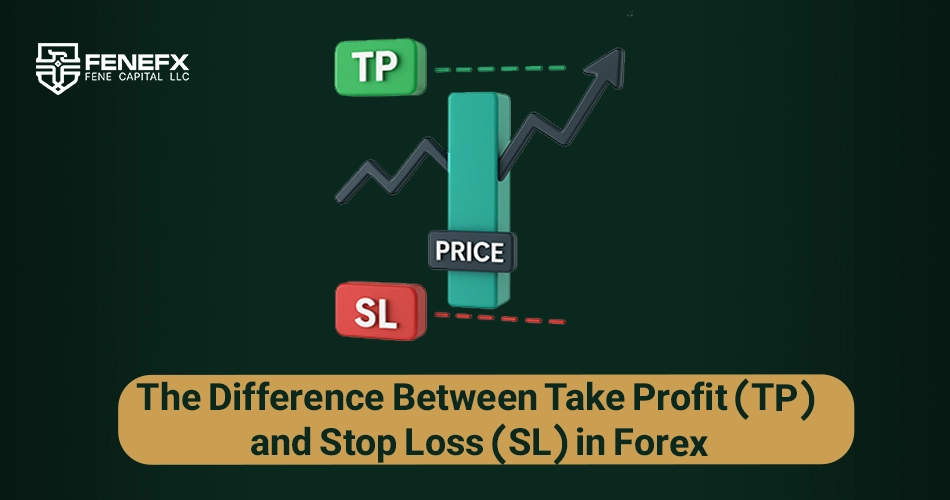
Take Profit (TP) and Stop Loss (SL) are two essential risk management tools that work together to control profits and losses in Forex trading.
Definition of Stop Loss (SL)
A Stop Loss is a predefined price level set by a trader to limit potential losses. If the price reaches this level, the trading platform automatically closes the trade to prevent further losses. The SL is usually placed at a point where technical analysis suggests that continuing the trade poses a high risk.
Key Differences in Function and Application
While both TP and SL are designed to trigger automated exits, their objectives differ significantly. The TP is set to secure profits when the market moves in your favor, whereas the SL is designed to minimize losses when the market moves against you.
When setting an SL, traders should ensure there’s enough room for natural market fluctuations while still limiting excessive losses. On the other hand, setting an optimal TP requires identifying points where price reversal is likely to occur.
Maintaining a balanced approach by pairing TP and SL with a logical Risk/Reward Ratio (e.g., 1:2 or 1:3) is the most effective way to preserve capital and achieve sustainable profits in Forex trading.
Comments
Could you do a follow-up on setting targets with risk-reward ratios? Like when 1:2 makes sense vs holding out for 1:3?
Short and to the point, nice one.
I used to move my target further away every time price got close... cost me so many winners turning into losers. Now I set it and walk away.
Okay this finally cleared up TP vs target for me. I always thought they were two different things lol. Thanks!
Decent overview, but I'd add that targets shouldn't be arbitrary. I set mine at prior structure levels, not fixed pip counts — fixed TPs ignore what price is actually doing.