




What Is Market Cap?
Market Capitalization, or Market Cap, refers to the total financial value of an asset in the markets. It is calculated by multiplying the total number of existing units of an asset by its current market price. For example, if a cryptocurrency has ten million units in circulation and each unit is priced at two dollars, its market cap would be twenty million dollars. In other words, market cap is obtained by multiplying the total number of units by the asset’s current market price. This concept is used in the stock market to measure the total value of a company. Likewise, in the forex and cryptocurrency markets, market cap reflects the size and impact of a project within the broader scale of that respective market.
The Importance and Applications of Market Cap in Forex
In the forex market, unlike cryptocurrencies or the stock market, currencies are non proprietary assets, and their market caps are not officially presented. However, understanding the market value and the scale of influence of each currency using parameters similar to market cap is highly important. For instance, liquidity, trading volume, and the economic impact of a particular currency such as the US dollar, euro, or Japanese yen reveal how much dominance and influence that currency has in the market. The importance and applications of market cap in forex can be highlighted as follows:
Assessing Liquidity of Currency Pairs
In the forex market, unlike cryptocurrencies, currencies do not have a defined market cap. However, analyzing their performance based on similar concepts particularly trading volume and economic impact is highly useful. Market cap serves as an indirect method to understand which currency pairs have the highest liquidity. For example, the EUR/USD pair has the highest liquidity in the forex market due to the large volume of global exchanges.
Facilitating Asset Selection for Prop Accounts
If you plan to operate in the forex market through prop accounts, you face constraints such as risk to reward ratios. To succeed in prop firm evaluations, you must avoid abnormal market behavior by relying on market cap
Evaluating Dominant Currencies
Globally, the US dollar holds the highest level of economic dominance. Professional analysts compare the dollar’s trading volume and its share in global exchanges to evaluate the relative strength of other currencies against the dollar.
Identifying Asset Flow Pathways
At specific times, central banks announce policies known as expansionary or contractionary policies. During such periods, global investors tend to shift their assets toward currencies with higher stability or strong liquidity potential. This creates a dynamic flow toward high market cap assets, and understanding this can help prop traders identify opportunities.
Filtering High Risk Trading Symbols
Using market cap in forex allows traders to avoid high risk trading symbols with unpredictable behavior and instead focus on assets with more controlled and predictable volatility. This is especially crucial for traders operating in lower timeframes.
Types of Market Cap
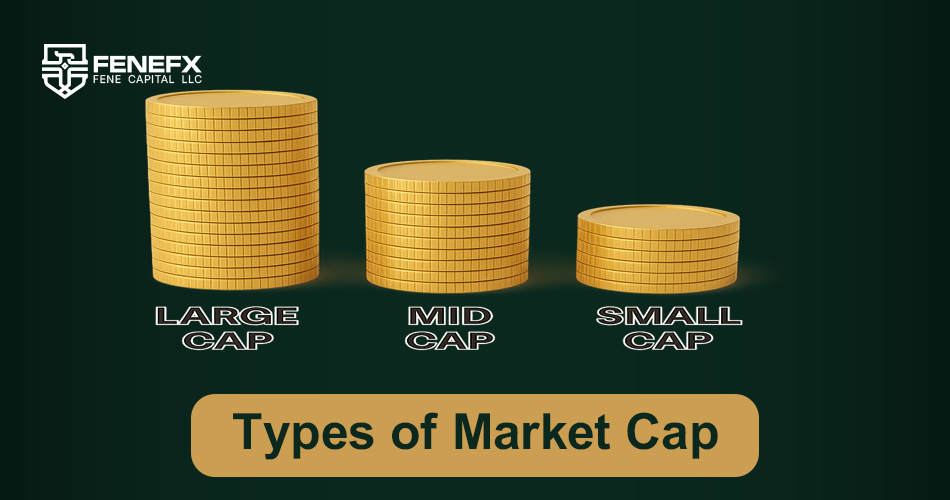
In the general classification of markets particularly in the fields of cryptocurrencies and stocks assets are divided into three main categories based on their market capitalization. The first category includes assets with high market cap, known as large and stable assets. The second category consists of mid cap assets, which are often in a growth phase and come with both opportunities and risks. The third category includes low market cap assets, which are prone to rapid growth but carry a high level of risk.
These classifications are especially important when building and designing trading strategies within prop trading accounts. For instance, if you are trading with funded capital from a proprietary trading firm like FeneFX, it may be more logical to focus part of your attention on large cap and mid cap assets in order to reduce the risk of sudden drawdowns.
Large Cap
These are assets with very high market value that hold a significant share of the overall market. In the cryptocurrency market, Bitcoin and Ethereum fall into this category. These assets typically experience lower volatility, offer greater stability, and enjoy global adoption. In the forex market, currency pairs like EUR/USD or USD/JPY are the equivalent: highly liquid, analytically predictable, and suitable for accounts with trading restrictions.
Mid Cap
These are assets with substantial market value but that have not yet reached full maturity. This category may offer considerable growth opportunities, though it also comes with certain risks. Some altcoins such as Chainlink or Avalanche typically fall into this group. In forex, pairs like AUD/USD or NZD/JPY may exhibit similar behavioral characteristics, especially under specific economic conditions or regional policy shifts.
Small Cap
This category includes assets with low market capitalization, which typically show high volatility, lower trading volumes, and elevated risk. However, they also present significant opportunities for sudden growth. New crypto projects, lesser known tokens, or exotic forex pairs such as USD/ZAR or USD/TRY are examples of this type. Utilizing such assets in prop trading strategies requires a high level of analytical skill and emotional control.
Key Market Cap Indicators and Their Use in Prop Accounts
Market cap alone is a raw and broad number, but there are several indicators that, through deeper analysis, provide better insights into an asset’s status and broader market trends. These indicators are especially critical in funded trading environments, where they play a vital role in risk management and selecting appropriate assets. This section examines the most important market cap related indicators and how they are used in prop accounts.
Market Dominance
This indicator shows what share of the total market cap a particular asset holds. In the crypto market, Bitcoin dominance (BTC Dominance) is a key metric for tracking capital flow direction. If this index is rising, it indicates that investors are shifting toward Bitcoin as a safer asset, while altcoins are losing capital.
In prop accounts, this indicator helps traders understand whether the market is focused on primary assets or riskier ones. During high Bitcoin dominance, trading weaker altcoins may lead to unpredictable volatility and increased drawdown.
Market Cap to Volume Ratio (MCap/Volume Ratio)
This ratio shows how the daily trading volume compares to the asset's total market value. A very high ratio indicates low trading volume and a stagnant asset. A lower ratio indicates higher volume and strong liquidity.
For prop traders, this indicator is essential for assessing the true strength of a trend and determining entry points. In assets with lower ratios, entering trades with tighter stop losses and reasonable targets is often more practical.
Circulating Supply
The higher the number of tokens in circulation, the more visible the price increase’s impact on market cap becomes. This factor, combined with live price and market cap, helps traders evaluate an asset’s real growth potential.
In prop accounts, this is useful when selecting suitable altcoins for mid term trades. For instance, two cryptocurrencies with the same price but one having 20 million and the other 200 million tokens in circulation will behave very differently in terms of volatility and liquidity.
Total Value Locked (TVL)
Although not directly a subset of market cap, TVL is a complementary metric used in DeFi projects, especially in the crypto space. TVL shows how much capital is locked in various projects.
For a prop trader operating in the crypto market, TVL helps identify which projects have genuinely attracted capital and hold real liquidity. Trading such assets significantly reduces the risk of slippage and irrational price movements.
Market Cap vs. Realized Cap
This indicator, primarily used in analyzing Bitcoin and Ethereum, reflects the market value based on the actual purchase price of the tokens. If the real market cap is significantly higher than the realized cap, it may indicate that the asset is in a price bubble.
In prop accounts, paying attention to this indicator is crucial for avoiding entry at price peaks or buying during overhyped markets. Using this metric alongside technical tools enhances precision in determining entry and exit points.
The Most Important Digital Currencies by Market Cap

In the forex and cryptocurrency markets, market cap is one of the main and highly important criteria for evaluating the stability and significance of any actively traded project. Cryptocurrencies and popular currencies that rank at the top of the market cap list generally possess specific characteristics such as global acceptance, high trading volume, and security.
U.S. Dollar (USD)
The U.S. dollar, as the global reserve currency and the asset with the highest functional market cap in the world economy, plays the most fundamental role in the forex market. Over 85% of all daily forex transactions involve the dollar.
Application in Prop Trading:
In most prop trading accounts, the major currency pairs include the U.S. dollar. Traders must be thoroughly familiar with USD price behavior, as Federal Reserve news, U.S. economic data, and global sentiment directly affect its performance.
Euro (EUR)
As the official currency of the Eurozone, the euro is the second most important currency in the forex market in terms of trading volume. The EUR/USD pair is one of the most popular symbols in prop trading accounts due to its low spread, fast order execution, and technical behavior.
Application in Prop Trading:
EUR/USD is one of the safest choices for traders who aim to achieve consistent returns using trend following or swing structures. The analysis of this pair in prop trading is fully applicable due to its alignment with market psychology.
Japanese Yen (JPY)
The Japanese yen is one of the currencies that experiences increased demand during times of crisis or global instability. For this reason, it plays a very important role in currency pairs such as USD/JPY and EUR/JPY.
Application in Prop Trading:
For traders who are sensitive to fundamental analysis, trading the yen is a valuable opportunity. In volatile markets, sentiment shift strategies (such as going long on JPY during crises) are widely applicable.
Bitcoin (BTC)
Bitcoin, as the largest cryptocurrency by market value, often sets the overall direction of the crypto market. In bullish conditions, Bitcoin dominance decreases and altcoins tend to rise. In bearish conditions, capital typically flows back into BTC.
Application in Prop Trading:
Due to its high liquidity and relatively predictable volatility, Bitcoin is one of the most suitable assets for traders looking for classic, technically analyzable price structures. In prop accounts, BTC is generally considered a standard option for starting trades in the crypto market.
Ethereum (ETH)
Ethereum is not only the second largest cryptocurrency by market cap, but also the foundational platform for most DeFi and NFT projects. Compared to Bitcoin, it has higher volatility and at times its movements create better opportunities for swing traders.
Application in Prop Trading:
In prop accounts where swing trading with defined risk is permitted, ETH is a suitable choice. However, due to its greater volatility, it must be traded with a professional stop loss strategy and precise position management.
Comments
Simple and clear, nice one 👌
Could you do one on fully diluted valuation next? Keep seeing FDV thrown around and I just nod like I get it.
Bought a 'cheap' meme coin once purely off unit price. Learned about supply the hard way when I did the math afterwards.
Decent explainer, but market cap alone can mislead — check liquidity and token unlock schedules too. A $2B cap with 90% of supply still locked is a very different animal.
I genuinely thought a $0.002 coin was 'cheaper' than a $60k one. The circulating supply explanation fixed a very embarrassing gap in my knowledge, thanks.