

What is smart money?
Smart money generally refers to capital that is managed by professional investors, large financial institutions, or individuals with extensive experience in financial markets. This term was originally used in traditional stock markets and financial systems, but today it is also widely used across various financial markets, including Forex and cryptocurrencies. So, what exactly does "smart money" mean? The term refers to investment decisions made not only based on thorough analysis but also on access to superior information. Large investors and financial institutions have access to specific information that enables them to make decisions that seem "smart" from the market’s perspective. Smart money typically moves in a market that is technically predictable, yet still carries significant risks. Therefore, smart money is based on a deep analysis of market trends and investor behavior. It is this type of capital that often drives market movements, whether in the form of large buy or sell orders by institutional investors.
Does Smart Money Really Exist or Is It Just a Trader’s Myth?
Many traders, especially those who are new to the market, often ask if smart money really exists or if it's just a concept designed to complicate the markets further. The truth is that smart money truly exists, but identifying and understanding how to recognize it can be challenging.
Smart money actually refers to the behavior of certain market participants who typically have access to more information and engage in more sophisticated analysis. These participants can be large financial institutions, central banks, or major hedge funds, and they tend to act on insider knowledge and advanced market insights.
In fact, it is smart money that can sometimes shift the overall direction of the market or guide it. For example, when a large institution decides to buy or sell a stock, it can dramatically affect the price movement of that stock and influence other traders to follow suit. This behavior is what constitutes smart money in the market.
However, spotting smart money isn’t always easy. To identify it, traders need to pay close attention to market behavior, particularly price changes, trading volume, and price breakouts. If we can identify these movements, we can potentially capitalize on the actions of smart money.
Why Is It Called "Smart Money"? What’s the Philosophy Behind This Term?
The term "smart money" is used because the capital behind it comes from investors and institutions that have access to sophisticated analysis and exclusive information, which makes their market decisions appear "smarter" than those made by individual or retail traders.
Smart money is called smart because the individuals or entities managing it have access to more tools, data, and in-depth analysis than typical retail traders. This information might include economic reports, company earnings, and insider data, all of which allow them to make more informed decisions.
These investors don’t just rely on basic technical analysis, but also on fundamental analysis and economic signals to understand the market. They take a more calculated, less emotional approach to trading, making decisions based on cold, hard data rather than market speculation. As a result, when smart money enters the market, it often leads to significant price shifts, which in turn affects the broader market.
Smart money also has a reputation for risk management and strategic investing. This careful approach to risk is a defining trait, as these investors use advanced techniques to identify the best opportunities while protecting their capital.
In essence, the philosophy behind smart money is that those who manage it are equipped with better access to information and the tools to make informed, precise investment decisions, making their actions appear much "smarter" in comparison to others.
Certainly, Abbas! Here is the translation of the second part of the article into English:
How to Identify Smart Money on the Chart? What Are the Behavioral and Structural Indicators?
Identifying smart money on the chart requires a lot of skill and attention to detail. The ability to distinguish between natural market movements and those influenced by smart money requires precise analysis and the right tools. In this section, we will explore the methods and indicators used to identify smart money on the chart.
1. Trading Volume
One of the most important indicators for identifying smart money is trading volume. When a price movement occurs along with a significant increase in trading volume, it is likely that this movement is being driven by smart money. Smart money typically enters the market when there is a noticeable increase in volume, signaling that large players are actively involved.
For example, if a stock’s price suddenly rises and trading volume also surges, it might indicate that smart money is entering the market.
2. False Breakouts
False breakouts are one of the common signs of smart money activity. When the price seems to be moving toward a significant support or resistance level and it appears to be breaking that level, but then quickly reverses, this could indicate the presence of smart money trying to trap retail traders.
In other words, when the market looks like it's breaking out but then makes a strong reversal, it could be a sign that professional or institutional investors are acting behind the scenes.
3. Accumulation and Distribution Zones
Smart money often operates during accumulation and distribution phases. Accumulation refers to buying large quantities of an asset at lower prices, while distribution refers to selling that asset at higher prices. Identifying these phases on the chart can help traders understand when smart money is entering or exiting the market.
To identify accumulation, traders can look for price movements that occur slowly within a certain range. During this phase, professional investors accumulate assets. During the distribution phase, price movements go up and then reverse, signaling that smart money is selling.
4. Divergence
Divergence between price and indicators such as RSI or MACD can also be a strong sign of smart money presence. When the price reaches new highs, but momentum indicators like RSI or MACD fail to confirm the move, it can indicate weakness in the price movement, possibly caused by smart money.
If the price is making new highs but the indicators are not confirming this, it may suggest that smart money is acting behind the scenes and could be preparing for a reversal.
Does Smart Money Have Different Types? If So, How Can We Differentiate Between Them?
Smart money generally refers to capital that is managed by experienced market participants who have access to superior information and advanced analysis. However, it is interesting to note that smart money can come in different forms, each with its own characteristics. In this section, we will explore the types of smart money and how to distinguish between them.
1. Institutional Smart Money
This type of smart money is managed by large financial institutions such as banks, investment funds, and insurance companies. These institutions have access to information that retail traders do not, and they use sophisticated tools to analyze markets and make decisions.
Institutional smart money typically operates in markets like Forex, stock exchanges, and bonds. These institutions have the power to move markets with large transactions based on their analysis of economic and fundamental data.
2. Central Bank Smart Money
Another specific form of smart money is that of central banks, such as the Federal Reserve or the European Central Bank. Central banks can influence financial markets significantly with their monetary policies, such as adjusting interest rates or implementing quantitative easing.
This type of smart money has a profound impact, particularly in the Forex market and gold market. When central banks engage in buying or selling currency, it can lead to significant market shifts that affect global financial systems.
3. Algorithmic Smart Money
Algorithmic smart money refers to capital managed by automated systems and computer algorithms. This type of smart money is typically found in hedge funds and high-frequency trading firms that use complex mathematical models to predict market movements.
These funds rely on fast execution and precise data analysis to enter and exit markets quickly. Algorithmic trading systems can handle vast amounts of data and execute trades in fractions of a second, giving them a competitive edge in the market.
4. Professional Trader Smart Money
This type of smart money is managed by professional traders with extensive experience in financial markets. These traders often use advanced technical and fundamental analysis to identify opportunities in the market. They take a strategic approach to trading and are adept at managing risk.
Professional traders typically operate in the stock and Forex markets, utilizing price action, candlestick patterns, and technical indicators to determine optimal entry and exit points.
Comparison of Smart Money with Classic Technical Analysis and Supply and Demand
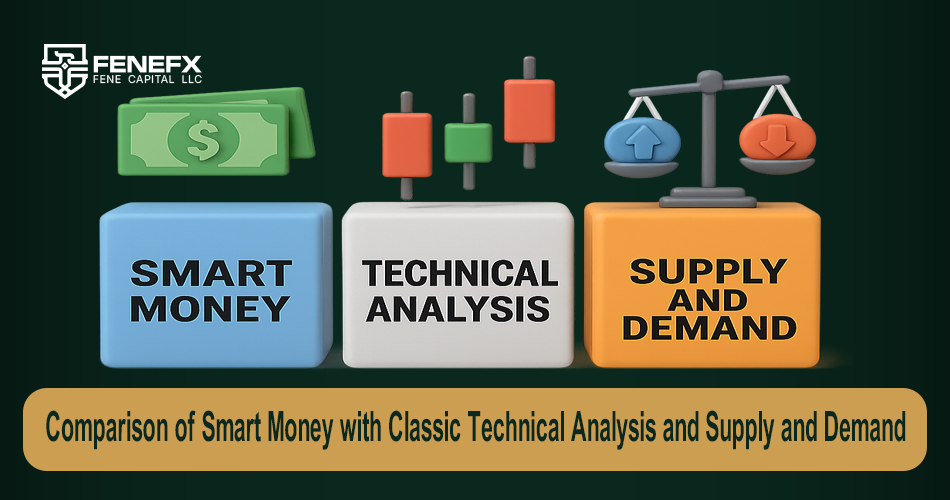
Smart money, compared to classic technical analysis and supply and demand analysis, takes a different approach. While technical analysis mainly focuses on historical price data and various patterns, smart money looks at the behavior of large institutional players and their impact on the market.
Supply and demand analysis, on the other hand, focuses on identifying areas of support and resistance based on market buying and selling behavior. While supply and demand analysis directly addresses price changes, smart money focuses more on understanding how large capital moves in and out of the market.
Certainly, Abbas! Here’s the translation of the third part of the article into English:
Is Smart Money Suitable for All Traders?
Using smart money strategies can be highly beneficial, but is it suitable for all traders? To answer this question, we need to consider the different characteristics and needs of various types of traders. Some traders might benefit greatly from utilizing smart money strategies, while others may face challenges when trying to apply them.
1. Beginner Traders
For beginner traders, using smart money strategies can be challenging. These traders usually lack the experience to recognize and analyze smart money behavior. As a result, for beginners, relying on smart money strategies can be complex and may lead to misinterpretations. Beginners should focus on learning basic technical analysis concepts and risk management techniques before diving into more advanced strategies like smart money.
2. Professional Traders
Professional traders with extensive experience in the markets can easily leverage smart money strategies. These traders are typically adept at identifying smart money movements and can incorporate this into their decision-making process. They are also skilled at using tools such as price action, chart patterns, and volume analysis to detect and track smart money movements.
For professional traders, smart money strategies are a powerful tool, as they are capable of reading the market dynamics and entering or exiting trades based on the activities of institutional investors or large financial entities.
3. Low-Risk Traders
For traders with a low-risk tolerance, smart money strategies may seem a bit risky. Smart money movements often accompany sharp price fluctuations, and this can be challenging for risk-averse traders. As such, these traders might prefer more traditional, less volatile strategies that don't involve such significant market swings. For low-risk traders, following more conservative strategies based on long-term trends or fundamental analysis might be a better approach.
4. Short-Term vs. Long-Term Traders
Short-term traders typically focus on quick market movements and can benefit from identifying smart money behavior in shorter timeframes. These traders are looking for immediate price changes and use strategies that react quickly to market shifts. For long-term traders, however, smart money strategies may not always be ideal. Long-term traders often seek trends that evolve over extended periods, and the fast-paced changes associated with smart money may not align with their investment approach.
Ultimately, whether smart money strategies are suitable depends on the trader's experience level, risk tolerance, and preferred trading style. While these strategies can be highly effective for professional traders, they may not be the best fit for beginners or risk-averse traders.
The Role of Timeframes in Smart Money Analysis: From Higher Timeframes to Accurate Entries
One of the key aspects of using smart money strategies is the role of timeframes. Different timeframes provide different perspectives of the market, and they can significantly impact how smart money is analyzed and understood. In this section, we will examine how to effectively use various timeframes to analyze smart money.
1. Long-Term Timeframes
Long-term timeframes, such as weekly and monthly charts, typically focus on fundamental analysis and the overall market structure. These timeframes offer traders a broader view of the market's overall direction and can help identify significant accumulation or distribution phases. Smart money movements are often more visible on these timeframes, as large institutional players tend to make more gradual and strategic decisions over longer periods.
In long-term timeframes, traders can identify significant trends or shifts in the market that are often influenced by institutional decisions. For instance, when a large financial institution enters or exits a market, it does so over a period of weeks or months, and this movement is usually visible on longer-term charts.
2. Medium-Term Timeframes
In medium-term timeframes, such as daily and 4-hour charts, smart money movements become more apparent. These timeframes are ideal for traders who are looking for trends that last for several days or weeks. In these charts, the influence of institutional investors is often clearer, and traders can use a combination of technical indicators, such as moving averages, support and resistance levels, and volume analysis, to track smart money.
Medium-term timeframes provide traders with the opportunity to spot smart money at key turning points. Price reversals, especially when accompanied by high volume, are often driven by institutional actions, making these timeframes crucial for detecting potential entry points for trades.
3. Short-Term Timeframes
Short-term timeframes, such as 1-minute, 5-minute, and 15-minute charts, are generally more suited for traders looking for quick market movements. These timeframes are typically used by scalpers and day traders who aim to capitalize on small price changes within a short period. In short-term timeframes, smart money can be seen as quick bursts of activity, where institutional investors may initiate trades based on urgent market conditions or immediate opportunities.
Short-term traders need to act fast and use indicators like candlestick patterns, momentum indicators, and order flow to identify smart money movements. The high frequency of trades in these timeframes means that quick decision-making is essential for successfully executing trades based on smart money behavior.
How to Build Your Own Strategy Based on Smart Money?

Building a personalized strategy based on smart money requires precision, analysis, and understanding of how institutional investors and large entities behave in the market. To profit from smart money movements, traders need to simulate the actions of these large players and adapt them to their own trading style. In this section, we will discuss how to build a smart money-based strategy.
1. Identifying Accumulation and Distribution Phases
The first step in creating a smart money-based strategy is to identify accumulation and distribution phases. During the accumulation phase, smart money buys large quantities of an asset at lower prices, while in the distribution phase, it sells those assets at higher prices. Recognizing these phases on the chart can help traders enter and exit trades based on smart money's movements.
To spot accumulation, traders should look for slow price movements within a specific range. During this phase, professional investors tend to accumulate assets. During distribution, prices rise and then quickly reverse, signaling that smart money is distributing the asset.
2. Using Volume and Candlestick Patterns
Incorporating volume and candlestick patterns into your strategy can help you better identify smart money movements. A significant increase in volume, especially when paired with certain candlestick patterns like morning star or inverse candlestick patterns, can indicate the presence of smart money entering or exiting the market.
Volume analysis, combined with candlestick patterns, gives traders a clear view of market behavior driven by institutional investors, providing a more accurate and reliable strategy for timing trades.
3. Simulating Smart Money Behavior
Another way to build a smart money-based strategy is to simulate the behavior of smart money using historical data and market information. By analyzing past price movements and understanding the impact of large investors, traders can replicate similar strategies to take advantage of market shifts. Using this approach, traders can anticipate how smart money will react in certain market conditions and incorporate those insights into their own trading decisions.
Comments
Spent months chasing every 'liquidity grab' and got chopped up. Once I limited it to higher timeframe zones only, things calmed down. Wish someone had told me that on day one.
Nicely explained, no fluff.
I kept hearing 'smart money' on trading Twitter and assumed it was some paid indicator. Now I actually get what institutional flow means, thanks for this.
Been trading SMC for two years. Honest take: half of it is just support/resistance and supply/demand rebranded. The liquidity-sweep concept is the genuinely useful part.
Good intro. Could you follow up with something on order blocks specifically? Everyone on YouTube explains them differently and it's driving me mad.