




What is Web 3?
Given that 75% of internet users worldwide are concerned about corporate misuse and 72% express worry over government surveillance while only 23% of American users feel they have full control over their personal data Web 3.0, by integrating blockchain technology with over 420 million cryptocurrency users globally and artificial intelligence, enables the direct allocation of digital identity keys and data access permissions. As a result, the decentralized identity market value is expected to grow from $1.153 billion in 2024 to approximately $89.628 billion by 2033.
Definition of Web 3.0
Web 3.0 is the next generation of the internet, founded on the principles of decentralization, transparency, and user self governance. In this era, data is stored and managed in a distributed manner across blockchain or peer to peer networks; smart contracts enable automated transactions and interactions without the need for central intermediaries; decentralized digital identity guarantees users full control over their data and access permissions; and artificial intelligence, along with the semantic web, elevates search and content personalization to a more intelligent level.
Importance and Applications of Web 3.0
Web 3.0, by restoring true data ownership to users, empowers them to retain their private keys and precisely control who can access their information. Its tokenized economy allows for direct financial incentives, rewarding participation in the network particularly in content creation and its security. Decentralized digital identity streamlines the authentication process using blockchain standards in a fast and secure manner, without requiring users to repeatedly disclose personal information. Decentralized finance (DeFi) enables borderless access to lending, exchange, and investment services without relying on banks or brokerages. Decentralized autonomous organizations (DAOs) facilitate collective decision making and transparent budget management without hierarchical structures.
Operational Outlook
In Web 3.0, non fungible token (NFT) markets and digital art flourish by documenting ownership and transactions on the blockchain. Transparent supply chains trace product authenticity from origin to destination, boosting consumer trust. Decentralized social networks allow users to control their content and share in advertising revenue. Additionally, the concept of self sovereign identity enables users to participate in various projects using a secure and anonymous identifier.
Web 3.0 is not only a technological advancement but also a framework for building a trustworthy, user centric, and dynamic digital ecosystem where individuals and businesses are empowered and gain opportunities for innovation and direct participation in the online economy.
Differences Between Web 1.0, Web 2.0, and Web 3.0
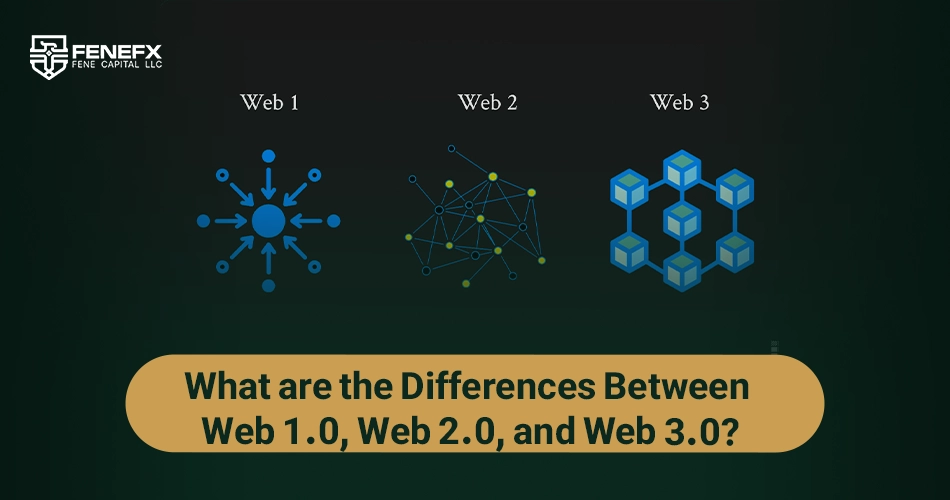
The Evolution of the Internet from Web 1.0 to Web 3.0
The internet has undergone significant transformations over time, with each phase possessing its own unique features and capabilities. Understanding this evolution helps us grasp how Web 3.0 can impact our lives.
Web 1.0: The Static Internet
Web 1.0, known as the “read only web,” was the first stage in the development of the internet. This era spanned from the early 1990s to the early 2000s. Websites during this time were mostly static, and information flowed one way from the server to the user. Users could read web pages but had little to no interaction with the content. Web 1.0 consisted of simple HTML pages that were uploaded to servers and could be easily browsed by users.
Web 2.0: The Interactive Internet
Over time, the need for greater user interaction with content and with one another led to the emergence of Web 2.0. This phase, referred to as the “read write web,” began in the early 2000s. Web 2.0 allowed users to generate content and interact with others. Social networks, blogs, and video platforms like YouTube are examples of this era. During this period, the internet became a space for sharing information and collaboration, and companies began utilizing user data to enhance their services.
Web 3.0: The Intelligent and Decentralized Internet
Web 3.0, known as the “read write own web,” is a step toward a more intelligent and decentralized internet. This version of the web, leveraging technologies like blockchain and artificial intelligence, enables users to have greater control over their data. Instead of relying on centralized servers, Web 3.0 uses decentralized networks, offering enhanced security and privacy.
One of the key features of Web 3.0 is the ability of systems to understand and interpret data semantically, which helps improve user experience. Moreover, the focus on decentralization allows users to interact without intermediaries, potentially reducing costs and increasing efficiency.
The Importance of the Shift Toward Web 3.0
The evolution from Web 1.0 to Web 3.0 represents a shift toward an internet where users are not only consumers of content but also contribute to and manage it. These changes allow users to gain more control over their data and interactions, along with increased privacy and security. By introducing novel capabilities, Web 3.0 can drive fundamental transformations across various industries and create new opportunities for innovation and collaboration. These developments point to a future in which the internet becomes a more powerful and user centric tool.
The Role of Blockchain and Cryptocurrencies in Web 3
In Web 3, blockchain with its distributed and immutable ledger enables secure, intermediary free transaction recording and serves as the core infrastructure for running decentralized applications (dApps) and smart contracts. Cryptocurrencies, as tokenized units of value, provide financial incentives for network participation, facilitate the flow of payments, and enable decentralized governance.
Blockchain as the Backbone of Decentralization
Within the Web 3 framework, blockchain provides a distributed and immutable ledger that allows for the secure and transparent recording of transactions without the need for traditional intermediaries. This structure empowers users to confidently prove digital ownership of their assets and break free from the monopolies of centralized platforms. It also establishes a solid foundation for the development of decentralized services and applications (dApps).
Tokens and the Participatory Economy
In the Web 3 ecosystem, cryptocurrencies function as units of value and as functional incentives within the network. From utility tokens used to pay transaction fees to governance tokens granting voting rights in network decisions, these tokens are creating a new model of participatory economics. The tokenization mechanism distributes benefits among participants and provides strong incentives to maintain security and accelerate the development of decentralized projects.
Smart Contracts and Transaction Automation
The integration of blockchain with smart contracts enables the automatic execution of financial agreements without human intervention. Examples include automated loan issuance, real time supply chain payments, and the implementation of incentive mechanisms within the network all of which minimize human error and delay.
Impacts and Future Outlook
As blockchain and cryptocurrency adoption grows, Web 3 is expected to fundamentally transform how the internet is used, how organizations are structured, and how global financial flows operate. These technologies act as infrastructure for everyday interactions and the creation of new business models, opening new horizons for the digital economy and decentralized democracy.
Key Technologies of Web 3.0
These technologies together form a framework in which data and decision making power are removed from the control of centralized entities and placed in the hands of individual users, paving the way for the creation of new services and business models in the digital economy.
Blockchain and Smart Contracts
Blockchain, as one of the fundamental components of Web 3, is a distributed ledger that records transactions in a chained and immutable manner, thereby providing high levels of transparency and security. On the basis of this technology, smart contracts are executed self executing programs that evaluate and enforce the terms of an agreement without the need for intermediaries. In financial transactions, these contracts can automate payments entirely, thereby significantly enhancing efficiency and reducing the risk of error or fraud.
Decentralization and Its Applications
Decentralization, the brain behind Web 3, challenges traditional centralized structures and distributes the power of data control and decision making among all participants.
Application in Financial Systems (DeFi)
Decentralized financial systems enable direct access to banking services such as lending, saving, and market making through smart contracts and blockchain, while also reducing fees and entry barriers.
Application in Identity Management
With decentralized digital identity, each user manages their own private keys and can confidently decide which information to share with which entities. This approach enhances privacy and reduces the risk of identity theft.
Application in Content Creation and Distribution
In the Web 3 space, content creators can offer their work directly to audiences without advertising intermediaries or centralized platforms, securing their income through tokenized models or direct subscriptions.
Application in Democratic Processes and Voting
Decentralized voting platforms increase transparency and security by recording votes on the blockchain and enable public verification of results without the need to trust a central authority.
Distinctive Features of Web 3.0
Trustlessness and Permissionless Systems:
Web 3.0, leveraging blockchain technology, introduces trustlessness. In this system, the need for centralized intermediaries is eliminated, allowing users to interact directly and securely with one another. Permissionless systems enable anyone to join the network without requiring approval from central authorities. This feature facilitates broader participation and greater access to resources, enhancing transparency and security in transactions.
Semantic Web and Machine Learning:
Web 3.0 places special emphasis on the semantic web, which allows machines to better understand data and content. Through the use of machine learning and natural language processing, systems can semantically analyze data and deliver more accurate results. This contributes to an improved user experience and the provision of personalized services. The semantic web, by creating more complex relationships between data, helps users find information faster and more accurately.
Interoperability and Inclusiveness:
One of the main goals of Web 3.0 is to increase interoperability between different systems and platforms. This feature allows users to easily move between various services and applications and utilize their data across different environments. Inclusiveness refers to the availability of information and services to all users, regardless of geographical location or platform used. This helps promote social and economic inclusion and creates new opportunities for collaboration and innovation.
With its distinctive features such as trustlessness, the semantic web, and interoperability, Web 3.0 transforms the internet into a more intelligent and user centric space. These developments not only enhance user experience but also provide new infrastructure for innovation and economic growth. As these features evolve, Web 3.0 can become a powerful tool for social and economic change, where users have greater control over their data and digital identity. These features represent a future in which the internet becomes a primary tool for progress and sustainable development.
Applications of Web 3.0 and Practical Examples
Web 3.0, through these examples, demonstrates how the internet can be transformed into a more secure, user centric, and participatory system. In this ecosystem, users are not merely consumers but owners and stakeholders of their digital experiences, creating unprecedented opportunities for innovation and value creation.
Decentralized Applications (dApps)
Decentralized applications, or dApps, run on distributed blockchain networks and, unlike traditional software, operate without reliance on a central server. In this environment, all application logic and user data are processed and stored in a peer to peer manner to ensure transaction transparency, enhanced security, and resistance to censorship. dApps can offer innovative, data ownership based user experiences across various domains such as financial services, online gaming, and social networks.
Ethereum: The Leading Smart Contract Platform
Ethereum, as the first public blockchain to widely support smart contracts, has played a central role in the growth of the Web 3.0 ecosystem. Developers can use the Ethereum Virtual Machine to write applications that automatically execute conditions and business logic from decentralized exchanges to instant lending protocols, all built on this platform. Ethereum’s open and extensible architecture has enabled continuous innovation in dApps and has solidified its role as the foundational layer for the tokenized economy of Web 3.0.
Brave: A Browser for User Privacy
Brave browser is an example of applying Web 3.0 technology to enhance user autonomy and security. By blocking intrusive ads and trackers, Brave not only speeds up page loading but also makes privacy a central priority. In addition, Brave’s economic model uses the Basic Attention Token (BAT) to reward users for viewing high quality ads, allowing them to directly allocate these rewards to content creators. In this way, Brave represents a new model of user engagement and online economy, where the value of user attention is transparently measured and fairly compensated.
Benefits of Web 3.0 for Users
Web 3.0, by offering unparalleled advantages in data control and privacy, enhancing interactions, and democratizing communications, can lead to a more user centric and secure internet. These technologies, by increasing transparency and reducing reliance on intermediaries, provide users with new opportunities to actively participate in digital environments and enjoy a safer, more rewarding experience. With these advancements, Web 3.0 has the potential to drive significant changes in how digital and economic interactions take place, placing users at the center of these transformations. These benefits represent a major step toward a future in which users have greater control over their digital world and can actively contribute to shaping it.
Data Control and Privacy
Web 3.0 enables users to have greater control over their own data. Unlike Web 2.0, where large tech companies hold ownership and control of data, Web 3.0, by leveraging blockchain technology, returns that power to the users. Individuals can decide what information to share and how it is used, contributing to enhanced privacy. Furthermore, due to the use of decentralized systems, the risk of data breaches and cyberattacks is reduced, as data is stored in a distributed manner with no single point of failure.
Enhanced Interaction and Democratization of Communication
Web 3.0 democratizes the communication space and allows users to interact with each other without intermediaries. This shift enables users to access information directly and participate in decision making processes. For example, on decentralized social networks, users can publish content without censorship and have more control over their interactions.
In addition, by utilizing smart contracts, users can easily manage their transactions and interactions. These contracts are executed automatically without the need to trust third parties, making processes faster and more efficient.
Web 3.0 also provides greater interoperability among various platforms and services. This feature allows users to move seamlessly between different applications and use their data and digital identity across diverse environments. Such interoperability not only enhances the user experience but also contributes to innovation and the development of new technologies.
Challenges and Obstacles Facing Web 3.0
In this section, we examine the barriers and challenges that may affect the development of Web 3.0:
Technical and Scalability Challenges
One of the biggest challenges of Web 3.0 is related to technical issues and scalability. Due to their decentralized nature, blockchains face limitations in speed and capacity. These constraints can reduce the ability of systems to process large volumes of transactions. For Web 3.0 to achieve widespread adoption, solutions are needed to improve efficiency and reduce costs. Recent advancements in consensus algorithms and layer two technologies, such as sidechains, can help improve scalability.
User Adoption and User Experience
User adoption of Web 3.0 also encounters challenges. Many users are still accustomed to centralized systems and may find the shift to decentralized platforms difficult. The user experience in Web 3.0 needs to improve in order to attract more users. This includes creating simpler user interfaces and educating users about the benefits of using decentralized systems. Additionally, increasing public awareness and reducing technical complexity can support broader adoption.
Legal and Regulatory Issues
Legal and regulatory issues are also serious obstacles facing Web 3.0. Decentralized technologies such as blockchain challenge existing legal frameworks and may face resistance from regulatory bodies. Privacy, data ownership, and taxation are among the main concerns. To address these issues, new legal frameworks are needed that can adapt to the rapid pace of technological change. International cooperation and dialogue between regulatory agencies and developers can help establish balanced and supportive regulations.
Although Web 3.0 has the potential to bring about significant changes to the internet and our digital lives, it also faces considerable challenges. Technical and scalability issues, user adoption and experience, and legal and regulatory matters all require attention and innovative solutions. By working to overcome these barriers, Web 3.0 can lead to a fundamental transformation in how we use the internet and create new opportunities for innovation and economic growth. These challenges also highlight the need for broad collaboration among developers, users, and regulators to build a better and more sustainable future.
The Future of Web 3.0 and Its Impact on Various Industries
Web 3.0, as the next generation of the internet, with a focus on decentralization and innovative technologies such as blockchain and smart contracts, holds immense potential to drive fundamental transformations across multiple industries. This evolution not only enhances efficiency and transparency but can also lead to widespread economic changes.
Transformation in the Financial Industry
One of the most significant impacts of Web 3.0 is on the financial industry. Through decentralized finance (DeFi) systems, banks and financial institutions can offer their services directly, without intermediaries. This results in reduced costs, increased transparency, and better access to financial services for a broader population. Moreover, smart contracts can automate financial processes and reduce risks associated with fraud.
Innovation in Supply Chains
Web 3.0 can also enhance supply chains. Using blockchain, product information can be stored transparently and traceably from production to consumption. This transparency helps reduce fraud, improve product quality, and increase consumer trust.
Changes in the Media and Content Industry
In the media industry, Web 3.0 enables content creators to connect directly with their audiences and eliminate the need for intermediaries. As a result, creators gain greater control over their content and can generate more income. Additionally, users can support their favorite content through digital tokens.
Impact on the Job Market
The job market will also be affected by the transformations of Web 3.0. As the use of decentralized technologies increases, there will be a growing demand for new skills in blockchain development, cybersecurity, and data analysis. These changes may lead to the creation of new job opportunities and significant shifts in how organizations operate.
With its transformative potential, Web 3.0 can deeply impact various industries and bring about extensive economic changes. These developments not only improve efficiency and transparency but also create new opportunities for innovation and economic growth. By embracing and adapting to these technologies, organizations and individuals can benefit from the unique advantages of Web 3.0 and contribute to shaping a more sustainable and efficient future.
Comments
The Web1 to Web2 to Web3 comparison finally made the whole concept make sense to me. I'd read like five other explainers and stayed confused.
First time I used a dApp I sent tokens to the wrong network and lost them. Web3 is exciting but the learning curve is real — articles like this help.
Well explained without the usual buzzword soup.
Reasonable overview, though I'd push back a bit: most 'Web3' apps still run on centralized infrastructure like AWS and a handful of RPC providers. The decentralization is thinner than the marketing suggests.
Nice intro. Could you write a piece on what Web3 actually means for regular traders? Wallets, DEXs, on-chain data — the practical stuff.