
What Is Bitcoin? With History
Bitcoin is the first and most well known digital currency in the world. This cryptocurrency is designed to be transferred between individuals without the need for a bank or financial intermediary. In other words, you can send a specific amount of Bitcoin to someone anywhere in the world without going through any institution. Unlike traditional currencies, which are printed and controlled by governments, Bitcoin is completely decentralized. This means that no entity or individual can control it or stop transactions. All transactions are recorded in a transparent and secure system called the blockchain a public ledger stored on thousands of computers around the world that everyone can view, but no one can alter.
Bitcoin was introduced in 2009 and gradually attracted the attention of investors, programmers, and even governments. Today, it is used both as an investment and, in some countries, as a method of payment or money transfer. Simply put, Bitcoin is a new form of digital asset that can be transferred between individuals without intermediaries, offering high security and transparency.
Why Bitcoin Was Created
In the fall of 2008, the global financial crisis revealed the consequences of complete reliance on the centralized banking system; thousands of people lost their savings, and governments, in an effort to prevent collapse, bailed out banks with newly printed money. The direct result of these policies was inflation and the devaluation of national currencies. During this time, a paper titled Bitcoin: A Peer to Peer Electronic Cash System was published, presenting an alternative solution: digital money that does not require trust in a third party. The anonymous author(s) of this paper are known by the pseudonym Satoshi Nakamoto.
In that same file, Nakamoto demonstrated how the combination of public key cryptography, a blockchain structure, and a proof of work consensus algorithm could permanently solve the problem of double spending in digital money. On 3 January 2009, the first block, called the Genesis Block, was mined. In the text of this block, Nakamoto included the headline from The Times: "Chancellor on brink of second bailout for banks" a symbolic message reflecting Bitcoin’s core purpose: to create a financial system resistant to censorship and unbacked money printing.
After the network launch, the first transaction was recorded on 12 January 2009; 10 bitcoins were sent from Nakamoto to Hal Finney. This small transaction proved that an idea on paper had turned into a working product.
Bitcoin’s Underlying Technology: Blockchain, Mining, Halving
Blockchain
Blockchain is a chain of blocks, where each block contains a list of confirmed transactions. Every block is linked to the previous one through its hash; therefore, changing a single block would require rewriting all subsequent blocks an act that demands immense computational power. This design makes transaction forgery virtually impossible. On average, one new block is added to the chain every 10 minutes. This interval is regulated by the network’s difficulty adjustment to the issuance rate of Bitcoin remains constant.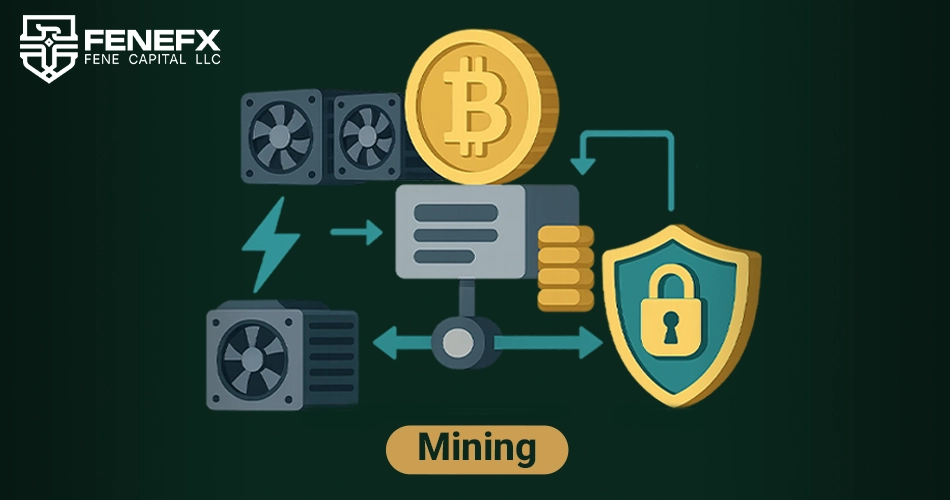
Mining
The process of adding new blocks is called mining. Miners solve complex cryptographic puzzles; the first miner to find the correct solution announces the block to the network and receives a reward. This reward consists of two components: the coinbase (newly minted bitcoins) and transaction fees included in the block. To succeed in mining competition, specialized high performance equipment known as ASICs (Application Specific Integrated Circuits) is used, which consumes significant electricity. This energy cost helps deter financially motivated attacks, as an attacker would need to purchase massive computational power.
Halving
The initial block reward was 50 BTC. However, according to Bitcoin’s code, the reward is halved every 210,000 blocks. This event is called a halving. So far, four halvings have occurred: 2012, 2016, 2020, and 2024, with the most recent reducing the reward from 6.25 BTC to 3.125 BTC. Each halving reduces Bitcoin’s daily issuance and limits the selling pressure from miners. Analysts often view this cycle as a key historical driver of Bitcoin’s price appreciation. Eventually, when the reward drops to zero (around the year 2140), miners will earn revenue solely from transaction fees.
Understanding these three elements is essential for any newcomer, as the core difference between Bitcoin and traditional money lies in these very mechanisms. In the next section, we’ll cover major historical events and Bitcoin’s price journey up to2025.
The Birth of Bitcoin: From Whitepaper to Genesis Block
On the brink of the 2008 global financial crisis, public trust in the banking system plummeted. Around the same time, a nine page document titled Bitcoin: A Peer to Peer Electronic Cash System was published on a cryptography mailing list. The paper’s author, using the pseudonym Satoshi Nakamoto, remains anonymous to this day. In this whitepaper, an algorithm was outlined that combined public key cryptography, blockchain structure, and proof of work to solve the problem of double spending digital money without relying on a central institution.
Less than three months later, on 3 January 2009, Nakamoto released the Bitcoin client on an open source repository, and the Genesis Block the network’s first block was mined. Embedded in the block’s text was a headline fromThe Timeswarning about a second bank bailout package:
“Chancellor on brink of second bailout for banks” a symbolic message highlighting Bitcoin’s political mission: resisting unbacked monetary systems.
From that moment, the Bitcoin network began updating automatically every ten minutes, and no central authority could halt the chain. The public release of the source code allowed for independent review and permissionless replication by any developer a key factor that led to the early growth of the community and gave Bitcoin its censorship resistant nature.
The Network’s First Transaction: 10 BTC from Satoshi to Hal Finney
Just nine days after the network launched, on 12 January 2009, the first ever Bitcoin transaction between two individuals was recorded. Satoshi Nakamoto sent 10 bitcoins to Hal Finney, a programmer with a deep interest in cryptography and one of the first people to download the software. Finney promptly announced on his personal blog that he had received and run the software, and reported the transaction as a successful test.
The significance of this event was that it demonstrated a peer to peer transaction could occur without any intermediary and be confirmed by miners, then recorded on the blockchain. On the technical layer, the transaction consisted of a simple input with Satoshi’s digital signature, and one output to Finney’s public address a signature generated with a private key and verifiable with the corresponding public key.
From an economic standpoint, the 10 BTC transferred had nearly zero dollar value at the time. However, that small transaction showcased the potential of the technology to build independent monetary networks. In the years that followed, Hal Finney continued to contribute to Bitcoin’s development and testing, often discussing the need to optimize fees and block confirmation times efforts that later influenced improvements to Bitcoin Core and paved the way for alternative clients.
The First Commercial Purchase: The “Pizza Day” Story and the Emergence of Market Value
Until mid 2010, Bitcoin was mostly traded in online forums and didn’t have a stable price. On 22 May 2010, Laszlo Hanyecz, a software developer in Florida, proposed that someone order him two pizzas in exchange for 10,000 BTC. A fellow forum member accepted the offer and delivered the pizzas to Hanyecz’s home.
This transaction was the first time Bitcoin was used to buy a physical good, proving that it could be used within the real economy. At that time, 10,000 BTC was worth about $40, but the deal became a turning point that gave Bitcoin its first real market value.
Afterwards, forum users began suggesting conversion rates so that buyers and sellers could agree on a spot price. These discussions laid the groundwork for the creation of the first centralized exchanges, which were launched a few months later.
Bitcoin Pizza Day also sparked a new understanding of Bitcoin’s future scarcity. With its limited supply and scheduled halvings, the number of bitcoins in circulation would grow slowly, implying that each unit could represent greater potential value. Since then, May 22 is celebrated annually by the crypto community as Bitcoin Pizza Day, a reminder that even the smallest transactions can help shape the path of the digital economy.
Bitcoin History from 2009 to 2025
The Beginning: 2009 to 2012
Bitcoin was launched in January 2009 with the mining of the first block by Satoshi Nakamoto. The first transaction took place between Satoshi and Hal Finney. In 2010, Laszlo Hanyecz became the first person to use Bitcoin to purchase goods (two pizzas). That same year, the first exchanges were launched, and Bitcoin's price gradually reached around $1. In 2012, the first halving event occurred, reducing the mining reward from 50 to 25 bitcoins.
Gaining Public Attention: 2013 to 2015
In 2013, the financial crisis in Cyprus led to increased attention to Bitcoin, pushing its price up to nearly $1,000. However, after the hacking of the Mt. Gox exchange in 2014, the market crashed and the price dropped to around $200. During this period, developers focused on improving security and scalability.
Massive Surge: 2016 to 2017
The second halving took place in 2016. A year later, with rising demand and the launch of Bitcoin futures on the Chicago Mercantile Exchange (CME), the price surged to nearly $20,000. This growth attracted more investors to the market but was followed by a sharp correction.
Consolidation and Maturity: 2018 to 2020
In 2018 and 2019, the price declined and remained volatile, but technological advancements such as the Lightning Network began to take shape. In 2020, the COVID 19 crisis and the entry of companies like Tesla into the market drove prices higher and increased Bitcoin’s credibility. By the end of the year, the price reached around $29,000.
A Period of Records and Challenges: 2021 to 2023
In 2021, Bitcoin's price peaked at around $69,000. However, rising interest rates and the collapse of major exchanges like FTX in 2022 triggered a market correction, with the price dropping to around $16,000. By 2023, market activity became calmer and more stable.
Institutional Transformation: 2024 to 2025
In 2024, the fourth halving occurred, coinciding with the approval of the first Bitcoin ETFs in the United States. These developments led to a renewed price rally. By mid 2025, Bitcoin has been trading in the range of$55,000 to $70,000, with growing institutional adoption.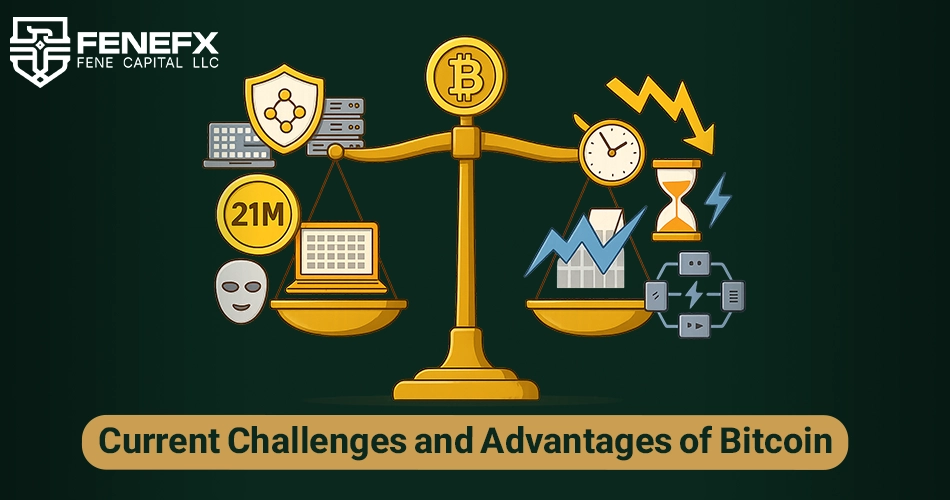
Current Challenges and Advantages of Bitcoin
Over the past decade, Bitcoin has managed to secure a significant position in the global financial system. However, this journey has come with both opportunities and limitations that still persist today.
In terms of advantages, Bitcoin’s most important feature is its decentralized nature. No institution or central government controls the network, which enables peer to peer asset transfers without intermediaries. Additionally, its limited supply (21 million units) ensures that, unlike traditional currencies, it is not subject to inflation caused by excessive money printing.
Transparency is another key strength of Bitcoin. All transactions are publicly and permanently recorded on the blockchain. At the same time, wallet ownership is not tied to users’ real world identities, which helps preserve a degree of user privacy.
However, there are also notable challenges. One of the biggest is extreme price volatility, which can make decision making difficult for users and investors. Additionally, during times of high network congestion, transactions may be delayed and carry high fees.
Another issue is scalability the network’s limited capacity to process a large number of transactions in a short time. Although solutions such as the Lightning Network are being developed, this issue has not yet been fully resolved.
Comparative Table of Bitcoin’s Advantages and Challenges
| Advantages | Challenges |
| Decentralized and free from central control | High price volatility |
| Limited supply and resistant to inflation | Limited scalability |
| Transparency and permanent transaction records | High fees during peak times |
| Relative preservation of user privacy | Lack of clear regulations in many countries |
How Is Bitcoin Mined?
The process of Bitcoin mining refers to the activity in which new transactions are verified and recorded on the blockchain. This is done by machines with high computational power that continuously solve complex mathematical problems.
In fact, miners generate new blocks by performing cryptographic calculations. Each time a valid block is added to the network, the corresponding miner receives a specific amount of Bitcoin as a reward. This reward was initially 50 bitcoins, but according to the network’s programmed schedule, it is halved every four years (halving). Currently, the reward is 3.125 bitcoins.
In addition to the block reward, miners also receive the transaction fees included in the block. This serves as an incentive to keep the mining process going even after new bitcoin issuance ends.
Using regular computers or graphics cards is no longer cost effective for mining Bitcoin. Today, the process is carried out exclusively with specialized machines called ASICs, which are designed for one specific task: solving the equations of the Bitcoin network.
Bitcoin mining requires a large amount of energy and is often conducted in countries with low electricity costs and suitable industrial infrastructure. Due to high electricity consumption and environmental concerns, some countries have implemented specific regulations for mining operations.
Overall, mining plays a key role in the security and stability of the Bitcoin network. Without it, transaction verification and the continued existence of the blockchain would not be possible.
Comments
Any chance you could do a follow-up on how bitcoin mining actually works? The proof-of-work bit went over my head a little.
Really well written, enjoyed the timeline part.
Good overview, but you kinda glossed over Mt. Gox. That collapse shaped exchange regulation more than anything Satoshi wrote imo.
Okay the halving concept finally makes sense to me now. I'd read three other articles and stayed confused, so thanks for this.
I bought my first BTC in 2017 right before the crash and panic sold at the bottom. Reading the history section reminded me how many cycles this thing has actually survived.