
The Dollar Symbol (Index) in Forex and Its Role
The U.S. Dollar Index is one of the most important tools for measuring the economic strength of the United States and one of the primary drivers of global financial markets; a tool that nearly all professional traders in Forex, crypto, gold, and commodities consider as the compass of their analysis. If you want to understand why gold suddenly falls, why EUR/USD turns bullish, or why the U.S. stock market experiences sharp volatility, the answer should be sought in the movements of the Dollar Index. This index not only defines the direction of capital flows, but is also regarded as one of the most reliable benchmarks for forecasting the future behavior of markets. In this article, we examine the Dollar Index from basic to advanced levels; from its history and calculation method to trading approaches, its impact on assets, and the strategies that traders actually use.
Introduction to the Dollar Index, Its History, and a Review of Trading Symbols (DXY and USDX)
The U.S. Dollar Index (U.S. Dollar Index) is one of the most important economic indices in the world, measuring the value of the U.S. dollar against a basket of six major currencies. This index, as a benchmark for assessing the strength of the dollar in global markets, plays a key role in analyzing trends in Forex, gold, oil, and other dollar denominated assets. Professional traders use this index to forecast the movement of dollar based currency pairs and identify trading opportunities.
History of the Dollar Index
The history of the Dollar Index dates back to 1973, when, following the collapse of the Bretton Woods system, global currencies shifted from fixed exchange rates to floating rates. During this period, the Federal Reserve introduced the Dollar Index as a benchmark for measuring the value of the dollar relative to other major currencies. The base value of this index was set at 100, and since then, economic fluctuations, financial crises, and U.S. monetary policies have had a direct impact on its movement. The Dollar Index specifically incorporates changes in the euro, Japanese yen, British pound, Canadian dollar, Swedish krona, and Swiss franc with predetermined weights in its calculations, with more than half of the index’s influence attributed to the euro.
Review of Dollar Index Trading Symbols (DXY and USDX)
In financial markets, the Dollar Index is commonly known by the symbols DXY and USDX. The DXY symbol is more widely used on analytical platforms and Forex charts, allowing traders to closely monitor fluctuations in the U.S. dollar. The USDX symbol is mainly seen in futures contracts on the ICE exchange and other regulated markets. Both symbols represent the same index, but depending on the type of trade and the platform used, one may be more common than the other. Familiarity with these symbols is essential for traders, investors, and financial market analysts, as a clear understanding of dollar movements is the key to successful trading decisions and effective risk management strategies.
How to Trade the U.S. Dollar Index via CFDs, Futures, and ETFs
The U.S. Dollar Index (DXY) is one of the key indices for Forex traders and global investors. Trading this index allows you to profit from fluctuations in the U.S. dollar against other major currencies without directly entering the foreign exchange market. To trade the Dollar Index, several instruments are available, including CFDs (Contracts for Difference), futures contracts, and Exchange Traded Funds (ETFs). Each method has its own advantages, limitations, and risks, and choosing the appropriate instrument depends on your experience, capital, and trading style. Below, each method is examined in detail:
Trading the Dollar Index via CFDs
In CFD (Contract for Difference) trading, you do not own the underlying Dollar Index itself; instead, you trade based on its price movements. This method allows traders to open larger positions with relatively small capital and profit from both rises and falls in the value of the U.S. dollar. The use of leverage in CFD trading is one of its most attractive features; however, it also involves high risk, and traders must carefully set their stop loss and take profit levels. CFDs are suitable for those who want to operate in the Forex market in the short term with high flexibility and can quickly provide access to trading opportunities.
Trading the Dollar Index via Futures
Dollar Index futures contracts are traded on the Chicago Mercantile Exchange (CME) and are primarily used by professional investors and financial institutions. In this method, the trader enters into a standardized contract to buy or sell the index at a specified date in the future. Futures contracts offer high liquidity and, due to their standardized terms, provide the ability to hedge against U.S. dollar fluctuations. This method is more complex for beginners and requires greater capital; however, for those with sufficient risk management experience, it creates more professional and potentially profitable opportunities.
Trading the Dollar Index via ETFs
Exchange Traded Funds (ETF s) provide a simple and relatively low risk way to invest indirectly in the Dollar Index. For example, funds such as the Invesco DB USD Index Bullish Fund (UUP) allow investors to gain exposure to the value of the U.S. dollar without the need for direct trading. This method is suitable for long term investors and reduces the complexity and risks associated with direct trading. However, the potential returns are generally lower than those achieved through leverage in CFDs or futures, and fund management fees can affect overall performance. ETFs are considered an appropriate option for those who wish to participate in the Forex market in a stable manner with minimal complexity.
How Is the U.S. Dollar Index (DXY) Calculated and Which Currencies Play a Role in It?
The Dollar Index consists of six major currencies that contribute to the calculation of this index with different weighting coefficients:
- Euro (EUR) – 57.6%
- Japanese Yen (JPY) – 13.6%
- British Pound (GBP) – 11.9%
- Canadian Dollar (CAD) – 9.1%
- Swedish Krona (SEK) – 4.2%
- Swiss Franc (CHF) – 3.6%
How the Value of the Dollar Index Is Calculated and Its General Formula
The Dollar Index is calculated as a geometric weighted average of the value of the six currencies listed above against the U.S. dollar. Its general formula is as follows:
The Difference Between the Dollar Index and the Direct Exchange Rates of Dollar Currency Pairs
- DXY is a composite index that measures the value of the U.S. dollar against a basket of currencies, whereas currency pairs such as EUR/USD, GBP/USD, and USD/JPY show only the relationship between the dollar and a single specific currency.
- DXY is mainly influenced by the euro (since it accounts for more than 50% of its weight), while other currency pairs do not have an equal impact on it.
Why Is the U.S. Dollar Index (DXY) Important for Forex Traders?
The U.S. Dollar Index is one of the most important economic indicators in the Forex market. Traders use it to assess the strength or weakness of the U.S. dollar and to determine the direction of dollar based currency pairs.
The Impact of the Dollar Index on Major Currency Pairs Such as EUR/USD, GBP/USD, and USD/JPY
- EUR/USD: It has an inverse relationship; an increase in the Dollar Index usually leads to a decline in EUR/USD.
- GBP/USD: It has a similar effect to EUR/USD but is also influenced by domestic UK policies.
- USD/JPY: It usually has a direct relationship with the Dollar Index; an increase in DXY typically causes USD/JPY to rise.
The Relationship Between the Dollar Index and Gold, Oil, and Other Major Macroeconomic Assets
- Gold (XAU/USD): It has an inverse relationship; an increase in the Dollar Index generally leads to a decrease in gold prices.
- Crude Oil: It has a negative relationship, as oil is priced in U.S. dollars.
- Stock Market: An increase in DXY usually puts pressure on U.S. equity markets.
How Can the Dollar Index Be Used to Analyze Financial Markets?
The Dollar Index is one of the key tools for analyzing financial markets, and traders can use it to identify macroeconomic trends, recognize trading opportunities, and examine its impact on other assets. Below, we review how this index is used in financial analysis.
How to Use the Dollar Index to Identify Macro Trends in the Forex Market
The Dollar Index can help traders identify major trends in the U.S. economy and their impact on other currencies. An increase or decrease in the Dollar Index can provide clues about the overall condition of the Forex market.
- If the Dollar Index is in an uptrend, currency pairs such as EUR/USD and GBP/USD are likely to decline. A strong dollar indicates U.S. economic growth and contractionary Federal Reserve policies, which lead to a decrease in the value of other currencies against the dollar.
- Conversely, if the Dollar Index is in a downtrend, currency pairs such as EUR/USD and GBP/USD are likely to rise. This usually occurs when expansionary policies are implemented in the United States or when weak economic data is released, putting pressure on the dollar.
By using the Dollar Index, traders can gain a better understanding of the overall market direction and make their trading decisions based on a combination of technical and fundamental analysis.
The Relationship Between the Dollar Index and Capital Flows Between Safe Haven and Risky Assets
One of the key characteristics of the Dollar Index is its relationship with capital flows between safe haven assets and risky assets.
- During periods of economic crises or global recessions, the U.S. dollar tends to strengthen, as investors seek safe haven assets. In such conditions, assets like gold and the Japanese yen also usually rise.
- During periods of economic expansion and growth in equity markets, the Dollar Index may decline, as capital flows move away from the dollar toward riskier assets such as stocks, oil, and commodities.
- This relationship helps traders adopt more effective strategies for capital and risk management during times of instability in financial markets.
Examining the Impact of the Dollar Index on Emerging Market (EM) Currencies
Emerging market currencies (such as the Turkish lira, Mexican peso, Brazilian real, and Indian rupee) are typically highly influenced by the Dollar Index.
- When the Dollar Index rises, emerging market currencies usually weaken. This is because international investors tend to convert their assets into U.S. dollars and avoid investing in developing countries.
- Conversely, when the Dollar Index declines, emerging market currencies strengthen. Under these conditions, more foreign capital flows into these countries, leading to an increase in the value of local currencies.
Traders who seek to trade emerging market currencies in Forex should closely monitor the Dollar Index, as its movements can have a significant impact on the value of these currencies.
How Can an Increase or Decrease in the Dollar Index Indicate Changes in the Global Economy?
The Dollar Index, as one of the most important global economic indicators, can provide valuable information about the state of the global economy, monetary policies, and changes in liquidity across financial markets.
- An increase in the Dollar Index usually indicates a reduction in global liquidity and contractionary Federal Reserve policies. This can lead to slower global economic growth and put pressure on equity and commodity markets.
- A decline in the Dollar Index typically signals increased risk appetite and expansionary policies. This environment is generally favorable for riskier assets such as stocks, oil, gold, and cryptocurrencies.
As a result, traders and investors can analyze the trend of the Dollar Index to forecast the potential direction of financial markets and make more informed trading decisions.
What Factors Drive Movements in the Dollar Index?
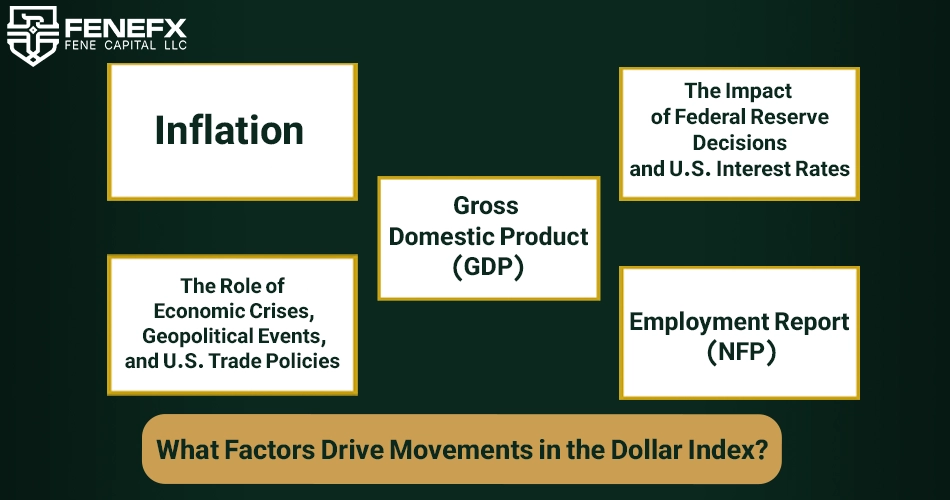
The U.S. Dollar Index (DXY) is influenced by multiple factors that can change its value in financial markets. These factors include Federal Reserve monetary policies, key economic data, economic and geopolitical crises, and U.S. trade policies. Professional traders closely monitor these variables in order to anticipate dollar fluctuations and make better trading decisions.
The Impact of Federal Reserve Decisions and U.S. Interest Rates on the Dollar Index
The Federal Reserve (Fed), as the central bank of the United States, plays a decisive role in the value of the dollar. The institution’s decisions regarding interest rates and monetary policy can have a direct impact on the Dollar Index. When the Federal Reserve raises interest rates, the dollar typically strengthens, as higher interest rates create greater appeal for foreign investors and increase demand for the dollar. Conversely, interest rate cuts can weaken the dollar, as investors seek assets with higher returns. In addition, expansionary monetary policies such as bond purchases and increased liquidity generally reduce the value of the dollar, while contractionary monetary policies tend to strengthen it.
The Impact of Key Economic Data Such as Inflation (CPI), Gross Domestic Product (GDP), and Employment (NFP)
One of the most important variables affecting the Dollar Index is U.S. economic data. Inflation (CPI), Gross Domestic Product (GDP), and employment figures (NFP) are three key indicators that determine the direction of the Dollar Index.
Inflation (CPI – Consumer Price Index)
Inflation reflects changes in the prices of goods and services. If the inflation rate rises, expectations for interest rate hikes also increase, which tends to strengthen the dollar. Conversely, declining inflation may force the Federal Reserve to adopt accommodative policies, which can weaken the value of the dollar.
Gross Domestic Product (GDP)
This is another important economic indicator that reflects economic growth. An increase in GDP usually signals a strong economy and leads to a rise in the value of the dollar. If economic growth slows or signs of recession emerge, the dollar may weaken, as investors move toward safer assets such as gold.
Employment Report (NFP – Non Farm Payrolls)
The employment report also has a significant impact on the Dollar Index. If employment levels increase and the unemployment rate declines, the economy appears stronger, and the likelihood of interest rate hikes rises, which is favorable for the dollar. Conversely, if the unemployment rate increases and employment figures decline, the dollar may come under pressure.
The Role of Economic Crises, Geopolitical Events, and U.S. Trade Policies in Dollar Index Volatility
In addition to economic data and Federal Reserve policies, the Dollar Index is influenced by global economic and geopolitical crises. During periods of economic uncertainty or global recession, investors tend to move toward the dollar as a defensive strategy, as it is considered a safe haven asset. For this reason, during times of geopolitical tensions such as wars or economic crises, demand for the dollar increases and the index rises.
On the other hand, U.S. trade policies can also have a direct impact on the value of the dollar. For example, trade wars and the imposition of new tariffs can affect capital flows and U.S. exports, ultimately leading to fluctuations in the Dollar Index.
The Best Strategies for Trading the Dollar Index in Forex
Traders in the Forex market use various strategies to profit from changes in the Dollar Index. Three common strategies include trend trading, reversal trading, and spread trading, which are applied depending on market conditions and the trader’s trading style.
Trend Trading: How to Profit from Bullish and Bearish Trends in the Dollar Index
In this approach, traders aim to follow the main trends of the Dollar Index. If the Dollar Index is in an uptrend, traders may sell currency pairs such as EUR/USD and GBP/USD and instead invest in USD/JPY and USD/CHF. Conversely, when the Dollar Index is in a downtrend, traders may buy EUR/USD and GBP/USD to benefit from the weakening of the U.S. dollar.
Reversal Trading: Identifying Key Reversal Points in the Dollar Index
Reversal trading is based on identifying overbought and oversold levels. Traders use indicators such as RSI and MACD to detect potential reversal points. If the Dollar Index reaches a strong resistance level and shows signs of a bearish reversal, traders may look to sell the Dollar Index. Conversely, if the Dollar Index reaches a key support level and bullish reversal signals are observed, traders may consider long positions.
Spread Trading: How to Benefit from the Price Differences Between the Dollar Index and Other Assets
In spread trading, traders take advantage of price differences between the Dollar Index and other assets such as gold, silver, and oil. For example, when the Dollar Index rises, gold prices usually fall, and vice versa. Traders use this inverse relationship to open two sided trades.
For professional traders who seek access to advanced tools and precise risk management, prop trading offers a unique opportunity. By using prop firm accounts, traders can enter the market with larger capital and controlled leverage, allowing them to profit from movements in the Dollar Index and other assets. This approach is considered a professional and relatively low risk opportunity, especially for prop traders and those who want to practically test their technical and fundamental strategies.
The Relationship Between the Dollar Index and Other Financial Markets and Commodities
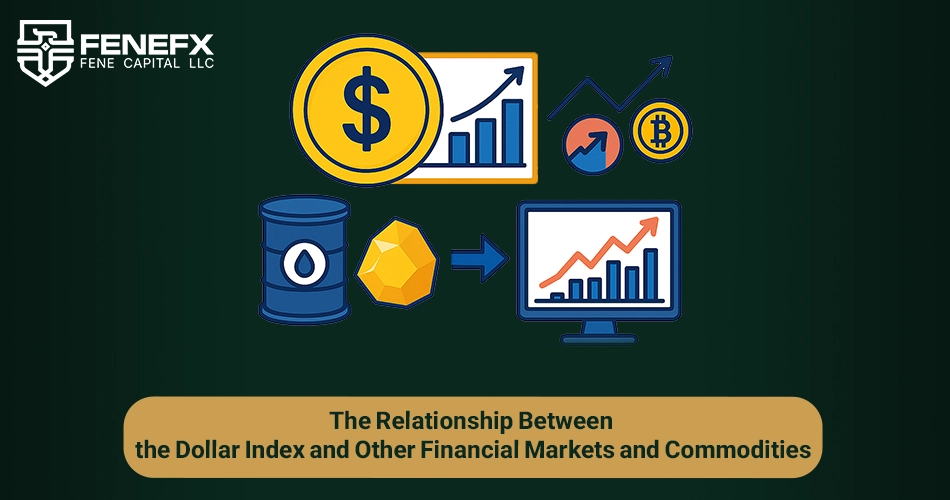
The Dollar Index has a broad impact on various financial markets. In particular, its relationship with gold, oil, the U.S. stock market, and cryptocurrencies is highly significant.
The Impact of the Dollar Index on Gold and Oil Prices
The relationship between the Dollar Index and gold is usually inverse. An increase in the value of the dollar typically leads to a decline in gold prices, as gold becomes more attractive as a safe haven asset during periods of dollar weakness.
With regard to crude oil, an increase in the Dollar Index also tends to push oil prices lower, because oil is priced in U.S. dollars in global markets. When the value of the dollar rises, the cost of purchasing oil becomes more expensive for other countries, leading to reduced demand and, consequently, lower oil prices.
The Correlation Between the Dollar Index and the U.S. Stock Market
The Dollar Index has a direct impact on U.S. multinational companies. A rising Dollar Index can reduce the profitability of these companies, as their exports become more expensive. Conversely, a decline in the Dollar Index is usually beneficial for the stock market.
The Impact of Dollar Index Fluctuations on the Cryptocurrency Market
Cryptocurrencies, especially Bitcoin (BTC), usually have an inverse relationship with the Dollar Index. When the value of the U.S. dollar declines, the price of Bitcoin and other cryptocurrencies may rise, as investors look for alternative assets.
If you are looking for real experience in the world of professional trading, the Fenefx prop account is an ideal option for you. With this account, you can easily trade the Dollar Index and other assets, benefit from larger capital, and enhance your skills in a controlled environment. Take action now to purchase a prop from Fenefx and start professional trading.
Final Conclusion
The U.S. Dollar Index (DXY) is a key tool for analyzing the value of the dollar and the direction of financial markets. Trading it through CFDs, futures contracts, and ETFs enables profit opportunities and risk management, while its impact on currency pairs, gold, oil, and emerging market currencies is of high importance. Becoming familiar with proper trading methods and suitable strategies, along with effective risk management and trade timing, helps traders make smarter and more profitable decisions in the Forex market.
Frequently Asked Questions (FAQ)
1. What is the U.S. Dollar Index and why is it important?
The U.S. Dollar Index measures the value of the U.S. dollar against six major global currencies and is important for analyzing Forex trends and economic impacts.
2. How can the Dollar Index be traded?
The Dollar Index can be traded through CFDs, futures contracts, and ETFs, each with its own advantages and risks.
3. What impact does the Dollar Index have on EUR/USD and gold?
An increase in the Dollar Index usually leads to a decline in EUR/USD and lower gold prices, while a decrease in the Dollar Index has the opposite effect.
4. What is the best method for risk management when trading the Dollar Index?
Using stop loss orders, setting appropriate position sizes, maintaining a proper risk to reward ratio, and adhering to a trading strategy are the best risk management practices.
Comments
Kept seeing analysts mention 'the DXY' and just nodding along without a clue. Now the inverse relationship with gold finally makes sense. Thanks for keeping it simple.
Good primer. My tip: use DXY as a filter, not a signal. If the index is sitting at a major level, I skip counter-trend setups on the majors entirely — saves me from a lot of bad entries.
I traded EUR/USD for months without ever glancing at the dollar index, then wondered why my bias kept being wrong. Adding DXY as a second chart honestly changed how I trade.
Concise and useful, cleared up years of casual confusion.
Given how euro-heavy the DXY basket is, wouldn't a trade-weighted dollar index be a better gauge? Would enjoy an article comparing the two.