

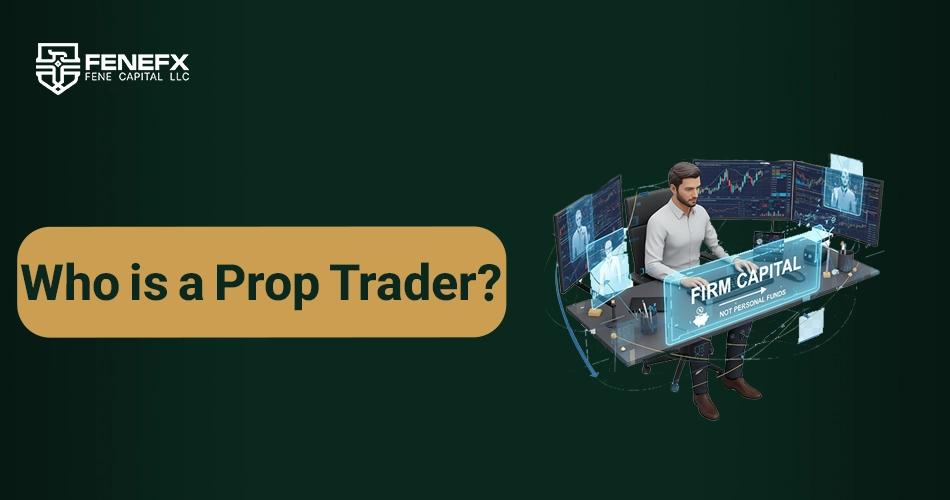
Who is a Prop Trader?
Trading is no longer exclusive to those who possess large amounts of capital. Today, a new model called Proprietary Trading (Prop Trading) is spreading rapidly across the globe, allowing traders to enter the market using professional firms’ capital, relying solely on their own skills and knowledge, and share in the profits from trades. This model has not only removed barriers to market entry but has also created significant financial and career growth opportunities for traders. In this article, we will thoroughly examine who a prop trader is, how this model works, what skills it requires, and why it can be one of the most profitable career paths in financial markets. If you are looking for a smart way to enter the world of trading without financial risk, this guide is written precisely for you.
Who is a Prop Trader and What Do They Do?
A prop trader (short for proprietary trader) is a professional in the financial markets who trades using the capital of an investment firm or a prop trading company, rather than personal funds.
In this arrangement, the trader operates with the firm’s money instead of their own and shares a portion of the profits from trades with the company.
This approach not only reduces the trader’s financial risk but also provides access to larger amounts of capital and the potential for substantial earnings.
In essence, prop trading serves as a bridge between trading skill and access to capital when one possesses the necessary expertise, the lack of personal funds is no longer a barrier to growth.
Definition of a Prop Trader in Simple Terms
In simple terms, a Prop Trader is a trader who does not trade with their own money.
Instead of providing capital from their own pocket, they enter the market using the funds of Proprietary Trading Firms, and in return for their performance, they receive a share of the profits.
For example, a prop firm may provide you with $100,000 in trading capital to trade in Forex, stocks, or crypto. If you make a profit of say $10,000 you might receive 80% of it ($8,000) while 20% goes to the firm.
The important point is that these firms do not only provide capital; they also support the trader through supervision, analysis, professional tools, and a support team to help them perform at their best. This collaboration creates a win–win situation: the company benefits from your skill, and you benefit from its capital and resources.
Difference Between a Prop Trader and a Retail Trader or Individual Investor
Many people assume that a prop trader is the same as a regular trader, but there are fundamental differences between the two:
1.Source of Capital:
A retail trader uses their own funds and bears the full risk of loss.
A prop trader trades with the company’s capital and has no direct financial risk.
2.Profit Sharing:
In personal trading, profits and losses belong entirely to the individual.
In proprietary trading, profits are shared between the trader and the firm.
3.Structure and Rules:
A prop trader must follow the company’s risk parameters, limits, and objectives, while a retail trader enjoys greater freedom.
4.Access to Resources:
Prop traders typically have access to professional infrastructure, fast servers, analytical tools, and support teams resources that most individual traders do not possess.
In short, a Prop Trader is a professional trader who operates in a structured environment using third party capital.
How Does the Prop Trading Business Model Work?
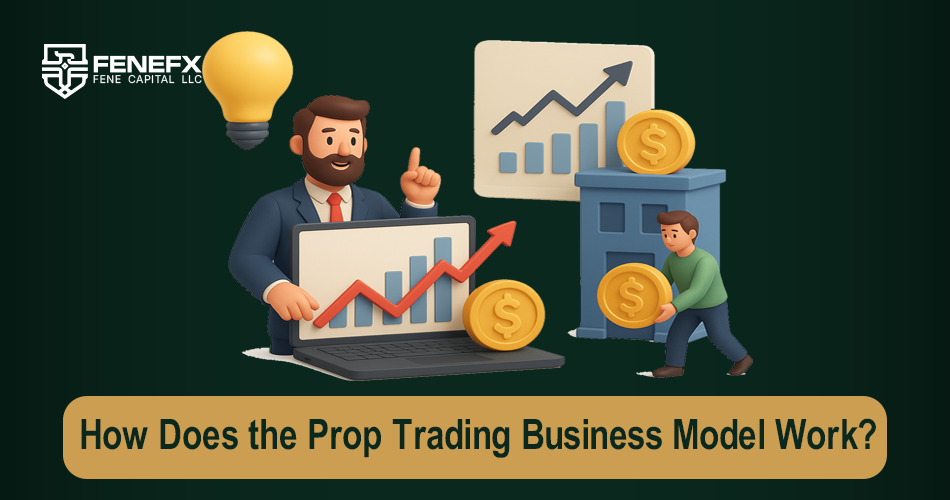
To better understand the role of a prop trader, it’s essential to know how prop firms operate and how this collaboration is structured. The prop trading business model is built on one simple principle:
Trader’s Skill + Company’s Capital = Shared Profit
Prop firms identify talented traders and provide them with capital to trade in the market. In return, the firms take a percentage of the profits. This model is profitable for both sides, the company and the trader, because it eliminates the need for the trader to have initial capital.
How Prop Firms Collaborate with Traders
The collaboration process between prop firms and traders usually includes the following stages:
1.Registration and Plan Selection:
The trader first registers with a prop firm and chooses the desired account type or trading plan.
2.Initial Evaluation:
To verify the trader’s skill level, the firm places them in an evaluation phase or challenge.
3.Capital Allocation:
After passing the evaluation, the company provides the trader with a specific amount of capital (for example, $50,000 or $100,000) to trade with.
4.Professional Trading:
The trader begins trading using the company’s funds and follows predefined rules, such as risk limits or profit targets.
5.Profit Sharing:
At the end of the trading period or once profit targets are achieved, the profits are shared between the trader and the firm.
This structure allows companies to benefit from traders’ skills without the need for formal employment, while traders can enter the market without making large personal investments.
Profit Sharing and Income Structure in Prop Trading
One of the main attractions of this model is the income potential for prop traders. Depending on each company’s policy, the profit split may vary, but typically 70% to 90% of trading profits go to the trader.
For example, if you make a $15,000 profit using a company’s $100,000 capital with an 80/20 split, you would receive $12,000, and the company would earn $3,000.
Some firms even increase the trader’s share up to 90% or more as their experience and consistent performance grow. In addition, many prop firms offer refunds of the registration fee or performance bonuses, which further increase total earnings.
How to Become a Prop Trader?
Becoming a prop trader does not require personal capital, but skill, discipline, and persistence are the most important prerequisites. To enter this field, you need to follow specific steps and prove your trading ability.
Steps to Join a Prop Firm
1.Learning and Practice:
First, you must gain the necessary knowledge in technical analysis, risk management, and trading psychology.
2.Choosing a Reputable Prop Firm:
Select firms with a solid track record, transparent rules, and consistent payouts.
3.Registration and Challenge Fee Payment:
Most prop firms charge a fee to participate in the evaluation or challenge phase.
4.Passing the Evaluation:
You must demonstrate that you can trade profitably under real market conditions while maintaining proper risk control.
5.Receiving a Live Account:
After successfully completing the evaluation, you’ll be given a real trading account funded by the company, marking the beginning of your partnership.
Common Evaluations and Challenges
Prop firms use multi stage challenges to identify the best traders. These usually consist of two main phases:
Phase 1 - Proving Profitability:
In this stage, you must achieve a specific profit target (for example, 8%) without exceeding the allowed drawdown limit.
Phase 2 - Consistency Verification:
The focus in the second phase is on maintaining profitability and adhering to risk management rules. This stage generally has a lower profit target but stricter trading conditions.
After successfully completing these stages, you are approved as a Prop Trader and can start trading in the real market using the company’s capital.
Essential Skills and Traits for Success as a Prop Trader
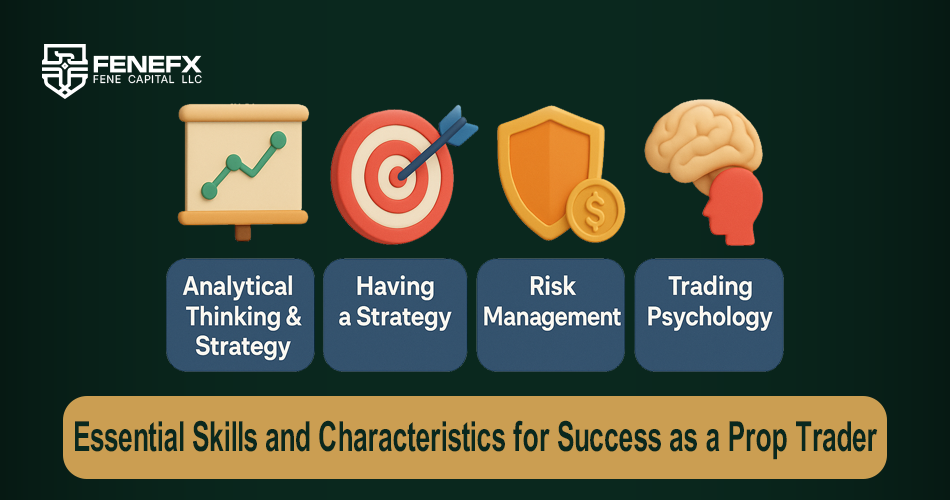
Prop trading is not just a job; it’s a combination of analytical ability, decision making, emotional control, and professional discipline. Although prop firms provide you with trading capital, your ability to manage that capital and turn it into consistent profit ultimately determines your success.
A professional prop trader is not someone who merely makes a few profitable trades, but someone who can maintain consistent performance under any market condition through thorough analysis, a clear strategy, and strong psychological control.
Analysis and Strategy
At the core of every successful trader whether independent or a prop trader lies the ability to analyze. Financial markets move based on data, news, price behavior, and collective psychology, and only those with deep analytical insight can profit from these dynamics.
A prop trader must be able to identify optimal entry and exit points using technical analysis tools, price patterns, and key indicators. However, analysis alone is not enough; a trader needs a coherent and repeatable strategy that performs well across different market conditions.
The strategy of a professional prop trader consists of a set of clearly defined rules for entries, exits, position sizing, capital management, and responses to specific scenarios. This is where the distinction between an amateur and a professional prop trader becomes clear: the amateur relies on emotions, while the professional acts based on data and predefined rules.
Ultimately, successful analysis requires experience, continuous testing, and constant learning. The market is always evolving, and a prop trader must evolve with it.
Risk Management and Trading Psychology
The biggest reason traders fail in prop trading is not a lack of analytical knowledge, but rather weakness in risk management and emotional control. When you trade with your own money, there is already psychological pressure but when trading with a firm’s capital, that pressure multiplies, because you don’t want to lose the opportunity for collaboration.
Risk management means keeping your losses small and letting your profits grow. No strategy is 100% successful, but what guarantees long term success is preventing losses from getting out of control. Professional prop traders usually risk no more than 1–2% of their capital per trade and always plan for the worst case scenario.
Alongside risk control, psychological discipline is equally crucial. Fear, greed, anger, and excitement are a prop trader’s greatest enemies. A trader who cannot stay calm during a loss, or control greed during a winning streak, will never achieve consistent profitability.
Trading psychology is the ability to make logical, well reasoned decisions even when emotions are at their peak.
Advantages and Disadvantages of Being a Prop Trader
Like any other professional path, prop trading has its advantages and disadvantages. Having a realistic understanding of these strengths and weaknesses helps you make an informed decision and choose your career path with clear insight.
Income Opportunities and Professional Growth
The greatest advantage of prop Trader Job is that you can enter global markets without initial capital and achieve significant profits based on your performance. In this model, your only valuable asset is your skill and if you have it, lack of capital will never be an obstacle.
In addition, there is no income ceiling in this profession. Unlike traditional jobs with fixed salaries, your rewards here depend directly on your results: the more profit you generate, the higher your share of the gains. Many prop traders around the world, with just a few years of experience, have reached monthly incomes of tens of thousands of dollars.
Moreover, this career offers continuous professional growth. With improved performance, you can qualify for larger trading accounts, receive higher profit shares, and even collaborate with firms as a senior trader or mentor.
Risks and Main Challenges of This Profession
Despite its many attractions, prop trading is not an easy career. The first major challenge is high psychological pressure. You are trading with capital that doesn’t belong to you, and even a small mistake in risk management can lead to termination of your collaboration. This constant awareness creates stress and anxiety, which become an inevitable part of your professional journey.
Another challenge is adhering to company rules. You cannot trade however you please. Many prop firms impose strict limitations on factors such as maximum drawdown, trading during news events, or the use of certain tools or strategies. Following these rules can sometimes feel difficult and restrictive.
In addition, consistent profitability is another major challenge. Even professional traders experience losing periods, and maintaining positive performance over time requires iron discipline and strong psychological resilience.
Comparison Between Prop Traders and Other Trading Models
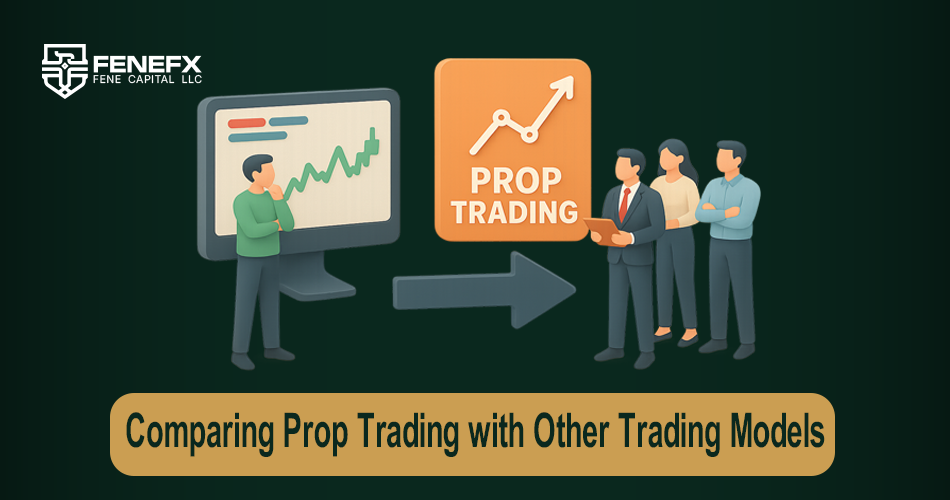
To better understand the advantages and limitations of prop trading, it is essential to compare it with other common trading models. This comparison provides a clear perspective on the nature of the profession and its position within the financial ecosystem.
Prop Trader vs. Independent Trader
The main difference between a prop trader and an independent trader lies in the source of capital and the level of risk involved. An independent trader trades with their own funds, meaning that all profits and losses belong solely to them. This offers greater freedom and flexibility but also comes with higher financial pressure, as any loss is directly borne out of their own pocket.
In contrast, a prop trader trades using the company’s capital and therefore bears no direct financial risk. However, they are required to share a portion of their profits with the firm and must adhere to specific rules and guidelines. Additionally, if their performance is poor, the partnership may be terminated.
Overall, an independent trader enjoys greater autonomy, while a prop trader benefits from faster growth opportunities and access to larger trading capital.
Prop Trader vs. Account Manager (PAMM/MAM)
An account manager or money manager typically trades using the funds of individual or institutional clients and earns either a management fee or a percentage of the profits in return. Their responsibility extends beyond generating profits; they are also accountable for preserving the client’s capital. In many countries, this role requires legal authorization or a professional license.
A prop trader, however, trades with the company’s capital rather than clients’ funds. They bear no legal responsibility toward others, focusing solely on their own trading performance. Moreover, obtaining trading capital from a prop firm is usually faster and easier than attracting private investors.
In other words, an account manager serves as an “investment manager,” whereas a prop trader is a “professional trader” who works for a company.
Examples of Well Known Prop Trading Firms Worldwide and in Iran
On a global scale, companies such as FTMO, The Funded Trader, and MyForexFunds are among the most recognized and reputable international prop trading firms. These companies provide traders with substantial capital allocations and maintain highly professional evaluation structures. However, due to sanctions and legal restrictions, most of them either do not offer services to Iranian users or have imposed strict limitations on their access. As a result, collaboration with foreign prop firms is practically impossible for many Iranian traders.
Exploring Reliable Options for Iranian Traders
For Iranian traders seeking to embark on a professional prop trading career, one of the best choices without a doubt is FeneFx. FeneFx is not only the first Iranian prop firm built with a professional structure and global standards, but in many aspects, it rivals and in some cases even surpasses its international competitors.
The company facilitates Iranian traders’ entry into global markets by offering multi stage evaluation accounts, profit splits of up to 90%, comprehensive support for Iranian users, and an advanced trading infrastructure. Furthermore, FeneFx is the only Iranian prop firm that has actively participated in prestigious international events such as Forex Expo Dubai 2025 and Money Expo India 2025, securing its place among the industry’s leading names.
If your goal is to turn your trading skills into consistent profitability, gain access to significant trading capital, and operate within a professional and secure environment, FeneFx is the ideal choice. By buying a prop from FeneFx , you not only gain access to funding but also enter a professional and international ecosystem that accelerates your journey from being an ordinary trader to becoming a professional prop trader.
Summary: From Skill to Success with Prop Trading
Prop trading is one of the most professional and intelligent paths to enter the world of financial markets, a path where your trading skills matter more than your initial capital. If you can analyze the markets effectively, follow a well defined strategy, and control your emotions, you can trade with a prop firm’s capital without any financial risk and earn a substantial income.
Today, more than ever, traders have the opportunity to turn their talent into real profit. By choosing professional platforms such as FeneFx, they can accelerate their journey toward professionalism and achieve success at a much faster pace.
Frequently Asked Questions About Prop Trading
Do I need initial capital to become a prop trader?
No. In the prop trading model, you trade using the firm’s capital, so you don’t need to provide personal funds. The only cost typically involves the evaluation or challenge phase required to qualify.
How much does a prop trader earn?
Income depends entirely on your performance. Some prop traders earn a few hundred dollars per month, while others make several thousand. The profit split usually ranges from 70% to 90% in favor of the trader.
What happens if I lose money in my trades?
As long as you comply with the risk management rules, your partnership with the firm will simply end, and your personal funds will not be affected. However, if you violate the firm’s rules, your trading account may be terminated.
Is prop trading suitable for beginners?
Although prop trading is primarily designed for professional traders, beginners can also enter this field with proper education and consistent practice. Many prop firms even offer training accounts or simplified evaluation programs tailored specifically for novice traders.
Comments
Passed my first evaluation last spring after two failed tries. Reading this earlier would've saved me some pain — I treated the challenge like my personal account and blew it fast.
Any chance of an article on how payouts actually work for funded traders? Like schedules, splits, and what happens if you breach after requesting a withdrawal.
Solid write-up, one of the clearer explanations I've read.
This cleared up so much for me. I always mixed up funded traders with people working at actual prop desks. The profit split part especially makes sense now.
Good intro, though I'd push back a bit — prop trading isn't 'free capital'. You're trading someone else's rules, and the drawdown limits change how you trade way more than people expect.