





How to Determine the Take Profit?
Take Profit, in the simplest terms, refers to the point at which a trader automatically closes a trade and secures their profit once the price reaches that level. This concept, alongside Stop Loss, is one of the fundamental principles of risk management and trading strategy in all financial markets.
Why Is Setting Take Profit Essential?
The first question that arises for a novice trader is why they must determine the take profit level before starting a trade. This matter is important from various perspectives. Firstly, setting a take profit helps the trader mentally and psychologically prepare for the trade and avoid unrealistic expectations. Without a defined take profit, the trader might follow their emotions during the trade and make wrong decisions, such as exiting the trade prematurely or greedily trying to gain more profit than the market can provide.
In fact, many traders enter trades in financial markets based solely on their “gut feeling” without having a take profit. This approach might yield some short term successes but, in the long run, leads to reduced profits and unpredictable losses.
Setting a take profit ensures that the trade is executed based on logic and a plan, not momentary emotions. When you specify the take profit, you essentially set your goal for the market and can follow your trading process with greater calmness.
On What Basis Should Take Profit Be Determined? (Separating Technical, Psychological, and Goal Oriented Approaches)

Determining take profit is not merely about choosing a random number. This process requires careful market analysis, combining technical tools, understanding market psychology, and aligning it with your trading goals. In this section, three main methods for setting take profit are discussed:
Technical Analysis
Technical analysis plays a very important role in determining take profit. For example, one of the simplest and most common methods is using support and resistance levels. Support and resistance are points where the price typically reacts and is likely to change direction. When the price approaches a resistance level, you can place your take profit at that level.
Additionally, Fibonacci tools and candlestick patterns can also help identify suitable levels for take profit. For instance, in a market that is undergoing a correction, Fibonacci can indicate the 61.8% level as an appropriate point to set take profit.
Market Psychology
Analyzing market psychology is also a crucial factor in setting take profit. The market is influenced by the collective emotions of traders and can suddenly enter phases of greed or fear. Traders should pay attention to psychological signals of the market and how it reacts at specific points.
For example, if there is a strong upward trend in the gold market, the price may continue until reaching a particular level recognized as resistance. In this case, psychological analysis can help you understand where the market is likely to quickly react with a reversal and place your take profit at that level.
Goal Oriented Approach
Here, it is important to note that every trade should have a specific goal. If you enter a trade based on a risk to reward ratio, this ratio can directly influence your take profit level. For example, if your risk is 20 pips, your target might be twice that amount (i.e., 40 pips). In this case, setting take profit based on this ratio is more logical and manageable.
Be careful that your take profit should not solely depend on psychological or technical levels. You must consider your personal goals and strategy when determining it. On the other hand, being goal oriented can help you control your risk and keep your profit within a specified range.
Technical Methods for Determining Take Profit
Using technical tools can be very effective and precise in setting take profit. In this section, the most important methods and tools widely used in financial markets for determining take profit are introduced.
Support and Resistance Levels
The simplest yet most practical technical tool for setting take profit is support and resistance levels. These levels are points where the price tends to reverse or pause. For example, when the price of an asset approaches a resistance level, you can place your take profit slightly before it. This level may act as a point for market reversal.
Fibonacci
The Fibonacci tool in technical analysis helps identify market reversal points. This tool is especially useful for setting take profit in markets undergoing corrections. Usually, after a significant move, the price retraces to Fibonacci levels such as 38.2%, 50%, and 61.8%. You can place your take profit at one of these levels.
Moving Averages
Using moving averages to determine take profit is also common. When the price crosses a moving average acting as a support or resistance level, it can signal a good point to set take profit. Especially in trending markets, moving averages act as psychological levels where take profit can be set.
Candlestick Patterns
Candlestick patterns such as the hammer, engulfing, harami, and other reversal patterns can serve as indicators for the end of a price movement and help determine take profit. If a reversal candlestick pattern forms near a support or resistance level, it can be a signal to place the take profit close to that level.
The Role of Timeframes in Determining Take Profit: From Micro to Macro Perspective
Setting take profit in market analysis is not only related to the price level but also requires attention to the timeframe used. Choosing the appropriate time frame can significantly impact the accuracy and success of your take profit determination. Many traders make the mistake of selecting timeframes that do not align with their strategy.
Impact of Long Term Timeframes on Take Profit
When entering the market on long term time frames such as daily or weekly, your goal is essentially to follow the overall market trend. In these cases, take profit should be set at more significant levels, usually including key support or resistance levels visible on these timeframes. For example, if there is a clear uptrend on the daily chart, take profit can be placed at the main resistance level observed on the daily chart.
Impact of Short Term Timeframes on Take Profit
In short term timeframes like 15 minutes or 1 hour, price movements are usually faster and more temporary. In these cases, take profit should be set according to short term price volatility and by identifying areas close to the entry point. One effective method for determining take profit in these timeframes is using internal demand and supply zones, which are clearly visible on lower time frames.
Alignment of Timeframes
For more precise take profit setting, it is better to analyze related timeframes together. For example, if you enter a trade on the 15 minute timeframe, first examine the overall trend on a higher timeframe such as 4 hours, then set your take profit according to the price structure on that timeframe. This helps avoid short term volatility and ensures your take profit aligns with the overall market trend.
In general, timeframes play an important role in determining take profit. If your timeframe is long term, take profit should be placed at long term support or resistance levels. However, in short term timeframes, take profit should be set based on key zones in the short term chart. The best approach is to combine these two perspectives.
Variable Take Profit; How to Set a Floating Take Profit?

A common mistake in setting take profit is that traders fix a static take profit level and do not change it until the end of the trade. In the real world, market conditions can continuously change, and the take profit should be adjusted flexibly and in accordance with the new conditions. This allows you to take advantage of price fluctuations while also preventing large losses.
Using Trailing Stop
An effective method for setting a variable take profit is using a trailing stop. The trailing stop automatically moves the take profit level as the price moves in your favor. This feature enables you to continuously shift your take profit to a new level if the price moves toward the target, but if the price moves against you, your position will be closed.
For example, suppose you enter a buy trade at the 1.2000 level and set your take profit at 1.2100. After the price moves to 1.2050, you can move your take profit to 1.2050. If the price continues to rise and reaches 1.2150, your take profit is moved to 1.2150.
Moving Take Profit to Break Even
Another common method for setting a variable take profit is moving the stop loss to the break even point. This means that after the price moves in your favor and reaches a certain level, you move your stop loss to the entry point. This ensures that if the market suddenly reverses, you will not incur any loss.
Scaling Out
Another method for managing a variable take profit is scaling out. This means partially closing your position. For example, if your take profit is at 1.2100, you can close part of your position at 1.2075 and keep the rest until it reaches 1.2100. This method allows you to secure part of your profit if the market moves in your favor while still benefiting from further potential movement.
In the end, setting a fixed and inflexible take profit rarely works. To succeed in the market, you need to adjust your take profit according to price movement and market conditions. Using trailing stops, moving take profit to break even, and scaling out are some useful techniques professional traders use to manage their profits.
Combining Take Profit with Risk to Reward; Decision Based on Logic, Not Wishful Thinking
Ultimately, the most important point in setting a take profit is to pay attention to the risk to reward ratio. Simply put, risk to reward refers to the ratio between the amount of risk you are willing to accept and the amount of profit you expect. This ratio should be determined based on logical and precise analysis.
Why is Risk to Reward Important?
If you seek only large profits in every trade, you will likely fall into the trap of high risk and illogical trades. On the other hand, if you aim for low risk, you may miss out on significant profits. The ideal is that risk and reward are considered proportionally to each other. For example, in a trade with a 20 pip risk, the target should be at least double that, meaning 40 pips.
How to Calculate the Risk to Reward Ratio?
To calculate the risk to reward ratio, you first need to specify your stop loss and take profit levels. For example, if your stop loss is 20 pips and your take profit is 60 pips, your risk to reward ratio will be 1:3. This means that for every unit of risk, you expect three units of reward. This ratio helps traders identify trades with a high probability of success.
The risk to reward ratio should be continuously adjusted according to market analysis and economic conditions. On the other hand, every trade should have a clear and reliable entry and exit strategy according to which the take profit and stop loss are set.
Common Mistakes in Setting Take Profit and How to Avoid Them
Setting a take profit is inherently a simple technique, but novice traders often make common mistakes that can undermine the desired outcome. In this section, common mistakes in setting take profit are addressed, and ways to prevent them for achieving better results are explained.
Choosing a Take Profit Too Far Out of Reach
One of the most common mistakes in setting take profit is choosing a price target that is too far from the current price position. This may occur due to greed or a lack of proper understanding of the market conditions. For example, a trader may enter a buy trade and set their take profit at a resistance level far beyond the main market zones. This can lead to ignoring market change conditions and the likelihood of a price reversal, especially in downtrends.
To avoid this mistake, you should set your take profit based on market analysis, key zones, and the risk to reward ratio. If you determine your take profit logically and based on market structure, the chance of such errors will decrease.
Setting Take Profit Without Considering Support and Resistance Zones
Another common mistake is that some traders set take profit without paying attention to support and resistance levels. Support and resistance levels are critical points in the market where price may pause or reverse. Setting take profit without considering these levels can cause a trader to exit a trade earlier than appropriate or miss out on significant profits.
Before setting your take profit, be sure to identify key support and resistance levels across different timeframes. These levels should be considered to ensure your take profit is placed in a price area that the market is likely to reach.
Not Aligning Take Profit with Psychological Conditions and Personal Goals
Sometimes traders change their take profit targets due to emotions, especially greed or fear. For example, when the price approaches the take profit level, a trader may arbitrarily decide to change their target because they believe the price can move further. This not only increases risk but may also reduce the final profit.
To avoid this mistake, set a clear goal and strategy for each trade. Especially for beginners, logically determining the take profit before entering the trade is very important. If emotions influence decision making, it is better to step away from the market and stick to your strategy.
Not Changing Take Profit During the Trade
Some traders set their take profit at the beginning of the trade and then make no changes to it, even if market conditions change. This can lead to missing out on greater opportunities during market movements, especially when the market is trending and the price continuously moves in the direction of the trend.
To avoid this issue, use techniques for adjusting take profit. For example, use a trailing stop to automatically move the take profit in the direction of the trend, or adjust your take profit when the price approaches key levels.
Practical Exercise: From Chart to Decision; How to Set Take Profit in Practice?
In this section of the article, a practical and understandable example of setting take profit in the real market is presented. This example includes technical analysis and the use of various tools to determine the take profit. Additionally, the chart related to the trade will be fully explained.
Practical Example: Trading the EUR/USD Currency Pair
Suppose you, as a professional trader, enter the EUR/USD market. First, you analyze the overall market trend and observe a general uptrend. Now, you want to set your take profit. In this example, we will use the daily timeframe to determine the overall trend, the 4 hour timeframe for structure, and the 15 minute timeframe for entry.
Trend Analysis on the Daily Timeframe (Daily):
First, you look at the daily chart of EUR/USD. You observe that the price is in an uptrend and has approached a major resistance area. On this timeframe, you identify a resistance level at 1.2100, where the price has repeatedly stalled in the past.
Market Structure on the 4 Hour Timeframe (H4):
On the 4 hour timeframe, you see that after a pullback to the previous support level, the market has started rising again. At this stage, you set your take profit slightly below the main resistance level, at 1.2085.
Entry and Take Profit Setting on the 15 Minute Timeframe (M15):
On the 15 minute timeframe, you observe a reversal candlestick pattern (for example, a hammer) indicating the continuation of the upward movement. Here, you enter a buy trade and place your take profit at 1.2085, where the price is likely to reach according to the trend and market structure.
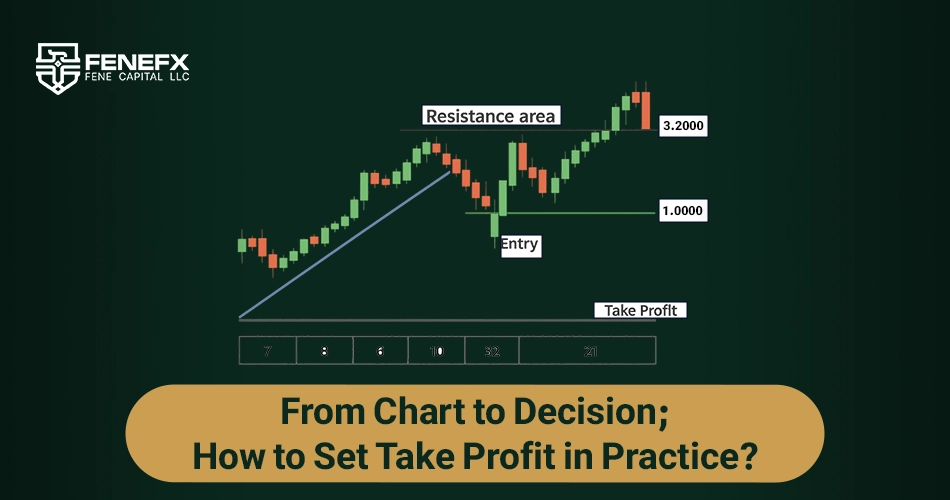
In this example, you accurately and logically determined your take profit level using multi timeframe analysis and technical tools such as support and resistance. After the price reached the desired level, your trade was closed with a profit. The most important principle in setting a take profit is that you must adhere to technical tools, market structure, and your strategy, and avoid emotional decisions.
Comments
Short, practical, no fluff. Nice one.
Decent guide, though I'd argue TP placement should come from structure first and RR second. Forcing a 1:3 onto a chart that doesn't offer it just wrecks your win rate.
I once moved my TP further away three times on the same trade because 'it looked strong'... price reversed and I closed at breakeven. Lesson learned the hard way.
Any thoughts on partial take profits? Would love a follow-up comparing scaling out vs a single fixed target.
The part about setting TP at prior support/resistance instead of a random pip count finally made this click for me. Thanks a lot.