





How to Profit in a Bear Market?
In a bear market, contrary to common belief, waiting for the next bullish reversal is not the only option. If the market is two way, such as Forex or cryptocurrencies, traders can also profit from falling prices. Tools like short selling, futures contracts, and buying put options allow traders to benefit from the decline in asset prices. Even in one way markets, such as many stock exchanges, there are indirect strategies to protect capital and generate returns.
What Is a Bear Market and What Are Its Characteristics?
A bear market refers to a period in which asset prices continuously decline over an extended timeframe. Understanding the characteristics and causes of these conditions helps traders select appropriate strategies to profit or avoid losses.
A bear market is typically defined as a situation where asset prices fall by more than 20% from their previous peak, and this downward trend continues for several weeks or months. This definition applies to stock markets, Forex, commodities, and cryptocurrencies, serving as a benchmark to distinguish between temporary corrections and a sustained bearish trend.
Signs and Causes of a Bear Market
The main signs of a bear market include continuous price declines, reduced trading volume, rising fear and distrust among investors, and the spread of negative economic news. Factors such as economic recessions, financial crises, tightening monetary policies, or geopolitical developments can trigger the beginning of a bearish trend. Another key characteristic of this period is the movement of capital away from risky assets toward safer ones such as bonds or gold.
How Bear Markets Differ from Bull Markets
In a bull market, investors are generally inclined to buy and hold assets because they expect prices to rise. In contrast, in a bear market, a more conservative approach dominates: investors liquidate their holdings or use bearish tools to profit from declining prices. Market psychology also shifts during this phase, as fear replaces greed.
Difference Between One Way and Two Way Markets in Trading

The structure of a market determines which tools traders can use to profit from price declines.
What Is a One Way Market? (e.g., Most Stock Markets)
In a one way market, traders can only profit by buying an asset and selling it later at a higher price. A prime example is many traditional stock markets. In this structure, to make gains during price declines, traders must rely on indirect instruments such as inverse ETFs or specific derivatives contracts.
What Is a Two Way Market? (e.g., Forex and Cryptocurrencies)
A two way market allows traders to profit from both directions of price movement. They can buy an asset and sell it later at a higher price (long position) or sell it first and buy it back cheaper (short position). This structure exists in markets such as Forex, commodity futures, and cryptocurrencies, offering traders greater flexibility.
The Advantage of Two Way Markets for Profiting from Price Declines
The main advantage of two way markets is the ability to enter a short position without initially owning the asset. In this case, if your analysis is correct and the price falls, you can profit from the difference between the initial selling price and the repurchase price. This feature is especially valuable in highly volatile markets, as it creates more trading opportunities.
How to Profit in a Bear Market? (Trading Methods)
In two way markets, there are several tools and trading methods that allow traders to profit from falling prices. The choice of method should depend on experience, risk tolerance, and the availability of instruments.
Short Selling and How It Works
In short selling , a trader borrows an asset from a broker, sells it immediately in the market, and later buys it back at a lower price to return it to the broker. The profit equals the difference between the selling price and the repurchase price, minus any fees or commissions. This method requires a margin account and carries significant risk, since if the asset price rises instead of falling, the potential loss can be unlimited.
Using Futures Contracts in a Bear Market
A futures contract is a binding agreement to buy or sell an asset at a specified price and date in the future. By taking a short futures position, if the price of the asset falls, the value of your contract increases, and you can close the position to secure a profit. This tool is widely used in markets such as oil, gold, stock indices, Forex, and cryptocurrencies. The risks include the need for margin management and exposure to price volatility.
Options Trading (Using Put Options or Bearish Strategies)
In options trading , buying a put option gives the holder the right to sell the underlying asset at a predetermined strike price. If the market price drops below that level, the value of the option increases. The trader can either sell the contract or exercise it.
Additionally, bearish strategies such as the bear put spread or bear call spread can help improve risk management by capping both potential profits and losses. This method is suitable for traders who want to define their risk level in advance.
Margin Trading and Leverage in Two Way Markets
Margin trading allows you to open positions larger than your own capital by borrowing funds from a broker. Leverage multiplies potential profits, but it also increases losses proportionally. In a bear market, using leverage for short trades can generate significant returns, but it must always be accompanied by stop loss orders and strict risk management to prevent heavy losses.
Investment Strategies and Risk Management in a Bear Market
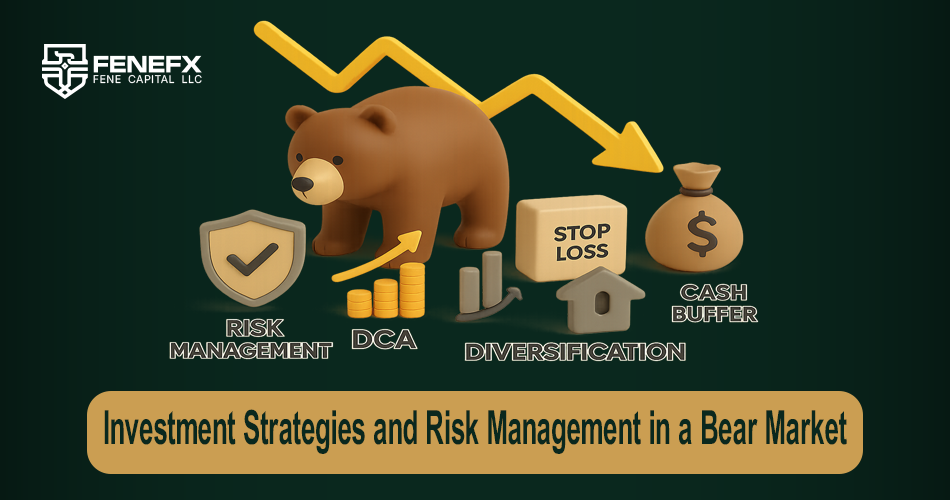
In a bear market, focusing solely on making profits can be dangerous. Risk management, capital preservation, and the use of proper tools should be every trader’s top priorities. Even professional traders aim to limit losses and achieve balanced returns in such conditions. Methods such as hedging, diversification, and setting stop loss orders are among the most essential principles on this path.
Hedging Positions
Hedging is a method in which a trader reduces the risk of their primary position by taking an opposite position. In a bear market, this can be done by buying put options, taking short positions in futures contracts, or using inverse ETFs.
For example, if you hold a stock in your portfolio and are concerned about a short term price drop, buying a put option with a strike price close to the current market price can offset your potential losses.
Portfolio Diversification
Diversification refers to spreading investments across different assets to reduce overall risk. In a bear market, holding a mix of safer assets such as bonds, gold, or other low risk instruments can help balance out the decline in riskier parts of the portfolio. Geographic and sector diversification also play an important role meaning that investing in different markets and industries can reduce the negative impact of a downturn in a specific market.
Capital Management and Setting Stop Loss Orders
Capital management is the cornerstone of long term trading success. In a bear market, using stop loss orders becomes even more critical. A stop loss should be determined based on technical analysis or as a fixed percentage of total capital. This tool helps you exit a trade before losses become irreparable.
Following the risk/reward ratio and avoiding risk of more than 1–2% of total capital in a single trade are among the most important principles of effective capital management.
Real Example of Profiting in a Bear Market
To better understand how to generate profits in a bear market, let’s review a real example of executing a bearish trade. This example includes trend analysis, selecting the right instrument, calculating profit and loss, and illustrating a payoff diagram.
Selecting the Asset and Analyzing Its Bearish Trend
Suppose the stock price of company XYZ is currently $100. After analyzing the chart and fundamental data, it becomes clear that due to a weak earnings report and negative market conditions, the price is likely to fall to $90 over the next two months.
Executing a Short Trade with Profit and Loss Calculations
Let’s assume we decide to short sell 100 shares of XYZ at a price of $100.
- Trade Entry: Sell 100 shares at $100 → receive $10,000 in cash.
- Trade Exit: Buy back the same 100 shares at $90 → cost $9,000.
- Net Profit: $10,000 − $9,000 = $1,000 (minus commissions and interest).
Profit and Loss Scenarios Table
| Closing Price of Stock | Initial Sale Amount | Repurchase Amount | Net Profit / Loss |
| $105 | $10,000 | $10,500 | −$500 |
| $100 | $10,000 | $10,000 | $0 |
| $95 | $10,000 | $9,500 | +$500 |
| $90 | $10,000 | $9,000 | +$1,000 |
| $85 | $10,000 | $8,500 | +$1,500 |
Advantages and Disadvantages of Trading in a Bear Market
Trading in a bear market offers its own unique opportunities, but without awareness of the risks, it can also be highly damaging.
| Pros | Cons |
| Ability to profit from falling prices | Unlimited risk in some methods, such as short selling |
| More opportunities in highly volatile markets | Requires greater skill and experience |
| Ability to hedge and protect portfolio risk | Potential for quick losses due to sudden market reversals |
| Wide range of instruments to implement strategies | Additional fees and costs in derivatives trading |
Professional Tips and Practical Advice for Traders in a Bear Market

Following a few key principles can increase your chances of success in a bear market and help you avoid major losses.
Choosing the Right Timing for Entering a Bearish Trade
Precise timing of entry is highly important. Using technical analysis (such as reversal patterns and support breakouts) and fundamental analysis (economic news and data) can help identify the right entry points. Entering too late may reduce potential profits or increase the risk of a market reversal.
Avoiding Excessive Use of Leverage
Although leverage can multiply profits, in a bear market with high volatility, overusing it can lead to heavy losses. It is recommended to keep leverage ratios at reasonable levels and always set stop loss orders.
Monitoring News and Macroeconomic Data
Bear markets are often directly influenced by macroeconomic factors. Tracking news related to interest rates, inflation, central bank policies, and political or geopolitical developments helps you make more informed decisions. A quick reaction to such data can make the difference between a successful trade and a heavy loss.
If you’re looking to take advantage of trading opportunities in bear markets but lack sufficient capital, FeneFx Prop could be the perfect solution. This proprietary trading firm provides funded accounts to skilled traders, allowing you to leverage your expertise in two-way markets such as Forex and crypto and profit from both rising and falling prices. By participating in FeneFx’s trading challenges and following their risk management rules, you can gain access to a live account with substantial funding and withdraw a share of your trading profits. If you’re ready to turn your trading skills into real income, start your journey now through buying a prop account and take your trading career to the next level.
Common Mistakes Traders Make in a Bear Market and How to Avoid Them
Even experienced traders may make mistakes in a bear market that lead to missed profits or increased losses. Being aware of these errors and preventing them can significantly improve your chances of success.
Not Having a Clear Exit Strategy
Many traders enter bearish positions without defining an exit point. This often results in larger than expected losses if the market suddenly reverses. Always set your stop loss and take profit levels before entering a trade.
Overleveraging
In a bear market, extreme volatility can quickly liquidate highly leveraged positions. Using excessive leverage, even with correct analysis, may result in the complete loss of capital. It is recommended to choose your leverage ratio based on capital management principles and personal risk tolerance.
Ignoring Fundamental Analysis
Some traders rely solely on technical analysis while neglecting fundamental market data. However, changes in interest rates, economic reports, and political news can either intensify or halt a bearish trend. Combining both technical and fundamental analysis provides a more comprehensive market perspective.
Overtrading
Attempting to profit from every bearish move can lead to mental fatigue and reduced decision making quality. Instead of entering multiple trades, it is better to focus on a few high quality opportunities.
Lack of Diversification in Trading Tools
Some traders rely solely on one instrument, such as short selling, while neglecting other risk management tools like hedging, buying put options, or using inverse ETFs. Utilizing a mix of tools can increase returns and reduce overall risk.
By identifying these mistakes and sticking to a disciplined trading plan, you can improve your performance in a bear market and take advantage of the opportunities this phase offers more effectively.
Final Conclusion
A bear market does not necessarily mark the end of profit opportunities; for an informed and flexible trader, it can be a platform to generate returns through a different approach. Understanding market structure, utilizing two-way trading tools such as short selling, futures contracts, and options, along with applying sound risk management and hedging principles, are the keys to success in such conditions. Ultimately, what matters most is mental discipline, adherence to strategy, and readiness to adapt to market changes. In every trend whether bullish or bearish, there are opportunities for profit, provided that you act with awareness and proper risk control.
FAQ
Can you make a profit in a bear market?
Yes, in two-way markets such as Forex and cryptocurrency, traders can profit from price declines by opening short positions.
Which tools are best for profiting in a bear market?
Tools such as short selling, futures contracts, purchasing put options, and inverse ETFs are among the most effective for this purpose.
Is using leverage recommended in a bear market?
Only if strict risk management is applied; otherwise, the risk of liquidation is very high.
How can you avoid losses in a bear market?
By setting stop-loss orders, diversifying your investment portfolio, and using hedging tools, you can minimize potential losses.
Comments
Nicely done, saving this one for the next downturn.
One thing I'd add: the hardest part of a bear market isn't finding shorts, it's position sizing. Volatility doubles and most people keep their usual lot sizes. That's what wrecks accounts.
Thanks, this finally made shorting click for me. I always thought a falling market just meant sitting on your hands until it recovers.
Would love a follow-up on hedging strategies specifically — like when it makes more sense to hedge than to just close and re-enter.
Shorted the market for the first time during the 2022 downturn and learned the hard way that bear market rallies are brutal. Wish I'd read something like this first.