
What is a Trailing Stop Loss?
A Trailing Stop Loss is one of the key tools in financial risk management that helps traders not only minimize potential losses but also protect their accrued profits. Unlike a fixed stop loss, which is set at a specific price point and remains unchanged throughout the trade, a trailing stop loss moves along with price fluctuations and adjusts itself to new market conditions. This feature allows the stop loss to shift in the direction of a favorable market move, thereby supporting the profitability of the trade.
Simply put, a trailing stop loss is a type of smart stop loss that automatically updates during upward trends in buy trades or downward trends in sell trades. As a result, if the market suddenly reverses direction, this tool can help ensure a timely exit from the market while preserving a portion of the gains. This method proves especially effective in volatile markets where price behavior is difficult to predict.
In contrast, a fixed stop loss is more suitable for those who prefer simpler trades and are not interested in constantly adjusting their positions. Meanwhile, a trailing stop loss is a more professional and reliable option for active traders and those looking to maximize returns from market fluctuations.
Why Should We Use a Trailing Stop Loss?
In financial markets, where extreme volatility can occur at any moment, having a smart tool to protect both capital and profits is essential. The Trailing Stop Loss is one of the most effective risk management tools that helps traders preserve their gains while avoiding heavy losses. Below are the main reasons for using this tool:
Automatic Preservation of Accrued Profits
When the price of an asset moves in your desired direction, the trailing stop loss automatically follows. This means that if the price suddenly reverses, you can still lock in a significant portion of your profit. This feature ensures that no gains go unprotected and helps avoid larger losses.
Reduced Stress and Psychological Pressure in Trading
Market volatility can turn rapid and constant decision making into a major challenge for any trader or investor. However, when using a trailing stop loss, there is no need for continuous monitoring. This tool automatically manages your position, leading to greater mental ease in trading and allowing you to focus on other aspects of your strategy.
Staying in Profitable Trades Until the Right Time
One common mistake among traders is exiting profitable trades too early a problem that the trailing stop loss addresses effectively. As long as the price continues in your favor, the stop loss moves along with it, allowing you to benefit from larger gains in your trades.
Flexibility in Risk Management
Unlike a fixed stop loss that needs to be manually adjusted, a trailing stop loss aligns itself with changing market conditions. This feature allows you to manage your capital and trades more effectively, whether you’re in a calm market or facing high volatility and risk.
A Smart Tool for Both Professional and Beginner Traders
The trailing stop loss combines profit protection, stress reduction, optimal trend utilization, and flexibility in risk management. For this reason, whether you are a novice trader or an experienced professional, using this tool can be a crucial step toward financial success.
Types of Trailing Stop Loss and Their Applications
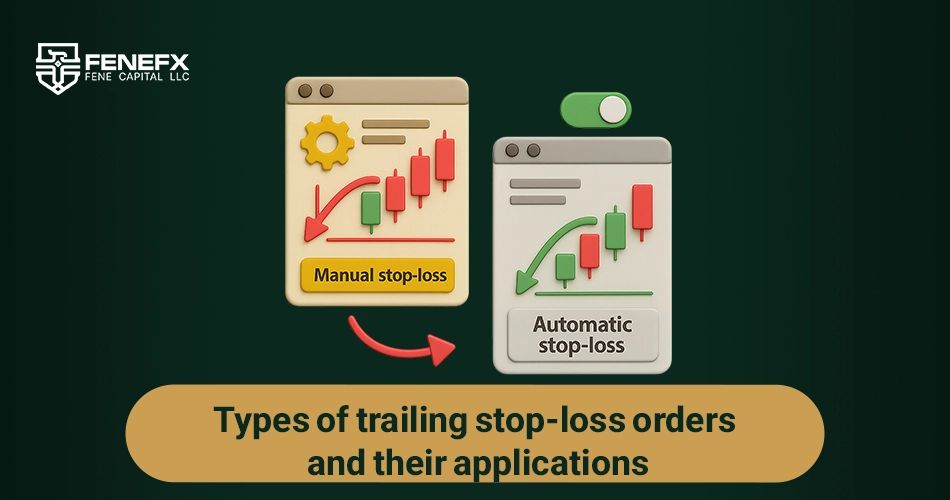
Trailing stop losses are generally divided into two main categories: manual trailing stop loss and automatic trailing stop loss. Each of these methods has its own features and applications, and depending on your trading style and strategy, one may be more suitable than the other.
Manual Trailing Stop Loss: Direct Trader Control Over Risk
In the manual trailing stop loss method, the trader actively and directly adjusts the stop loss according to price changes. In other words, whenever the price of your asset increases, you can manually move the stop loss to a higher level to lock in profits and reduce the risk of loss. This method is especially suitable for professional traders and those proficient in technical analysis.
The main advantage of a manual trailing stop loss is the full control it gives the trader over stop loss settings, enabling more precise decision making. However, it requires constant market monitoring, and the potential for human error in setting the stop loss can increase trading risks.
Automatic Trailing Stop Loss: A Smart Solution for Profit Protection
The automatic trailing stop loss, also known as a Trailing Stop Order, is a tool that automatically adjusts the stop loss in line with the asset's price movements. In this method, the trader sets a predefined distance either as a percentage or a fixed amount between the current market price and the stop loss. The system then automatically moves the stop loss upward as the price rises. However, if the price starts to decline, the stop loss remains fixed at its last position.
This approach is ideal for traders who lack the time or expertise to constantly monitor the market. Using an automatic trailing stop loss can reduce human error and save time. Nonetheless, in highly volatile markets, the automatic stop may be triggered too early, potentially taking the trader out of the market before achieving larger gains.
Which Type of Trailing Stop Loss Is Right for You?
The choice between manual and automatic trailing stop loss depends entirely on your trading strategy, level of experience, and available time.
If you're skilled in technical analysis and can actively monitor the market, the manual trailing stop offers greater control and may be the better choice.
However, if you prefer a simpler method that doesn’t require constant attention, the automatic trailing stop is a practical option that leverages technology to help manage your trading risk effectively.
How a Trailing Stop Order Works in Financial Markets
In financial trading, one of the smartest ways to manage risk is by using a Trailing Stop Order, which automatically updates the stop loss in response to price movements. This feature allows traders to limit potential losses and protect accumulated profits without the need for constant market monitoring.
The mechanism of this order involves the trader setting a specific distance either as a fixed number or a percentage between the current market price and the stop loss level. Whenever the asset price moves in a favorable direction, the stop loss also moves accordingly, essentially “trailing” the price. However, if the price reverses, the stop loss remains fixed at its most recent level. If the market price reaches this stop level, the position is automatically closed.
Example of Using a Trailing Stop Order in Forex Trading
Let’s say a trader opens a position on the EUR/USD currency pair at 1.1200 and sets a trailing stop distance of 50 pips.
If the price rises to 1.1250, the stop loss moves up to 1.1200 to lock in profit.
If the price continues upward to 1.1300, the stop loss shifts to 1.1250.
Now, if the price dips to 1.1270, the stop loss stays at 1.1250.
But if the market falls further and hits 1.1250, the trailing stop is triggered, and the trade is closed preventing additional losses and securing the prior gain.
The Importance of Proper Trailing Stop Distance Settings
The success of a trailing stop strategy largely depends on choosing an appropriate distance between the current price and the stop level.
If the distance is set too tight, short term market volatility might trigger the stop prematurely, causing the trader to miss out on potential gains.
On the other hand, if the distance is too wide, the stop may activate too late, leading to larger losses.
That’s why intelligent adjustment of this distance based on the asset type and market conditions is crucial for effectively using a Trailing Stop.
Advantages of Using a Trailing Stop Loss in Financial Trading
Traders and investors use the trailing stop loss as one of the key tools for risk and capital management, and this can be due to a variety of reasons. Among the most important reasons and benefits for which traders and investors use a trailing stop loss are the following:
Preserving and Securing Profits with a Trailing Stop Loss
In financial markets, prices change rapidly, and the profit you’ve worked hard to earn may be lost due to sudden price reversals. To prevent this from happening, it’s better to use a trailing stop loss. Simply set a reasonable distance (for example, a percentage of the purchase price) for the stop loss so that whenever the price moves in a positive direction, the stop loss automatically adjusts upward and your profit is preserved. This ensures that even if the price declines again, a certain portion of your profit remains protected and potential losses are reduced.
Reducing Stress and Anxiety with Automated Trade Management
Trading undoubtedly comes with psychological pressure and stress, especially when the market is volatile and prices change moment by moment. By using a trailing stop loss, there is no need to constantly monitor the market. This tool automatically adjusts the stop loss and helps you manage your trades easily without worrying about sudden changes. Especially if you don’t have enough time to constantly check prices, this method reduces mental pressure and allows better focus on other decisions.
Adjusting Stop Loss Distance According to Market Conditions
Each market and each moment has its own unique characteristics. For example, in markets where prices move quickly and erratically, it’s better to set a wider trailing stop distance to prevent being stopped out prematurely. However, in calmer, less volatile markets, you can choose a narrower distance so that profits are locked in more quickly. Therefore, learn to adjust the stop loss level based on market analysis in a way that aligns with your strategy and objectives.
Suitable for All Levels of Trading Experience
Whether you are new to the market or have years of experience, the trailing stop loss is beneficial for you. If you’re a beginner, this tool helps you better control trading risks and avoid large losses. If you’re a professional, you can optimize your trades with more precise settings and by incorporating it into advanced strategies to generate higher profits.
Preventing Emotional Decision Making with Automated Tools
One of the biggest challenges for traders is being influenced by emotions and excitement, which leads to closing trades too early or holding onto losses with the hope of a price reversal. The trailing stop loss automates this process, ensuring that decisions are made based on logic and planning rather than emotion. This feature helps you have more control over your trades and significantly reduces errors caused by emotional trading.
Optimal Times to Use a Trailing Stop Loss in Trading
The trailing stop loss is an efficient tool, but it is not suitable for every market condition and should be used based on the type of market and your trading approach. Below, we review the most important situations where this tool proves useful.
When the Market is in an Uptrend
When prices are continuously rising, the trailing stop loss is the best tool to protect your profits. Instead of setting a fixed stop loss point, with a trailing stop you can gradually move it along with the price increase.
Practical Tip: Set the trailing stop distance so that short term market fluctuations do not trigger the stop, while still locking in a reasonable amount of profit. For instance, if a currency pair typically fluctuates 50 pips daily, set your trailing stop slightly higher than that to avoid getting caught by normal volatility.
During Periods of High and Rapid Market Volatility
In highly volatile markets, prices can quickly rise and fall. A trailing stop helps you take advantage of these opportunities and lock in short term gains.
Practical Tip: In such markets, setting a properly distanced trailing stop is especially important. Too wide a distance may lead to large losses, while too narrow a distance may cause the stop to trigger too soon. Therefore, set and review the stop based on the daily volatility of the currency pair or asset.
For Long Term Trades
In long term trades, the primary goal is capital preservation and steady profits. A trailing stop allows you to manage trades smartly without needing to monitor the market daily.
Practical Tip: If you’re trading long term, it’s best to set the trailing stop at a greater distance from the current price so it’s not affected by short term fluctuations. You can also use larger timeframes, such as weekly or monthly charts, to make better and more reliable decisions.
When Constant Monitoring is Not Possible
If due to work or other commitments you can’t follow the market continuously, a trailing stop is a great help. This tool automatically adjusts the stop loss in line with price movement and reduces the need for your daily involvement.
Practical Tip: Be sure to set the stop loss distance in such a way that risk is minimized even during your absence. This distance should not be too close to trigger from minor movements, nor too far to allow excessive losses.
In Markets with Clear and Defined Trends
When the market has a clear trend (upward or downward), a trailing stop helps you stay in the move and increase your profits.
Practical Tip: Identify the market trend using technical tools such as moving averages or trendlines, and set the trailing stop accordingly. In strong trends, you can set a wider stop distance to avoid premature trade closure, but in weaker trends, reduce the distance to preserve even smaller gains.
Common Mistakes in Using a Trailing Stop Loss
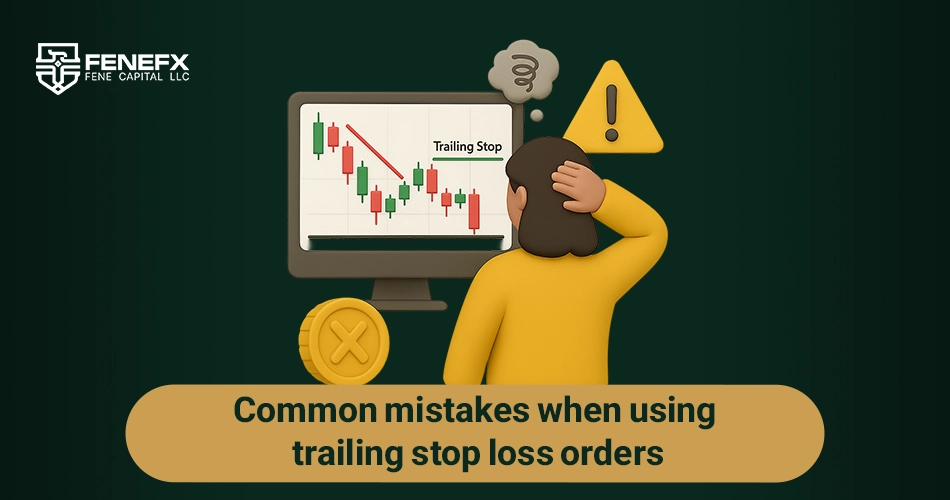
Using a trailing stop loss, if not done correctly, can backfire and lead to unexpected losses. Below are some common mistakes that can hinder your success in utilizing this tool.
Setting an Inappropriate Trailing Distance
One of the most common issues is selecting a trailing stop distance that is either too small or too large. If the distance is too tight, the stop may be triggered by short term and natural market fluctuations, causing you to exit a trade before reaching meaningful profit. Conversely, if the distance is too wide, the risk of larger losses increases, and you may lose a significant portion of your capital.
Practical Tip: Before setting a trailing stop, analyze the typical volatility range of your asset and adjust the distance accordingly.
Ignoring Market Volatility Levels
Different markets have unique characteristics in terms of volatility. Setting a trailing stop without considering these fluctuations often results in poor performance. For example, a stop level that works well in calm markets may be triggered too quickly in volatile ones, mistakenly closing the trade.
Practical Tip: Before using a trailing stop, assess the volatility of your currency pair or asset using volatility indicators such as ATR (Average True Range), and adjust the stop accordingly.
Disregarding Analytical Tools When Setting the Stop
Some traders set trailing stops arbitrarily, without using charts or technical indicators. This approach can lead to placing the stop at unsuitable levels that result in premature exits rather than profit protection.
Practical Tip: Use support and resistance levels, trendlines, or moving averages to place your trailing stop at strategic points for better accuracy.
Over Reliance on the Trailing Stop Loss
The trailing stop is an effective risk management tool, but relying solely on it can be risky. The best results come when this tool is used alongside other risk control methods, such as trade sizing, portfolio diversification, and detailed analysis.
Practical Tip: Consider the trailing stop as one part of your overall risk management plan and always maintain consistent monitoring and evaluation of your trades.
Frequently Asked Questions (FAQ) About Trailing Stop Loss
What is a trailing stop loss and how is it different from a fixed stop loss?
A trailing stop loss is a tool that automatically adjusts with market price movements, allowing traders to lock in profits while reducing the risk of losses. Unlike a fixed stop loss, which is set at a specific price and remains unchanged, a trailing stop moves dynamically in line with the price.
Why is using a trailing stop loss important?
This tool helps you preserve earned profits, avoid large losses, reduce the psychological stress of trading, and manage your positions intelligently.
What’s the difference between a manual and automatic trailing stop loss?
Manual trailing stop loss: The trader actively adjusts the stop loss based on their analysis.
Automatic trailing stop loss: The stop loss follows the price at a predefined distance without needing constant trader intervention.
Which type of trailing stop loss is more suitable for me?
If you have the time and expertise to monitor the market continuously, a manual trailing stop may be more effective. If you prefer to manage risk automatically with minimal attention, an automatic trailing stop is more appropriate.
How do you determine the right distance for a trailing stop loss?
The distance should match the asset’s and market’s volatility. A distance too small may close the trade prematurely and lose potential profits, while a distance too wide could result in bigger losses. The best approach is to analyze asset volatility and determine an appropriate percentage or pip range.
Is a trailing stop loss suitable for all types of trades and timeframes?
Trailing stops are particularly useful in trending or volatile markets, both for long term and short term trades. However, in flat or extremely unstable markets, they should be used with caution and proper adjustment.
Does using a trailing stop loss reduce trading stress?
Yes. Since the trailing stop adjusts automatically, it reduces the need for constant market monitoring and provides traders with greater peace of mind.
When is it better not to use a trailing stop loss?
In highly unstable markets or during scalping (very short term trading), a trailing stop may trigger too soon due to sharp fluctuations, causing missed profit opportunities.
Can a trailing stop loss be harmful?
If the stop distance is set improperly or used under the wrong market conditions, it may lead to premature exits or even larger losses.
How does a trailing stop loss help preserve profits?
When the price moves in your favor, the trailing stop also moves up with it. If the price reverses, the trade is closed with profit rather than a loss.
Is a trailing stop loss suitable for beginner traders?
Yes, because it helps manage trade risk intelligently and prevents emotional decision making.
Comments
Straight to the point, nicely done.
Set a 10-pip trail on gold once. Got wicked out three times in a row while the move went 200 pips without me. Trail distance matters way more than people think.
Does the trailing stop keep working on MT5 if I shut my computer down, or does it need the terminal running? A setup guide article would be great.
Finally get the difference between a trailing stop and just manually moving my SL. This was the missing piece for me, cheers.
Trailing stops are great in trends and miserable in chop. My rule: only switch the trail on after price breaks structure in my favor, never right at entry. Cuts out most of the noise exits.