

What is ERC20?
If you’ve been involved in the world of cryptocurrencies, you’ve probably come across the term “ERC20” many times, a label commonly seen on most Ethereum-based tokens. But what exactly is ERC20, and why is it so important on the Ethereum blockchain? Simply put, ERC20 is a set of technical rules and standards that define how tokens should be created and transferred so they remain compatible with all wallets, exchanges, and decentralized applications. This standard acts like a universal language that brings order and interoperability to the token ecosystem, paving the way for major innovations in fields such as DeFi, stablecoins, and ICOs. In this article, we’ll explore in detail how ERC20 works, its key advantages and limitations, and how it’s used across blockchain projects and investments.
What is ERC20 and why is it so important?
If you have entered the world of cryptocurrencies , you have probably heard the name ERC20 many times. You may have noticed, when buying a newly launched token or even stablecoins like USDT and USDC, that it is labeled “ERC20.” But what exactly does ERC20 mean, and why is it so important?
In simple terms, ERC20 is a common standard on the Ethereum blockchain that specifies what features a token must have and how it should interact with wallets, exchanges, and other applications. Imagine every company in the world wanted to issue a bank card but there were no rules defining the card’s size or the position of its magnetic stripe or chip. What would happen? No ATM would be able to recognize the cards. ERC20 prevents exactly this kind of chaos in the world of tokens.
Before ERC20 was introduced, each project on Ethereum created its own token with different rules. This meant wallets and exchanges had to write separate code for every new token. ERC20 was proposed in 2015 by Fabian Vogelsteller and quickly became an official standard. Since then, thousands of tokens have been built on this standard, and nearly all major Ethereum projects follow it.
The importance of ERC20 is that it created a common language among all Ethereum applications and tokens. When a token is built as ERC20, it is automatically compatible with wallets like MetaMask or Trust Wallet and can be traded on decentralized exchanges such as Uniswap. This standardization is what led to an explosion of innovation in DeFi, ICOs, and stablecoins.
How does ERC20 work? (with a simple example)
You might think ERC20 is a completely technical topic that only developers need to know, but in reality its concept is simpler than you think.
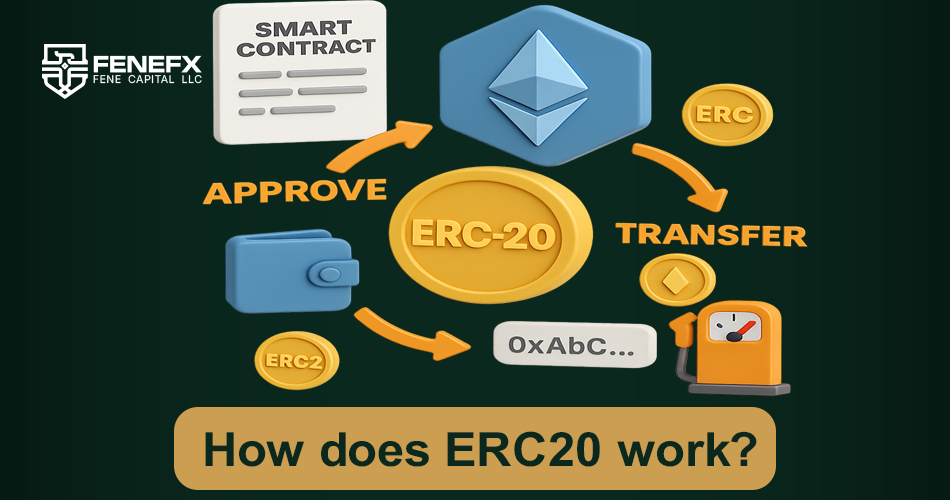
ERC20 consists of a set of basic rules that every token must follow. These rules are like contracts that all projects adhere to so full compatibility exists. For example, the rules specify that:
- Each token must be able to show a user’s wallet balance.
- It must be possible to transfer the token from one wallet to another.
- A user can authorize another person or application to spend tokens on their behalf (for use cases such as decentralized exchanges).
To make it clearer, let’s use a simple example. Suppose you want to build an application that sells concert tickets in digital form. If you had to write the token’s rules and structure from scratch every time, your work would be difficult and costly. But when you use ERC20, it’s enough to create your token according to this standard. Now, without any additional changes, this token is displayed in the MetaMask wallet, is tradable on exchanges, and you can even use it to pay fees.
This standard is like having a “universal power socket” for tokens. Any device (token) built according to this standard connects to the outlet (wallets and applications) without any problems. It is this simplicity that has made ERC20 the most widely used standard in the world of cryptocurrencies.
Real World Applications of ERC20
Now that we know what ERC20 is and how it works, let’s see what its real world applications are and why a large part of the crypto market relies on it.
Stablecoins: Stable Digital Money
One of the most important applications of ERC20 is the creation of stablecoins. Tokens such as USDT (Tether), USDC, and DAI all have ERC20 versions. Stablecoins are pegged to the U.S. dollar or other fiat currencies and offer greater price stability. Users can use them to transfer money, trade on exchanges, or even for savings, without worrying about the sharp volatility of Bitcoin or Ethereum.
DeFi Tokens (DeFi)
The DeFi ecosystem is built almost entirely on ERC20. Protocols such as Uniswap, Aave, or Compound all use ERC20 tokens to represent assets, loans, or participation rights. If someone wants to invest in DeFi today, a large portion of their holdings will likely be ERC20 based.
Governance Tokens
Many blockchain projects use ERC20 governance tokens to manage key decisions. For example, holders of the UNI token can participate in votes about the future of the Uniswap protocol. These tokens effectively grant users ownership and decision making rights in projects.
The Role of ERC20 in ICOs and Project Fundraising
In 2017 and 2018 the golden age of ICOs almost all projects used ERC20 tokens to raise capital. The reason is clear: by issuing an ERC20 token, a project could attract global investors without creating a new blockchain, and have its token easily supported by wallets and exchanges.
Payments and Everyday Uses
Beyond investing, some companies use ERC20 tokens to pay for services or products. Even in blockchain games or entertainment platforms, ERC20 tokens are used as the internal currency.
In today’s financial world, many platforms are leveraging token standards like ERC20 to open new paths for investment and growth. One of the most appealing opportunities is accessing funded trading accounts through prop account purchase from FeneFx. FeneFx offers fair trading conditions, strong support, and a secure environment that allows traders to showcase their skills and earn profits without the need for large initial capital. If you’re looking to start your professional trading journey, FeneFx is a reliable place to begin.
Benefits of ERC20 for Users and Developers
Thanks to its flexibility and broad applicability, the ERC20 standard has become one of the main pillars of the cryptocurrency world. Both everyday users and project developers have many reasons to use it.
Greater Security and Trust
One of the biggest concerns for users in the crypto world is security. With its well defined structure and widespread adoption in major projects, ERC20 creates a layer of trust. When a user sees an ERC20 token in a reputable wallet, they can feel more assured about its compatibility and correct operation. In addition, developers know that the standard’s code has been tested repeatedly and reviewed by the Ethereum community.
Ease of Use and Broad Accessibility
Users do not need to install a separate application for every new token or deal with complex rules. It is enough to have a wallet like MetaMask or Trust Wallet to store and transfer almost all ERC20 tokens. This ease of use is the main reason for ERC20’s popularity among beginners.
For developers, this ease translates into saving time and cost. Instead of building a dedicated blockchain or designing complex protocols, they can create an ERC20 token within a few days and list it on various exchanges.
Interoperability
One of ERC20’s strengths is interoperability among wallets, exchanges, and decentralized applications. For example, if a DeFi project launches an ERC20 token, users can immediately trade it on decentralized exchanges like Uniswap or store it in popular wallets. No additional configuration is needed; everything is ready in advance.
Global Accessibility
ERC20 knows no borders. Anyone, anywhere in the world, can use these tokens with just an internet connection. This feature has made ERC20 stablecoins like USDT and USDC widely used tools for transferring money across countries.
What limitations and issues does it have?
Despite its many advantages, ERC20 is not without flaws. Users and developers should understand its limitations and issues to make more informed decisions.
High fees on the Ethereum network
One of ERC20’s biggest challenges is Ethereum’s high transaction fees. Every ERC20 transaction requires paying a Gas Fee, which can reach tens of dollars when the network is congested. This is not cost effective for users making small transactions.
Network congestion and slow transactions
Because of its popularity, Ethereum often becomes congested. This means ERC20 transactions may be processed with significant delays. For example, a user who wants to quickly trade a token on an exchange might miss a profit opportunity due to network congestion.
Need for caution when using contracts
One drawback of ERC20 is that users must know the exact contract address of the token. Many scammers create counterfeit versions of popular tokens, and unsuspecting users may buy them. This is where the importance of verifying the real contract address becomes even more evident.
Technical issues and complexity for beginners
Although using ERC20 is simple, concepts like gas, slippage, or interacting with smart contracts can be confusing for newcomers. Without sufficient knowledge, a user may make a mistake and lose part of their assets.
How to recognize a legitimate ERC20 token?
Given the growth in the number of tokens, distinguishing a legitimate project from a worthless token or even a scam is very important. Below are a few practical tips for users:
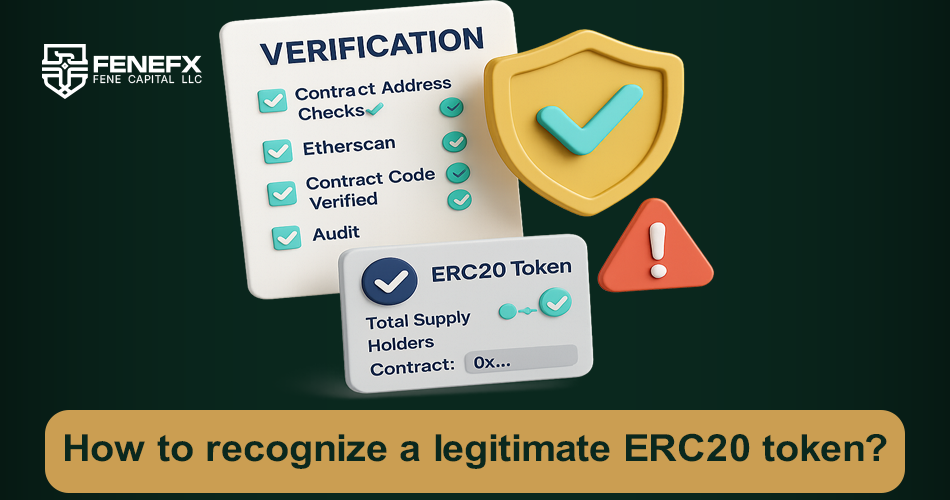
Checking the contract address on Etherscan (Etherscan)
Every ERC20 token has a smart contract address. Users can search this address on the Etherscan.io website. If the token is legitimate, complete information including the number of holders, transactions, and signs of official verification will be displayed. Projects that do not have a clear and transparent contract address are usually not trustworthy.
Pay attention to the community and project transparency
A legitimate token should have an active and transparent community. The presence of communication channels such as an official website, a clear white paper, active social media, and known developers are positive signs. Conversely, tokens that provide no precise information about their team or objectives carry high risk.
Use Reputable Wallets
You should always use reputable and well known wallets to store and interact with ERC20 tokens. Wallets like MetaMask or Trust Wallet automatically filter many fake tokens and provide more accurate information to the user.
Avoid Unlimited Approve
Many users, when using DeFi, enable the Approve option for contracts without limits. This is dangerous because it allows the contract to move any amount of tokens. It is better to always set a limit for Approve so your assets remain safe.
Check Liquidity and Exchange Listings
Another way to assess a token’s legitimacy is to check its liquidity on decentralized exchanges and whether it is listed on reputable exchanges. Tokens with low liquidity or that are traded only on unknown exchanges carry higher risk.
Conclusion
The ERC20 standard can be considered the backbone of the Ethereum ecosystem, a framework that enables the creation of millions of interoperable and compatible tokens. Despite challenges such as high gas fees and network congestion, ERC20 remains the most popular and widely used token standard in the crypto world. It has not only simplified blockchain development but also empowered everyday users to manage digital assets with greater security and ease. In essence, ERC20 serves as a bridge between innovation and usability in the decentralized world.
Frequently Asked Questions (FAQ)
What is an ERC20 token?
An ERC20 token is a digital asset built on the Ethereum standard, designed to work seamlessly with all wallets and exchanges that support the Ethereum network.
How can I tell if a token is ERC20?
You can check a token’s contract address on
Etherscan.io to confirm whether it’s built on the ERC20 standard.
Can ERC20 tokens be transferred to other blockchains?
Not directly, but equivalent versions can be transferred across networks using blockchain bridges.
What are the best wallets for storing ERC20 tokens?
Reputable wallets such as MetaMask, Trust Wallet, and Ledger are among the best options for securely storing and managing ERC20 tokens.
Comments
Worth adding that you need ETH in the same wallet to pay gas for any ERC20 transfer. That catches almost every newcomer at least once.
Nice and simple explainer, well done.
I always just clicked whatever network was default when withdrawing. After reading this I finally get what those options actually mean. Really helpful, thanks!
How do I start trading
Sent tokens to an exchange on the wrong network once and spent a week emailing support to recover them. Lesson learned the expensive way.
Could you do a comparison of ERC20 vs TRC20 withdrawal fees next? Gas costs are what actually hurt when moving USDT around.