





What Is the Intrinsic Value of a Stock?
In financial markets, one of the most important questions every investor faces is: “Is the current price of a stock truly fair or not?” The answer to this question lies in a concept called the intrinsic value of a stock. Intrinsic value helps investors think beyond short term fluctuations and market sentiment and make decisions based on financial data, cash flows, growth, and risk. If you can understand the difference between a stock’s true value and its market price, you have taken a major step toward smart, long term investing. In this article, you will become fully and practically familiar with the concept of intrinsic value, the methods used to calculate it, how it differs from market price, and its role in investment decision making.
What does intrinsic value mean?
Intrinsic value is defined as an estimate of an asset’s true value based on factors such as future cash flows, profitability, growth, and related risks. This value is typically calculated through financial models such as the discounted cash flow (DCF) model.
In this model, a company’s future cash flows are discounted to their present value using a discount rate that represents risk and the cost of capital. These calculations enable investors to form a more accurate picture of the company’s potential financial performance.
Intrinsic value helps investors look past short term effects and market fluctuations that may influence the market price, and focus on an asset’s true value. This concept is especially important for value investors who look for stocks that are priced in the market below their true value.
What is the difference between intrinsic value and market price
Market price is simply the current price of an asset in the market, determined by supply and demand. This price can be influenced by various factors such as economic news, political changes, market psychology, and other external factors. In contrast, intrinsic value is determined based on fundamental analysis and a company’s financial data and is usually more stable and sustainable than the market price.
The difference between intrinsic value and market price can indicate investment opportunities. If a stock’s intrinsic value is higher than its market price, the stock may be attractive to buy, because its price may move toward its intrinsic value in the future. Conversely, if intrinsic value is lower than the market price, the stock may be overvalued, and investors may choose to sell it.
Ultimately, understanding the difference between intrinsic value and market price helps investors make better decisions and take advantage of market opportunities in the best possible way. This ability is especially important in unstable and volatile markets, where prices can change quickly and drift away from true value. For this reason, careful analysis and a deep understanding of intrinsic value can help investors achieve better long term returns.
The Role of Intrinsic Value in Investment Decision Making
Intrinsic value enables investors to focus on a more accurate and long term assessment of an asset rather than relying on short term market fluctuations. If intrinsic value is higher than the current market price, this indicates a potential buying opportunity. In such circumstances, investors can expect the market price to move toward intrinsic value over time.
This analysis is especially important for investors who pursue valuation based strategies. They look for assets that are priced in the market below their true value, and intrinsic value is a key tool for identifying these opportunities. In other words, intrinsic value helps investors optimize their investments and benefit from long term opportunities.
The Relationship Between Market Price and Intrinsic Value
Market price is the price at which assets are traded in the market and is influenced by various factors such as supply and demand, economic news, and political events. This price can be highly volatile and does not necessarily reflect an asset’s true value.
On the other hand, intrinsic value is determined based on careful analysis and real data such as future cash flows, profitability, and risk. Therefore, there may be a significant difference between market price and intrinsic value.
This difference can create opportunities and challenges for investors. For example, if the market price is lower than intrinsic value, the stock may be attractive to buy, because the market likely has not yet recognized its true value. Conversely, if the market price is higher than intrinsic value, the stock may be overvalued, and investors should act cautiously.
Understanding the relationship between market price and intrinsic value helps investors identify suitable opportunities to buy or sell and avoid hasty decisions driven by short term market changes. In this way, intrinsic value, as an effective analytical tool, helps investors operate in financial markets with greater confidence and achieve their financial goals.
Methods to Calculate Intrinsic Value
Calculating intrinsic value is one of the key tools for investors to make better decisions about their investments. In this section, we examine different methods for calculating intrinsic value.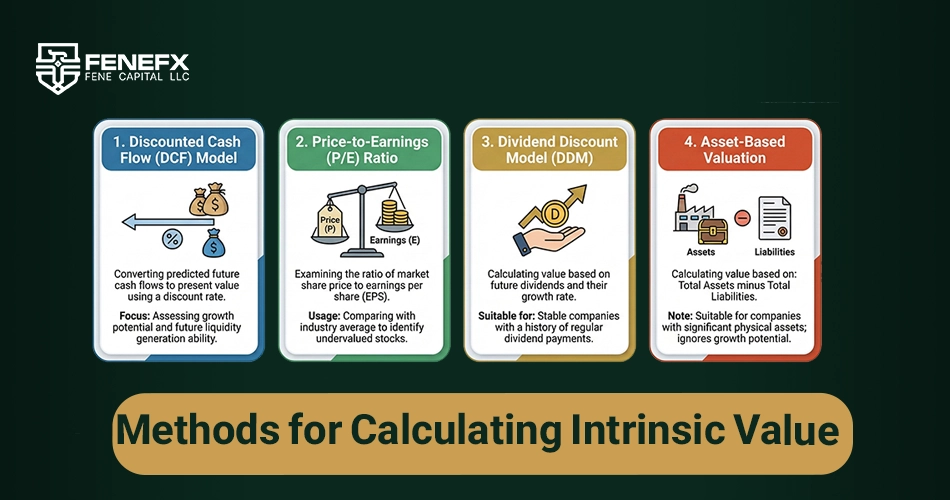
Discounted Cash Flow (DCF) Model
The discounted cash flow model is one of the most widely used methods for evaluating intrinsic value. In this method, a company’s future cash flows are forecast and converted into present value using a discount rate.
The discount rate usually represents the cost of capital or the expected rate of return. This model helps investors assess the company’s ability to generate cash in the future. Using this method, one can gain a better understanding of the company’s growth and profitability potential.
Price to Earnings (P/E) Model
The price to earnings model examines the ratio of a stock’s market price to the company’s earnings per share. This ratio reflects the market’s expectations of the company’s future performance.
If a company’s P/E ratio is lower than the industry or market average, its stock may be priced below its true value. This model helps investors identify investment opportunities by comparing this ratio with industry standards.
Dividend Discount Model (DDM)
The dividend discount model is used for companies that regularly pay dividends. In this model, the intrinsic value of a stock is calculated based on future dividends and their growth rate.
This model is suitable for stable companies with a history of dividend payments and can help investors determine a stock’s intrinsic value based on predictable cash flow.
Asset Based Valuation
In this method, a company’s intrinsic value is calculated based on the total value of its assets minus its liabilities. This method is more suitable for companies that have substantial physical assets, such as manufacturing firms or companies with significant fixed assets. This model may be simpler than other methods, but it typically does not take the company’s potential growth into account. For this reason, it is better to use it alongside other methods.
Each of these methods has its own advantages and disadvantages, and choosing the appropriate method depends on the type of company and market conditions. Using a combination of these methods can help investors gain a more comprehensive understanding of companies’ intrinsic value and make more informed decisions.
Trading Opportunities Based on Intrinsic Value
Intrinsic value, as an important metric in investing, helps investors identify suitable trading opportunities and make smarter decisions by using precise analysis.
Identifying Stocks with Intrinsic Value Higher than Market Price
One of the key investment opportunities is identifying stocks whose intrinsic value is higher than their current market price. This situation indicates that the market has not yet fully recognized the stock’s true value, and there is a possibility of price appreciation in the future. Investors can benefit from potential price growth by buying these stocks.
To identify these opportunities, analysts use various valuation models such as discounted cash flow (DCF) and the price to earnings (P/E) model. These models help investors assess the company’s future cash flows, growth potential, and profitability through careful evaluation.
Risks and Challenges Associated with Misvaluation
Despite the attractive opportunities that accurate valuation can provide, there are also numerous risks and challenges. One of the most important of these challenges is misvaluation, which can result from incorrect assumptions, inaccurate data, or weak analysis.
If intrinsic value is mistakenly calculated to be higher than it actually is, investors may end up buying stocks that in fact have a lower true value. This can lead to financial losses. In addition, the market may react quickly for various reasons, including sudden changes in economic or political conditions, causing prices to fluctuate.
To reduce these risks, investors should use different valuation models in combination and continuously review and update their assumptions. Additionally, paying attention to external factors and market conditions can help reduce risk.
The Role of Market Risk in Calculating a Stock’s Intrinsic Value
Market risk, as one of the key elements in calculating intrinsic value, plays an important role in investment decision making. Investors must have a proper understanding of how various factors and market fluctuations affect intrinsic value in order to make more accurate assessments.
The Impact of Different Factors on a Stock’s Intrinsic Value
The intrinsic value of an asset is calculated based on financial and economic analyses and by considering various factors such as future cash flows, growth rate, interest rates, and the cost of capital. Each of these factors can be influenced by different market risks.
- Interest rates: Changes in interest rates can affect the cost of capital and the discount rate used in discounted cash flow (DCF) models. An increase in interest rates can reduce the present value of future cash flows and, as a result, lower intrinsic value.
- Economic growth rate: Expectations about economic growth can influence forecasts of future cash flows. Higher economic growth usually leads to higher revenues and profitability for companies, and vice versa.
- Political and economic risks: Political and economic changes, such as sanctions or changes in tax policies, can affect companies’ performance and consequently their intrinsic value.
Examining Market Volatility and Price Instability
Market volatility is one of the important aspects of intrinsic value analysis. Price instability can stem from various factors that affect investors’ analysis and decision making:
- Market psychology: Investor sentiment and emotional reactions to news or economic events can lead to sharp price fluctuations that may not be consistent with intrinsic value.
- Supply and demand: Changes in supply and demand for an asset can affect market prices without any change in fundamental factors.
- External shocks: Unexpected events such as financial crises or natural disasters can significantly influence prices and cause market instability.
Market risk and its volatility can significantly affect the calculation and interpretation of intrinsic value. Investors should adjust their analyses in light of these factors and use a variety of techniques to assess intrinsic value more accurately. Proper understanding and analysis of market volatility and the factors influencing it help investors make better decisions and manage the risks associated with investing.
How Intrinsic Value Works in Options Contracts?
In options contracts, intrinsic value plays an important role in determining contract prices. This concept helps investors make better decisions in their trades.
Calculating Intrinsic Value in Call and Put Options
Intrinsic value in call and put options refers to the difference between the current market price of the underlying asset and the contract’s strike price.
- Call Option: Intrinsic value exists when the market price of the underlying asset is higher than the strike price. For example, if the market price of the stock is $50 and the strike price is $45, the intrinsic value of the call option is $5.
- Put Option: Intrinsic value exists when the market price of the underlying asset is lower than the strike price. For example, if the market price of the stock is $40 and the strike price is $45, the intrinsic value of the put option is $5.
In both cases, intrinsic value cannot be negative; if the difference is not in favor of the contract holder, intrinsic value is considered zero.
The Difference Between Intrinsic Value and Time Value
Intrinsic value and time value are the two main components of an option contract’s price that must be examined carefully.
- Intrinsic value: As explained, it represents the difference between the market price and the strike price and indicates the profit that can be obtained from exercising the contract immediately.
- Time value: This represents the potential for greater profitability in the future. It depends on various factors such as market volatility, the time remaining until the contract’s expiration, and interest rates. Even if an option’s intrinsic value is zero, its time value may be high because there is still time for price changes to occur.
Time value decreases as the expiration date approaches, a process known as “time erosion” or “Time Decay.” For this reason, investors must carefully consider timing and market volatility.
Both intrinsic value and time value are essential in pricing and decision making for options contracts. A proper understanding of these concepts can help investors take advantage of opportunities in the market through more precise analysis and better strategies. Given the complexities associated with these contracts, knowing how intrinsic and time value work is necessary for success in options trading.
How to calculate an asset’s intrinsic value?
Intrinsic value is calculated through various models, each of which operates based on its own assumptions and specific data. In the following, we address the steps for calculating intrinsic value using different models and provide practical examples.
Steps to Calculate Intrinsic Value Using Different Models
Discounted Cash Flow (DCF) Model
Forecast future cash flows: First, you need to forecast the company’s future cash flows for the next few years.
Choose a discount rate: A discount rate that represents the cost of capital or the expected rate of return is selected.
Calculate the present value of cash flows: Convert each forecast cash flow into present value using the discount rate.
Formula:
Present Value = the first year’s cash flow divided by (1 + discount rate) to the power of the number of years.
Price to Earnings (P/E) Model
Calculate the P/E ratio: This ratio is obtained by dividing the stock’s current market price by its earnings per share.
Estimate intrinsic value: Using forecast earnings and the P/E ratio, intrinsic value is estimated.
Dividend Discount Model (DDM)
Forecast future dividends: The expected dividends for future periods are forecast.
Choose the expected rate of return: The investor’s expected rate of return is determined.
Calculate the present value of dividends: Future dividends are discounted to present value based on the rate of return.
Formula:
Stock Value = dividend divided by (rate of return minus the dividend growth rate).
Asset Based Valuation
Calculate asset value: First, calculate the total value of the company’s assets.
Subtract liabilities: The company’s total liabilities are subtracted from the value of its assets to obtain the net asset value.
Practical Examples of Intrinsic Value Calculations
P/E Model Example: If the current stock price is $20 and earnings per share are $2, the P/E ratio is 10. Assuming forecast earnings of $3, the estimated intrinsic value would be $30.
These examples help better understand how intrinsic value is calculated and show how different data can be used to evaluate the true value of an asset.
The Difference Between Intrinsic Value and Market Value
Intrinsic value and market value are two key concepts in investing that help with financial analysis and decision making. Understanding the differences between the two can help investors identify suitable opportunities and manage risk.
Analyzing the Factors Affecting Market Value
Market value simply refers to the current price of an asset in the market and can be influenced by various factors:
- Supply and demand: One of the most important factors affecting market value is the level of supply and demand for the asset. Higher demand or lower supply can cause prices to rise, and vice versa.
- Market psychology: Investors’ emotions and behavior, such as fear or greed, can strongly affect market prices, even if these changes are not aligned with the asset’s intrinsic value.
- News and events: Economic, political, and industry news can quickly affect market value. For example, better than expected financial results or changes in a company’s management can influence prices.
- Global events: Changes in global economic policies, interest rates, and geopolitical developments can also affect market value.
Uses of Each in Investing
Intrinsic Value
Fundamental analysis: Intrinsic value helps investors assess an asset’s true value based on real data and careful analysis. This is very useful for investors who are seeking long term and sustainable opportunities.
Identifying undervalued stocks: By comparing market value and intrinsic value, investors can identify stocks that are trading below their true value and take advantage of this opportunity for investing.
Market Value
Technical analysis: Investors who use technical analysis focus more on market value and price trends to identify short term opportunities.
Risk management: Market value helps investors manage the risks associated with their investments by monitoring price changes and making faster, more up to date decisions.
Understanding the difference between intrinsic value and market value enables investors to develop strategies aligned with their goals. Using these two concepts in combination can improve investment decisions and increase returns. Investors should, through careful analysis and the use of these tools, gain deeper insight into the opportunities and challenges present in the market.
Comparative Analysis Between Intrinsic Value and Market Value During Volatile Periods
During periods of market volatility, a comparative analysis between intrinsic value and market value can help investors make better decisions. This analysis examines price behavior and evaluates opportunities and risks under different conditions.
The Impact of Market Volatility on Values
During volatile periods, market prices can change rapidly and may even become unstable. These changes are often driven by investors’ emotional reactions to news and unexpected events. In such conditions, market value may temporarily diverge from intrinsic value.
For example, the release of negative news about a company can cause a sudden decline in its stock price, even if the company’s fundamentals have not changed. In this situation, the stock may trade below its intrinsic value, which can be a good buying opportunity. Conversely, positive and hype driven news can push prices to levels above intrinsic value, in which case investors may consider selling the asset.
Investment Strategies in Volatile Conditions
Investors can use various strategies to take advantage of the difference between intrinsic value and market value during periods of volatility:
- Buy low and sell high: Identifying stocks that are trading below intrinsic value and buying them in the hope that the price will return to its true level. Similarly, selling stocks that are trading above intrinsic value to avoid a potential price decline.
- Diversifying the investment portfolio: In volatile conditions, diversification can help reduce risk. Investors can reduce the impact of volatility on their portfolio by combining different assets.
- Thorough fundamental analysis: Using fundamental analysis to assess intrinsic value more accurately and identify long term opportunities helps investors avoid emotional and hasty decisions.
Challenges Ahead
One of the main challenges in comparative analysis during volatile periods is the need for accurate and up to date data. Rapid market changes can complicate analyses and increase the need for continuous review of assumptions and data. In addition, accurately forecasting market behavior under volatile conditions can be difficult and may require deeper experience and knowledge.
Comparative analysis between intrinsic value and market value during volatile periods provides investors with a better view of the opportunities and risks present. This analysis helps them use appropriate strategies to benefit from market volatility and move closer to their investment goals.
Understanding a stock’s intrinsic value is most useful when a trader can implement these analyses with sufficient capital and within a professional framework. Many traders, despite having strong analytical knowledge, cannot take advantage of opportunities created by the gap between market price and intrinsic value solely due to capital limitations. Prop trading is designed precisely to solve this challenge, and Fenefx Prop, by providing trading capital, transparent rules, and fair conditions, makes it possible for you to execute your fundamental and value based analyses on a larger scale. If you are looking to turn your valuation knowledge and analysis into real market performance, you can experience a more professional path in trading by purchasing a prop account from Fenefx.
Final Conclusion
A stock’s intrinsic value is one of the most important tools in fundamental analysis, helping investors make more rational and lower risk decisions. By comparing intrinsic value and market price, it is possible to identify undervalued or overvalued stocks and benefit from long term investment opportunities. However, calculating intrinsic value requires precision, reasonable assumptions, and a combined use of different valuation models. Ultimately, investors who apply intrinsic value alongside risk management and an understanding of market volatility have a greater chance of achieving sustainable returns and success in financial markets.
Frequently Asked Questions (FAQ)
What is a stock’s intrinsic value?
Intrinsic value is an estimate of a stock’s true value based on financial analysis, cash flows, the company’s growth, and its risk.
What is the difference between intrinsic value and market price?
Market price is driven by supply and demand, but intrinsic value is calculated based on fundamental analysis and the company’s real data.
Which method is more accurate for calculating intrinsic value?
No single method is the best, and using a combination of models such as DCF, P/E, and DDM usually provides more accurate results.
Does intrinsic value always move closer to market price?
In the long term, market price typically moves toward intrinsic value, but in the short term there may be a significant gap due to market volatility and sentiment.
Comments
The margin of safety concept finally clicked for me. I never understood why Buffett fans keep repeating it, now it makes complete sense.
I bought a 'cheap' stock once purely off a low P/E and watched it get cheaper for two years. Learned the hard way that value needs context, exactly like this article says.
Explained better than my finance textbook did, honestly.
Could you cover how intrinsic value works for companies with no earnings yet? Trying to value growth stocks with these methods feels impossible.
DCF is great in theory, but garbage in, garbage out. Your growth assumptions matter more than the formula. I always sanity-check with a simple earnings multiple before trusting any DCF output.