





How to Become a Successful Forex Trader?
More than 80% of forex market traders ultimately leave this market at a loss not because they lack a strategy, but due to the absence of the right mindset, poor capital management, and emotional decision making. For this reason, the answer to the question “How can we become a successful forex trader?” goes beyond learning a few indicators or trading signals. A successful forex trader is someone who applies a combination of analytical skills, trading psychology, risk management, and personal discipline together. Success in this market is a gradual path, not a sudden event. You must learn how to analyze the market, protect your capital, control your emotions, and learn from your mistakes. In this article, we will examine in a completely practical and step by step way what characteristics successful forex traders have, how they build a personal trading system, how they manage their capital, and what methods they use to achieve consistent profitability. If you are looking to build a real and sustainable path in the forex market, this guide will provide you with a clear and actionable perspective.
Principles and Methods for Success in Forex
Success in the forex market requires a combination of several key skills. Contrary to what many people think, success in this market does not end with simply knowing trading strategies. To succeed in the forex market, you need to combine various skills such as a professional mindset, a personalized trading system, strong market analysis skills, and professional capital management, and so on. By repeating and practicing these skills, you can gradually become a successful forex trader over time.
These points may sound cliché or repetitive, but the reality of trading in forex is exactly this: these are the fundamentals that are always repeated, and a trader who truly adheres to them can achieve consistent profits in forex. In the following, we will review the most important elements a trader needs in order to succeed in Forex:
The Professional Mindset of a Successful Forex Trader
Market psychology is one of the most important factors for long term success in forex a topic that many beginner traders often underestimate. Experience shows that many traders who perform well in technical analysis lose their trading accounts solely because they are unable to control their emotions. Fear of losses, greed for greater profits, and stress caused by market volatility disrupt rational decision making.
In practice, traders who enter a trade without a predefined stop loss suffer the most from fear. These individuals often close profitable trades earlier than they should or, after several consecutive losses, lose their confidence. In contrast, professional traders by accepting a specific, predetermined level of risk maintain greater peace of mind and remain committed to their trading plan.
The Importance of Market Psychology
Fear can force you to close your profitable trades too early or avoid entering suitable opportunities. To manage fear, it is essential to set your stop loss before entering any trade. By doing so, you know exactly how much of your capital is at risk if you are wrong, and this increases your peace of mind. On the other hand, greed often causes people to keep profitable trades open for too long or enter new trades without proper analysis. Sticking to a specific trading strategy and setting a take profit level before entering a trade can save you from this trap.
Managing Emotions in Trading (Fear, Greed, Stress)
Stress is another factor that may push you toward making rushed decisions. To manage this, establishing a consistent trading routine, taking sufficient breaks, and adhering to your trading plan can be helpful.
How to Turn a Losing Mindset into a Winning Mindset?
Ultimately, to turn a losing mindset into a winning mindset, you must take responsibility for all of your decisions. A successful trader is someone who not only learns from their mistakes, but also focuses on improving their trading processes rather than concentrating on short term profits and losses. This mindset keeps you away from emotional decisions and brings more sustainable long term success.
Designing a Personalized Trading System
One of the common mistakes among beginner traders is copying other people’s strategies without considering personal circumstances. In the experience of many traders, a strategy that was profitable for someone with plenty of free time and high focus has resulted in nothing but losses for a person who has a full time job or trades only a few hours a day.
Successful traders usually design their trading system based on their lifestyle, risk tolerance, and individual personality. For example, a trader with a low tolerance for stress may make emotional decisions in short term trading, but perform better by using higher timeframes. This adaptability is exactly what turns a trading system into a reliable tool.
How to Create a Trading Strategy That Fits Your Personal Style?
To design a personalized trading system, you must first determine which timeframe you intend to trade. If you have a lot of time available each day, short term trading may be suitable for you. On the other hand, if you have limited time, medium term or long term trading will be better options. After that, define a set of rules for entering and exiting the market. These rules must be completely clear and specific so that you do not become confused in highly volatile market conditions. Also, do not forget to include your stop loss and take profit in the strategy so you can manage potential losses and lock in your profits.
How to Backtest and Optimize Your Trading System?
Backtesting a trading strategy is a step that many traders either ignore or perform superficially. Experience has shown that strategies that enter the real market without backtesting usually fail during the first period of high volatility.
Professional traders identify weaknesses by evaluating their strategy’s performance under different market conditions. For example, a strategy may perform very well in trending markets but be unprofitable in ranging markets. This awareness helps the trader know when to use their strategy and when to refrain from trading.
Proficiency in Market Analysis: Technical, Fundamental, and Sentiment
To succeed in Forex, you must be able to combine different types of market analysis. Technical analysis helps you identify suitable entry and exit points based on price patterns and technical indicators. In contrast, fundamental analysis focuses on economic and political factors that have a significant impact on the market. Combining these two types of analysis gives you a comprehensive view of the market.
Market Sentiment Analysis and Its Impact on Trends
Alongside these two methods, sentiment analysis also plays an important role. This type of analysis examines traders’ emotions and expectations in the market. Indicators such as the COT report or the VIX index can provide you with a clear perspective on the market’s emotional state. For example, when the market becomes excessively bullish or bearish, the likelihood of a price reversal increases.
How to Interpret Economic Data Correctly?
In addition, a proper understanding of economic data can have a significant impact on your decision making. Economic reports such as interest rates , employment indicators, and inflation have a major effect on currency pairs. Becoming familiar with how to analyze this information and predict the market’s reaction to it can help you enter trades at the right time.
Capital Management: The Main Pillar of Sustainable Success
Capital management is the most important factor for maintaining your longevity in the Forex market. The 2% rule is one of the most common and effective risk management methods. This rule states that in each trade, you should risk only 2% of your total capital. With this approach, even if you face several consecutive losses, your account will not suffer a severe drawdown, and you will not miss the market’s next opportunities.
Smart Methods for Calculating Stop Loss and Take Profit
For proper capital management, you need to incorporate accurate stop loss and take profit calculations into your trades. A stop loss can be determined based on support and resistance levels or the average of recent volatility. A take profit should also be set in a way that keeps your risk to reward ratio reasonable and profitable. Many successful traders follow a 1:2 or 1:3 risk to reward ratio in their trades so that larger profits can offset potential losses.
Position Sizing Strategies to Reduce Large Losses
Position sizing also plays a very important role in reducing large losses. Instead of allocating a heavy amount of capital to a single trading position, it is better to adjust your trade size based on market conditions and your trading strategy. This approach helps you protect your capital with greater flexibility during unfavorable market conditions and increase your returns when conditions are profitable.
Prop Trading: A Professional Path for Talented Traders with Limited Capital
One of the common challenges on the path to becoming a successful trader is having limited initial capital. Many traders have the necessary knowledge and skills, but due to low capital, they cannot implement standard risk management or generate meaningful profits. In such cases, prop trading , as a professional solution, provides the opportunity to trade with larger capital without personal risk.
In the prop trading model, after a trader proves their ability within a specific framework, they gain access to the firm’s capital and share in the trading profits. This structure allows the trader to focus on proper strategy execution and risk management without the psychological pressure associated with personal capital.
Among the companies active in this field, Prop Fenefx , with transparent rules, reasonable drawdown, and the absence of unnecessary limitations, is a suitable option for traders who are looking for real and professional growth. If you feel you have reached a level where you can trade according to a plan and manage your capital correctly, using a prop firm can multiply your progress speed by several times.
To start this path and gain access to larger trading capital, you can enter the world of professional prop trading by purchasing Prop Fenefx.
Mastering Time Management and Choosing the Right Trading Sessions
Time management in the Forex market is one of the key factors for consistent success. The Forex market, due to its 24 hour activity, provides a unique opportunity for traders to enter the market at any time of the day or night. However, this feature, while offering opportunity, can also be a challenge for traders; because not all trading sessions are equally suitable, and some times have higher profit potential.
Choosing the Best Times to Enter and Exit Trades
Entry and exit timing should be determined based on market volatility and liquidity levels. For example, trading sessions that overlap usually have higher trading volume, which creates better trading opportunities. For instance, during the overlap of the London and New York sessions, market liquidity reaches its peak and significant price movements occur. In contrast, during hours when the market is relatively quiet, the risk of entering trades increases; because prices fluctuate within narrow ranges and there are fewer profitable opportunities.
Understanding the Characteristics of Different Trading Sessions (Asia, Europe, America)
Trading sessions in Forex consist of three main periods:
- Asian Session (00:00 to 09:00 GMT): This session is usually calmer, and currency pairs such as USD/JPY and AUD/USD tend to be more active. Volatility is more limited during this time, but sometimes, with major economic news from Japan or Australia, sudden moves can occur.
- European Session (08:00 to 17:00 GMT): This session coincides with the opening of the London market and usually has stronger volatility. Currency pairs such as EUR/USD, GBP/USD, and USD/CHF experience the highest trading volume during this time.
- US Session (13:00 to 22:00 GMT): This session aligns with the New York market and, due to its overlap with the European session, has the highest liquidity and volatility. Many important US economic reports are released during this period, which can strongly impact the market.
How to Align Your Trading Schedule with Your Lifestyle?
Aligning your trading schedule with your daily routine is very important. If you have a job or limited time, it is better to choose higher timeframes (such as 4 hour or daily) so you do not need to be constantly watching the charts. On the other hand, if you have enough time and prefer short term trading, you can be active during volatile time windows such as the London–New York session overlap. This approach not only increases performance, but also reduces the stress caused by continuously monitoring the market.
Drafting a Trading Plan and Sticking to It
Having a consistent trading plan is your guide on the path to success in Forex. Without a plan, your trades will be driven by emotions, and this can easily expose your trading account to heavy losses.
How to Create a Consistent Trading Plan?
Your trading plan should include the following:
- Entry and Exit Strategy: Define clear rules for when to enter and exit trades. These rules can include a combination of technical indicators, price patterns, or support and resistance levels.
- Risk Management Rules: Determine your stop loss, take profit, and the amount of risk per trade in advance.
- Trading Times: Specify the time windows during which you will be active, so you can maintain better discipline in your trading.
- Review Plan: Schedule regular sessions to review your performance so you can identify your strengths and weaknesses.
The Importance of Recording and Reviewing a Trading Journal
Recording trades in a trading journal is one of the shared habits among successful traders. Traders who do not keep a journal usually repeat their mistakes because they do not have an accurate picture of their actual performance. In the experience of many traders, only after a few weeks of consistent trade logging, incorrect behavioral patterns become clearly identifiable.
Reviewing the journal on a weekly or monthly basis helps the trader understand which types of trades generated the most profit or loss. This process leads to gradual strategy improvement and increased confidence in future decision making.
How to Correct Mistakes by Analyzing Previous Trades?
After recording your trades, identify your mistakes by reviewing your performance on a weekly or monthly basis. This helps you find weaknesses in your trading strategy and develop better methods for managing your trades.
How to Avoid Common Mistakes in the Forex Market?
Overtrading is one of the most common mistakes traders make. This mistake is often caused by excitement, fear of missing out on the market, or an attempt to recover losses. The solution to prevent this issue is to set a specific number of daily or weekly trades. In addition, traders should look for high probability setups and avoid entering the market under uncertain conditions.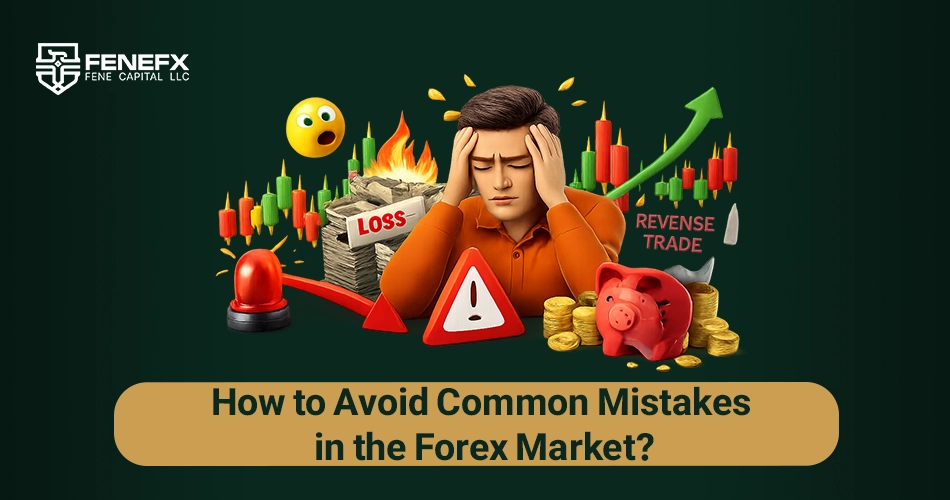
Why Are Emotional Entries the Killer of Trading Accounts?
Emotional trading, such as rushing into the market after a loss, usually leads to irrational decision making. To prevent this issue, you should stick to your trading plan and avoid making emotion driven decisions.
How Can We Stay Safe from the Temptation of Revenge Trading?
Revenge trading happens when a trader, in an attempt to recover a recent loss, enters the market without sufficient analysis. This approach usually results in even greater losses. The best solution is to step away from the market for a while after a major loss and return to trading only after carefully reviewing your mistakes.
Getting Familiar with Useful Tools and Resources for Professional Traders
Using professional platforms such as MetaTrader 4/5, cTrader, or TradingView gives you access to powerful analytical capabilities. These platforms include advanced tools for technical analysis, risk management, and automated trade execution.
Tools for Analyzing Economic Data and News
Tools such as ForexFactory, Investing.com, and Myfxbook allow you to accurately track economic data and major market news and analyze their impact on the market.
How to Use Technology to Improve Your Trading?
Automation tools such as Expert Advisors (EAs) in MetaTrader or custom scripts in TradingView can help you execute trades more precisely. In addition, trading robots, through automated risk management and timely trade execution, can prevent emotional decisions.
Creating a Daily Routine to Maintain Focus and Productivity in Trading
Start your day by reviewing economic news, setting your trading plan, and checking for trading opportunities. This routine helps you enter the market with a calm mindset.
Techniques to Improve Focus During Trading Hours
Techniques such as meditation, deep breathing, and setting break intervals while trading can increase your focus in volatile market conditions.
The Importance of Rest and Mental Recovery for Sustainable Performance
Trading in the Forex market can be stressful. Setting aside time to rest and step away from the monitor helps refresh your mind and enables you to make more rational decisions.
Conclusion: The Path to Becoming a Successful Forex Trader
Becoming a successful trader in the Forex market is not the result of a momentary decision or a magical strategy; rather, it is the outcome of building a clear path and consistently committing to it. Experience shows that traders who focus on a professional mindset, capital management, designing a personal trading system, and discipline in executing their plan have a much higher chance of longevity and profitability.
The Forex market always creates new opportunities, but only traders who have preserved their capital and learned from past mistakes can take advantage of them. If you can control your emotions, document your trades, and instead of focusing on short term profits, focus on improving your trading process, you will achieve completely different results in the long run.
Ultimately, success in Forex depends less on predicting the market and more on managing yourself. The more logical, disciplined, and plan based your decisions are, the smoother your path toward becoming a successful trader will be.
Frequently Asked Questions (FAQ)
Can you become a successful Forex trader without a large amount of capital?
Yes, many successful traders started with small capital and achieved sustainable profitability through proper risk management and gradual account growth.
How much time does it take to become consistently profitable in Forex?
This depends on the amount of practice, education, and commitment to a trading plan, but it usually takes anywhere from a few months to a few years.
Is learning technical analysis alone enough for success?
No, technical analysis without capital management and trading psychology usually leads to losses.
What is the most common reason Forex traders fail?
Not having a clear trading plan and making emotional decisions are the main reasons traders fail.
Comments
How do you know when you're actually ready for a funded account? Would love an article on realistic milestones before attempting a prop challenge.
Really helpful, especially the demo-to-live transition part. I was about to go live after two profitable weeks on demo, now I'll wait for a bigger sample.
Decent roadmap. I'd add: track your stats per setup, not just overall P&L. I found out one of my three setups was carrying the other two, and cutting them doubled my expectancy.
Spent my first year jumping between strategies every two weeks. The consistency point hit home — sticking to one system for six months is what finally turned things around for me.
One of the better guides I've seen on this, no fluff.