




Is Forex Gambling?
The Forex market provides a major opportunity for earning profit and developing trading skills, but many beginners lose money due to emotional trading, lack of education, and poor planning. Unlike gambling, Forex is an analytical and predictable market, and success in it requires strategy, capital management, and emotional control. In this article, we examine the reasons why beginners lose, the principles of capital management, and the methods to avoid a gambling mindset in Forex trading so that your path toward becoming a professional trader becomes smoother.
A Detailed Examination of the Question: Is Forex Gambling?
To answer this question, we must first compare the concept of gambling with the mechanism of the forex market. Gambling is an activity in which a person, without any analysis or knowledge, places bets purely based on luck and random probabilities. In contrast, Forex is a financial market where the currencies of different countries are traded, and success in it depends on multiple factors such as knowledge, experience, analysis, and precise risk management.
Therefore, Forex is not gambling. However, if someone enters this market without awareness and proper planning, and executes trades based solely on guesses and speculation, their activity can resemble gambling. The main difference between Forex and gambling is that in Forex, logical analysis and prediction are possible, whereas in gambling, chance and randomness are the only factors determining the outcome.
As a result, a trader’s approach and how they engage with Forex determine whether their activity is gambling like or a professional investment.
Key Differences Between Forex and Gambling
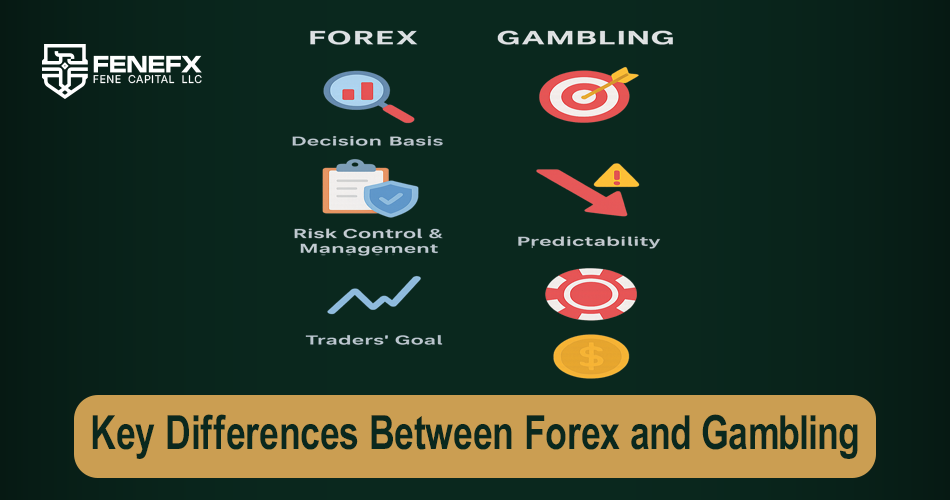
To better understand the differences between Forex and gambling, it is necessary to examine the details more closely. Below are several key distinctions between the two activities:
Basis of Decision Making
One of the main differences between Forex and gambling lies in the basis of decision making. In Forex, decisions are made based on economic data, technical and fundamental analysis, market news, and historical price behavior. Traders use various tools and methods such as chart patterns, indicators, and analysis of economic reports to predict price movements. This process requires knowledge and effort.
However, in gambling, outcomes are entirely dependent on chance, and there are no tools or data available to predict the result. For example, in card games or roulette, the individual has no control over the final outcome, and luck is the only determining factor.
Risk Control and Management
In Forex, traders have tools and methods available to control risk. Tools such as stop loss and Take Profit help prevent large losses. Additionally, capital management is one of the fundamental principles of Forex trading, allowing you to allocate your capital rationally and strategically.
In contrast, there are no tools for risk management in gambling. A person may lose all their money in a single bet, with no way to limit potential losses.
Predictability
Forex is a market that is largely predictable. Although short term price fluctuations may be unpredictable, in the long term the market’s trend is influenced by economic, political, and social factors. Professional traders can forecast market movements by correctly analyzing these factors.
In contrast, in gambling, outcomes are entirely random and lack any logical or predictable pattern. This unpredictability is one of the defining characteristics of gambling.
The Goal of Participants
The goal of traders in Forex is to achieve consistent and sustainable profit through analysis and planning. The main focus is on improving skills and identifying suitable trading opportunities.
However, in gambling, the primary goal is usually entertainment and momentary excitement. Even if someone wins in gambling, such profit is typically not sustainable and is often quickly lost, as there is no professional or long term approach involved.
Forex and Luck: Does Luck Play a Role in Forex Trading?
Luck may play a role in Forex trading in the short term, but in the long term it has very little impact on success. Simply put, a trader may profit in one or several trades without analysis and purely based on guesswork. However, in the long run, this approach leads to nothing but losses.
The advantage of Forex is that traders can influence outcomes in their favor by using their knowledge and experience. Unlike gambling, where luck is the main factor, in Forex luck is only a secondary element. Success in this market depends on skills such as analysis, risk management, and emotional control. For this reason, professional traders focus their time and energy on learning and improving their skills rather than relying on luck.
Ultimately, luck may favor you occasionally, but without strategy and planning, long term losses will erase all temporary gains. Therefore, success in Forex is based on effort and knowledge not luck and randomness.
Consequences of a Gambling Mindset in Forex
Entering the Forex market with a gambling mindset can lead to irreversible consequences. This type of perspective usually stems from a lack of knowledge, excitement, and the hope for quick profits. In such situations, the trader relies solely on luck and guesswork instead of analysis and planning. This approach not only leads to capital loss but also results in several other negative effects, which are outlined below:
Complete Loss of Capital:
Gambling like behavior in Forex often causes traders to invest a large portion of their capital into a single trade without considering the risk. This can lead to the complete loss of capital, as no management strategy exists to limit potential losses.
Increased Stress and Psychological Pressure:
When a trader relies on luck instead of analysis and logic, each loss or failure leads to severe stress and feelings of frustration. This psychological pressure can, in the long term, result in serious mental and even physical problems.
Trying to Recover Losses Through High Risk Behavior:
One of the characteristics of traders with a gambling mindset is that after every loss, they attempt to recover it by taking larger and riskier trades. This behavior usually leads to even greater losses.
Lack of Learning and Improvement:
Traders who view Forex as a gambling activity make no effort to learn, analyze, or improve their skills. This results in no long term progress and causes repeated failures.
Missing Real Investment Opportunities:
Such a mindset prevents traders from recognizing real and logical investment opportunities because they only seek quick, unplanned profits.
In the end, a gambling mindset distances you from a professional trading path and drastically reduces your chances of success. To avoid these consequences, you must enter this market with an informed and well planned approach.
Principles of Capital Management and Risk Control in Forex to Avoid Gambling Like Trading
Capital management and risk control are essential parts of every successful Forex trade. Even the best strategies can lead to heavy losses without proper capital management. By learning capital management principles, determining the risk percentage for each trade, and using protective tools such as Stop Loss, you can prevent your trades from becoming gambling like and turn them into professional and sustainable decisions.
Determining the Risk Percentage for Each Trade
One of the fundamental principles of capital management is deciding what percentage of your total capital to risk on each trade. Professionals recommend not risking more than 1 to 2 percent of your capital in a single trade. For example, if your capital is $1,000, no trade should expose more than $10 to $20 to risk. This ensures that even after several consecutive losses, your overall capital remains intact and psychological pressure is reduced.
Using Stop Loss and Trailing Stop
A Stop Loss is a tool that a trader sets to limit potential losses. A Trailing Stop, on the other hand, allows you to lock in profits and protect them from sudden price reversals. Proper use of these tools prevents your trades from becoming gambling like and transforms them into logical and well planned decisions.
Risk/Reward Ratio
Before entering any trade, assessing the risk to reward ratio is essential. For example, if you risk $10 to gain $20, a 1:2 ratio has been achieved. This metric helps ensure that even with several consecutive losses, the overall investment trend remains profitable. This ratio acts as a protective tool and prevents the trader from making emotional decisions.
Diversification in Trading
Do not concentrate all your capital on a single currency pair or one type of trade. diversification in trading reduces risk and prevents large losses. For example, distributing capital across different currency pairs or combining short term and long term trades can decrease the impact of strong market volatility.
If you are seeking a professional path in Forex trading and want real experience in a specialized and controlled environment, Buy prop firm Account from Fenefx can be an ideal option for you. With secure prop accounts, professional risk management, and educational opportunities, Fenefx allows traders to develop their skills with company capital and the support of a specialized team without risking their own personal funds. This opportunity helps you gain real market knowledge and experience and accelerates your path to success in Forex.
Is Forex Suitable for Everyone?
The Forex market is one of the largest and most dynamic financial markets in the world, offering numerous opportunities for profit. However, it is not suitable for everyone. Contrary to what many people believe, Forex is not a simple or quick way to get rich. Success in this market requires qualities and preparations that not everyone may possess.
Forex is suitable for individuals who have the ability for continuous learning, deep analysis, and acceptance of risk. This market requires a high level of patience and flexibility, as its volatility can quickly lead to profit or loss. If a person cannot manage their emotions, they may engage in emotional trading and incur significant losses.
In addition, Forex requires capital that a person can invest without depending on it or affecting their daily financial life. Investing with money intended for essential living needs can be extremely risky.
The Forex market is not suitable for individuals seeking quick profits without effort. This market is similar to a profession in which success requires spending significant time and energy on learning, analysis, and gaining experience. Those who are unwilling to dedicate enough time to learning or who cannot handle losses and setbacks are better off staying away from this market.
Ultimately, Forex is a market with high profit potential, but it is suitable only for individuals who are prepared to accept risk, conduct analysis, and commit to long term effort. If you are someone who seeks stability, financial security, and guaranteed profits, Forex may not be the right choice for you.
Recommendation for a Professional Outlook and Avoiding a Gambling Mindset
Forex is a professional market, and a gambling mindset leads to loss of capital and real opportunities. Having a written trading plan, limiting the number of trades, accepting losses as a natural part of trading, and practicing emotional control are the keys to becoming a professional trader. A professional approach not only reduces the likelihood of losses but also paves the way for skill development and consistent profitability.
Having a Written Trading Plan
One of the most important methods for avoiding a gambling mindset is creating and adhering to a written trading plan. The plan should include entry and exit rules, capital management, and clearly defined profit targets. When a trader has planned in advance, they are less influenced by market emotions, and emotional decisions are reduced.
Limiting the Number of Trades and Capital per Trade
Setting limits for the number of daily trades and the percentage of capital used in each trade prevents traders from entering positions without a plan and relying solely on luck. This technique is one of the simplest and most effective ways to avoid gambling like behavior in Forex.
Accepting Losses as a Natural Part of Trading
Losses are an unavoidable part of Forex trading. A professional outlook toward Forex turns losses into opportunities for learning and improving strategies rather than fearing them. Professional traders understand that trying to recover losses through high risk trades is gambling behavior, and in the long run, it results in nothing but capital loss.
Recording and Analyzing Trades
Keeping a trading journal and documenting the details of each trade helps traders identify their weaknesses and correct gambling like behaviors. Reviewing real data, recognizing repeated mistakes, and improving strategies pave the way toward sustainable success.
Practicing Mindfulness and Emotional Control
Mindfulness exercises, meditation, and trading psychology techniques help control fear and greed. The better a trader becomes at managing emotions, the less likely they are to enter trades without analysis or with a gambling mindset.
Final Conclusion
Success in the Forex market cannot be achieved by relying on luck alone, and approaching trades with a gambling mindset guarantees a path of loss and failure. Professional traders, by learning the principles of technical and fundamental analysis, capital management, and emotional control, can reduce risks and make logical and sustainable decisions. Commitment to a trading plan, using protective and trading tools , and maintaining a professional outlook are the keys to turning trades into profitable opportunities and achieving long term skill growth.
Frequently Asked Questions (FAQ)
Is Forex gambling?
No, Forex is an analytical market, and success in it depends on knowledge, experience, and risk management.
Why do beginners lose money in Forex?
Because they enter trades without education, strategy, and capital management, and act under the influence of emotions.
What role does luck play in Forex?
Luck may have an effect in the short term, but long-term success depends on skill and analysis.
How can one avoid a gambling mindset?
By having a written trading plan, managing risk, adhering to rules, and controlling emotions, one can avoid gambling like trading.
Comments
This answered something that's bugged me for months, thanks. The point about positive expectancy vs pure chance finally made the difference clear for me.
The line for me is simple: if you know your risk and your edge before entering, it's trading. If you're just hoping, it's a bet with extra steps. No indicator changes that.
Balanced take, you gave both sides a fair hearing.
My cousin treated forex exactly like a casino — max leverage, no plan, doubling down after losses. Watching that convinced me the gambling part is the trader, not the market.
Interesting read. Could you follow up with how regulators actually classify retail forex vs gambling? I've heard some countries literally tax it like betting.