




How Not to Lose in Forex
The Forex market is an attractive opportunity for many people to earn dollar based income, but the truth is that a significant portion of traders suffer losses due to poor capital management, lack of a strategy, and emotional decision making. Preventing losses in Forex does not depend on luck or a magical indicator; rather, it relies on a set of specific principles such as risk management, emotional control, choosing a reliable broker, and adhering to a trading plan. This article not only examines the main reasons behind traders’ failures but also provides a practical and executable roadmap for reducing losses and increasing profitability consistency exactly what a trader needs to survive and grow in the Forex market.
Why Do We Lose in Forex Trading?
One of the biggest reasons for losses in Forex trading is insufficient understanding of the market. Many beginner traders enter this market without the necessary knowledge and make wrong decisions in the hope of earning quick profits. Below, we examine several main reasons behind traders’ failures in Forex:
Emotions and Emotional Decisions
The Forex market, due to its high volatility, heavily impacts traders’ emotions. Fear of losing capital or greed for higher profits pushes individuals into making hasty trades that fall outside their trading plan. These emotional decisions usually lead to losses.
Lack of a Clear Strategy
Many traders enter positions randomly instead of having a precise trading plan. They trade purely based on guesswork without technical or fundamental analysis and without a deep understanding of market conditions.
Improper Use of Leverage
Leverage is one of the attractive tools in Forex that allows traders to execute large trade volumes with a small amount of capital. However, irrational use of leverage can lead to heavy losses. Many traders use high leverage without considering the risk, and eventually lose their capital.
Lack of Proper Capital Management
Many individuals enter the market without setting a Stop Loss or planning how much of their capital they will risk on each trade. This lack of capital management increases trading risk and results in irreparable losses.
Ignoring Education
Forex is a complex market, and success in it requires continuous learning and staying up to date. Traders who do not dedicate enough time to education usually struggle to understand market behavior and predict trends.
Capital Management Principles That Protect You
Capital management is not just a financial tool; it is a “survival system.” Its purpose is not to increase your profits, but to prevent the destruction of your capital and the collapse of your trading psychology. Once capital is preserved, making profit becomes only a matter of time and learning.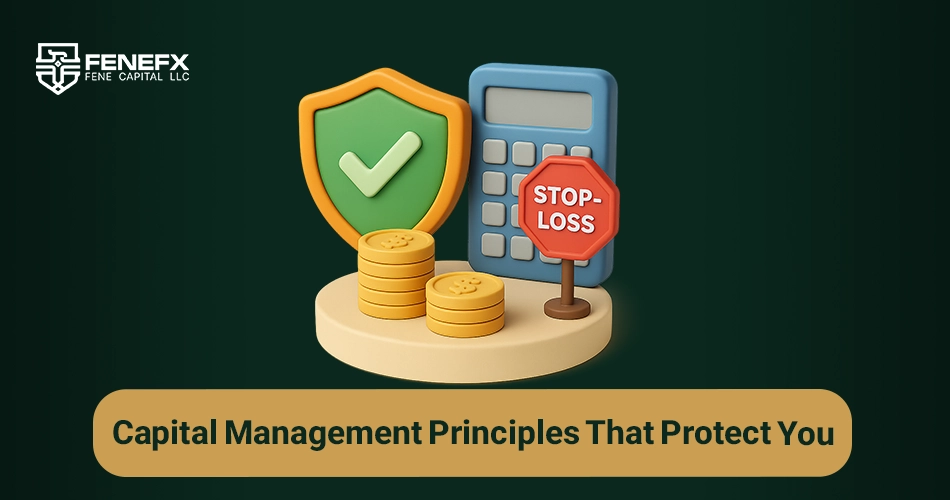
How to Calculate Position Size (Numerical Example and Formula)
Position Size means determining the trade volume in a way that if the stop loss is triggered, no financial or emotional damage is inflicted on the trader.
Global Standard Formula:
(Position Size) = (Account Balance × Risk %) / Stop Loss Distance (pips)
A completely realistic example:
Suppose someone has a $10,000 account and wants to risk a maximum of 1% per trade (meaning $100). If the stop loss distance is 50 pips:
Position Size = 100 / 50 = 2 dollars per pip
This means the standard volume that should be traded is$2 per pip.
This is why fixed and calculated risk is more important than the trading strategy itself.
Setting Stop Loss and Using Trailing Stop
A Stop Loss (SL) means exiting a trade when you are wrong not being afraid of the market.
A Trailing Stop automatically moves the stop loss when the trade goes into profit in order to lock in gains.
The combination ofStop Loss + Trailing Stopmakes the trader a winner in both scenarios:
- If the analysis is wrong, the loss is limited.
- If the analysis is correct, the profit is locked while allowing the trade to grow.
How to Design an Effective Forex Trading Strategy?
Having a well defined trading strategy is the key to success in Forex. A strategy helps you make decisions based on an organized and logical framework and avoid emotional trading. Below, we examine the steps for designing an effective trading strategy:
Precise Goal Setting:
The first step in designing a strategy is defining clear objectives. Are you looking for short term profits, or do you intend to make long term investments? These goals determine how you should analyze the market and what tools you need to use.
Technical Analysis:
Technical analysis helps you predict future market behavior based on past price patterns. Using tools such as moving averages, indicators, support and resistance levels, and candlestick patterns can help you identify entry and exit points.
Fundamental Analysis:
Fundamental analysis involves examining economic news, central bank monetary policies, and macroeconomic indicators. This type of analysis helps you understand how economic events affect the Forex market and make more informed decisions.
Market Psychology:
Alongside technical and fundamental analysis, understanding market psychology is also important. The behavior of other traders, market emotions, and the impact of unexpected news are factors that must be incorporated into your strategy.
Testing and Optimization:
Before applying your strategy to a real account, first test it on a demo account. This helps you identify the weaknesses of your strategy and optimize it.
Low Risk Trading Strategy Training
A low risk trading strategy is a decision making model that focuses not on achieving “big profits,” but on “profit consistency and preventing major losses.” A good strategy is not necessarily one that predicts the market accurately; rather, it is one that has solid rules for entry, exit, position size, and conditions for canceling a trade. The main goal of a low risk strategy is that even if the analyses are wrong, the capital remains protected and the trader can stay in the game.
Goal Setting, Risk/Reward Ratio, Entry/Exit Rules
The first step in a low risk strategy is setting a measurable goal: for example, a 3% monthly profit is far more reasonable than a 20% daily profit. Then, the risk to reward ratio (Risk/Reward) must be defined. The standard ratio is at least 1:2 or 1:3 so that even with an average win rate, the account can grow.
Entry rules must be based on specific market conditions for instance, entering only when the trend is confirmed, or when market volume aligns with the analysis. Exit rules must also be emotion free: exiting at stop loss or take profit levels, not based on momentary fear or greed.
Backtesting and Transition from Demo to Live
No strategy is reliable without backtesting and observing its performance in past market data. A trader must first apply their strategy to historical data, and then execute it on a demo account for at least one month. A proper transition to a live account happens when:
- More than 30 trades have been recorded.
- The average profit is greater than the average loss.
- The rules are practically executable, and the trader does not feel psychological pressure while following them.
Once the strategy proves that it is workable, it must be moved to a real account with the smallest possible position size in order to keep psychological pressure under control.
Emotional Control and Trading Psychology
No professional trader has ever achieved success without mastering trading psychology. The market always offers profit opportunities, but the human mind is not always ready to execute principles consistently. Emotional control means the ability to act according to the plan when excitement, fear, or greed try to divert the trader’s behavior.
Techniques to Prevent Overtrading (Numerical Rules)
Overtrading occurs when a trader trades beyond the limits of their plan. The solution is to establish strict numerical rules. For example:
- A maximum of 2 trades per day
- Stop trading after two consecutive losses
- A maximum of 4 trades per week if the first two trades are profitable
These rules prevent the mind from entering a “gambling to recover losses” mode and ensure the trader only enters high quality setups.
Mindfulness Exercises and Trading Journal
For a trader, mindfulness means being fully present in the moment without judgment. The simplest exercise is 5 minutes of deep breathing before starting a trade to regulate the nervous system. A trading journal is also the best tool for emotional control. Recording each trade along with the reasons for entry, momentary emotions, chart screenshots, recurring mistakes, and a plan for correcting errors helps the trader make progressively more conscious and logical decisions. The journal documents reality and prevents the mind from self deception.
Broker Selection and Execution Settings (Spread, Slippage, Costs)
Even the best trading strategy will lead to losses without precise execution. High spreads, heavy commissions, frequent slippage, and slow order execution can eliminate small profits and even cause trades with reasonable risk to close in loss. Choosing the right broker is an integral part of risk management and directly affects profitability.
How to Choose the Right Broker (Checklist)
To choose the right broker, the following points must be considered (the only bullet point section in the entire article):
- Valid license and reputable regulation
- Lowest possible spread on major currency pairs
- No severe slippage during news releases
- Account types suitable for the trading style (scalping, swing, etc.)
- Reliable support and withdrawal methods for Iranian users
Any broker lacking these features is not a suitable choice, even if it offers attractive bonuses or extensive advertising, and in the long run its costs will exceed its benefits.
In recent years, many professional traders, in order to reduce personal investment risk and increase profitability, have shifted from using their own capital to funded accounts. In this context, Fenefx , as the first Iranian international prop firm with global standards, has provided conditions that allow traders to focus solely on executing their strategy and growing returns without worrying about the risk of initial capital. Flexible accounts, fair rules, Persian support, and the ability to withdraw profits in dollars make Fenefx the best option for Iranian traders. If you are looking to start professionally in the Forex market, it is recommended to visit the prop account purchase page today and continue your trading journey with secure and professional capital.
The Importance of Capital Management in Forex
Capital management is the most important factor for long term survival and success in Forex. Even the best strategies can lead to losses without proper capital management. Below, we examine the key principles of capital management:
Setting a Stop Loss:
Always determine a stop loss level before entering a trade. This level should be where, if the market moves against your prediction, your loss is minimized.
Risk/Reward Ratio:
Ensure that your risk to reward ratio in every trade is logical. For example, if you risk $10 in a trade, you should expect to earn at least $20 in profit (a 1:2 ratio).
Risking a Small Percentage of Capital:
Risk only a small percentage of your total capital in each trade (usually 1 to 2 percent). This allows your capital to remain protected even if you experience several consecutive losses.
Diversification in Trades:
Do not concentrate all your capital on a single currency pair. Diversifying your trades can reduce risk and prevent large losses.
Commitment to the Rules:
Capital management is only effective when the trader adheres to it. Avoid changing your trading plan in the middle of a trade.
The Role of Education and Practice in Preventing Forex Losses
Education and practice are among the key factors in preventing losses in Forex. Due to its complexity and high volatility, this market requires continuous learning and practical training. Traders who enter the market without proper preparation and education usually lose their capital in a short period of time. To better understand this concept, we examine two main factors in this process:
1. The Importance of Learning Market Principles and Concepts
Forex is a market influenced by various factors, including economic news, monetary policies, and the behavior of other traders. Therefore, learning fundamental basics such as technical analysis, fundamental analysis, and capital management is essential for success in this market. Using reliable resources such as specialized books, training courses, and webinars can help you develop your skills.
2. Practical Training in a Demo Account
One of the best ways to learn and strengthen skills is by using a demo account. This tool allows you to test your strategies without the risk of losing real capital. Practicing in a demo account also helps you identify and correct your mistakes and become familiar with market psychology.
In the end, learning and practice not only help you better understand the market, but also strengthen your confidence and your ability to make logical decisions.
How to Control Emotions in Forex Trading?
Emotions are one of the biggest enemies of traders in Forex. Fear, greed, stress, and unrealistic hope can cause you to deviate from your trading plan. Below are several strategies for controlling emotions in trading:
Having a Written Trading Plan:
When you have a clear plan, you are less influenced by emotions. Your plan should include entry and exit rules, capital management, and trading objectives.
Using a Demo Account:
If you struggle to control your emotions, it is better to practice on a demo account first. This helps you strengthen your skills without worrying about losing real capital.
Accepting Losses:
Loss is a natural part of trading. Instead of panicking, see it as an opportunity to learn. Try to take a lesson from each loss to improve your future trades.
Setting Time Limits and Trade Limits:
Overtrading usually stems from emotions. Set limits for yourself and stick to them.
Practicing Mindfulness:
Mindfulness exercises and meditation can help you maintain calm and make more rational decisions.
Common Mistakes Traders Make in Forex and How to Prevent Them
One of the main reasons for losses in Forex is traders’ repeated mistakes. These mistakes usually stem from emotions, lack of planning, or insufficient knowledge. Below, we discuss two of the most common mistakes and how to prevent them:
1. Overtrading
Overtrading is one of the biggest mistakes traders especially beginners tend to make. This behavior is usually caused by excitement or the attempt to recover previous losses. Overtrading reduces focus and increases risk. The best way to avoid this mistake is to set a specific number of trades per day and stick to your trading plan.
2. Entering Trades Without Analysis
Some traders enter trades without thoroughly examining market conditions or based on emotions and momentary news. This usually leads to losses. To prevent this mistake, you should perform both technical analysis (to study price trends) and fundamental analysis (to evaluate the impact of news on the market), and make decisions solely based on logical data.
Although these two mistakes may seem simple, they can have a severe negative impact on your trading performance. Being aware of these mistakes and actively working to correct them can significantly increase your chances of success in Forex.
How to Reduce Losses by Creating a Written Trading Plan?
Having a written trading plan is one of the best ways to manage your trades and reduce losses in Forex. This plan helps you avoid emotional decisions and operate within a defined framework. To design an effective plan, you must consider several key steps: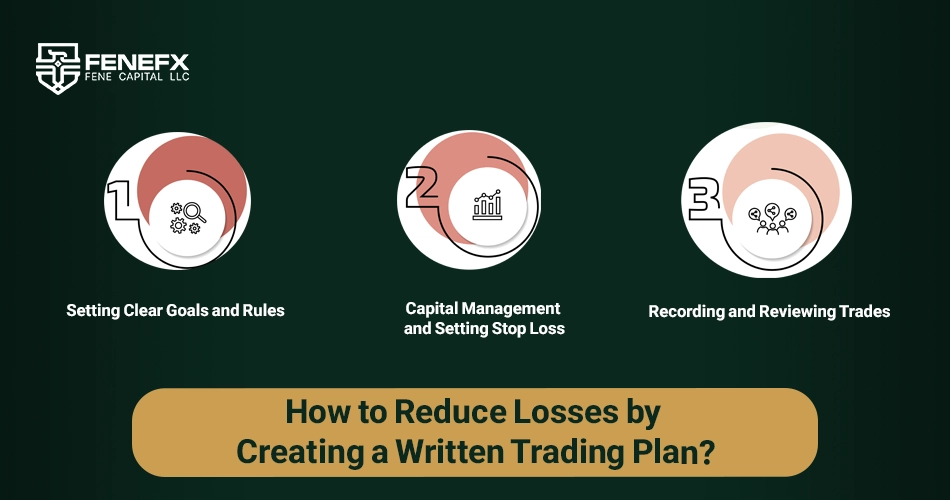
1. Setting Clear Goals and Rules
The first step in creating a plan is defining your trading objectives. These goals should be clear, realistic, and measurable. For example, determine the specific percentage of profit you aim to achieve by the end of each month. In addition, you must define your entry and exit rules. These rules can be based on technical analysis (such as price reaching a support level) or fundamental analysis (such as the release of economic news).
2. Capital Management and Setting Stop Loss
Capital management is one of the essential components of a trading plan. You must determine how much of your capital you risk in each trade. It is generally recommended that this amount should not exceed 1 to 2 percent of your total capital. Additionally, setting a Stop Loss for each trade is necessary to limit your losses if the market moves against your prediction.
3. Recording and Reviewing Trades
One of the important parts of a trading plan is recording the details of all your trades. By doing this, you can evaluate your performance and identify the weaknesses in your strategy. This information also helps you make better decisions in the future and gradually improve your plan over time.
Overall, a written trading plan gives you discipline and prevents emotional trading. Commitment to this plan is the key to success in Forex.
Instant Checklist for Preventing Losses
Preventing losses requires fast and logical decision making in every trade. Many traders don’t lose because their analysis is wrong, but because they lack clear entry and exit rules. A trading checklist is a simple yet incredibly powerful tool that ensures the mind does not replace rules and emotions stay under control. Using this checklist before every trade significantly reduces the chances of unmeasured risk, emotional entries, overtrading, and failure to set stop loss levels.
Complete Loss Prevention Checklist
- Is the reason for entering the trade completely clear and explainable?
- Is the position size aligned with capital management and daily limits?
- Are the stop loss and take profit levels set before entering, and is the R/R ratio at least 1:2?
- Is the market trending or ranging, and is the strategy aligned with the current condition?
- Are there any major economic news events within 30 minutes before or after the trade?
- After two consecutive losses, have the “stop trading” rules been followed?
- After take profit or stop loss is triggered, is the “no interference with active trades” rule respected?
- Is the entry based on the trading plan, or is it an attempt to take revenge on the market?
- Are the broker’s spread and slippage appropriate and not interfering with risk management?
- Is the emotional state (fatigue, anger, excitement) stable and controlled?
Conclusion
Reducing losses in Forex is a non random and fully manageable process. Successful traders are not those who always predict the market correctly, but those who preserve their capital when they are wrong. Implementing a low risk strategy, adhering to capital management, controlling emotions, working with a reliable broker, and following written rules are the key elements of long term survival in the market. Profitability is the result of adhering to principles not the result of luck or excitement.
Frequently Asked Questions (FAQ)
1. Where should I start to prevent losses in Forex?
Start by writing your strategy and using a trading checklist before every trade.
2. What is the best risk to reward ratio for trading?
The standard R/R ratio is at least 1:2 or higher for consistent capital growth.
3. Is emotion free trading possible?
No, but its effects can be controlled with a trading journal and numerical rules.
4. How important is backtesting?
Without backtesting, any strategy is just a guess and cannot be trusted.
Comments
Could you do a deeper piece on position sizing? I suspect most of my losses come from wrong size, not wrong direction.
Small nitpick: you can't 'not lose' in forex — losses are a cost of doing business. The real skill is keeping them small and boring. To be fair, the article lands on that point eventually.
My worst losses always came from revenge trading after a red morning. I now have a hard rule: two losses in a row and I'm done for the day. It's saved my account more than any indicator.
Simple, honest advice — no get-rich-quick nonsense. Refreshing.
Thank you! The stop loss section hit home. I've been trading without stops for a month (I know, I know) and this finally convinced me to change that before it costs me.