
From Exile to Talmud: The Birth of a Landless Religion
When Nebuchadnezzar’s army shattered the walls of Jerusalem in 586 BCE and set Solomon’s Temple ablaze, the ancient Jewish world collapsed. Kingship, sacrifice, and religious authority vanished. But what remained was a wounded memory and a living faith that shed its skin in exile and survived.
In this episode, we explore a precise and analytical narrative of one of the most critical turning points in Jewish history: from the Babylonian exile to the return to Jerusalem, from sacrificial priests to interpretive rabbis, and from a ritualistic religion to an interpretive one.
How did Judaism become a global legal system without a king, without a land, and without a prophet?
How did Babylon, the conquering enemy, become the womb of a new Judaism?
And why did Cyrus the Persian earn the title “Messiah of the Lord” in the eyes of the Jews?
This chapter of history is neither an end nor a footnote, but the beating heart of what is known today as Judaism.
The Exile to Babylon: End of an Era, Beginning of a Religion
In 586 BCE, with the destruction of the First Temple and the collapse of the political structure of the Kingdom of Judah, more than just a city fell: the ancient world of Judaism came to an end. What had unified the Jewish people for centuries land, kingship, and temple sacrifice all disintegrated at once. Yet within this catastrophe, a kind of rebirth began; one that fundamentally transformed the nature of the Jewish religion.
A Religion Without a Temple, a Law Without Sacrifice
At the center of ancient Jewish religion stood Solomon’s Temple. All religious rituals including sacrifices, festivals, and the atonement of sins depended on the sacred physical space of Jerusalem. With this center destroyed, Jews faced a foundational question for the first time:
How can one remain Jewish when the Temple no longer exists?
The answer emerged through religious ingenuity and the pressure of emergency: the transformation of religion from ritual based to text based. From then on, the preservation of the Law, study, and prayer replaced sacrifice and presence in the Temple.
The Rise of Scribes and Early Rabbis
In the absence of sacrificial priests, scribes (soferim) and religious interpreters became the new center of gravity in the faith. This group was tasked with preserving, rewriting, and interpreting the sacred texts (the Torah). Gradually, they became the founders of a tradition that would later find its final form in the Talmud.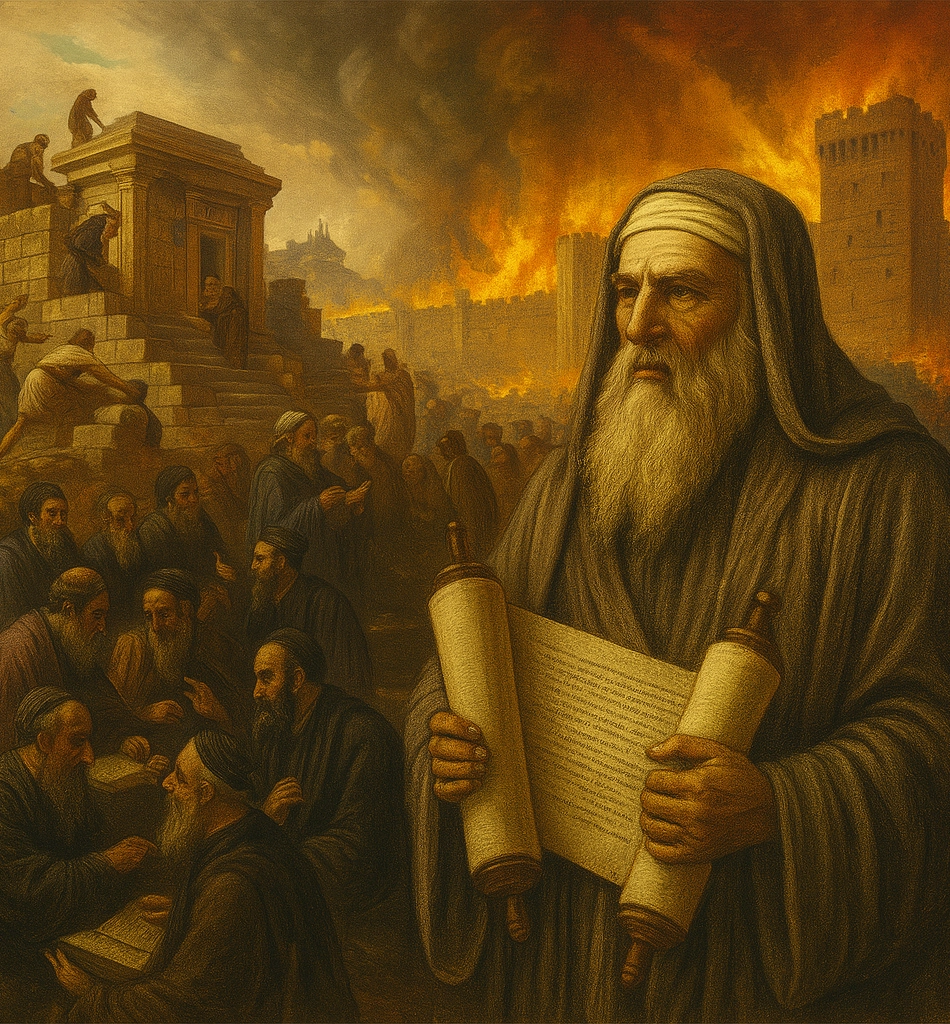
From within this class, the first rabbinic nucleus emerged not as prophets or kings, but as knowledgeable authorities on the Law, who preserved the faith from decline. Authority no longer stemmed from bloodline or royalty, but from mastery of the sacred text.
The Writing of the Torah: The Beginning of a Written Law
Although the narratives of the Torah had previously been passed down orally from generation to generation, the Babylonian exile marked the point at which written traditions began in earnest. During this period, the Jews came to realize that a written religion could survive without a homeland or political sovereignty.
Thus:
- The Torah was written down and codified (the Five Books of Moses, or the Pentateuch)
- Historical, legal, mythological, and poetic elements were consolidated together
- The collective Jewish memory was inscribed not in stone and sacrifice, but in text and narrative
Babylon: The Womb of the Talmud and the Diaspora
The Babylonian exile was also the first true experience of Jewish minority life in the diaspora a life outside the ancestral land that not only endured but became a foundation for religious flourishing. Babylon would later become the place where Judaism’s most significant legal and theological work was compiled: the Babylonian Talmud, written centuries later, but whose roots lie in this very exile.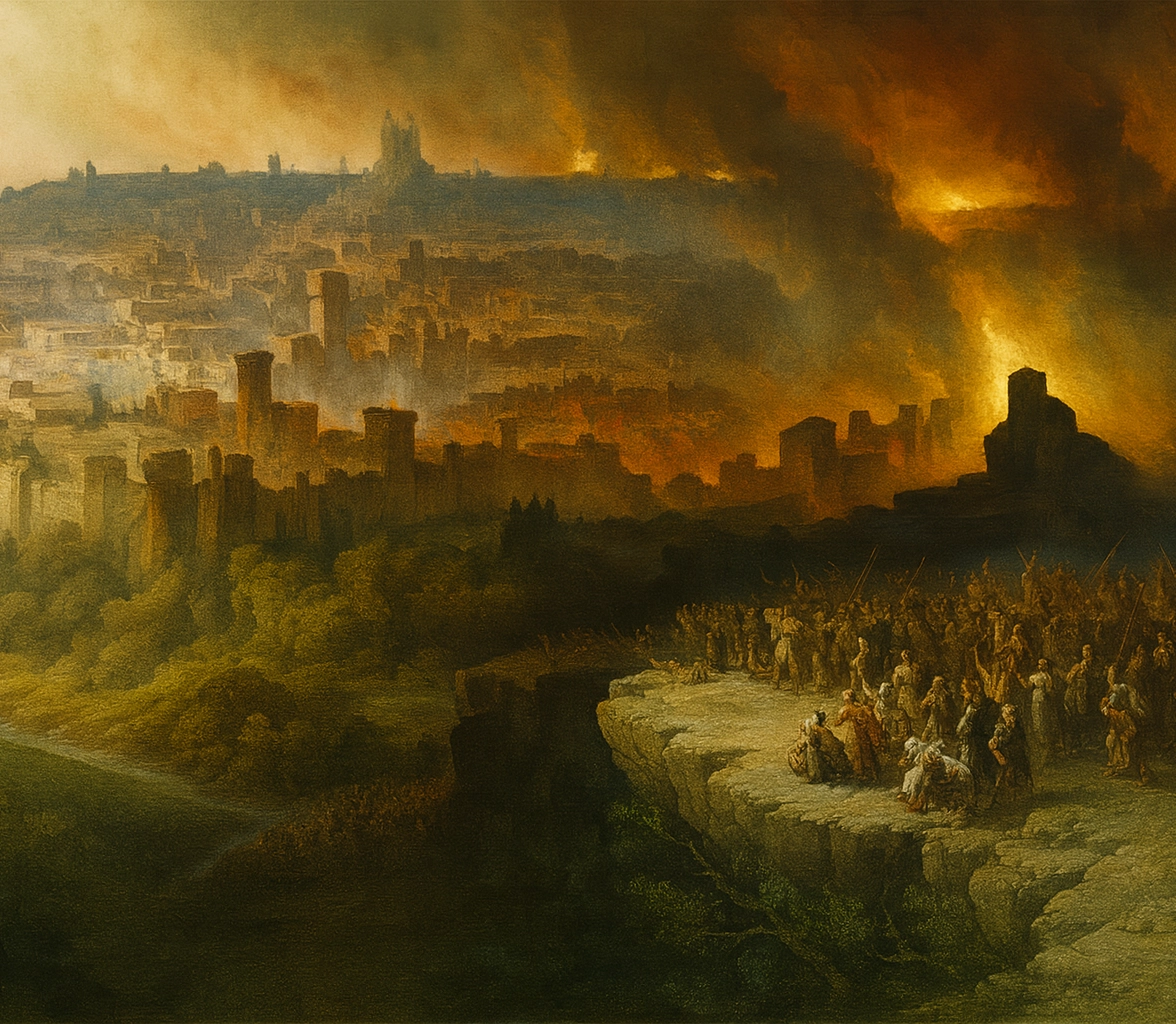
Here, for the first time, Judaism learned how to survive in exile how to endure without land, army, or king, by relying on book, memory, and law.
The Story of Esther and Mordechai: Salvation Within Foreign Power
Following the Babylonian exile and during the period of Jewish reconstruction within the Persian Empire, a unique narrative appears in the Jewish sacred text one that is not only historical in dimension but has become one of the deepest myths of survival and deliverance within a foreign system in the Jewish collective memory: the story of Esther and Mordechai.
This story is recounted in the Book of Esther (Megillat Esther) and takes place during the reign of Xerxes, king of the Achaemenid Empire (most likely Xerxes I, son of Darius), in the capital city of Susa. The events are estimated to have occurred between 480 and 460 BCE several decades after part of the Jewish population had returned to Jerusalem, at a time when a large number of Jews still lived throughout Persia.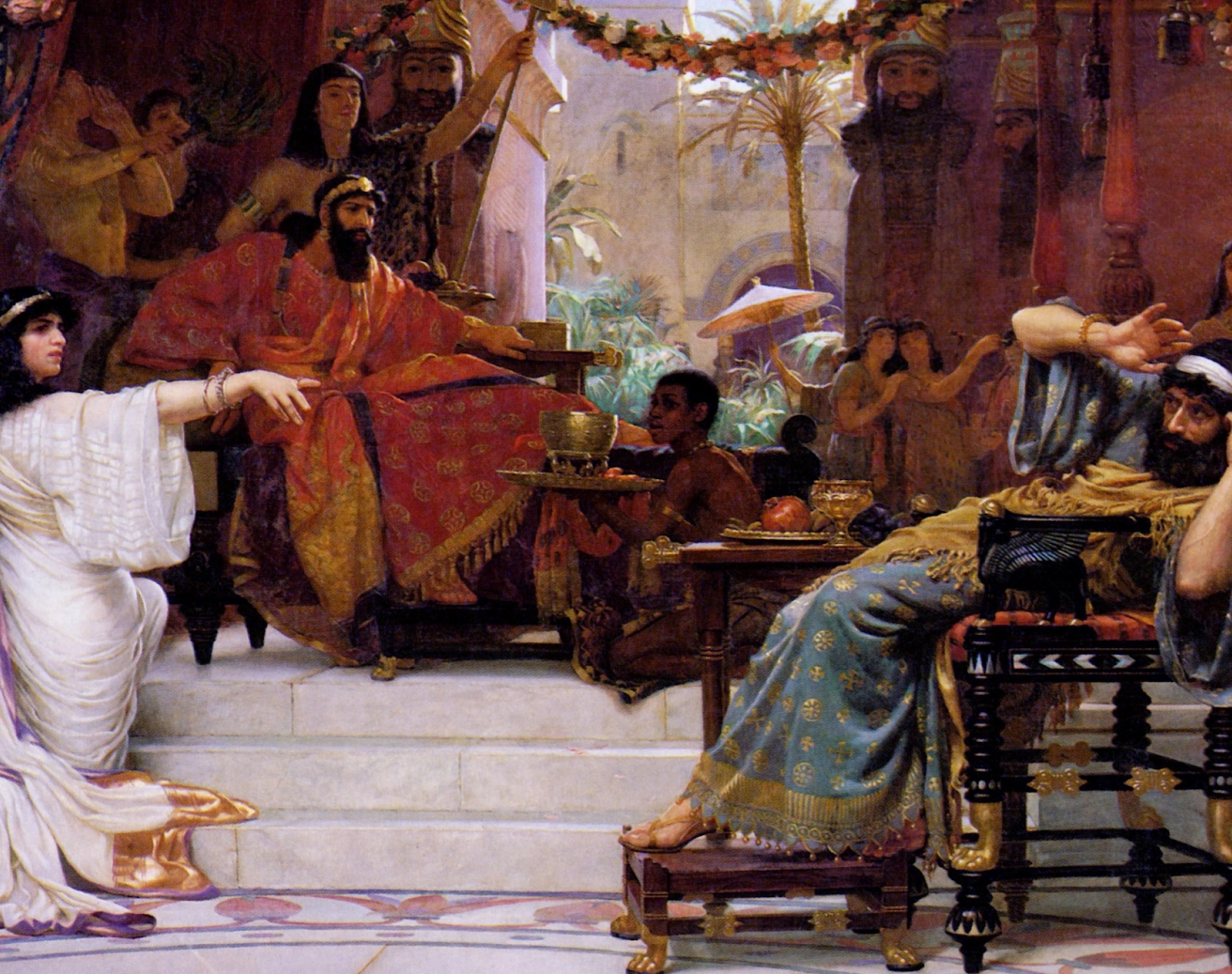
Xerxes, following Queen Vashti’s refusal to obey a royal command, deposes her from the throne. He then issues an order that the most beautiful young women of the empire be brought to the royal harem, so that he may choose one of them as queen. Among them is a Jewish girl named Esther (Hadassah), who is brought to the court. She has been raised by her cousin Mordechai and, on his advice, conceals her Jewish identity at the palace.
Xerxes is captivated by Esther’s grace and beauty and chooses her as the new queen.
Meanwhile, Haman the Agagite, one of the king’s powerful ministers, is promoted to the highest rank in the court. All are commanded to bow before him; but Mordechai, a devout Jew, refuses to do so. This act of defiance enrages Haman.
But Haman is not content with punishing Mordechai alone. He resolves to annihilate all the Jews in the Persian Empire. Using his influence, he convinces the king that a “rebellious and different” people live scattered throughout the realm and must be destroyed. A royal decree is issued under the king’s seal. A date is chosen for this genocide, determined by casting lots (pur) a detail that later gives the holiday of Purim its name.
Turning Point: Esther, the Hidden Woman in Power
When Mordechai learns of the decree, he sends word to Esther that the time has come to reveal the truth and plead with the king. At first, Esther hesitates; entering the king’s presence uninvited could mean death. But Mordechai stirs her with these words:
“Perhaps you have come to the kingdom for such a time as this!”
After fasting for three days, Esther courageously approaches the king. He spares her life. With strategic wisdom, she invites the king and Haman to two banquets; at the second banquet, she reveals her Jewish identity and exposes Haman’s plot.
Xerxes, in shock and fury, orders Haman’s execution he is hanged on the very gallows he had prepared for Mordechai.
Although Persian law could not be revoked, the king issues a new decree: the Jews are granted the right to defend themselves on the appointed day. Across the empire, the Jews successfully defend themselves and are not destroyed.
The Establishment of the Festival of Purim
In memory of this event, Mordechai and Esther decree that Purim shall be celebrated each year on the same day. This holiday is marked by feasting, the reading of the Book of Esther, giving gifts to the poor, and joyous family celebration.
Purim has become one of the most joyful and symbolic festivals in the Jewish tradition.
Torah Interpretation: Self Defense or Massacre?
At the end of the Book of Esther, although the initial decree calling for the destruction of the Jews is not revoked (since, under Persian law, a royal edict sealed with the king’s signet could not be rescinded), a second decree is issued through the intervention of Esther and Mordechai: on the appointed day, the Jews are granted the right to defend themselves.
On that day, they strike back against their attackers and, according to the biblical account, kill 500 people in Susa and a total of 75,000 of their “enemies” throughout the Achaemenid Empire.
This number, considering the vast geography of the empire and the narrative nature of the text, is generally seen as symbolic. Historical sources do not regard it as an exact statistical report. Furthermore, the Torah refers specifically to the “enemies of the Jewish people,” not to the Persian populace as a whole. The narrative speaks of conflict and self defense, not genocide.
Xerxes, as the reigning monarch, is not portrayed as the instigator of the violence, but rather as the one who through the second decree creates the conditions for the Jews’ survival. In traditional Jewish view, Persian kings especially Cyrus, Darius, and Xerxes are regarded as just and supportive rulers.
Cyrus, the Return, and the Rebuilding of the Temple – The Restoration of a People Under a Foreign King
The years of exile in Babylon, though filled with hardship, did not destroy Jewish faith they transformed it. Yet the true historical turning point in the restoration of the Jewish people came with the rise of Cyrus the Great (king of Persia) and the fall of the Babylonian Empire.
The Fall of Babylon and the Decree of Cyrus
In 539 BCE, Cyrus the Great, king of the Achaemenid Empire, conquered Babylon without bloodshed. Just a year later, in 538 BCE, he issued a decree allowing all exiled peoples in Babylon including the Jews to return to their homelands and rebuild their temples.
In the Book of Ezra, this decree is presented as the fulfillment of divine promise:
“The Lord stirred up the spirit of Cyrus king of Persia, so that he made a proclamation… ‘The Lord, the God of heaven, has given me all the kingdoms of the earth and has appointed me to build Him a house in Jerusalem.’”
Cyrus, in the Jewish tradition, is seen not only as a just conqueror but as the “Messiah of the Lord” (Moshiach Adonai) the only non Jew to be given this title in the sacred text (Isaiah 45:1).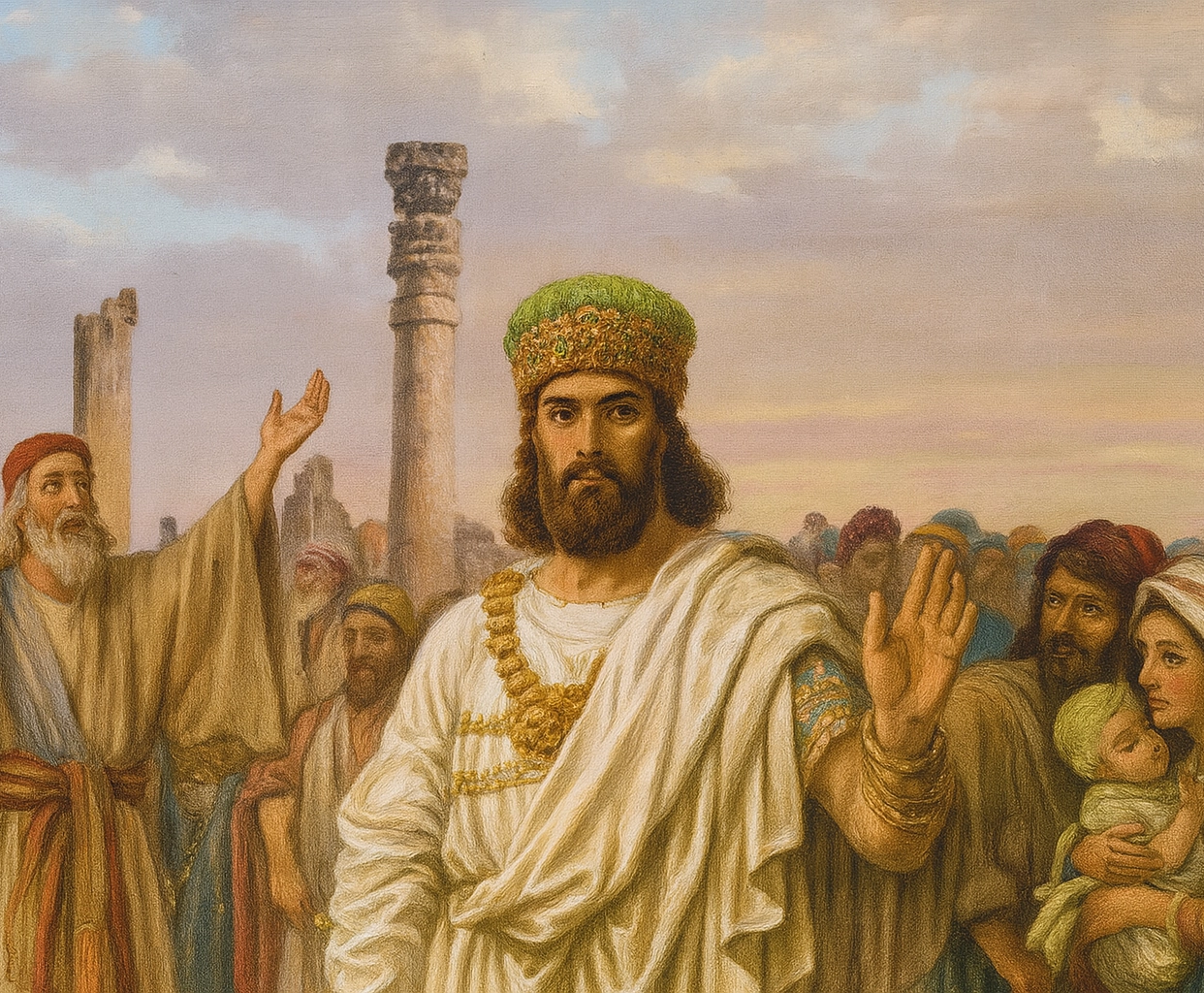
Return to Jerusalem and the Construction of the Second Temple
Around 50,000 exiled Jews, led by Zerubbabel (a descendant of David) and Jeshua (the high priest), returned to Jerusalem. This return was not the restoration of a monarchy, but rather the reconstruction of religious and cultural identity.
The construction of the Second Temple began, but due to political pressure, it was delayed. Eventually, around 516 BCE, the Second Temple was built on the same site as the First this time not as the center of kingship, but as a symbol of survival and religious unity.
This temple remained the central religious institution of Judaism until its final destruction by the Romans in 70 CE.
Rabbis, the Law, and the Emergence of Dual Track Judaism
The return from Babylon brought with it a major shift:
Judaism now functioned on two levels Temple (sacrifice) and Text (law).
- Figures such as Ezra the scribe and Nehemiah made the written Law of Moses the core of Jewish social and religious life.
- The Great Assembly (Knesset HaGedolah) emerged, an early prototype of the rabbinic system.
This era became the foundation for what would later be formally known as the Talmud: a vast collection of interpretation, law, and intergenerational rabbinic dialogue about how to live a life of faith.
From Prophet to Jurist: The Silent Revolution in the Structure of Jewish Religion
The Transformation of Religious Authority
Before the Babylonian exile, Judaism was primarily organized around prophets and the Temple:
- The prophet was a divine intermediary and a moral and political warning voice.
- The Temple was the center for religious law and sacrificial rites.
- Religious authority was directly tied to kingship and land.
But after the exile, this structure collapsed there was no longer a prophet, no monarchy, and no Temple. What remained were memory, text, and a dispersed community.
In response to this new reality, Judaism entered a new phase:
The center of religion shifted from revelation to interpretation, from prophet to jurist, from inspiration to jurisprudence.
The Rise of the Rabbi as Jurist Narrator
The Rabbi literally meaning “great teacher” became the representative of a new generation of religious thinkers who:
- Mastered the preservation and interpretation of the Torah
- Transmitted oral tradition from generation to generation
- Responded to the evolving needs of the Jewish people living in exile and without political sovereignty
This group relocated religious authority from direct experience of revelation to mastery of text and interpretation. Gradually, religion became a network of legal rulings, questions and answers, and rules for both individual and communal life.
Post exilic Judaism became a legal interpretive system in which each rabbi functioned as a judge, teacher, and thinker.
From Experiential to Legalistic Religion
One of the most significant aspects of this transformation was the shift away from an experiential religion centered on prophets, miracles, and living revelation toward a legalistic and dialogical faith:
- Revelation ceased; interpretation began
- The silence of heaven was filled by human dialogue
- Divine presence was replaced by divine law
This is precisely what the Talmud would later embody—not a new holy book, but a boundless sea of interpretation and jurisprudence.
Conclusion
In this episode, we explored how the Babylonian exile though seemingly the end of the golden age of kingship and the Temple actually became the beginning of a new religious identity:
- Judaism transformed into a religion of book, interpretation, and law
- Religious authority shifted from prophet to rabbi, from inspiration to jurisprudence
- The Second Temple, though rebuilt with the support of Cyrus, was no longer unchallenged; synagogues and rabbis emerged with new roles
- Oral and written traditions together laid the foundation for the Talmud
- Judaism now had the capacity to survive and even thrive without land, king, or Temple
Sources of the text
Hebrew Bible (Tanakh)
- Second Book of Kings, Chapter 25 (The fall of Jerusalem and the exile to Babylon)
- Book of Ezra, Chapter 1 (Cyrus's decree for return)
- Book of Nehemiah (Rebuilding the walls of Jerusalem)
- Book of Esther (The story of Esther and Mordecai during the reign of Xerxes)
Jewish historiography
- Flavius Josephus, Antiquities of the Jews
- A reference for the historical narrative of the Exile period, the Second Temple, and the role of Cyrus
Babylonian Talmud (Talmud Bavli)
- Sections of the "Perakim" (Chapters) on the origins of the oral tradition
- Indicates the beginning of rabbinic centered development and religious jurisprudence during the exile
A History of the Jews – Paul Johnson
- Paul Johnson, A History of the Jews
- A reputable book on the transformations of Judaism from the Exile to the modern era
Modern historical interpretations
- Martin Goodman, A History of Judaism
- Shaye J.D. Cohen, From the Maccabees to the Mishnah
- Presenting academic analyses of the transition from temple nglibased religion to rabbinic Judaism
Ancient Near Eastern studies
- Research sources on Cyrus, the Cyrus Cylinder, and Achaemenid religious policy
- Including: Amélie Kuhrt, The Persian Empire (Routledge)
Comments
Didn't expect this from a trading site, but I'm here for it. Great series.
Never understood how a religion survives losing its temple and its land. The idea of portable law as the answer really clicked for me here. Thanks.
I visited a very old synagogue in Isfahan years ago and never really understood the history behind that community. This article connected a lot of dots for me.
Well written, though I'd have liked a bit more on the split between the Babylonian and Jerusalem Talmuds — the Babylonian one becoming the authoritative text is a story in itself.
Fascinating read. Any plans for a piece on the Jewish communities of ancient Persia? Feels like a natural next chapter.