




Comparison of Investing in Forex and the Stock Market
Forex is a global, 24 hour market for trading currency pairs which, due to features such as high leverage, large trading volumes, and exceptional liquidity, is mainly favored by traders seeking short term profit opportunities and dollar based income. In contrast, the stock market especially the Iranian stock market has a centralized structure in which trading takes place within a limited time frame and places greater emphasis on long term investment, actual ownership, and the payment of cash dividends.
In this article, we take an analytical and realistic look at the differences and similarities between the Forex market and the global stock market. It is also explained that this comparison can largely be extended to the situation of the Iranian stock market as well, although with consideration of the specific conditions of this market.
1. Trading Hours and Market Accessibility
The timing of transactions is one of the key differences between Forex and the stock market. While stock exchanges typically operate during specific and limited daily hours, the Forex market is almost continuously active, and this characteristic has a direct impact on trading styles and the flexibility of investors.
Forex Trading Hours
The Forex market operates 24 hours a day, five working days a week (Monday to Friday). Market activity is divided into four main trading sessions: Sydney, Tokyo, London, and New York. This structure ensures that at any hour of the day, at least one market is active and a relatively suitable level of trading volume is present.
This feature is considered a significant advantage for traders who live in different time zones or are looking for fast and short term opportunities. In addition, the ability to take advantage of market fluctuations at various times throughout the day increases the flexibility of traders’ personal scheduling.
Stock Market Trading Hours (Global and Iran)
Unlike Forex, stock market trading hours are limited and vary depending on geographic location. Major stock exchanges around the world, such as New York (NYSE), London (LSE), and Tokyo (TSE), each operate only for a few hours per day and on specific working days.
In Iran, the Iranian stock market is currently active from 9:00 a.m. to 12:30 p.m., Saturday through Wednesday. This time limitation results in fewer trading opportunities and creates greater challenges for investors who seek to implement fast paced strategies.
2. Type of Asset and Actual Ownership
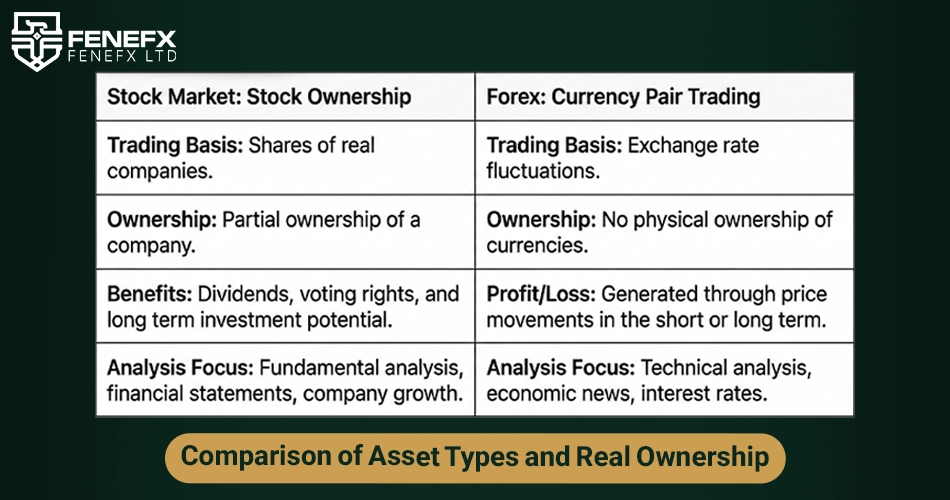
The type of assets traded in Forex and the stock market, as well as the underlying concept behind these transactions, is another fundamental difference between the two markets. In Forex, trading mainly involves changes in exchange rates, whereas the stock market is based on shares of real companies.
Currency Pair Trading (Forex)
In Forex, traders buy and sell currency pairs ; meaning that in each transaction, one currency is purchased while another is simultaneously sold. For example, in the EUR/USD currency pair, buying implies an expectation that the euro will strengthen against the dollar.
The key point is that in Forex there is no physical or actual ownership of currencies; rather, traders profit or incur losses through price fluctuations over short or long time horizons. This market operates primarily based on technical analysis, economic news, interest rates, and macroeconomic indicators.
Share Ownership (Stock Market)
In the stock market, by purchasing shares, individuals effectively acquire a portion of ownership in a company. This ownership comes with rights such as receiving cash dividends, voting rights in general assemblies, and the ability to hold shares over the long term. Stock market investors seek either growth in the company’s value or the receipt of annual dividends.
This characteristic makes the stock market suitable for individuals who are seeking stable investment and the creation of long term assets. In addition, the ability to conduct fundamental analysis of companies and review financial statements provides a clearer perspective for decision making.
3. Liquidity and Market Size
Liquidity, or the ability to convert an asset into cash, is one of the key factors in choosing a market for investment. Alongside market size, it reflects the depth and financial soundness of the market in question.
High Liquidity in Forex
With more than 7 trillion dollars in daily turnover (according to BIS reports), the Forex market is considered the most liquid financial market in the world. Due to the presence of central banks, large financial institutions, multinational corporations, and retail traders, this market continuously faces a high volume of buy and sell orders.
In practice, this means that a trader can open or close a position at almost any moment with minimal price difference (spread). This feature is particularly important for high frequency or short term trading styles such as scalping or day trading.
Liquidity Variation in Global and Iranian Stock Markets
In global stock markets, liquidity largely depends on the traded symbol. Shares of large companies such as Apple, Microsoft, or Amazon have high liquidity, whereas shares of smaller or emerging companies may be traded with much lower volume.
In the Iranian stock market, this issue is also highly evident. Stocks that have a significant impact on the main or equal weight indices (such as Foolad, Fomeli, or Shasta) generally enjoy higher liquidity. However, many smaller symbols face a lack of buyers and sellers, which increases the risk of capital being locked in those stocks.
4. Financial Leverage and Its Risks
Financial leverage , or leverage, is a tool that allows investors to enter trades with multiples of their actual capital. This capability is one of the main differences between the Forex market and the stock market and has a significant impact on the level of investment risk.
Leverage Range in Forex
In the Forex market, the use of leverage is common and, in many cases, unavoidable. Forex brokers typically offer their clients leverage ranging from 1:10 up to even 1:500 or higher. This means that with only $100, it is possible to trade up to $50,000.
The use of leverage can generate high profits in a short period of time, but at the same time it dramatically increases the risk of losses. Many novice traders lose their capital quickly due to insufficient understanding of the nature of leverage and risk management. Therefore, education, experience, and capital management are considered key factors for the proper use of leverage in Forex.
Limited Leverage in the Stock Market
In contrast, the stock market both global markets and the Iranian stock market generally has stricter limitations on the use of leverage. In global stock exchanges, margin trading requires specific conditions such as minimum account balances, adequate credit levels, and strict regulatory rules.
In the Iranian stock market, there are no direct leverage based instruments, and only certain official institutions such as brokerage firms or exchange traded funds provide credit facilities with limited percentages. As a result, the stock market overall carries lower risk compared to Forex in terms of leverage driven volatility, although opportunities for rapid profits are also fewer.
5. Comparison of Volatility, Profit, and Opportunities
One of the key aspects in comparing Forex and the stock market is the level of volatility and profit opportunities. Differences in the price behavior of assets have made each of these markets suitable for a particular type of investor.
High Volatility in Forex – Opportunities and Risks
The Forex market generally exhibits higher daily volatility compared to the stock market. Currency pairs can experience significant fluctuations over short time periods, driven by economic news, macroeconomic reports, central bank decisions, or even tweets from influential economic figures.
This high volatility provides opportunities for short term traders (day traders and scalpers) to generate profits from small price movements. However, the same characteristic can also lead to substantial losses, especially when combined with high leverage. Therefore, Forex is more suitable for individuals who possess the ability to analyze the market quickly, have trading experience, and can effectively control their emotions.
Sustainable Growth and Long Term Returns in the Stock Market
Unlike Forex, the stock market focuses more on the gradual growth of asset prices and the distribution of dividends. Investing in fundamentally strong companies with sound financial conditions can, over the long term, lead to an increase in asset value and the receipt of cash dividends.
In addition, stock market indices tend to grow over the long run (provided there is economic and political stability). This sustainable growth is considered a reliable option for individuals seeking secure investment and long term financial planning. In the Iranian stock market, although notable volatility is observed, the prevailing view is that it serves as a market for preserving capital against inflation.
6. Two Way Trading Capability
One of the most important tools for flexibility in financial markets is the ability to profit from declining asset prices. In this regard, there is a significant difference between Forex and the stock market especially the Iranian stock market.
Profiting from Price Declines and Increases in Forex
In Forex, all transactions are conducted in currency pairs, meaning that in every trade, one currency is bought while another is sold. This inherent structure enables two way trading. For example, if an analyst predicts that the U.S. dollar will weaken against the euro, they can open a sell position on the EUR/USD pair and earn a profit if the prediction materializes.
This feature allows traders to remain active even in bearish markets and not miss out on profit opportunities. In fact, in the Forex market, there is never truly a “negative market,” as traders can always take positions in either direction.
One Way Trading in the Iranian and General Stock Markets
In many global stock markets, instruments for two way trading exist, such as short selling and derivative contracts. However, these tools are usually not available to all participants and require specific legal conditions, regulatory approval, and technical infrastructure.
In the Iranian stock market, trading is effectively conducted on a one way basis. This means that an investor can only generate profits when a stock’s price increases. During bearish or stagnant market periods, there is no opportunity to profit, and the only available option is to sell the asset and temporarily exit the market.
This limitation has resulted in lower flexibility for active traders in the Iranian stock market. Although in recent years there have been efforts to develop instruments such as covered short selling or futures contracts, broad and smooth access to these tools at the retail investor level has not yet been achieved.
7. Transparency, Regulation, and Market Structure
Information transparency and the presence of clear regulations are vital factors in building trust and security for investors. In this regard, there are fundamental differences between the structure of the Forex market and the stock market especially the Iranian stock market which affect how participants operate and the level of risk they face.
The Decentralized Forex Market and Its Risks
The Forex market operates in a decentralized manner, meaning that no single central authority is responsible for executing transactions. Forex trades are conducted through a network of banks, financial institutions, brokers, and individual traders that are interconnected.
This structure provides greater flexibility and freedom in trading; however, it also comes with certain challenges. The absence of a single governing authority means there is no centralized global supervision of the market, and in cases of misconduct or unfair practices by some brokers, users’ legal recourse may be limited. Therefore, choosing a reliable broker with strong regulatory oversight is extremely important in Forex trading.
Regulatory Authorities in Global and Iranian Stock Markets
In contrast, the stock market generally operates under the supervision of clearly defined legal authorities. In global stock exchanges, organizations such as the SEC (United States) or the FCA (United Kingdom) oversee the activities of companies, brokerage firms, and overall market structure. This framework increases information transparency, enforces financial reporting requirements, and provides greater protection for the rights of retail shareholders.
In the Iranian stock market, the Securities and Exchange Organization is responsible for market oversight. All listed companies are required to publish their financial reports and material disclosures through the CODAL system. This level of transparency enhances analysts’ and investors’ access to accurate information and enables more informed decision making.
8. Costs and Initial Capital
The costs associated with executing trades, as well as the amount of capital required to start operating in each market, are among the determining factors when choosing a target market for investment.
Commissions, Spreads, and Fees in Forex
In Forex, the cost structure includes spread s (the difference between bid and ask prices), commissions (charged by some brokers), and sometimes holding costs (swap fees). Spreads vary depending on the currency pair, market volatility, and the type of trading account. In short term trading, even small spreads can have a noticeable impact on final profitability.
In addition, under certain conditions such as using the Ethereum network for withdrawals or token transfers gas fees may be imposed on users. These costs can appear complex for beginners and require greater education and attention to manage effectively.
Trading Costs and Minimum Capital in the Stock Market
In the stock market, the fee structure is relatively simpler. For each stock purchase and sale, a fixed percentage is charged as commission by brokerage firms and the stock exchange authority, which is transparently published on the website of the Exchange Technology Management Company. In the Iranian stock market, this rate is currently around 1.5 percent of the total value of buying and selling transactions.
In terms of minimum capital, entering the stock market does not require a large amount of money, and shares can be purchased with relatively small capital (for example, around 500,000 tomans in the Iranian stock market). This feature has made the stock market accessible to middle income segments of society as well. However, for more professional trading and better portfolio diversification, having larger capital is recommended.
9. Suitability of Specialized Investment
One of the important criteria in choosing a market is its level of applicability in other words, how well that market aligns with an individual’s needs, goals, and personal investment style.
Dollar Based Income and Diversification in Forex
Due to its international nature, the Forex market enables traders to earn income in U.S. dollars. This is particularly a major competitive advantage for users in countries with high inflation or currency volatility, such as Iran. In addition, the wide range of tradable assets from currency pairs to precious metals, energy commodities, indices, and even cryptocurrencies provides traders with a broad variety of opportunities.
Forex is suitable for individuals who can analyze the market in real time, use risk management tools, and seek active, short term income.
Cash Dividends and Long Term Value in the Stock Market
In contrast, the stock market is a suitable option for individuals seeking long term capital growth and the receipt of cash dividends. In the Iranian stock market, many companies distribute annual dividends to shareholders, and the intrinsic value of shares can increase over multi year periods.
For those with long term financial planning goals, the stock market offers a more stable environment with less complexity compared to Forex. Moreover, the option of indirect investment through investment funds has expanded the range of available choices.
Final Comparison of Forex and the Stock Market
Comparison Criteria | Forex | Stock Market (Global & Iran) |
Asset Type | Currency pairs, metals, energy, indices | Stocks, funds, securities |
Trading Hours | 24 hours a day, 5 days a week | Limited (official working hours of each country) |
Leverage | High (up to 1:500 or more) | Limited or no leverage |
Volatility & Risk | High, suitable for professional traders | Moderate, suitable for long term investors |
Liquidity | Very high (about $7 trillion daily) | Variable, depending on the stock and market |
Two Way Trading | Yes (buying and selling) | No in Iran limited globally |
Regulation & Transparency | Broker dependent, sometimes without a central regulator | Transparent, under official regulatory supervision |
Fees & Costs | Spread, commission, swap, gas fees | Fixed and transparent fees, relatively simple |
Required Initial Capital | Flexible, from a few dollars to thousands | Can be started with relatively low capital |
Investment Objective | Dollar based income, short term, high risk | Sustainable growth, long term, cash dividends |
One of the main challenges of entering the Forex market is insufficient capital and the psychological pressure caused by risking personal funds. Prop trading addresses this issue by allowing traders to trade using the capital of a reputable firm. In this model, instead of putting personal capital at risk, you focus on skill, strategy, and risk management, and if you are profitable, you receive a defined share of the profits. Prop trading is especially considered a smart and lower risk path for traders who have the knowledge but lack sufficient capital to enter Forex professionally.
Fenefx prop, with its transparent structure, reasonable rules, and challenges aligned with real market conditions, is regarded as one of the reliable options for Persian speaking traders. By focusing on capital management, risk control, and performance consistency, this platform provides conditions in which traders can test their true abilities in Forex without the stress of losing personal capital. If you want to enter the Forex market but are concerned about the risk to your personal funds, buying prop from Fenefx can be the best starting point for professional trading and earning dollar based income.
Final Conclusion
Ultimately, the choice between Forex and the stock market depends entirely on your goals, risk tolerance, and investment style. Forex is a dynamic and highly liquid market suitable for active, dollar based income generation, offering numerous short term profit opportunities through tools such as leverage and two way trading, but it requires a high level of knowledge, experience, and risk control. In contrast, the stock market especially the Iranian stock market is considered a more rational option for long term investment, preserving capital value, and receiving cash dividends. If you are seeking professional activity and active income, Forex is more attractive; if stability and a long term horizon are your priorities, the stock market will be the more suitable choice.
Frequently Asked Questions (FAQ)
1. Who is Forex more suitable for?
For individuals who are risk tolerant, have market analysis skills, and are seeking active, dollar based income.
2. Does the Iranian stock market carry less risk than Forex?
Yes. In general, due to the absence of leverage and lower volatility, the systematic risk of the Iranian stock market is lower.
3. With limited capital, is Forex better or the stock market?
Both allow starting with relatively low capital; however, in Forex, due to the use of leverage, risk management is far more critical.
4. Is it possible to participate in both Forex and the stock market at the same time?
Yes. Many investors use the stock market for long term investment and Forex for active income generation simultaneously.
Comments
As someone brand new, the part about market hours finally explained why my stock orders never fill at night. Thanks!
Solid comparison, saved this one.
How would you compare the costs though? Spreads vs commissions never seem apples to apples to me. Would love a breakdown article on that.
Started in stocks, moved to forex for the 24/5 hours since I work full time. Honestly the leverage took some getting used to.
One thing I'd add: stocks give you dividends and long-term compounding, forex doesn't. I trade both but treat forex as income and stocks as wealth building.