




What Is the Shiba Inu Cryptocurrency?
Shiba Inu (SHIB) is a digital currency built on the Ethereum network that was initially introduced as a meme coin, but today it has evolved into an ecosystem encompassing DeFi, NFTs, and a dedicated layer two solution. Relying on an active community, high price volatility, and tools such as ShibaSwap and Shibarium, this project has attracted the attention of many investors and traders. In this article, we will comprehensively examine what Shiba Inu is, how it works, what advantages and risks it has, and whether it can be a suitable option for trading or investment.
History and Foundation of Shiba Inu Digital Currency
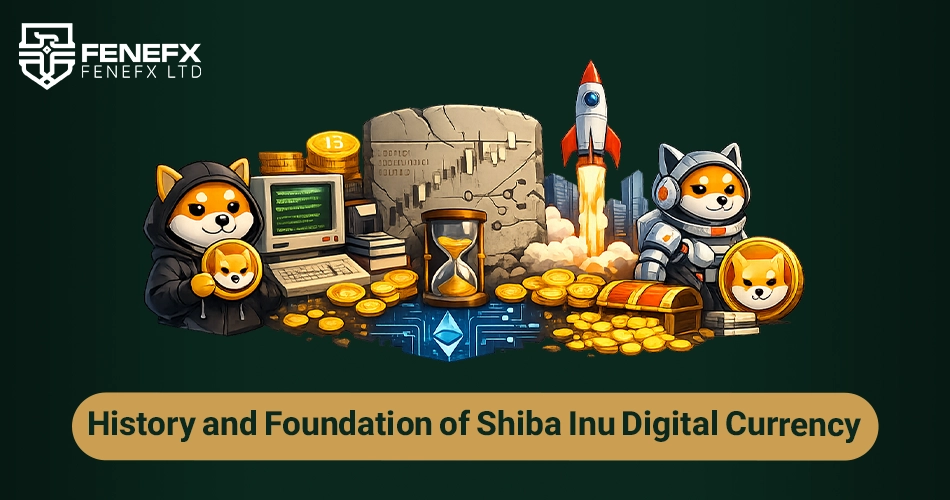
Shiba Inu emerged from the culture of internet memes and the hype surrounding cryptocurrencies. Although many did not take it seriously at first, a combination of unique marketing strategies, the anonymity of its founder, and strong community support turned Shiba into one of the most searched cryptocurrencies.
Creation by Ryoshi and the Initial Philosophy
The founder of Shiba Inu is an anonymous individual known by the pseudonym Ryoshi. In blog posts published by him, it is clearly stated that the goal of creating SHIB was not merely a joke or an imitation of Dogecoin, but rather the creation of a truly decentralized project based on the power of the community. Ryoshi emphasized that no owner or entity should have full control over the project, and that its success should be determined by its users.
Sending a Portion of Tokens to Vitalik Buterin and Its Impact
In an unexpected move, 50% of the initial supply of SHIB tokens was sent to Vitalik Buterin, the creator of Ethereum. From Ryoshi’s perspective, this action was a symbolic gesture aimed at building trust. However, in response, Vitalik burned a large portion of these tokens and donated the remainder to charitable causes. This action drew significant media attention to the project and greatly contributed to its rapid growth in the early stages.
Technology and Cryptographic Structure of Shiba Inu
Shiba Inu is launched on the Ethereum network and uses the ERC 20 standard for its token structure. This choice has enabled Shiba, from the very beginning, to be fully compatible with Ethereum’s vast ecosystem, including wallets, exchanges, and smart contracts.
Why ERC 20? Advantages and Limitations
Using the ERC 20 standard allowed SHIB developers to benefit from Ethereum’s reliable and secure infrastructure without the need to build a dedicated blockchain. This choice facilitated easier deployment, broad support, and interoperability with other DeFi projects.
On the other hand, complete reliance on Ethereum meant that high transaction fees and slow processing times especially during periods of network congestion became one of the major challenges faced by users.
The Shibarium Layer Two Solution and Its Advantages
To address scalability and fee related issues, the Shiba development team decided to launch a layer two solution called Shibarium. This platform is designed to process transactions off the main Ethereum chain, enabling a significant reduction in costs and an increase in transaction speed.
Shibarium also provides a foundation for expanding new projects such as games, decentralized applications, and even NFTs, effectively transforming Shiba from a simple meme coin into a comprehensive ecosystem.
An Overview of the Shiba Inu Ecosystem
After moving beyond the stage of being merely a novelty token, Shiba Inu gradually adopted a more complex structure and incorporated a variety of projects within its ecosystem. From the development of auxiliary tokens to the launch of a dedicated decentralized exchange and entry into the NFT market, this ecosystem has today become one of the most active projects among meme coins.
SHIB, LEASH, and BONE Tokens and Their Roles
The Shiba Inu ecosystem consists of three main tokens:
- SHIB:The core and flagship token of the project, with a very large supply, used for exchange, holding, and staking.
- LEASH:A scarcer token with a limited supply that was initially designed to track the price of DOGE, but later came to be used as a reward mechanism within ShibaSwap.
- BONE:The governance token of the ecosystem, which allows holders to participate in voting processes and decision making regarding the future of the project.
Each of these tokens plays a specific role within the overall structure of the project, and together they shape the economic and governance functionality of the ecosystem.
ShibaSwap, Staking, and Yield Farming
ShibaSwap is a dedicated decentralized exchange for Shiba users that provides features such as token swapping, staking, yield farming, and liquidity provision. By locking SHIB, LEASH, or BONE tokens on this platform, users receive rewards in the form of BONE tokens or other assets.
These tools not only encourage users to hold their tokens over the long term, but also contribute to increased liquidity and overall stability of the ecosystem.
Other Projects: NFTs, Metaverse, and DAO
Shiba Inu has recently entered the NFT market and introduced collections known asShiboshis. These NFTs are designed to be usable in games and future metaverse platforms of the project.
In addition, through the development of a Decentralized Autonomous Organization (DAO), the Shiba community is involved in major decision making processes of the project. These initiatives demonstrate an effort to transition from a hype driven project to a stable and serious structure within the Web3 space.
Community Characteristics and the Role of the ShibArmy
The user community of a cryptocurrency project especially in projects with a decentralized nature plays a crucial role in growth, sustainability, and even asset pricing. In the case of Shiba Inu, this community is known as the ShibArmy and is regarded as one of the most active and enthusiastic crypto communities across social media platforms.
Online Community and Its Impact on Price
The ShibArmy consists of a mix of retail users, traders, DeFi participants, and meme coin enthusiasts who are highly active on platforms such as Twitter, Reddit, Discord, and Telegram. These users have often played a key role in word of mouth promotion, generating market hype, and even making the SHIB token trend globally.
Strong community support for the project has, in the past, led to major price surges and has even compelled some major exchanges to list the token. This demonstrates that, in the absence of a central authority or a formal marketing team, the community itself can act as a powerful catalyst for the growth of both the project’s price and its credibility.
Charitable Contributions and Social Responsibility
One of the notable characteristics of the Shiba community is its involvement in humanitarian initiatives. When Vitalik Buterin donated a portion of SHIB tokens to an Indian charitable foundation, the action received global attention and helped enhance the project’s legitimacy among market observers.
The ShibArmy has also launched charitable campaigns in areas such as dog rescue, environmental protection, and support for victims of natural disasters, aiming to present an image beyond that of a mere meme coin. These responsible actions have enabled Shiba Inu to develop a social dimension in addition to its investment appeal.
Advantages and Disadvantages of Shiba Inu
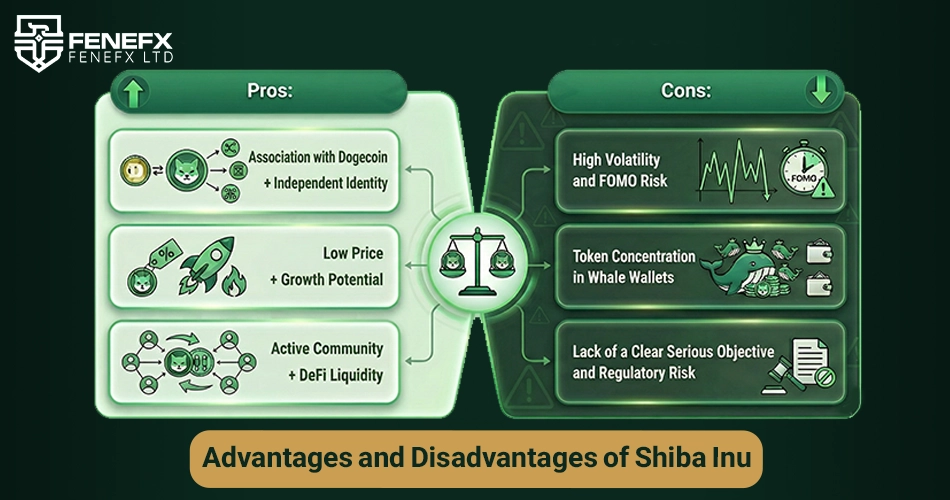
Although Shiba Inu was initially regarded as a joke token, over time it has managed to develop features that have turned it into an attractive option for a segment of cryptocurrency market investors.
Pros:
Association with Dogecoin + Independent Identity
One of SHIB’s advantages was its smart use of Dogecoin’s popularity to gain initial attention. However, unlike Dogecoin, which lacks a broad technical ecosystem, Shiba Inu has succeeded in building an independent platform with various tools, including ShibaSwap, multiple tokens, and NFT projects.
As a result, Shiba has come to be known not only as the “Dogecoin killer,” but also as a project with its own independent technical and social identity.
Low Price + Growth Potential
The low price of each SHIB unit allows users to hold large quantities of the token in their wallets with a relatively small amount of capital. This psychological factor creates a strong sense of participation among retail users.
On the other hand, while the large token supply is considered a challenge, the successful implementation of token burn strategies and the practical growth of the ecosystem could provide significant room for long term price appreciation.
Active Community + DeFi Liquidity
The presence of a passionate and active community that is willing to participate in DeFi projects, DAO voting processes, and marketing campaigns is considered a strong competitive advantage. In addition, the availability of SHIB, BONE, and LEASH tokens on platforms such as ShibaSwap has created a steady flow of liquidity within the ecosystem.
This liquidity enables faster transactions, attracts new investors, and provides stronger support for token performance, effectively moving the project beyond a purely symbolic phase.
Cons:
Alongside the advantages attributed to SHIB, it is important to note that this project also carries notable weaknesses and risks that investors should not overlook.
High Volatility and FOMO Risk
One of the most prominent characteristics of Shiba Inu is its extreme price volatility over short periods of time. Part of this volatility stems from social media hype and the sudden influx of capital from new participants, often driven by the fear of missing out (FOMO).
This behavior leads to the formation of price bubbles followed by sharp corrections after upward phases. Therefore, investing in SHIB without sufficient awareness and proper risk management can be detrimental.
Token Concentration in Whale Wallets
Despite the relatively broad distribution of SHIB among users, a significant portion of the total supply is still held by a limited number of addresses. This can be risky, as large sell offs by any of these whales have the potential to cause severe market shocks.
Although some of these tokens are held in locked contracts or on exchanges, distribution concentration remains a major weakness in the project’s fundamental analysis.
Lack of a Clear Serious Objective and Regulatory Risk
Although projects such as ShibaSwap and Shibarium have been developed, Shiba Inu still lags behind larger blockchain projects in terms of real world use cases. The absence of a clear and well defined commercial objective may lead to a decline in investor interest in the future.
Moreover, due to the lack of transparency surrounding the development team and the identities of the founders, this project could become a priority target if governments impose stricter regulations on the cryptocurrency sector. This issue may pose additional legal and technical challenges to its future.
Given the extreme volatility of assets such as Shiba Inu, success in trading depends more than anything on capital management and risk control. Fenefx prop trading makes it possible to trade highly volatile assets like SHIB without committing substantial personal capital, while operating within clear rules and a professional framework. This trading model helps traders focus on strategy execution and performance consistency rather than emotional decision making. If you want to take advantage of cryptocurrency market volatility in a structured and lower risk manner, buying a prop account from Fenefx can be a professional starting point on your trading journey.
How to Store and Transfer SHIB
Secure storage of the SHIB cryptocurrency and familiarity with its transfer methods are among the most critical considerations for investors and users of this token. Since Shiba Inu is an Ethereum based (ERC 20) token, a wide range of secure wallets and platforms are available to support it.
Recommended Wallets (MetaMask, Trust, Ledger, etc.)
For storing SHIB, both software and hardware wallets are reliable options. Among software wallets, MetaMask and Trust Wallet are among the most popular choices, offering mobile and browser based versions. These wallets fully support ERC 20 tokens and also allow users to connect to decentralized applications such as ShibaSwap.
If security is a higher priority, hardware wallets such as Ledger Nano S/X or Trezor are recommended. These wallets store private keys offline and are significantly more resistant to online attacks.
Transfers and Security in a DEX Environment
When transferring SHIB within decentralized environments (such as Uniswap or ShibaSwap), strict adherence to security principles is essential. The destination address must be carefully verified, as blockchain transactions are irreversible. Users must also ensure that the selected network during the transfer is the Ethereum network.
To enhance security in these environments, it is important to use reputable wallets, review smart contracts before connecting, and avoid clicking on suspicious links. Additionally, using smart contract security auditing tools and extensions such as WalletGuard is recommended to reduce the risk of phishing or unauthorized wallet access.
How to Buy, Sell, and Stake SHIB
Due to its global acceptance, the SHIB cryptocurrency is listed on most centralized and decentralized exchanges and can be easily bought and sold. In addition, users can earn periodic rewards by staking their tokens on the dedicated ShibaSwap platform.
Trading on Centralized and Decentralized Exchanges
SHIB is listed on centralized exchanges such as Binance, KuCoin, Coinbase, OKX, and many others. Users can create an account on these platforms, complete the identity verification process, and purchase SHIB directly using trading pairs such as USDT or ETH. This method is generally more suitable for beginners and those who prefer a simpler trading environment.
On the other hand, decentralized exchanges such as Uniswap or ShibaSwap allow users to trade directly from their wallets without intermediaries. This type of trading requires familiarity with smart contracts and the payment of Ethereum network gas fees, but it offers greater privacy for users.
Staking Process on ShibaSwap
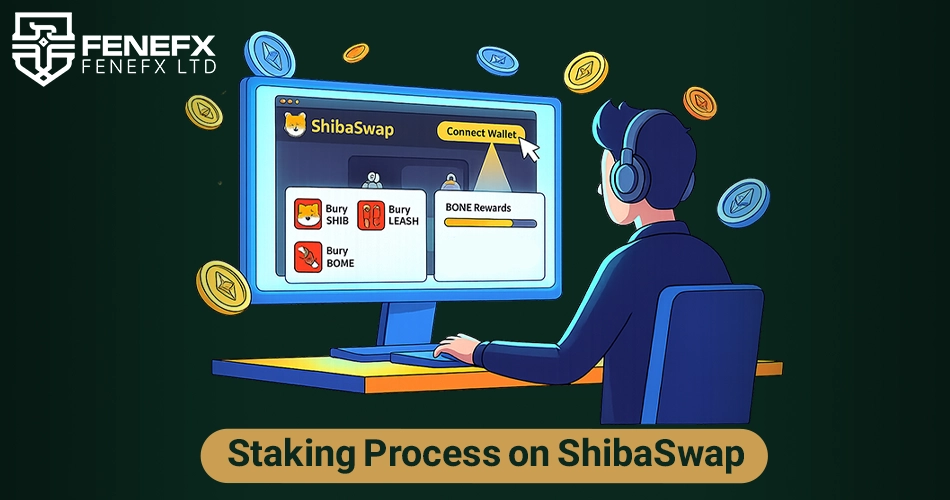
To participate in staking, users must first connect their wallet to ShibaSwap. After connecting, options are available toBurySHIB, LEASH, or BONE tokens. By locking these tokens, users become eligible to receive rewards.
Rewards are typically distributed in the form of BONE and other ecosystem tokens. The staking process on this platform is designed to be simple and user friendly; however, users should ensure they fully understand the lock up period and withdrawal conditions of their assets before proceeding.
Security Tips and Costs
Users should be aware that conducting transactions on the Ethereum network involves paying transaction fees (gas fees), which can increase significantly during periods of high network congestion. Using tools to monitor network conditions, such as Etherscan or Gas Now, is recommended.
It is also advisable for users to revoke access permissions after finishing their activities when connecting their wallets to DeFi platforms, in order to prevent potential misuse or unauthorized access.
The Future of Shiba Inu: DeFi, Metaverse, and DOGE Comparison
The future of Shiba Inu is closely tied to further development in areas such as DeFi, the metaverse, and NFTs. The launch of Shibarium as a layer two solution can reduce costs and enable new use cases for the token. In addition, entry into the NFT market with projects such as Shiboshis and new collaborations has expanded the project’s outlook.
In comparison with Dogecoin, which still lacks a strong ecosystem, SHIB has managed to build more extensive infrastructure and move beyond being merely a meme coin. However, in practice, many of its features are still in the development stage, and proving their effectiveness will require time.
Conclusion
Shiba Inu is a prominent example of the transformation of a simple meme coin into a multi layered ecosystem within the blockchain space. By relying on the strong ShibArmy community, developing tools such as ShibaSwap, launching the Shibarium layer two solution, and entering fields such as DeFi, NFTs, and the metaverse, this project has sought to move away from exclusive dependence on market hype. Nevertheless, extreme price volatility, the concentration of a portion of tokens in whale wallets, and the lack of fully established use cases remain significant risks for investors. Ultimately, Shiba Inu can offer attractive opportunities for risk tolerant traders who are knowledgeable about capital management, but entering without proper analysis, strategy, and emotional control can be detrimental.
Frequently Asked Questions (FAQ)
1. Is Shiba Inu only a meme coin?
No. Although SHIB started as a meme coin, it now has an ecosystem including ShibaSwap, multiple tokens, NFTs, a DAO, and the Shibarium layer two solution.
2. Is long term investment in SHIB reasonable?
This depends on the investor’s level of risk tolerance. If Shibarium is successful and real world use cases are developed, there is growth potential; however, the risk remains high.
3. What is the main difference between Shiba Inu and Dogecoin?
Dogecoin is primarily a simple payment currency, whereas Shiba Inu has attempted to build a complete ecosystem with DeFi, staking, and decentralized governance.
4. What is the best way to store SHIB?
For small amounts, wallets such as MetaMask or Trust Wallet are suitable. For larger holdings, using a hardware wallet such as Ledger is recommended.
Comments
Decent overview, but I'd stress that liquidity matters way more than tokenomics for coins like this. Supply burns are mostly marketing in my experience.
I always thought Shiba Inu was just a Dogecoin copy, didn't know it had its own ecosystem with Shibarium and everything. Thanks for clearing that up.
Bought some shib back in 2021 during the hype and rode it all the way down lol. Lesson learned about meme coins and buying tops.
Could you do a follow-up on how SHIB burns actually affect price? I keep hearing about the burn portal but I've never seen real numbers on it.
Nice clear rundown, enjoyed this one.