




What Is an Option Contract?
A Call Option contract is an instrument that allows investors, by paying a limited amount, to benefit from the increase in the price of assets while simultaneously controlling their risk. If you want to know exactly what a Call Option is, how it works, what advantages and disadvantages it has, and under what conditions it can turn into a profitable strategy, this article is a comprehensive and practical guide for you.
Definition of a Call Option Contract
A Call Option contract is a derivative financial instrument that gives the buyer the right, but not the obligation, to purchase a specific asset such as stocks, bonds, or commodities at a predetermined price known as the strike price, up to a specified date. This contract allows investors to benefit from an anticipated increase in the price of the underlying asset.
In this contract, the buyer pays an amount known as the premium to the seller. This amount is the cost that the buyer pays for the right to purchase the asset in the future. If the price of the underlying asset increases and exceeds the strike price, the buyer can exercise the contract, purchase the asset at the lower price, and sell it in the market to earn a profit from the price difference.
On the other hand, the seller of the contract is obligated to sell the asset at the strike price if the buyer decides to exercise the contract. If the price of the underlying asset does not exceed the strike price by the expiration date of the contract, the buyer will not exercise the contract, and the only loss incurred is the amount of the premium paid.
A Call Option allows investors to achieve higher financial leverage with a smaller amount of investment. This means that with limited capital, they can obtain greater potential profits. Of course, these instruments also carry risks, especially if the price of the underlying asset declines.
These contracts are used for various purposes such as speculation, income generation, and tax risk management. For example, investors can earn additional income by selling call options on stocks they already own.
How Call Option Contracts Work
Call Option contracts, as derivative financial instruments, allow investors, by paying a premium, to obtain the right to purchase a specific asset in the future at a predetermined price known as the strike price. These contracts have unique characteristics that make them a popular tool for investment and risk management.
Structure and Components of the Contract
A Call Option contract consists of three main components:
- Underlying Asset:This may include stocks, bonds, commodities, or other financial instruments.
- Strike Price:The price at which the buyer can purchase the asset at or before the expiration date.
- Expiration Date:The date after which the option expires and is no longer exercisable.
Role of the Buyer and the Seller
In these contracts, the buyer (holder) has the right to purchase the asset but is not obligated to do so. The buyer pays an amount known as the premium to the seller for this right. The seller (writer) is obligated to sell the asset at the strike price if the buyer decides to exercise the option.
Profitability Mechanism
The buyer profits when the market price of the underlying asset exceeds the strike price. In this case, the buyer can purchase the asset at a lower price and sell it at a higher price in the market. The buyer’s profit is calculated as the difference between the market price and the strike price, minus the premium paid.
Risk and Reward
The greatest advantage of a Call Option is that the buyer’s risk is limited to the premium paid. If the price of the underlying asset declines or does not exceed the strike price, the buyer only loses the premium and is not required to purchase the asset. On the other hand, the potential profit is unlimited, because if the price of the asset increases significantly, the buyer can benefit from this increase.
Basic Concepts in Call Option Contracts
Call Option contracts are complex financial instruments, and a proper understanding of their basic concepts is essential for successful use. These concepts help investors make better investment decisions and manage the associated risks.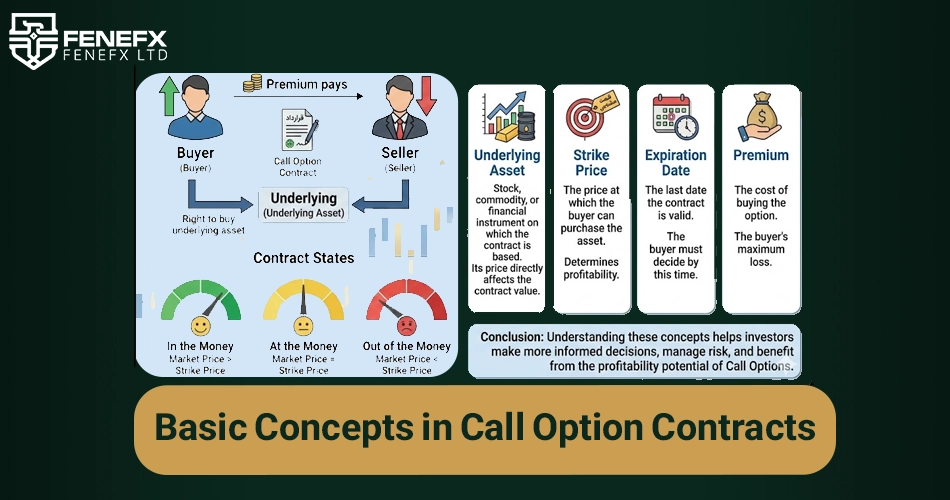
Underlying Asset
The underlying asset refers to a stock, commodity, or any other financial instrument on which the option contract is based. The price performance of this asset directly affects the value of the contract.
Strike Price
The strike price is the price at which the option buyer can purchase the underlying asset at or before the expiration date. This price determines the profitability of the contract. If the market price of the asset rises above the strike price, the buyer can profit from this difference.
Expiration Date
The expiration date is the point in time after which the option contract will no longer be valid. The buyer must decide by this date whether to exercise the right to purchase or not. This timing can influence investment strategies.
Premium
The premium is the amount the buyer pays to the seller to purchase the option. This amount represents the cost of the right to buy the underlying asset and is the maximum loss that the buyer can incur.
Contract Statuses
Option contracts can be in one of the following states:
- In the Money:When the market price of the underlying asset is higher than the strike price.
- Out of the Money:When the market price is lower than the strike price.
- At the Money:When the market price is equal to the strike price.
Role of the Buyer and the Seller
In Call Option contracts, the buyer has the right to purchase the asset but is not obligated to do so. The seller is obligated to sell the asset at the strike price upon the buyer’s request. This dynamic allows the buyer to benefit from market movements with lower risk, while the seller benefits from receiving the premium.
Overall, understanding these basic concepts helps investors make more informed decisions when using Call Option contracts and improve their investment strategies. Due to their profit potential and risk management capabilities, these instruments continue to attract attention in financial markets.
Advantages and Disadvantages of Using Call Options
The Call Option contract is one of the widely used instruments in financial markets, allowing investors to benefit from increases in the price of the underlying asset by paying a limited amount. Due to its high financial leverage and controlled risk, this instrument is attractive to traders; however, alongside these advantages, it also has limitations and risks, awareness of which is essential for making sound decisions. Below, the advantages and disadvantages of Call Options are reviewed in a concise and practical manner.
Advantages | Disadvantages |
High financial leverage with a small amount of capital | Existence of an expiration date and loss of contract value |
Risk limited to the amount of the premium paid | Loss of value due to time decay |
Unlimited potential profit in case of price appreciation | Requirement for knowledge and understanding of options concepts |
No need to purchase the underlying asset | High premiums during periods of extreme market volatility |
Difference Between Call Option and Put Option
Call Options and Put Options are two fundamental instruments in the options market that allow investors to profit from price fluctuations or manage their risk without directly buying or selling the underlying asset. A Call Option gives the holder the right to purchase the underlying asset at a specified strike price until the expiration date and is typically used in situations where price growth is expected. In this case, the higher the market price rises above the strike price, the greater the profit potential for the Call Option buyer.
In contrast, a Put Option gives the holder the right to sell the underlying asset at the strike price until the expiration date and is mainly used in bearish markets or for risk hedging. Investors turn to Put Options when they anticipate a decline in the price of the asset, and profit is realized when the market price falls below the strike price. In summary, the main difference between Call and Put lies in the expected direction of price movement, and the choice of each depends on the investor’s outlook on the future of the market.
Trading Strategies Using Call Options
Using Call Option contracts allows investors to manage their risks and increase their potential profits by employing various strategies. Below are some of the most popular strategies.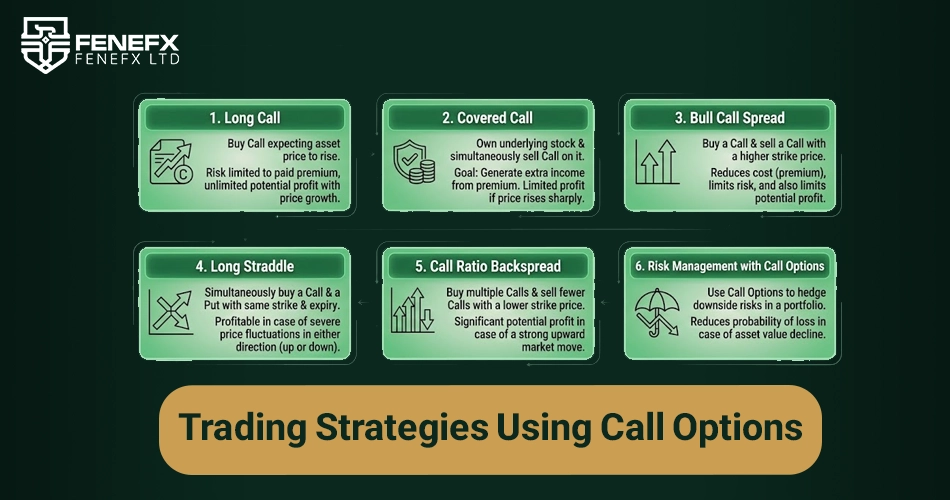
1. Direct Purchase (Long Call)
In this strategy, the investor buys a Call Option with the expectation that the price of the underlying asset will increase. This method allows the investor to benefit from rising prices with limited risk (the premium paid). The potential profit is unlimited, and the only possible loss is the premium paid.
2. Covered Call
In this method, the investor already owns the underlying stock and simultaneously sells a Call Option on the same stock. The objective of this strategy is to generate additional income through receiving the premium. If the stock price remains stable or increases slightly, the investor keeps the premium. However, if the price rises significantly, the investor must sell the stock at the strike price and may not benefit from further price increases.
3. Bull Call Spread
This strategy involves buying a Call Option and selling another Call Option with a higher strike price and the same expiration date. This approach reduces costs (premium) and limits risk, but it also caps the potential profit. This strategy is suitable for investors who expect the asset price to rise up to a certain level.
4. Long Straddle
In this strategy, the investor purchases both a Call Option and a Put Option with the same strike price and expiration date. This approach is suitable when significant price volatility in the underlying asset is expected, but the direction of the movement is uncertain. If the price moves sharply (either upward or downward), one of the options will become profitable.
5. Combination Strategy (Call Ratio Backspread)
This method involves buying multiple Call Options and selling a smaller number of Call Options with a lower strike price. This strategy is appropriate when a strong upward movement in the market is expected. If the asset price rises sharply, there is significant potential profit.
6. Using Call Options for Risk Management
Investors can also use Call Options to hedge downside risks. For example, if an investor is concerned about a decline in the value of an asset in their portfolio, they can reduce the potential loss by purchasing a Call Option.
Overall, there are various strategies that utilize Call Options, each of which is suitable for specific market conditions and investment objectives. A proper understanding of each strategy and aligning it with market forecasts can help investors make optimal decisions and take advantage of market opportunities.
Calculating Profit and Loss in Call Option Contracts
Calculating profit and loss in Call Option contracts helps investors make accurate projections about the returns on their investments. These calculations involve analyzing the strike price, the premium, and the market price of the underlying asset.
Buyer’s Profit
To calculate the profit of a Call Option buyer, the strike price and the premium must first be considered. If the market price of the underlying asset is higher than the strike price, the buyer can exercise the contract and purchase the asset at the strike price. The net profit is calculated as follows:
Premium – (Strike Price – Market Price) = Net Profit
If the market price does not rise above the strike price, the buyer will choose not to exercise the option and will only lose the premium paid.
Seller’s Profit
The seller of a Call Option benefits from receiving the premium. If the market price does not exceed the strike price by the expiration date, the seller retains the premium as net profit. However, if the market price increases and the buyer exercises the contract, the seller must sell the asset at the strike price, and the seller’s profit is calculated as follows:
(Strike Price – Market Price) – Premium = Net Profit
In this case, the seller’s risk is unlimited, because the market price may rise significantly.
Applications of Call Options in Risk Management
Using Call Options as tools for risk and tax management allows investors to employ a variety of strategies to protect their capital.
Risk Management
- Downside Risk Hedging:Investors can use Call Options to hedge against downside risks. By purchasing a Call Option, an investor can benefit from potential upside gains if prices rise, while simultaneously limiting potential losses.
- Portfolio Diversification:Call Options can help investors diversify their portfolios at a lower cost and gain exposure to different assets.
Ultimately, Call Options, as versatile financial instruments, help investors manage their risks more effectively. Proper use of these tools requires a deep understanding of financial markets and related strategies.
Alongside learning trading strategies based on Call Options, many traders look for ways to apply these strategies in real markets without risking their personal capital. This is where prop trading becomes important. By using the capital of prop trading firms, traders can test their skills in real accounts and receive a share of the trading profits. In this context, Fenefx prop, by offering a variety of plans, transparent rules, and a strong focus on professional traders in financial markets, is considered a suitable option for the practical execution of options based and trading strategies. If you are looking to trade with higher capital and lower personal risk, buying a Prop from Fenefx account can be your next step toward entering the world of trading more seriously.
Practical Examples of Using Call Options
Call Option contracts have wide applications in the financial world, and investors use them for various purposes. Below are several practical examples.
Example 1: Speculation
Suppose an investor believes that the stock price of company ABC will increase in the near future. They purchase a Call Option with a strike price of $50 and a premium of $2. If the stock price rises to $60, the investor can exercise the contract, buy the stock at $50, and sell it in the market at $60 to make a profit. The net profit would be calculated as (60 − 50 − 2) = $8 per share.
Example 2: Income Generation
An investor who owns shares of XYZ may decide to generate additional income by selling a Call Option on their shares. They can sell a Call Option with a strike price higher than the current stock price and receive a premium. If the stock price does not rise above the strike price, the investor keeps the premium as profit.
Example 3: Risk Management
A company that depends on a specific commodity may use Call Options to protect itself against an increase in the price of that commodity. If the commodity price rises, the company can exercise the Call Option and purchase the commodity at a lower price, thereby controlling its costs.
The Role of Call Options in Financial Markets
Call Option contracts play a significant role in financial markets and allow investors and companies to benefit from various advantages.
1. Increased Liquidity
Call Options contribute to increased liquidity in financial markets. By enabling the buying and selling of these contracts, investors can respond quickly to market changes and adjust their strategies accordingly.
2. Price Discovery
These contracts assist in the price discovery process. Option prices reflect market expectations about future volatility of the underlying assets and can provide investors with useful insights into price direction.
3. Risk Management
Investors and companies use Call Options to protect against unfavorable price fluctuations. These contracts act as a form of insurance against rising prices and help manage risk.
4. Advanced Trading Strategies
Call Options enable investors to use more sophisticated trading strategies such as spreads and various combinations. These strategies can help optimize returns and reduce risk.
Ultimately, Call Options, as powerful financial instruments, help investors participate in financial markets with greater confidence and achieve their financial goals. Using these contracts requires knowledge and experience, but they can significantly improve investment performance and risk management.
Differences and Similarities Between Option Contracts and Futures Contracts
Option contracts and futures contracts are both important derivative instruments in financial markets, deriving their value from an underlying asset such as stocks, commodities, currencies, or indices. These contracts help traders both profit from price fluctuations and hedge potential risks. Despite this overall similarity, the legal structure, level of risk, and the nature of the obligations of the parties involved differ fundamentally between these two instruments. Understanding these differences is essential for choosing the appropriate instrument.
In summary, in an option contract, the buyer has therightto buy or sell the asset but is not obligated to exercise the contract, and their risk is limited to the premium paid. In contrast, in futures contracts, both parties are obligated to execute the transaction at the maturity date, which can result in higher risk. Additionally, options offer greater flexibility in designing trading strategies , whereas futures contracts are generally more standardized and are more commonly used for hedging price fluctuations in large and regulated markets.
Comparison Table of Option Contracts and Futures Contracts
Comparison Criteria | Option Contracts (Options) | Futures Contracts (Futures) |
Type of Instrument | Derivative instrument | Derivative instrument |
Parties’ Obligation | Buyer has the right, not the obligation | Both parties are obligated to execute the contract |
Initial Cost | Premium paid by the buyer | No initial premium |
Level of Risk | Buyer’s risk is limited to the premium | Potentially unlimited risk for both parties |
Flexibility | High, suitable for diverse strategies | Lower, with a standardized structure |
Common Use | Precise hedging and advanced strategies | Hedging price fluctuations and general speculation |
Final Conclusion
A Call Option is one of the most flexible and powerful derivative instruments in financial markets, enabling investors to profit from upward trends, manage risk, and implement a wide range of trading strategies. The limitation of the buyer’s risk to the premium paid, combined with high potential profit, makes this instrument attractive to professional and semi professional traders. However, success in using Call Options requires a precise understanding of core concepts, proper market timing, and selecting strategies that align with prevailing price conditions. When used wisely, Call Options can play a significant role in optimizing returns and controlling portfolio risk.
Frequently Asked Questions About Call Options
1. What type of market is a Call Option most suitable for?
It is best suited for bullish markets or when an increase in the price of the underlying asset is expected.
2. What is the maximum loss when buying a Call Option?
The maximum loss is equal to the premium paid for the contract.
3. What is the main difference between a Call Option and a Put Option?
A Call Option is used to profit from price increases, while a Put Option is used to profit from price declines.
4. Are Call Options suitable for beginner traders?
Yes, with proper education and risk management; however, they require learning the basic concepts of options trading.
Comments
Could you follow this up with how options differ from CFDs? As a forex trader I'm trying to figure out if options hedging is worth the complexity.
My first option trade expired worthless because I didn't understand time decay. Lost the whole premium on something I was 'sure' about. Expensive but effective lesson.
Well structured, from someone who's read a lot of bad option explainers.
The strike price and premium example cleared up years of confusion. I always thought options were only for professionals, turns out the concept itself is pretty simple.
Decent intro. One thing I'd add: theta decay is the silent killer for beginners. Buying cheap out-of-the-money calls feels like a lottery ticket, and it usually pays like one too.