


Starting Forex with $10
For many people, entering the world of Forex means having large amounts of capital and starting with thousands of dollars; however, the truth is quite different. What if we told you that you can enter the largest financial market in the world with just $10 and, at the same time, gain real trading experience, knowledge, and skills? It may sound hard to believe, but Forex thanks to cent accounts, leverage, and a wide range of trading tools offers opportunities for participation and growth to anyone, even with very small capital. This article is written specifically for those who want to start with the minimum possible investment, understand the risks, avoid common mistakes, and move forward in a smart and informed way. If you also want to know how you can enter Forex with $10 and not be a loser, this article is for you from beginning to end.
Is entering Forex with $10 really possible?
Entering Forex with a capital as small as $10 is completely possible, but you need to look at this realistically. The Forex market is one of the most flexible financial markets in the world. Due to the availability of various trading account types, diverse financial instruments, and the ability to use leverage, it allows individuals with very small capital to participate. However, this opportunity will only be beneficial if it is accompanied by proper awareness and careful planning.
With a $10 investment, you can use specific trading accounts such as cent or micro accounts, which allow you to open much smaller trade sizes. In these types of accounts, your funds are displayed in cent s (meaning $10 is shown as 1,000 cents), which enables you to place smaller trades and manage risk more effectively.
However, there are also important limitations to consider:
- Limited trade size:With $10, you cannot place large trades because you do not have sufficient margin to open such positions.
- High risk:Any trading mistake can quickly wipe out your entire capital.
- Impact of trading costs:Costs such as spreads and commissions especially in small accounts can have a significant effect on your profitability.
Therefore, starting with $10 is possible, but it requires precise risk management, choosing the right broker, and using appropriate trading tools.
Choosing the Right Broker and Account to Start with $10
One of the most important steps in entering Forex with limited capital is choosing the right broker. Not all broker s offer the necessary conditions to accept small deposits such as $10. Therefore, you must select a broker that not only has a low minimum deposit requirement, but also provides features suitable for traders with small capital.
Cent and Micro Accounts
These types of accounts are designed for traders with small capital. In a cent account, your balance is converted into cents ($10 equals 1,000 cents), allowing you to place very small trades. In a micro account, you can also reduce trade size down to 0.01 lots, which significantly lowers risk.
Key Features of a Suitable Broker
- Low minimum deposit:Choose a broker with a minimum deposit of less than $10.
- Low spreads:High spreads can wipe out your profits, especially when trading with small capital.
- No or low commissions:Brokers that charge heavy commissions are not suitable for small accounts.
- Support for high leverage:Leverage allows you to place larger trades with limited capital (of course, with proper risk management).
- Reliable support:Make sure the broker supports Iranian users and offers easy deposit and withdrawal methods.
Leverage: Friend or Foe for Traders with Small Capital?
Leverage is one of the most attractive features of the Forex market, allowing traders to control larger trading volumes with a small amount of capital. For example, if your broker offers 1:500 leverage, you can open trades worth $5,000 with just $10. However, this feature can be just as dangerous as it is profitable.
Advantages of Using Leverage
- Increased buying power:With limited capital, you can open larger positions and access more trading opportunities.
- High profit potential:If your analysis is correct, leverage can multiply your profits several times over.
Disadvantages and Risks of Leverage
- Increased risk:Just as leverage can increase your profits, it can also multiply your losses.
- Rapid loss of capital:With improper use of leverage, you may lose your entire $10 capital in a single trade.
How to Use Leverage in a Logical Way?
- Avoid extremely high leverage (such as 1:1000), especially if you do not have sufficient experience.
- Keep your trade sizes small to better manage risk.
- Always use a Stop Loss to limit potential losses.
Therefore, leverage can be both a friend and a foe. Proper use of leverage depends on your risk management, experience, and knowledge.
Risk Management with Small Capital: How to Avoid Losing Your $10 Investment
Risk management is one of the most important skills every trader must have, especially when trading with small capital. When you only have $10, even a minor mistake can result in losing your entire account. Therefore, you must act with extreme caution.
Risk Management Principles
- Use of Stop Loss:Every trade should have a clearly defined stop loss. This tool helps keep your losses within a controllable range.
- Trade with small position sizes:Avoid opening large positions. For example, in cent or micro accounts, keep your trade size at 0.01 lots.
- Risk less than 1-2% per trade:Never risk more than 1-2% of your capital on a single trade. With $10, this means risking a maximum of $0.1 $0.2 per trade.
Risk Management Strategies
- Trade diversification:Instead of concentrating your entire capital on a single currency pair, spread it across several different trades.
- Avoid emotional trading:Hasty and emotional decisions, especially after a loss, can lead to even greater losses.
- Learn from mistakes:Analyze your trades and learn from them.
Proper risk management in small trades helps you preserve your capital while gradually gaining experience and confidence. Remember, your primary goal at the beginning is to survive in the market, not to achieve large profits.
$10 vs. Trading Costs: Is Profitability Really Possible?
One of the biggest challenges traders with small capital such as $10 face is the impact of trading costs. In Forex, trading costs include spreads, commissions, and overnight interest (swap), each of which can directly affect profitability.
Spread
The spread is the difference between the bid and ask price of a currency pair. This cost is deducted indirectly from your balance and can vary depending on the broker and the selected currency pair. For example, if the spread on the EUR/USD pair is 1 pip, you start the trade with a 1 pip loss the moment you open it. Now imagine trading with just $10 even small spreads can reduce a significant percentage of your capital.
Commission
Some brokers charge a separate commission per trade in addition to the spread. This cost is especially noticeable in small accounts and can quickly eliminate your profits. That is why choosing a broker with no commissions or very low commissions is extremely important.
Overnight Interest (Swap)
If you keep a trade open and roll it over to the next day, you may be charged a fee known as the overnight interest, or swap. This cost varies depending on the currency pair and the direction of the trade (buy or sell). Traders with small capital should avoid holding long term positions in order to prevent the negative impact of swap fees on their accounts.
Is profitability possible with $10?
Profitability with a $10 investment is possible, but it is very limited and challenging. To achieve profits, you must minimize spreads and commissions and trade currency pairs with low trading costs. In addition, you should use short term trading strategies such as scalping to eliminate overnight fees. Ultimately, your success depends on your ability to manage costs effectively and execute your trading strategies with precision.
Suitable Trading Strategies and Tools for Small Capital
When entering the Forex market with a small capital such as $10, you must choose strategies and tools that not only reduce risk but also provide the potential for profitability. Under these conditions, short term trading strategies and simple tools are the best options.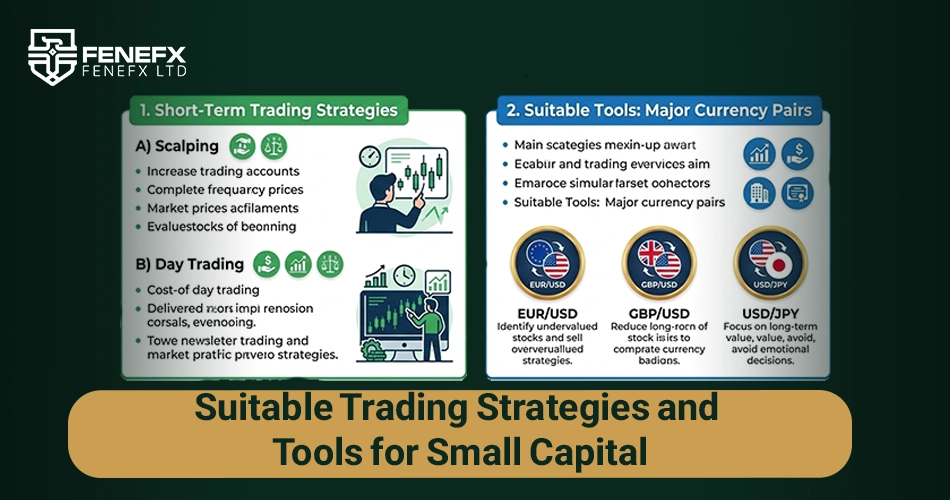
Scalping
Scalping involves opening short term trades aimed at capturing small profits (a few pips). Due to small position sizes and very short holding periods, this strategy is suitable for small capital accounts. However, it requires a high level of skill, speed, and focus.
Day Trading
In this strategy, you open and close your trades within the same day without holding them overnight. This helps you avoid overnight interest (swap) fees and reduces overall risk.
Suitable Currency Pairs
For small capital accounts, it is better to choose currency pairs with low spreads and high liquidity such as EUR/USD, GBP/USD, or USD/JPY. These pairs have lower trading costs and their price movements are generally more predictable.
Trading Psychology with Small Capital: How to Control Your Mindset
One of the main challenges for traders with small capital is the psychological pressure caused by financial limitations and higher perceived risk. Managing your mindset and controlling emotions is one of the keys to success under these conditions.
Psychological Challenges of Trading with Small Capital:
- Fear of losing capital:When you only have $10, even the smallest loss can create significant stress.
- Greed for quick profits:Traders often try to compensate for their small capital by taking large, high risk trades, which usually leads to losing the entire account.
- Emotional decision making:Stress caused by limited capital can push you toward impulsive and emotional decisions.
Strategies for Controlling Your Mindset:
- Focus on learning:Instead of focusing on profits, concentrate on learning and gaining experience. This approach helps reduce psychological pressure.
- Accept losses:Losses are a natural part of trading. Accepting this reality allows you to make more rational decisions.
- Create a trading plan:Having a clear trading plan helps prevent emotional and impulsive decisions.
Controlling your mindset and maintaining emotional discipline in Forex trading especially with small capital can help you protect your investment and gradually make progress.
Is it possible to achieve consistent profits in Forex with $10?
Achieving consistent profits in Forex with a $10 capital is possible, but it must be viewed realistically. With such a small amount of capital, reaching stable income is very difficult and requires a high level of skill, experience, and excellent risk management.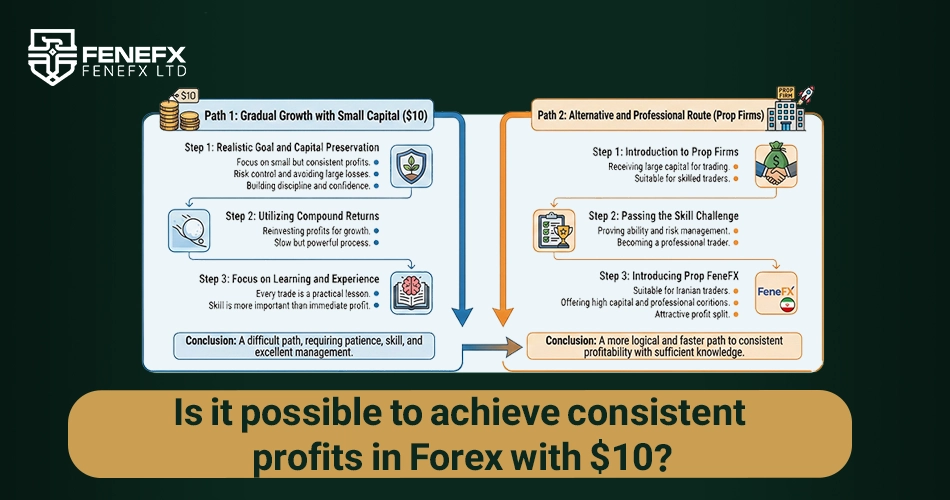
How can you grow with $10?
When aiming to grow with a small capital like $10, the most important point is having a realistic understanding of trading goals. In the beginning, you should not expect large profits; therefore, you must move forward in small steps. Your main objective at this stage is capital preservation, risk control, and achieving small but consistent profits. This approach not only helps you avoid major losses, but also gradually builds the confidence and mental discipline required for professional trading.
Next, to achieve real capital growth, you should usecompound returns; meaning that you reinvest the small profits you earn back into your trades so that your capital grows gradually over time. This process is slow but extremely powerful. Alongside this, focusing on learning and gaining experience is far more important than focusing solely on profit. Every trade even with a small position size can serve as a practical lesson whose value is greater than its financial return. If your priority is skill development and understanding the market, capital growth will naturally and sustainably follow.
An Alternative Path: Prop Firms
If you already have sufficient knowledge and skills in Forex, instead of starting with $10, you can use proprietary trading firms (prop firms). These companies provide professional traders with trading capital. By passing their evaluation or challenge phases, you can become a funded trader and trade with significantly larger capital.
One of the leading companies in this field is Prop Fenefx , which is also suitable for Iranian traders. By offering substantial trading capital, this firm allows you to operate professionally in the Forex market and keep a percentage of the profits you generate. As a result, while starting with $10 can be a valuable educational experience, for long term and sustainable profitability, purchasing a prop account is a more logical and professional path.
Final Conclusion
Starting Forex with $10 is completely possible, but only for those who enter the market realistically, intelligently, and with proper risk management. By choosing the right broker, using cent or micro accounts, keeping position sizes small, controlling emotions, and focusing on learning, this amount of capital can become a launchpad for real growth. Big profits start with small and consistent gains; therefore, if your goal is to gain experience and build a professional future in trading, this path is worthwhile. However, if your goal is sustainable profitability and larger capital, joining prop firms will be a far more logical and realistic option.
Frequently Asked Questions
Can you place real Forex trades with $10?
Yes, by using cent or micro accounts, you can place real and low risk trades.
Can you earn a steady income with $10?
A steady income with this amount of capital is difficult and requires experience and gradual capital growth.
What is the best type of strategy for a $10 account?
Short term strategies such as scalping and day trading, with an appropriate stop loss, are the best options.
Is using high leverage suitable for a $10 account?
Very high leverage increases the risk of losing capital quickly and is not recommended.
Comments
Started with $15 two years ago, blew it in a month, but honestly learned more from that than six months of demo. The emotional side only shows up when real money's on the line.
Thanks for this! I kept postponing my start because I thought I needed at least $500. Opening a cent account this week just to feel real market conditions.
What lot size actually makes sense on $10? Even 0.01 seems too big for proper risk management. Would appreciate a position sizing breakdown for micro accounts.
A $10 account won't make you money, but it will show you how you react to real losses, which demo never does. That's worth far more than ten bucks. Just use a cent account so position sizing stays sane.
Refreshingly realistic take on small accounts.