





How to Build a Successful Trading Strategy?
Financial markets are always full of opportunities and risks, and achieving success in them without having a structured and intelligent trading strategy is almost impossible. In this article, you will become familiar with a practical and comprehensive guide to building a successful trading strategy that combines price action, indicators, and market sentiment analysis. This strategy not only helps you make precise and systematic entry and exit decisions, but also reduces trading risk and increases your chances of success in short term and medium term markets. By following this approach, you can base your trades on real data and professional analysis and operate in the market with greater confidence.
What Is a Successful Trading Strategy? A Practical Guide
A trading strategy is recognized as a comprehensive and systematic guide for entering and exiting financial markets. This strategy consists of a set of rules and criteria that help traders make trading decisions. The primary objective of this strategy is to generate profit and optimize risk management. In other words, a trading strategy enables traders to operate effectively in complex and dynamic markets through accurate analysis and structured planning. By using this framework, traders can achieve greater clarity in their decision making processes and, as a result, increase their chances of success.
The Importance of a Trading Strategy
A trading strategy is highly important for several reasons:
Guiding Trading Decision Making Process
Making trading decisions through a defined strategy helps traders act logically and correctly when making decisions. Such a strategy includes rules and criteria that determine when to enter or exit the market. By having this framework, traders can avoid emotional influences and impulsive reactions and instead rely on accurate and well planned analysis.
Risk Management
One of the core pillars of a trading strategy is risk management. By determining the amount of capital exposed to risk in each trade and using tools such as stop loss and take profit orders, traders can limit losses and maximize profit opportunities. This approach helps preserve capital and increases the chances of long term success.
Enhancing Trading Discipline with a Strategy
Adhering to a trading strategy strengthens trading discipline. Discipline means following the rules and regulations defined within the strategy, helping traders avoid emotional and sudden decisions that may lead to significant losses.
Improvement in Trading Financial Performance
An effective trading strategy provides clear methods for generating profits and reducing losses. By consistently and systematically implementing these strategies, traders can improve their financial performance and move closer to their financial goals. These strategies are designed based on precise market analysis and past experience, which increases the accuracy and effectiveness of trades.
Adaptability to Changing Market Conditions in Trading
A strong trading strategy must be flexible enough to adapt to new market conditions. Such strategies enable traders to respond quickly to market changes and effectively adjust their approach based on current conditions, which helps preserve and enhance profitability.
Building Confidence
When a trader is confident in having a clear and effective plan for executing trades, they enter the market with greater calm and assurance and feel more satisfied with their decisions.
This confidence is impactful not only during normal market conditions but also in challenging situations and periods of market volatility. In other words, a well structured strategy helps traders make decisions with less stress and respond more decisively to sudden changes.
Types of Trading Strategies
In this section, we explain and analyze different types of trading strategies so that you can choose the best option based on your needs and conditions: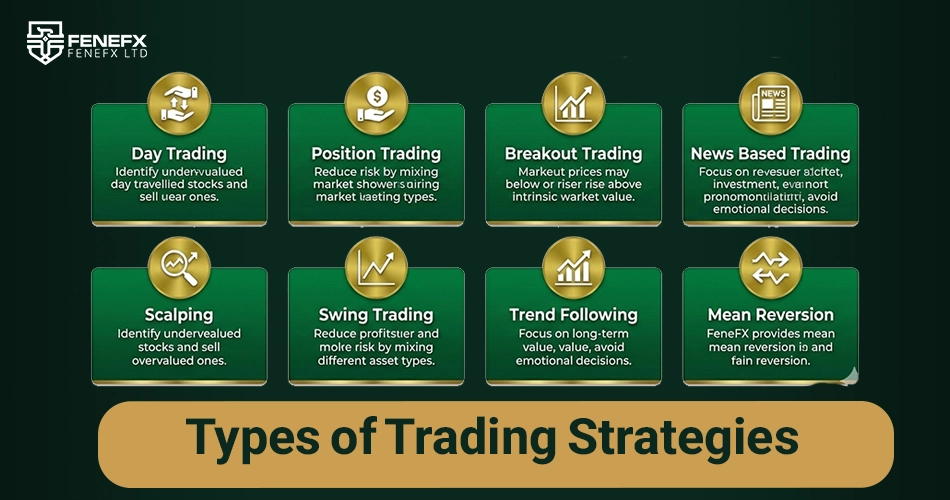
1. Day Trading
Day trading refers to opening and closing all trades within a single trading day, without carrying positions over to the next day. This strategy is suitable for those who want to take advantage of short term market fluctuations and reduce the risk of holding positions overnight.
Reducing the risk caused by overnight volatility and the ability to benefit from daily price movements are among the advantages of this method. However, the need for continuous market analysis and monitoring, as well as high psychological pressure, are considered its main drawbacks.
2. Long Term Trading (Position Trading)
This strategy involves holding positions for several months or even years based on fundamental and technical analysis. It is suitable for investors who seek sustainable capital growth and want to benefit from long term price trends.
This strategy generally requires less time and continuous monitoring, and taking advantage of long term market trends is one of its positive features. However, it requires accurate fundamental analysis and is exposed to the risk of major economic or political changes.
3. Breakout Trading
Breakout trading refers to entering the market when the price breaks through key support or resistance levels. This strategy is based on the assumption that after breaking a key level, the price will continue its movement. The advantages of this method include capturing strong and rapid market moves and precisely defining entry points. However, the risk of false signals and the need for additional confirmation to avoid incorrect trades are considered its main disadvantages.
4. News Based Trading
This strategy, known as news based trading, involves entering the market based on the release of economic, political, or financial news that can have a significant impact on asset prices. In this approach, traders seek to benefit from the volatility created by the market’s reaction to such news.
The advantages of this strategy include the opportunity to profit from unexpected market volatility and the use of new and critical information. However, this trading method also has drawbacks, such as high risk due to unpredictable market reactions and the need for rapid access to news and accurate analysis in order to make appropriate decisions.
5. Scalping
The scalping strategy is one of the fastest and potentially most profitable trading methods, in which traders aim to generate small and frequent profits over very short periods of time. This type of trading requires high concentration and the ability to react quickly to market changes. Scalpers typically use minute or even second based charts to identify trading opportunities.
The potential for quick profits and a higher number of successful trades is one of the advantages of this method. However, its disadvantages include the need for constant attention and high transaction costs due to trading commissions.
6. Swing Trading
Swing trading refers to holding positions for several days to a few weeks in order to take advantage of medium term market fluctuations. This strategy is suitable for traders who want to benefit from larger price movements and do not require constant market monitoring.
Compared to scalping and day trading, this method requires less time and also allows traders to benefit from larger price swings. However, the need for accurate trend analysis and the risk of sudden market volatility are considered its main disadvantages.
7. Trend Following Strategy
This strategy relies on identifying and capitalizing on current market price trends. Traders using this approach aim to enter trades in the direction of the prevailing market trend and hold their positions as long as the trend continues. The advantages of this method include leveraging the strength of market momentum and increasing the probability of successful trades. However, there is also the risk of late entries and sudden trend reversals.
8. Mean Reversion Strategy
This strategy is based on the assumption that prices tend to revert to their historical average over time. Traders using this approach look to buy when prices are near lower extremes and sell when they reach higher extremes. This strategy provides good trading opportunities at strong buying and selling levels and takes advantage of natural market fluctuations. However, there is a risk of fundamental changes in market trends and a need for precise identification of entry and exit points when applying the mean reversion strategy.
Stages of Building a Successful Trading Strategy
Building a successful trading strategy goes beyond simply choosing a few indicators or price patterns. A trading strategy is a cohesive system that must align with the trader’s personality, market conditions, and financial goals. In this section, we examine the strategy design process across five main phases so that you can create a practical, executable, and scalable trading plan.
Phase One: Understanding Yourself and the Target Market
The first step in building a trading strategy is gaining a clear understanding of yourself as a trader and selecting the appropriate market. Many traders enter the market without considering their personal traits, level of patience, risk tolerance, and available time, which often leads to failure.
At this stage, you should determine whether you are interested in fast, short term trades or prefer a calmer approach involving medium or long term positions. Choosing the right market is also critically important, as each market has its own characteristics and may not be suitable for every trader. Defining your trading time frame, daily market involvement, and tolerance for volatility forms the foundation of your strategy design and determines the direction of the process ahead.
Phase Two: Designing Entry and Exit Rules
After understanding yourself and selecting the market, the next step is to design precise entry and exit rules. This phase represents the core of your trading strategy, and without it, trades will be executed randomly and emotionally.
At this stage, you must clearly define the basis on which you enter a trade and the conditions under which you exit it. These rules can be based on technical analysis, fundamental analysis, or a combination of both. The most important point is that entry and exit rules must be completely clear, repeatable, and unambiguous. When entry and exit conditions are precisely defined, it becomes possible to evaluate and optimize the strategy in the future, while emotional decision making is minimized.
Phase Three: Risk and Capital Management
Risk management is one of the most critical components of any trading strategy and plays a decisive role in a trader’s survival in financial markets. Even strategies with high win rates can lead to capital loss if proper risk management is not applied.
In this phase, you must determine how much of your capital you are willing to risk on each trade and how to use tools such as stop loss and take profit orders. Defining position size based on capital and risk tolerance helps you control potential losses and prevent severe drawdowns. The primary goal of risk management is not rapid profitability, but capital preservation and long term stability.
Phase Four: Testing, Evaluation, and Optimization of the Strategy
No trading strategy should be implemented in a live account without proper testing. Testing and evaluating a strategy allow you to assess its performance under different market conditions and identify potential weaknesses.
At this stage, the strategy should first be backtest ed on historical data and then executed in a demo environment. The results of these tests indicate whether the defined rules are effective or require modification and optimization. Analyzing the risk to reward ratio, win rate, and the strategy’s behavior across different market conditions helps you develop a more stable and rational version of your strategy.
Phase Five: Commitment, Trade Journaling, and Strategy Development
The final phase, yet one of the most important stages, is commitment to the strategy and its continuous development. Many traders fail to achieve desirable results despite having a suitable strategy due to a lack of discipline and emotional interference in their trading decisions.
Recording trades in a trading journal and regularly reviewing performance help you identify behavioral patterns and make better decisions. In addition, financial markets are constantly evolving, and a successful strategy must be periodically reviewed and updated. Gradual and informed strategy development is a key factor in maintaining profitability and achieving sustainable long term success.
Practical Example: A Combined Trading Strategy Using Price Action, Indicators, and Sentiment Analysis
To have a realistic and applicable strategy in financial markets, the best approach is to simultaneously use price action, indicators, and sentiment analysis. This combination helps you base your decisions on real data and market trends while minimizing trading risk.
In the first step, price action forms the core foundation of this strategy. You should begin by identifying key support and resistance levels and monitoring price behavior around these areas. Reversal candlestick patterns such as Pin Bar and Engulfing are very useful for defining entry and exit points. In addition, analyzing breakouts of important levels can help confirm the short term market trend.
In the second step, indicators are used to confirm price action signals. For example, using the EMA 20 and EMA 50 helps determine the direction of the market’s short term and medium term trends. At the same time, indicators such as RSI or Stochastic can identify overbought and oversold conditions. Trade entries are executed only when price action and indicator signals align, reducing the probability of error.
The third step involves market sentiment analysis , which adds greater depth to your trading decisions. Reviewing economic news, fundamental data, and sentiment surveys helps you understand the prevailing market bias and align your trades with the dominant trend. Additionally, identifying psychological support and resistance levels that major market participants react to helps confirm optimal entry and exit points.
Ultimately, this strategy includes the following practical steps: identifying the overall market trend, finding key levels, waiting for the formation of suitable candlestick patterns, confirming entries with indicators, setting logical stop loss and take profit levels, accurately recording trades, adhering to the strategy rules, and continuously reviewing performance.
With this combination, you will have a complete, practical, and usable trading strategy that is suitable for short term and medium term trading in Forex, indices, and even cryptocurrencies, while providing the ability to reduce risk and increase the probability of success.
If you are looking for a professional and practical path to start trading with low capital and without risking your own funds directly, Prop Fenefx is an ideal option. This company provides access to large trading capital under fair conditions, allowing you to gain real market experience by applying your professional strategies. To get started and take advantage of trading opportunities with substantial capital, take action now and experience purchasing Prop Fenefx.
Practical Checklist for Building a Successful Trading Strategy
To turn theoretical knowledge into practical performance in financial markets, having a precise and actionable checklist is essential. This checklist helps you systematically follow each stage of designing and executing a trading strategy, control risks, and make decisions according to a structured plan. By using this guide, you can ensure that no step in the strategy building process is overlooked and that your trading remains systematic and professional.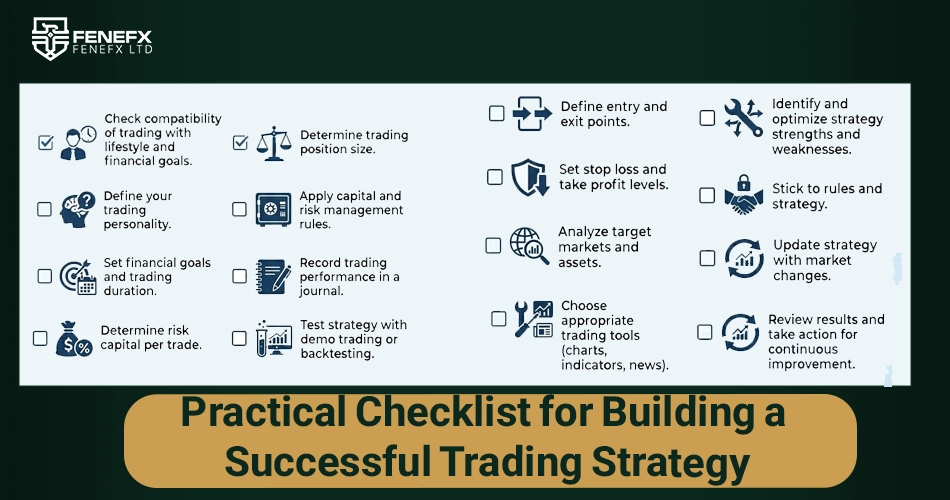
- Check whether trading aligns with your lifestyle and financial goals.
- Define your trading personality.
- Set your financial goals and trading time horizon.
- Determine the amount of capital you are willing to risk per trade.
- Define trade entry and exit points.
- Set your stop loss and take profit levels.
- Analyze your target markets and assets.
- Select appropriate trading tools (charts, indicators, and news).
- Determine position sizes.
- Apply your capital and risk management rules.
- Record your trade performance in a trading journal.
- Test the strategy through demo trading or backtesting.
- Identify and optimize the strategy’s strengths and weaknesses.
- Adhere strictly to the rules and the strategy.
- Update the strategy in line with changing market conditions.
- Review trading results and take action for continuous improvement.
Final Conclusion
Building a successful trading strategy is a combination of knowledge, experience, and personal discipline. By following a structured process that includes understanding the trader’s personality, defining entry and exit rules, risk management, and continuous testing and optimization, trades can be executed in a systematic and professional manner. Using a combination of price action, indicators, and sentiment analysis enables more accurate decision making and reduces trading risk. Ultimately, adherence to the strategy and accurate trade journaling are the keys to long term success in financial markets.
Frequently Asked Questions
1. What is a trading strategy and why is it important?
A trading strategy is a set of rules and criteria for entering and exiting the market that helps reduce risk and increase the probability of success.
2. What is the difference between day trading and long term trading?
Day trading involves short term trades executed within a single day, whereas long term trading involves holding positions for months or even years.
3. Why is risk management vital in a trading strategy?
Risk management prevents large losses and preserves capital, allowing traders to continue operating in the market.
4. How can a trading strategy be optimized?
By conducting backtesting, demo trading, and reviewing past results, the strengths and weaknesses of a strategy can be identified and refined.
Comments
I built my first real strategy after blowing an account on random entries. Took three months of testing before I trusted it, but that process taught me more than any course did.
Bookmarking this one, solid step-by-step.
Good framework. My two cents: forward-test on demo for at least a month after backtesting. Live spreads and slippage killed a strategy of mine that looked flawless on historical data.
How many trades should a backtest include before the stats mean anything? I've got 40 logged and I'm not sure if that's enough to go live.
This finally made backtesting feel approachable. I always assumed you needed coding skills, didn't realize you could do a manual backtest with just a replay tool and a spreadsheet.