

The Golden Formula of Capital Management
Many people think that success in financial markets depends only on the trading strategy, but the reality of the market is something else. If you do not have proper capital management, even the best analyses and the most precise strategies cannot protect your capital. The difference between traders who are always losing and traders who endure in the market is only one thing: how they manage capital and control risk. This article not only teaches you the basic principles of capital management, but also introduces formulas and methods that the world’s top traders use to preserve and grow their capital; knowledge that can change the fate of your trading account forever.
Fundamental Principles of Capital Management That Every Trader Need to Know
Before we delve into the details of capital management formulas and techniques, it is necessary to understand the most basic principles that form the foundation of all professional approaches in the financial markets. These principles are designed in such a way as to protect your capital under different market conditions and to allow you, even after several unsuccessful trades, to remain on the path of growth and survival. Adhering to these simple principles may seem obvious at first, but it is exactly what defines the boundary between an emotional trader and a professional trader. In the following, we will examine each of these principles.
1) Capital preservation is the first priority
One of the most important principles of capital management is that before making a profit, you must protect your capital. This principle means that if you lose your capital, you will no longer have any chance to trade and earn a profit. Many professional traders consider long term survival in the market, rather than short term profit, to be their first priority.
2) Always be aware of your level of risk
Risk in financial trading is inevitable, but its amount must be controlled and planned. A successful trader never enters a trade without determining the level of risk. The best way to control this is to use a fixed risk to capital ratio in each trade, which will be explained later.
3) Keep risk at a level you can tolerate
A key principle in capital management is that the risk of each trade should not be so high that, in case of failure, it puts severe psychological pressure on you. Traders who take excessive risks experience stress and emotional decision making, which usually leads to poor outcomes.
4) Understand the power of compounding
Compound profit, or compound growth , is one of the most important concepts that traders must understand. This concept shows that if you risk a small percentage of your capital in each trade and gradually increase your profits, you will achieve exponential growth in the long term.
5) The importance of liquidity and its management
Even if you make the best trades, without proper liquidity management you may run into a crisis. A professional trader always keeps a portion of their capital in cash so that they can use it in emergencies or for new opportunities
Why is capital management more important than the trading strategy?
In the world of trading, people usually focus more on trading strategies and underestimate capital management. However, experience has shown that without capital management, even the best trading strategies can lead to the loss of all your capital.
A trading strategy without capital management is useless
Imagine that your trading strategy is successful 70% of the time. This means that out of every 10 trades, 7 will be profitable and 3 will be losing. Now, if you risk 10% of your capital in each trade, just 3 consecutive losing trades are enough for you to lose 30% of your account. In such conditions, you will experience severe psychological pressure and may make wrong decisions. But if you risk only 2% of your capital in each trade, even after several unsuccessful trades, you will still remain in the market.
Sustainable profitability depends on capital management, not the number of winning trades
One of the common mistakes among novice traders is that they focus on the win rate of their trades. But the reality is that a trading strategy can be profitable even with only 40% winning trades, if it has proper capital management. How? By using an appropriate risk to reward ratio, which will be explained later.
The market is unpredictable; capital management protects you
Even the best strategies fail under certain conditions. Sometimes the market moves against the analyses. Traders who lack capital management are forced out of the game after a few losing trades, but professional traders, with proper capital management, ensure their survival even in unfavorable conditions.
Key principles of capital management in trading: from risk control to long term survival
Capital management is based on three key principles that every trader must follow in their trades: determining the risk percentage in each trade, the risk to reward ratio, and setting stop loss and take profit levels.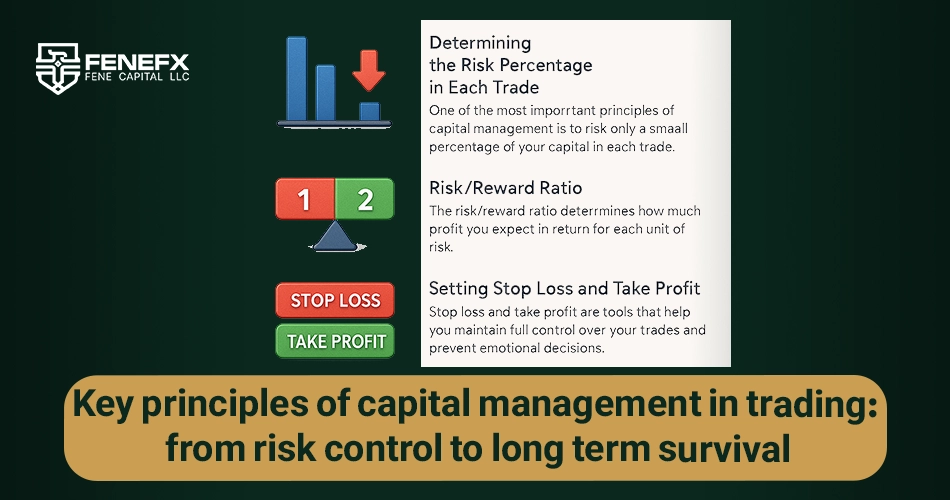
Determining the risk percentage in each trade
One of the most important principles of capital management is to risk only a small percentage of your capital in each trade. Most professional traders recommend risking between 1% to 3% of your capital per trade.
Suppose your capital is 10,000 dollars. If you want to risk 2% of your capital in each trade, your risk amount will be 200 dollars. This means that if your stop loss is 20 pips, you must adjust the position size in such a way that your total loss does not exceed 200 dollars.
Risk/Reward Ratio
The risk/reward ratio determines how much profit you expect in return for each unit of risk. Professional traders usually choose a 1:2 or 1:3 ratio for their trades.
For example, if you lose in 50% of your trades and your risk/reward ratio is 1:2, you can still be profitable, because in each winning trade you make twice the amount you lose in losing trades.
Setting Stop Loss and Take Profit
Stop loss and take profit are tools that help you maintain full control over your trades and prevent emotional decisions.
- A Stop Loss is the point at which the trade is closed to prevent further loss
- A take profit is the point at which the trade is closed and your profit is locked in.
If a trade is opened without a stop loss, the market may move against your expectations and eventually wipe out all your capital. On the other hand, a take profit helps you avoid greed and secure your profits before the market reverses.
Top Capital Management Formulas for Professional Traders
Capital management is both an art and a science that allows traders to survive market fluctuations by controlling the level of risk and to remain profitable in the long term. In this section, we will examine key and practical capital management methods. Some of these methods focus on preserving capital, while others seek to maximize profitability. We will explain each method in full and review its strengths and weaknesses.
Fixed Percentage Method – Capital management with a fixed percentage
The fixed percentage capital management method is one of the most widely used and simplest risk management methods among professional traders. In this method, the trader always risks a specific percentage of their total capital in each trade. Depending on the trader’s risk tolerance, this percentage is usually chosen between 1% to 3% of the total capital.
How to implement the Fixed Percentage method
To implement this method, you must first determine your total trading capital. Then, specify the percentage of your capital that you are willing to risk. For example, if your capital is 10,000 dollars and you want to risk 2% in each trade, the amount of capital you put at risk in each trade will be:
1000 * 0.02 = 200
So if your stop loss is 20 pips, you must set the position size in such a way that the potential loss does not exceed this amount. In this way, even if you lose several consecutive trades, your total capital will not suffer a severe decline.
Advantages and disadvantages of the Fixed Percentage method
Advantages | Disadvantages |
Prevents large losses and account wipeout | Capital growth is slow for small accounts |
Automatically adjusts risk as the account balance decreases or increases | In highly volatile markets, it may lead to lower profits |
Suitable for most trading styles | Requires patience and a long term perspective |
Simple, transparent, and applicable for both beginner and professional traders | During long drawdown periods, the trader’s motivation may decrease |
2. Martingale Method - Exponential Increase of Capital after Loss
The Martingale method is one of the best known capital management strategies, which has its roots in the world of gambling. This method is based on the principle that each time you incur a loss in a trade, you must double the amount of capital in the next trade so that, in the end, the profit from one trade compensates for all previous losses.
How to implement the Martingale method
In this method, suppose you enter a trade with 100 dollars and you lose. In the next trade, you set the amount of capital at 200 dollars. If you lose again, you open the third trade with 400 dollars. This process continues until one trade becomes successful and all previous losses are recovered.
Advantages and disadvantages of the Martingale method
Advantages | Disadvantages |
After one winning trade, all previous losses are recovered | A few consecutive losses can wipe out the entire capital |
In theory, the probability of exiting with a profit is very high | Requires very large and sometimes practically unlimited capital |
Simple to implement, with no formulas or complex calculations | Very high psychological pressure on the trader during consecutive losses |
Suitable for markets with slow, non trending price action | Completely non standard and highly risky for long term capital management |
Anti Martingale Method - Increasing capital after a win, decreasing capital after a loss
The Anti Martingale method works exactly opposite to the Martingale method. In this method, the trader increases the amount of capital after each win, but reduces the amount of capital after each loss. This method is very suitable for use in trending markets.
How to implement the Anti Martingale method
Suppose you start your first trade with 100 dollars and you make a profit. Now, in the next trade, you increase the amount of capital to 200 dollars. If you make a profit again, you set the capital amount of the next trade at 400 dollars. But if you incur a loss in a trade, you reduce the amount of capital again so that the risk is controlled.
Advantages and disadvantages of the Anti Martingale method
Advantages | Disadvantages |
Risk is increased only when the strategy is performing well | May be less effective in ranging and highly volatile markets |
Suitable for trending markets and profitable strategies | Requires precise management of position size at each stage |
Loss control by reducing position size after losing trades | May not generate significant profit during short winning streaks |
Better psychological compatibility compared to Martingale | Its results depend entirely on the strength of the main strategy |
4. Kelly Criterion - Capital management based on win probability
The Kelly Criterion formula is one of the scientific methods of capital management that determines the optimal level of risk based on the probability of winning and losing a trade. This formula is specifically for traders who look at their trades statistically.
How to implement the Kelly Criterion method
The general formula is as follows:
In which:
B = profit to loss ratio
P = probability of a winning trade
Q = probability of a losing trade p - 1
F = percentage of capital that should be risked.
For example, if your win probability is 60% and your profit to loss ratio is 2 to 1, the calculated f value shows that you should risk approximately 40% of your capital in each trade.
Advantages and disadvantages of the Kelly Criterion method
Advantages | Disadvantages |
Scientific and precise determination of the optimal position size | Even the smallest error in estimating the win probability can cause large losses |
Provides the highest capital return in the long run | Not suitable for beginner traders |
Adaptable to strategies with reliable statistical data | Requires accurate recording of trading data and analysis of results |
Highly effective for algorithmic and systematic traders | May create excessive risk in highly volatile markets |
5. Risk Parity Method - Balance in risk allocation between assets
The Risk Parity method is an advanced capital management method that distributes the amount of risk among several assets in order to prevent severe volatility in a particular asset.
How to implement the Risk Parity method
In this method, capital is allocated based on the level of volatility of the assets. For example, if an asset has high volatility, a smaller amount of capital is allocated to it, and conversely, lower volatility assets receive a larger share.
Advantages and disadvantages of the Risk Parity method
Advantages | Disadvantages |
Reduces portfolio risk by distributing risk across different assets | Requires accurate and reliable data about asset volatility |
Reduces the dependency of capital performance on a single specific market | May reduce returns compared to high risk strategies |
Suitable for long term investors and conservative portfolios | Its practical implementation is not simple for retail traders |
Stable performance during periods of recession and economic crisis | Requires periodic rebalancing of asset weights |
How to reduce the probability of a margin call with capital management formulas?
A margin call is one of the worst nightmares of a trader. When the margin level of your account drops too much, your broker automatically closes some or all of your positions to prevent further losses. This usually happens when traders take excessive risks and do not have proper capital management. In this section, we will examine the main reasons for margin calls and the methods to avoid them.
What is the main reason for a margin call?
A margin call usually occurs due to improper capital management and the use of high leverage. Some of the main reasons for this are:
- Using a position size that is too large relative to the available capital.
- Not setting a Stop Loss and allowing trades to move too far in the opposite direction.
- Excessive use of leverage , which causes even the smallest market fluctuation to lead to large losses.
- Not having a precise plan for capital management and entering trades randomly.
Ways to prevent a margin call
One of the biggest nightmares of every trader in financial markets, especially Forex, is facing a margin call; a situation in which, due to improper capital management, excessive risk, or severe market volatility, the trading account is almost drained and the possibility of continuing to trade is lost. Many traders think that a margin call is the result of bad luck, while the reality is exactly the opposite; a margin call is almost always the result of not having a risk and capital management plan. If a trader knows the principles and adheres to them, even the toughest market conditions cannot lead to the account being wiped out. In this section, we will examine definite, simple, and practical solutions to prevent a margin call so that you can have stable trades and a safer account with peace of mind.
Using an appropriate position size (Position Sizing)
One of the best ways to prevent a margin call is to always choose an appropriate position size based on your available capital and your stop loss.
For example, if your capital is 10,000 dollars and you want to risk only 2% of your capital in a single trade, your risk amount will be 200 dollars. Now, if your stop loss is 20 pips, you must adjust the position size in such a way that, if the stop loss is hit, you lose a maximum of 200 dollars.
Using a stop loss in all trades
Not having a stop loss is one of the main reasons for getting a margin call. Always determine your stop loss before entering a trade so that if the market moves against your forecast, the losses remain limited.
Avoiding excessive use of leverage
Using high leverage is one of the main factors behind the destruction of trading accounts. As a general rule, lower leverages such as 1:5 or 1:10 are more suitable for capital preservation. High leverages such as 1:100 or more impose excessive risk on your account.
Keeping sufficient Free Margin
Always try to keep a portion of your capital in cash so that, in case of severe market volatility, your account has sufficient margin. Never engage all of your capital in a single trade.
Capital management methods of the world’s successful traders
Some of the most successful investors and traders in the world have capital management rules that have helped them achieve sustainable long term profitability. In this section, we will examine the strategies of Warren Buffett, Paul Tudor Jones, and Ray Dalio.
Warren Buffett - Long term oriented investing
Warren Buffett is one of the most successful investors in history, whose investment philosophy is based on conservative capital management and the selection of valuable stocks.
Warren Buffett’s capital management principles
- Protect your capital: Buffett’s first rule is to never lose your capital, and his second rule is to always remember the first rule.
- Invest in strong companies with solid fundamentals: Instead of short term trades, he focuses on long term investments in companies that have high intrinsic value.
- Do not use leverage: Buffett believes that excessive leverage can destroy an investor.
Paul Tudor Jones - Strict risk management
Paul Tudor Jones is one of the most successful traders in the world, who is best known for predicting the 1987 market crash.
Paul Tudor Jones’s capital management principles
- Never risk more than 1% of your capital in a single trade.
- Have a clear plan for exiting a trade: he believes that if the market moves against you, you must immediately accept the loss and exit the trade.
- Control your emotions in trading: he believes that emotions are the main enemy of traders, and successful traders must have control over their emotions.
Ray Dalio - Diversification for risk control
Ray Dalio, the founder of Bridgewater Associates, one of the largest investment funds in the world, bases his capital management philosophy on intelligent diversification.
Ray Dalio’s capital management principles
- Never put all your eggs in one basket: he always emphasizes diversification in the asset portfolio.
- Use the All Weather Portfolio model: this investment model is designed for different economic conditions and reduces risk.
- Do not focus on a single asset class: Dalio believes that for better risk management, one should invest in different assets such as stocks, bonds, gold, and cryptocurrencies.
Common capital management mistakes you must avoid
Many traders have a relatively good trading strategy, know technical and fundamental analysis, and have even participated in various training courses, yet their account still does not grow, or after a while they incur heavy losses. The reason for this is usually not a weakness in market analysis, but rather hidden yet recurring mistakes in capital management; mistakes that seem small on the surface, but gradually cause the account balance to shrink and eventually lead to the loss of capital.
Identifying these errors and avoiding them is the first step toward breaking out of the cycle of loss and moving onto the path of sustainable profitability. In this section, we will examine the most common capital management mistakes traders make so that, by avoiding them, you keep control of your account in your own hands and not at the mercy of market fluctuations.
- Risking too much in each trade: Many novice traders involve too much of their capital in a single trade and, in case of failure, suffer heavy losses.
- Not using a stop loss: Not having a stop loss causes you to make emotional decisions in times of loss and lose more capital.
- Revenge trading: After taking a loss, some traders try to recover it without proper planning, which usually leads to even bigger losses.
- Overusing leverage: High leverage may increase your profits, but in case of loss, it destroys your account.
- Ignoring market psychology: Controlling emotions plays a vital role in trading. Greed and fear can lead to wrong decisions.
Capital management has its greatest impact when the trader operates in a fully rule based environment grounded in trading discipline. For this reason, many serious traders have turned to prop trading; because in this trading model, the trader trades with the capital of a reputable company and is required to follow stop losses, risk management, and a precise trading structure. This very framework eliminates many common mistakes, including emotional risks, excessive use of leverage, or unplanned entries, and helps the trader become a professional trading personality more quickly. Prop trading is a real growth path for traders that, instead of relying on personal capital, provides the experience of sustainable profitability by relying on larger capital and clear rules.
If you are looking for a professional, safe, and transparent environment to experience prop trading, Fenefx prop is one of the best options for Iranian and international traders. This prop, with global standards, Farsi support, simple trading rules, and no time limit on the challenge, has created conditions in which the trader can trade without stress and with full focus on capital management and the execution of their strategy. Fenefx, due to its real profit withdrawal structure, lack of hidden rules, and direct cooperation with a reputable broker, has become a popular option for traders who are seeking real and sustainable growth. If you intend to pursue a more professional path in the financial markets, you can right now choose the appropriate prop plan by purchasing prop and begin the next stage of your trading growth.
Useful tools and software for capital management in Forex and cryptocurrencies
Capital management is not complete merely by knowing the principles and formulas; its precise execution in daily trading requires tools that can quickly and accurately perform calculations of risk, position size, risk to reward ratios, and trading performance analysis. Using specialized capital management tools not only reduces the probability of human error, but also helps the trader make disciplined decisions and avoid emotional behavior during market volatility. Whether you are active in the Forex market or in the field of cryptocurrencies, software, bots, and analytical platforms can play a key role in preserving capital and increasing the profitability of trades. In this section, we introduce the most practical tools and programs that can help you implement capital management more intelligently, faster, and more accurately.
Excel for capital management: Excel is one of the powerful tools for calculating position size, risk, stop loss, and analyzing trading data. Many professional traders use Excel formulas to manage their capital.
Risk management calculators: Websites such as Myfxbook and Babypips provide free tools for calculating position size and risk in each trade.
MetaTrader 4 and 5: MetaTrader has built in tools for managing trades, setting stop loss and take profit, and viewing technical analysis.
TradingView: An excellent platform for technical analysis and risk management that allows you to test and review your trading strategies in a professional environment.
Final Conclusion
Capital management is not just an additional tool for trading; it is the main pillar of survival and profitability in financial markets. Traders who focus on analysis and strategy but neglect risk control and position sizing will sooner or later face heavy losses and even the complete loss of their account. In contrast, traders who enter the market with a long term perspective, logical risk definition, an appropriate risk to reward ratio, and trading discipline can achieve sustainable profits in the long run even with an average strategy. The market will always remain unpredictable, but proper capital management is the only shield that keeps you in the game under any circumstances.
Frequently Asked Questions
How much of my capital should I risk in each trade?
Risking between 1% to 3% of your total capital is the best range for preserving the account in the long term.
What is an appropriate risk to reward ratio?
Usually, a 1:2 or 1:3 ratio creates an excellent balance between risk and reward.
Is it possible to trade without a stop loss?
No, trading without a stop loss is one of the fastest ways to blow up a trading account.
Is high leverage suitable for rapid capital growth?
In the short term, maybe, but in the long term it almost always leads to margin calls and account destruction.
Comments
Solid, though I'd argue fixed fractional isn't always optimal. With a low win-rate strategy you need smaller risk per trade to survive the losing streaks — expectancy and streak math matter as much as the formula itself.
I always heard 'never risk more than 2%' but nobody ever showed me how to turn that into an actual lot size. The worked example here finally connected the dots. Thank you!
One of the few money management articles that actually gives a formula instead of vague advice. Nice.
How would you adapt this for prop firm challenges with daily drawdown limits? A dedicated article on sizing for funded accounts would be really useful.
Blew two accounts before I took position sizing seriously. Once I capped risk at 1% per trade, everything calmed down — including me.