

How much is the daily turnover of the Forex market?
The Forex market is the largest financial market in the world, and its astonishing daily turnover plays a decisive role in liquidity and price fluctuations. In recent years, the increase in trading volume and the participation of both retail and institutional traders have made Forex an attractive yet challenging environment for investment. Many novice and professional traders are always seeking an answer to this question: How large is the Forex turnover, and what factors influence it? In this article, we have addressed exactly this topic and explained what important information trading volume provides traders regarding market trends, liquidity levels, trend strength, and trading opportunities. If you intend to gain a deeper understanding of market behavior and the reasons behind currency price fluctuations, reading this comprehensive analysis can be a powerful starting point.
Daily Forex Turnover
The Forex market is the largest financial market in the world, where various currencies are traded. The daily turnover of this market is remarkably high, averaging 7.5 trillion dollars per day, according to the BIS report in 2023. This figure reflects the massive volume of liquidity and activity in this market, unmatched by any other financial market.
Forex is a decentralized market, meaning trades are not executed in one specific physical location but rather through a network consisting of banks, financial institutions, and individual traders around the world. This high turnover is due to easy accessibility, low trading costs, and the ability to trade 24 hours a day.
The majority of these transactions involve the buying and selling of major currencies such as the U.S. dollar (USD), the euro (EUR), and the Japanese yen (JPY). A noteworthy point is that most of this trading volume consists of speculative transactions, with only a small portion related to the actual exchange of goods or services.
The daily turnover of this market reflects the endless opportunities available to traders. However, this massive trading volume also brings challenges, such as rapid price changes and unexpected volatility.
What Factors Influence the Daily Trading Volume of the Forex Market?
Trading volume in the Forex market is affected by multiple factors, each of which can directly or indirectly impact market liquidity and dynamics. Below, we address the most important of these factors:
Market Liquidity
One of the key factors in Forex trading volume is the level of liquidity available in the market. More heavily traded currencies, such as the U.S. dollar, account for a larger portion of total transactions due to their high liquidity. The greater the liquidity, the faster and more cost efficient trades are executed.
Trading Hours
The Forex market is distinct because it operates 24 hours a day. However, trading volume peaks during specific times of the day. For example, during the overlap of the European and U.S. trading sessions , trading volume significantly increases due to the simultaneous activity of major market participants.
Central Banks and Monetary Policies
Decisions made by central banks such as interest rate changes or monetary policy adjustments have a major impact on Forex trading volume. For example, when the U.S. Federal Reserve changes interest rates, the trading volume of the U.S. dollar rises sharply.
Economic Events and Major News
The release of economic data such as unemployment rates, gross domestic product (GDP), or the consumer price index (CPI) can alter trading volume. In addition, political or geopolitical events, such as elections or crises, can suddenly influence the market.
Market Psychology
Traders’ emotions and expectations also play an important role in shifting trading volume. During periods of heightened fear or excitement, trading volume may increase significantly.
Which Currencies Have the Largest Share in Forex Trading Volume?
The Forex market is filled with numerous currencies, but they are not all traded equally. In fact, a handful of major currencies account for the largest share of daily trading volume. These currencies attract more attention due to their high liquidity, stability, and close connection to the world’s largest economies.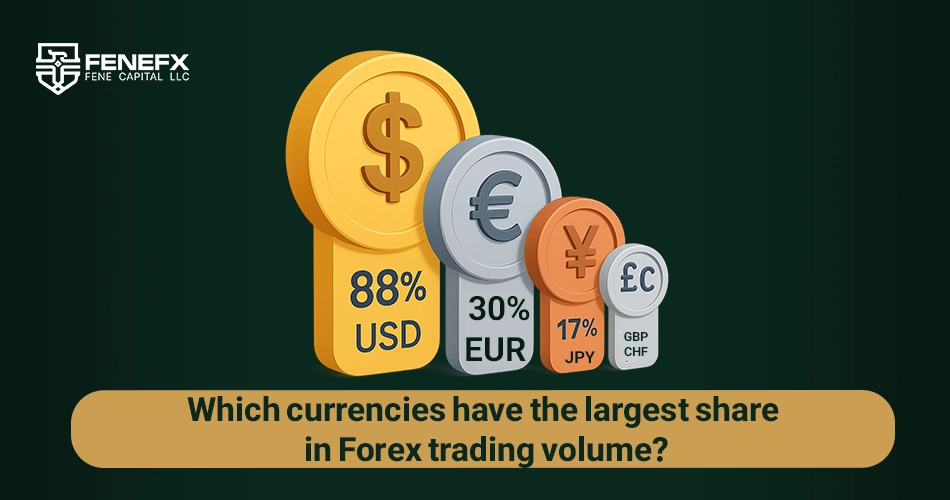
U.S. Dollar (USD):
The U.S. dollar is undoubtedly the king of the Forex market. About 88% of all Forex transactions involve the U.S. dollar. This dominance is due to the dollar’s crucial role in international trade and global foreign exchange reserves.
Euro (EUR):
The euro is the second most traded currency in the Forex market and accounts for about 30% of all transactions. The euro represents the major economies of the European Union, and due to the economic dynamism of this region, it attracts significant attention from traders.
Japanese Yen (JPY):
The Japanese yen is also one of the major currencies in Forex and accounts for about 17% of total transactions. Japan’s economy being one of the world’s leading industrial powers and its significant role in Asian trade contribute to the yen’s popularity.
British Pound (GBP) and Swiss Franc (CHF):
These two currencies also hold a considerable share of the market due to the economic stability of their respective countries and their strong connections to global financial market s.
The combination of these major currencies in highly traded pairs such as EUR/USD, USD/JPY, and GBP/USD makes up a significant portion of the market’s total turnover.
What Information Does Trading Volume Provide to Traders in the Forex Market?
Trading volume is one of the most important data points traders can use for market analysis and making trading decisions. It offers valuable insights into the level of market activity and traders’ interest in a specific currency pair.
Identifying Trends
Trading volume can indicate the strength or weakness of a trend. For example, if a currency’s price is rising and trading volume is also increasing, this suggests a strong bullish trend. Conversely, if trading volume decreases, the trend is likely weakening.
Confirming Breakouts and Key Levels
Trading volume is crucial during breakouts of support or resistance levels. If a breakout is accompanied by high volume, it is likely valid and the continuation of the move can be expected.
Identifying Liquidity and Market Activity
Trading volume helps traders identify areas where the market is more active. These zones often provide suitable opportunities for entering or exiting trades.
Improving Trading Strategies
Using trading volume as a complementary tool alongside technical analysis can strengthen trading strategies. For example, combining volume indicators with price patterns can increase prediction accuracy.
Ultimately, trading volume data enables traders to make more informed decisions and better take advantage of trading opportunities.
How Can Traders Use Trading Volume Information in Their Strategies?
Trading volume data is one of the most important tools traders can leverage to enhance their strategies. It helps them understand how much liquidity is present in the market and how they can use changes in volume for optimal entry and exit points. Below are the main ways traders use trading volume data:
Identifying Liquidity and Trading Opportunities
Trading volume shows traders which currency pairs currently have the highest liquidity. Pairs with high trading volume usually have lower spreads and can be traded with lower risk. Therefore, trading highly liquid pairs can help reduce transaction costs.
Confirming Trends and Breakouts
One of the key uses of trading volume is confirming market trends. If an uptrend or downtrend is accompanied by rising volume, it indicates that more traders are supporting the trend, increasing the likelihood of its continuation. Likewise, during breakouts of support or resistance levels, trading volume can serve as a criterion for confirming the breakout’s validity. Breakouts accompanied by high volume are generally more reliable.
Identifying Entry and Exit Points
Trading volume can help traders determine the best points for entering or exiting a position. For example, when trading volume suddenly increases, it may indicate the entry of major market participants. This information can help the trader enter or exit a trade at the right time.
Using Volume Indicators
Indicators such as Volume and On Balance Volume (OBV) help traders analyze volume changes. These tools can assist in identifying divergences, confirming trends, and even predicting price movements.
Analyzing Market Behavior at Key Levels
Trading volume near key levels such as support and resistance or during the release of major economic news usually increases. This rise in volume may signal major market shifts, creating unique opportunities for traders.
The Relationship Between Liquidity and Turnover in the Forex Market
Liquidity refers to the market’s ability to execute trades with minimal impact on price. Due to its massive daily turnover, the Forex market is considered one of the most liquid financial markets in the world. The relationship between liquidity and turnover in Forex is very close, as higher daily turnover indicates greater liquidity in the market.
- Liquidity and Reduced Spreads:
- In markets with high liquidity, the spread (the difference between the bid and ask price) decreases. In the Forex market, major currency pairs such as EUR/USD or USD/JPY typically have very low spreads due to their high liquidity. This minimizes trading costs for traders and allows for faster and more cost effective transactions.
- Liquidity and Price Volatility:
- When liquidity is high, price volatility generally decreases because the large volume of trades prevents sudden price movements. Conversely, during periods of low liquidity such as the final hours of trading sessions greater volatility is often observed in the market.
- Liquidity and Trading Opportunities:
- High liquidity allows traders to enter or exit trades at any time without significant concern about affecting the price. This feature is especially crucial for scalpers and short term traders.
Changes in Trading Volume Throughout Forex Trading Sessions
The Forex market operates 24 hours a day across three major sessions (Asian, European, and American). Trading volume varies significantly across these sessions, and traders should incorporate these changes into their strategies.
- Asian Session:
The Asian session, which begins with the opening of the Tokyo and Sydney markets, typically has the lowest trading volume. Due to relatively lower economic activity and reduced liquidity, this session experiences less volatility. Currency pairs involving the Japanese yen such as USD/JPY are more actively traded during this session.
- European Session:
With the opening of the London and Frankfurt markets, trading volume increases sharply. The European session is one of the most volatile sessions because many banks, financial institutions, and professional traders are active during this time. EUR/USD and GBP/USD are the most heavily traded pairs in this session.
- American Session:
With the start of the New York market, trading volume reaches its peak. The overlap between the European and American sessions results in maximum liquidity and trading activity. During this session, many major economic news releases occur, which can further increase market volatility.
- Volume Differences at Various Times:
Trading volume reaches its highest levels during periods when two trading sessions overlap (for example, the European and American sessions). Conversely, during the late hours of the day or when only the Asian session is active, trading volume decreases.
The Impact of Economic News and Global Events on Forex Turnover
Economic news and global events are among the most influential factors affecting trading volume and Forex market turnover. Such events typically lead to sudden increases in liquidity and heightened market volatility.
Release of Economic Data
Reports such as unemployment rates, gross domestic product (GDP), and the consumer price index (CPI) are among the data releases that have a significant impact on the Forex market. For example, if the U.S. CPI comes in higher than expected, the U.S. dollar may strengthen and its trading volume may increase.
Central Bank Decisions
Decisions regarding interest rates or monetary policies by central banks can create major shifts in the market. For instance, when the Federal Reserve raises interest rates, demand for the U.S. dollar rises sharply, and the trading volume of its currency pairs increases.
Geopolitical Events
Political crises, wars, or trade agreements can have a profound impact on the Forex market. Such events often cause traders to move toward safer currencies like the U.S. dollar or the Japanese yen.
Short Term and Long Term Impact
Economic news can have short term effects (such as sudden increases in trading volume) or long term effects (such as changes in market trends). Traders typically use fundamental and technical analysis to predict the impact of these events and adjust their strategies accordingly.
Risk Free Entry into Forex with Prop Trading:
The Best Way to Tap into Market Potential Without Personal Capital
One of the biggest challenges of entering the Forex market is the need for initial capital and the acceptance of financial risk by the trader. This is where prop trading has revolutionized the path to beginning a trading career. In the prop trading model, traders can enter the market using institutional capital without using their own money and without worrying about financial losses while receiving a share of the profits they generate. For this reason, prop trading is considered the best and safest method for entering the Forex market, even for individuals with little to no personal capital. Instead of bearing the risk of losing your money, you only need to apply your knowledge and trading skills to benefit from the massive turnover potential of the Forex market.
The Best Choice for Iranians in Prop Trading: Fenefx
Among reputable global prop firms, Fenefx is recognized as the best Iranian prop firm, providing Persian speaking traders with a smoother, faster, and fairer path into the Forex market. With standard rules, a one phase challenge, transparent trading conditions, and fast profit payouts, Fenefx offers a professional and secure environment for traders to utilize their trading expertise. If you are looking to begin trading risk free and with substantial capital, now is the best time to take a simple step into professional investing. To get started, just visit the Fenefx prop purchase page and turn your skill into a real and profitable career.
Final Conclusion
The daily turnover of the Forex market, which exceeds7.5 trillion dollars, reflects the magnitude, high liquidity, and attractiveness of this market for global investors. Factors such as central bank monetary policies, economic news, trading hours, and trader sentiment play important roles in increasing or decreasing trading volume. Smart use of volume data can significantly improve the accuracy of analysis, the quality of decision making, and the success rate of trading strategies. Ultimately, understanding the relationship between volume, liquidity, and volatility helps traders identify powerful trading opportunities and manage their risk more effectively.
Frequently Asked Questions
1. What is the daily turnover of the Forex market?
On average, it is around7.5 trillion dollars per day, according to the 2023 BIS report.
2. Which currency has the largest share of trading volume?
The U.S. dollar, participating in about88%of all Forex transactions.
3. During which trading hours does volume reach its peak?
During the overlap of the European and U.S. sessions, when liquidity and volatility are at their highest.
4. Can trading volume be used to confirm trends or breakouts?
Yes; an increase in volume in the direction of the trend or during the breakout of key levels is usually an indication of the validity of the continuation of the move.
Comments
Does this turnover figure include swaps and forwards, or just spot? Would love a follow-up on how much of it is actual spot trading.
Worth adding that turnover isn't spread evenly — the London/NY overlap does the heavy lifting. Liquidity during Asian hours on minor pairs is a different world, the spreads tell the story.
Short, clear, straight to the point. Nice one.
I quoted the old $6.6T figure in a uni presentation last year and got corrected — should've read the newer BIS survey first, lol.
Honestly had no idea the number was in the trillions per day. The comparison with global stock markets finally made the scale click for me. Thanks for breaking it down simply.