




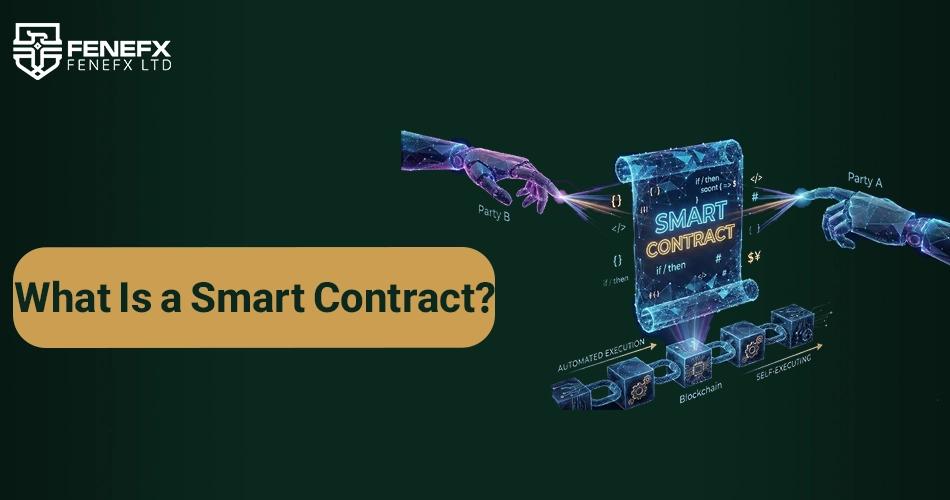
What Is a Smart Contract?
A smart contract is a digital program that runs on a blockchain and executes transactions or agreements automatically, securely, and without the need for intermediaries. In other words, these contracts automatically enforce agreed upon conditions, reduce errors and fraud, and provide full transparency in transactions. By using smart contracts, financial services, insurance, real estate, supply chains, and even legal processes can be carried out faster, more securely, and at lower cost.
Definition and Concept of a Smart Contract
A smart contract is essentially a self executing program that is stored on a blockchain and can automatically carry out predefined agreements. The most important feature of these contracts is immutability and a high level of trust; that is, once deployed, no one can alter or manipulate them.
This concept was first introduced in the 1990s by Nick Szabo, a computer scientist and legal scholar. He defined smart contracts as computerized transaction protocols that can execute the terms of a contract without the need for traditional intermediaries. Szabo likened these contracts to automated machines such as vending machines, where inserting money and selecting a product automatically results in the delivery of the item.
The primary objective of smart contracts is to reduce the need for intermediaries, enhance security, and improve the efficiency of transactions. These contracts enable the automatic execution of complex agreements and can simplify and increase the transparency of business processes.
Given these characteristics, smart contracts are used in areas such as finance, insurance, real estate, supply chains, law, and even voting, and they have the potential to transform the structure of economic and digital interactions.
History of Smart Contracts
The idea of smart contracts was first proposed in the 1990s by Nick Szabo. He sought a way to execute agreements automatically and securely while reducing the need for traditional intermediaries. At that time, the concept was largely theoretical, and its practical implementation was not possible without blockchain technology.
In 1994, Szabo introduced smart contracts as a method for digitizing traditional contracts. He likened these contracts to vending machines, where transactions are carried out automatically and without human intervention. The aim of this idea was to reduce costs, enhance security, and improve the efficiency of transactions.
The Role of Blockchain and Ethereum
With the emergence of blockchain technology, the practical execution of smart contracts became possible. Blockchain, as a distributed and immutable ledger, created a secure and trustworthy environment for executing contracts. The earliest implementations took place on the Bitcoin network, although Bitcoin was only capable of supporting simple contracts such as multi signature transactions.
The true turning point came with the launch of Ethereum in 2015. Ethereum was introduced as the first blockchain platform capable of executing complex smart contracts. Vitalik Buterin, the creator of Ethereum, described the platform as a “world computer” that could run smart contracts in a decentralized manner.
The Solidity programming language, which is used to develop smart contracts on Ethereum, enables developers to implement complex and customized contracts. Following Ethereum, other blockchains such as EOS, Tron, and Polkadot also began developing smart contract capabilities, offering greater scalability and reduced costs.
Challenges and Opportunities
Despite technological advancements, smart contracts still face several challenges. The most significant of these include code security, interaction with external data, and legal limitations. On the other hand, there are broad opportunities for applying this technology in decentralized finance (DeFi), non fungible tokens (NFTs), and supply chain management.
The history of smart contracts shows that this technology is continuously evolving, and with further advancements in blockchain, its role in the future of the digital economy will become more prominent.
How Do Smart Contracts Work?
Smart contracts are programs that run on a blockchain and consist of three main components:
- State Variables:Data that represent the state of the contract at any given time, such as balances or transaction status.
- Functions:A set of instructions used to perform specific operations, such as transferring funds or changing the contract’s state.
- Events:Messages that send state changes or the results of function execution to both the inside and outside of the contract.
How Smart Contracts Function
Smart contracts operate automatically and without human intervention, and their process includes the following stages:
- Defining Conditions:The terms of the contract are specified in the form of programming code.
- Deployment on the Blockchain:The contract is deployed on the blockchain network and is executed in a distributed and immutable manner.
- Receiving Inputs:The contract can receive data or transactions from users or other contracts.
- Executing Conditions:When the predefined conditions are met, the contract is executed automatically.
- Recording Results:The execution results are recorded on the blockchain and become accessible to all parties.
Advantages and Challenges
The advantages of smart contracts include enhanced security, reduced costs, greater speed, and higher transparency. However, code security, reliance on external data, and legal issues are among the major challenges of this technology.
By reducing dependence on intermediaries and increasing transparency, smart contracts play a significant role in economic digital transformation, and with technological advancement, they are expected to become a primary tool across various industries in the future.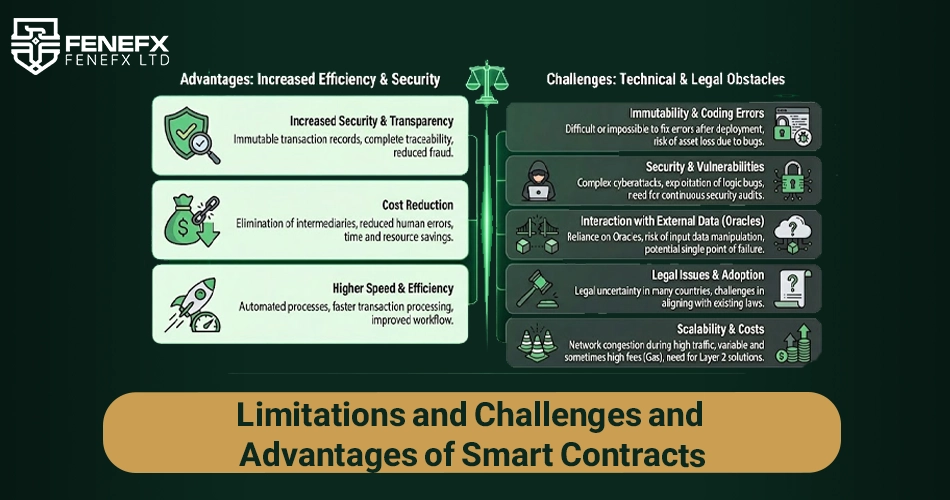
Limitations and Challenges of Smart Contracts
Despite their numerous advantages, smart contracts face specific challenges and limitations that can affect their efficiency and security. Understanding these limitations is essential for the successful use of this technology.
Immutability and Coding Errors
One of the main characteristics of smart contracts is their immutability after deployment. This feature provides a high level of security and transparency; however, if there is an error in the code, correcting it becomes difficult or even impossible. Programming errors can lead to the loss of assets or financial exploitation. For this reason, thorough review and comprehensive testing of code before deployment on the blockchain are of critical importance.
Security and Vulnerabilities
Smart contracts run on secure blockchains, yet they remain vulnerable to sophisticated attacks. Attacks such as code hacking or exploitation of logical bugs can cause irreparable financial damage. Adhering to best programming practices and conducting security audits by experts are essential.
Interaction with External Data
Smart contracts, by default, cannot interact with data outside the blockchain. To receive external information such as exchange rates or weather conditions, oracles are used. However, reliance on oracles can create a security weakness, because if the data is manipulated, the execution of the contract will also be affected.
Legal Issues and Adoption
In many countries, smart contracts still lack a clearly defined legal status. This legal uncertainty can hinder the broader adoption of this technology. Moreover, aligning smart contracts with existing laws and establishing new legal frameworks require international cooperation and a considerable amount of time.
Scalability
As the number of users and transactions increases, blockchain networks may face challenges related to speed and cost. The development of solutions such as Layer 2 networks and the optimization of consensus algorithms can help mitigate these issues.
Complexity and Costs
Developing smart contracts requires expertise in programming and a deep understanding of blockchain technology. In addition, the costs associated with contract execution, such as gas fees on the Ethereum network, can be challenging for users and businesses. Therefore, companies should conduct a cost–benefit analysis before adopting smart contracts.
Applications of Smart Contracts
Smart contracts have the ability to transform and improve operational processes across various industries. This technology can help increase efficiency, reduce costs, and enhance transparency.
Finance and Banking
In the financial sector, smart contracts can automatically execute transactions and financial agreements. For example, in lending systems, a smart contract can automate installment payments and loan management. In insurance, smart contracts can also automatically process claim payments once the policy conditions are met.
Supply Chain
In supply chain management, smart contracts can enhance transparency and accuracy. These contracts track different stages of the supply chain and automatically execute payments based on the delivery of goods. Such processes help reduce human error and ensure timely delivery of products.
Real Estate
In the real estate industry, smart contracts can automatically manage ownership transfers and payments. As a result, the need for intermediaries such as lawyers is reduced, and transaction time and costs are lowered. In addition, smart contracts can be used to manage leases and automatically collect rental payments.
Law and Contracts
In the legal field, smart contracts can automate the execution of agreements and legal obligations and automatically enforce penalties in the event of a contract breach. This capability can reduce legal disputes and streamline legal processes.
Healthcare
In the healthcare sector, smart contracts can improve the management of medical records and interactions between patients and healthcare providers. By enhancing security and protecting privacy, these contracts simplify complex insurance and payment processes.
Energy and Public Utilities
In the energy industry, smart contracts can be used to manage energy production and distribution. For example, in renewable energy systems, contracts can optimize energy generation and consumption and execute payments based on actual usage.
Art and Entertainment
In the art and entertainment industry, smart contracts can automatically manage the rights and revenues of artists and content creators. In the sale of digital artworks and NFTs, smart contracts transparently track royalties and ownership rights.
Practical Examples of Smart Contracts
Smart contracts have been adopted across various industries, and real world examples demonstrate this technology’s ability to drive transformation.
Decentralized Finance (DeFi)
Platforms such as Uniswap and Compound use smart contracts to provide financial services without intermediaries. On Uniswap, transactions are conducted in a decentralized manner, and smart contracts automatically adjust exchange rates between digital assets. On Compound, lending and interest accrual are also carried out automatically.
Insurance
In the insurance industry, smart contracts can automate the payment of claims. For example, in flight insurance, if a flight is delayed, the smart contract automatically pays compensation to the passenger without the need for manual review.
Real Estate
Platforms such as Propy use smart contracts to facilitate real estate transactions. These contracts automate ownership transfers and payments, reducing the need for traditional intermediaries.
Supply Chain
Companies such as IBM have increased transparency and efficiency in supply chains through the use of smart contracts. Different stages of production and delivery are tracked by smart contracts, and payments are executed automatically.
Art and Intellectual Property
Platforms such as OpenSea use smart contracts to sell and manage the rights of digital artworks (NFTs). Artists can automatically receive royalties, and ownership of their works is managed transparently.
Energy
In the energy sector, smart contracts can optimize energy distribution and payments. In renewable energy systems, energy production and consumption are coordinated using smart contracts, and costs are calculated based on actual usage.
Technologies Behind Smart Contracts
Smart contracts are built on advanced technologies such as blockchain and specialized programming languages. These technologies provide security, transparency, and automation for contracts.
Blockchain
Blockchain is a distributed and immutable ledger that stores all transactions and contract data. The core features of blockchain include:
- Decentralization:Data is stored across a network of nodes, making it difficult to alter.
- Transparency:All transactions are visible, increasing trust.
- Security:Advanced cryptography provides a high level of security for contracts.
Programming Languages
Smart contracts are written using specific programming languages:
- Solidity:The most widely used language for Ethereum contracts, similar to JavaScript and suitable for complex contracts.
- Vyper:A more secure and simpler language compared to Solidity, which reduces the risk of programming errors.
- Chaincode:Used in enterprise platforms such as Hyperledger Fabric and based on Go or Java.
How to Create a Smart Contract: A Step-by-Step Guide and Key Considerations
Implementing a smart contract requires careful planning and adherence to security considerations. Below, we review the main steps and the key issues associated with this process, step by step.
1. Defining the Contract’s Purpose and Conditions
Before doing anything else, the contract’s objective and its execution conditions must be specified. This stage includes the following:
- Precisely defining the obligations of the parties
- Specifying the conditions for the contract’s start and end
- Determining the possible outcomes and consequences in the event of a breach of contract
Having a precise design minimizes the likelihood of errors and abuse and provides a foundation for writing secure code.
2. Choosing the Appropriate Blockchain Platform
Depending on the project’s needs, a suitable blockchain platform must be selected. Some common options include:
- Ethereum: Suitable for complex contracts and widely used
- Binance Smart Chain: Lower fees and higher speed
- Solana: High scalability for fast transactions
Choosing the right platform has a direct impact on the contract’s costs, security, and performance.
3. Writing the Contract Using an Appropriate Programming Language
After selecting the platform, the contract must be written using the relevant programming language. The most common languages include:
- Solidity:The most popular language for Ethereum, similar to JavaScript and suitable for complex contracts
- Vyper:Simpler and more secure, with a focus on reducing programming errors
- Chaincode:Used for enterprise platforms such as Hyperledger Fabric, based on Go or Java
Precise coding in accordance with security standards is the foundation of every successful smart contract.
4. Thorough Testing and Code Review
Before deployment on the blockchain, the contract code must be fully tested:
- Using simulation tools and automated testing
- Evaluating contract performance under different conditions
- Identifying weaknesses and vulnerabilities
This stage helps prevent errors and potential financial losses.
5. Deploying the Contract on the Blockchain
After ensuring the correctness of the code, the contract is deployed on the blockchain network. Key points at this stage include:
- Paying gas fees for contract execution
- Ensuring the contract’s automatic and immutable execution
- Permanently recording transactions and contract conditions on the blockchain
6. Monitoring and Maintenance After Deployment
Even after deployment, the contract requires continuous monitoring:
- Verifying the correct execution of conditions and functions
- Applying updates through proxy contracts
- Ensuring the contract’s performance under real world conditions and overall network security
The Future of Smart Contracts
With their unique features, smart contracts will play a key role in digital transformation and the economy of the future.
Increased Adoption and Broader Use
As security improves, costs decline, and efficiency increases, companies and organizations will move toward wider adoption of smart contracts. This technology has attracted significant attention in finance, insurance, supply chains, and real estate, and its applications are expected to expand steadily.
Development of Complementary Technologies
New tools and technologies such as advanced oracles, Layer 2 networks, and improved programming languages will help enhance the efficiency and scalability of smart contracts. These developments will reduce current challenges, including interaction with external data and performance limitations.
Legal and Regulatory Frameworks
With the growing use of smart contracts, the need for new laws and regulations to support this technology is being felt more than ever. Various countries and international organizations are in the process of developing legal frameworks to ensure that the execution of smart contracts is lawful and secure.
A Key Role in the Digital Economy
By increasing transparency, reducing costs, and improving efficiency, smart contracts will become an integral part of commercial and legal processes. This technology is expected to bring about a significant transformation in economic and digital interactions and to be adopted as a core tool across various industries.
If you are a cryptocurrency trader looking for an opportunity to trade professionally with limited capital and managed risk, prop trading is an ideal option. Prop Fenefx gives you the opportunity to access the firm’s capital, test your strategies in real market conditions, and increase your profits without the need for substantial personal capital. This approach is especially valuable for traders seeking hands on experience and the development of their trading skills. Don’t miss this opportunity to start your professional journey in the world of crypto today by purchasing a Prop Fenefx account.
Conclusion
Smart contracts, with their ability to execute automatically, high transparency, and reduced reliance on intermediaries, have become one of the key innovations in the digital economy. This technology not only simplifies and secures financial, legal, and commercial processes, but also has the potential to bring about wide ranging changes across various industries. With technological advancement, improvements in programming languages, and the development of legal frameworks, smart contracts are expected to become a primary tool for increasing efficiency, reducing costs, and enhancing transparency in the future, playing a central role in digital transformation.
Frequently Asked Questions
1. What is a smart contract and what are its advantages?
A smart contract is a digital program that runs on a blockchain and automatically executes transactions once predefined conditions are met; its advantages include enhanced security, reduced costs, and the elimination of intermediaries.
2. What steps are required to implement a smart contract?
The steps include defining the contract’s objective and conditions, selecting an appropriate platform, writing and testing the code, deploying it on the blockchain, and monitoring it after deployment.
3. Are smart contracts completely secure?
Despite the high security of blockchain technology, smart contracts may be vulnerable due to coding errors or the use of insecure oracles; therefore, thorough testing and adherence to security standards are essential.
Comments
Nice and jargon-free, shared it with a friend who keeps asking about crypto.
Good primer, but worth stressing: immutability cuts both ways. Billions have been drained from smart contracts through bugs the devs couldn't patch. Never put serious money in unaudited contracts.
How do audits actually work for these? If the code is immutable, what happens when someone finds a bug after deployment? Would make a good follow-up.
First time I used a DEX I was amazed there was no company in the middle, just a contract. Then I fat-fingered a swap with no undo button and learned the other side of 'code is law'.
The vending machine analogy finally made this make sense to me. I've heard 'smart contract' a hundred times on crypto Twitter without ever understanding it's just code executing conditions.