





Take Profit (TP) in Forex
Take Profit, or TP, is one of the most fundamental yet critical concepts in Forex trading, as it is directly related to profitability and risk management. Many traders know when to enter a trade, but they do not know exactly where to exit with profit. In this article, you will learn in a complete and practical manner what Take Profit is, how to set it properly, and which strategies to use it with to increase profits and reduce emotional decision making.
Definition and General Concept of Take Profit (TP)
Take Profit (TP), or simply TP, is a type of pending order in financial trading that instructs the broker to close a position and lock in profit once the asset price reaches a specified level. This type of order is executed automatically and does not require direct intervention from the trader.
The main purpose of using Take Profit is to lock in profits at a predetermined level in order to prevent sudden market reversals that could reduce gains. By setting this level, traders avoid the temptation to hold a trade in pursuit of higher profits, which can ultimately lead to losing existing gains. This is especially important in highly volatile markets such as Forex.
Take Profit helps traders overcome their emotions and protect their profits by following a predefined strategy. This feature is particularly useful for beginners, who may be more susceptible to emotional influences.
How Take Profit Works
To better understand how take profit works, an example from the Forex market can be considered. Suppose a trader opens a buy (long) position on the EUR/USD currency pair at the price of 1.1700. He anticipates that the price will reach 1.1750 and therefore places a take profit order at this level.
In this case, when the EUR/USD price reaches 1.1750, the take profit order is triggered and the position is automatically closed. This occurs without the need for the trader’s intervention, and his profit is locked in at this level. If the price does not reach the specified level, the take profit order will not be activated and the position will remain open.
Take profit is also very useful in situations such as overnight trading. Suppose a trader predicts that the price will reach a specific level during the night, but does not want to stay awake until morning to close the position. He can use take profit to ensure that if the price reaches the anticipated level, his profit is locked in.
Another application of take profit is in risk management. Suppose a trader is implementing a trading strategy in which 70% of trades are losing trades closed with a stop loss, and 30% of trades are profitable trades closed with take profit. By setting an appropriate ratio between stop loss and take profit, this trader can ensure that overall profits exceed losses.
Overall, take profit is a powerful tool for traders that allows them to secure their profits without worrying about sudden market changes. This is particularly useful in volatile markets, where price fluctuations can occur rapidly. By using this tool, traders can operate in the market more strategically and with greater confidence.
Advantages and Disadvantages of Using Take Profit
Using take profit is a powerful tool in every trader’s toolbox that can help control emotions and improve risk management; however, it must be set carefully and based on thorough analysis in order to avoid its disadvantages and limitations. Traders should always keep in mind that no strategy is flawless, and the use of take profit also requires sufficient experience and knowledge of the market.
Emotional Control and Risk Management
One of the greatest advantages of using take profit (Take Profit) in financial trading is its role in helping control emotions and improve risk management. Traders are often influenced by emotions such as fear and greed, which can lead to irrational decision making. By defining a specific level for exiting a trade, take profit allows traders to lock in their profits without worrying about market fluctuations.
This feature is particularly useful for novice traders who may be quickly affected by market changes. By using take profit, traders can follow a well defined trading plan and be confident that their profits are preserved at the predetermined level. This helps reduce stress and psychological pressure, as the trader does not need to constantly monitor the market and can operate with greater peace of mind.
Additionally, take profit contributes to improved risk management. By correctly setting the take profit level alongside stop loss (Stop Loss), traders can optimize their risk to reward ratio. These settings allow traders to prevent large losses while targeting reasonable profits.
Limitations and Missed Opportunities
Despite its significant advantages, the use of take profit also has drawbacks that must be taken into account. One of the main limitations of take profit is the possibility of missing out on greater profitable opportunities. When the asset price reaches the take profit level, the trade is automatically closed, even if the price trend continues to move in the trader’s favor. This can mean losing additional profit that could have been achieved if take profit had not been used.
Additionally, in highly volatile markets or during the release of major news, take profit may be triggered quickly and the trade may be closed, while the market might subsequently move in the trader’s favor. This can lead to frustration and a sense of missed opportunity.
Moreover, incorrect setting of the take profit level can result in premature trade closure and the loss of profit potential. Determining an appropriate take profit level requires careful market analysis and a deep understanding of trends and volatility.
The Role of Take Profit in Risk Management
Take profit (Take Profit) is one of the key tools in trade risk management, helping traders preserve their profits and prevent potential losses. This tool is particularly important in volatile and dynamic markets such as Forex.
Profit Lock In and Risk Reduction
Take profit allows traders to lock in their profits at a specific level before sudden market fluctuations occur. By setting an appropriate take profit level, traders can prevent unexpected price reversals that may reduce their profits. This is particularly useful in situations where the market is influenced by economic news or political events.
Optimizing the Risk to Reward Ratio
One of the key principles of risk management is maintaining a favorable risk to reward ratio. Take profit helps traders optimize this ratio. Typically, traders aim to set a risk to reward ratio of at least 1:2, meaning that the potential profit should be at least twice the risk. By precisely setting take profit and stop loss, traders can ensure that when trades are successful, the profits gained exceed the losses.
Reducing the Impact of Emotions
Take profit helps traders remain protected from the influence of negative emotions such as fear and greed. By having a clearly defined plan for exiting a trade, traders can make more rational decisions and avoid trading based on emotions. This helps reduce stress and increases focus on trading strategies.
The role of take profit in risk management enables traders to operate in the market with greater confidence. By using this tool, traders can lock in their profits at desirable levels and prevent unexpected losses. Ultimately, take profit, as part of a comprehensive risk management strategy, helps improve a trader’s overall performance.
Alongside the proper use of tools such as take profit and stop loss, choosing an appropriate trading model also plays an important role in risk management. Prop trading allows traders to trade with the capital of prop firms without risking their personal funds, enabling them to focus primarily on precise strategy execution, risk management, and profit stabilization. In this model, adherence to rules such as setting a logical take profit becomes even more important, as sustainable profitability is achieved only through discipline and trading consistency. If you are looking to experience professional trading with higher capital, Prop Fenefx can be a suitable option to get started. To begin this path and receive trading capital, you can proceed by purchasing a prop account.
Strategies for Using Take Profit
These strategies help traders plan more effectively and optimize their profits by using take profit. However, choosing the appropriate strategy depends on market conditions, trading style, and the trader’s personal goals.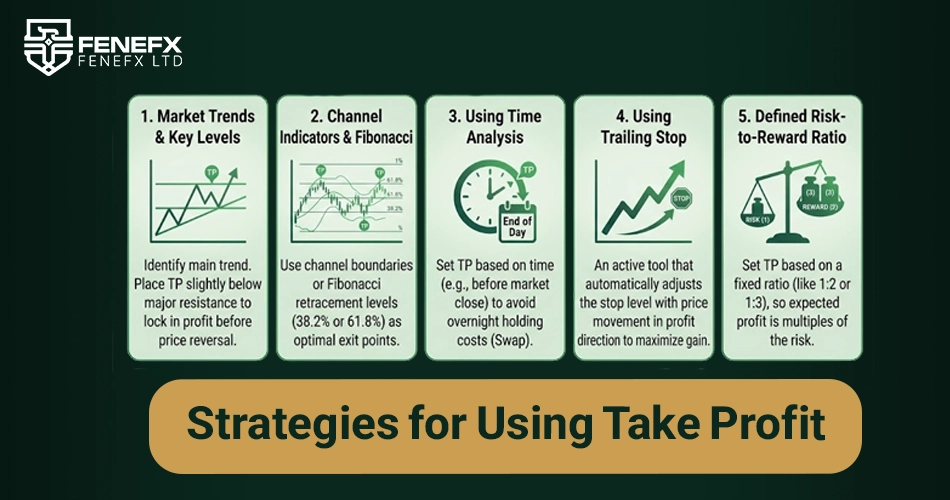
Trend Based Strategies and Key Levels
One effective strategy for using take profit is focusing on market trends and key support and resistance level s. In this approach, traders first identify the main market trend and then determine key levels where a price reversal or trend continuation is likely to occur.
For example, in an uptrend, a trader may place the take profit slightly below a major resistance level in order to lock in profits before encountering selling pressure. These levels can be identified through technical analysis and chart examination.
Using Channel Indicators and Fibonacci Levels
Channel indicators such as Bollinger Bands or Keltner Channels help traders identify price volatility ranges. By using these indicators, traders can set take profit at points where the price is expected to reach the channel boundary and potentially reverse direction. This method is particularly useful in volatile markets.
Fibonacci levels are another tool that can be useful in determining optimal take profit points. Traders use Fibonacci retracements to identify levels that the price may reach after a corrective move. For example, take profit can be set at the 38.2% or 61.8% Fibonacci levels to take advantage of potential price reversals.
Using Time Based Analysis
In this strategy, traders set take profit based on specific timeframes, such as the end of the day or the end of the week. This method is particularly useful for traders who want to avoid paying overnight holding costs. The take profit is set one hour before the market closes so that if the price does not reach the target, the trade can be closed manually.
Using a Trailing Stop
A trailing stop is an active tool that, instead of setting a fixed take profit level, automatically adjusts the stop level as the price moves in the favorable direction. This method allows traders to maximize their profits while still protecting their capital.
Using a Defined Risk to Reward Ratio
In this strategy, the trader sets a specific risk to reward ratio, such as 1:2 or 1:3. Based on this, the take profit is set at a level where the expected profit is two or three times the risk the trader is willing to accept. This method helps improve capital management and increases the likelihood of long term profitability.
How to Set Take Profit in MT4 & MT5 (Step by Step Guide)
MetaTrader 4 and 5 are among the most popular trading platforms in the Forex market, allowing traders to easily set and manage take profit. Below is an explanation of how to set take profit on these two platforms.
Setting Take Profit in MetaTrader 4
- Opening a Trade:
- First, log in to the MetaTrader 4 platform and open the chart of your desired currency pair.
- Click on the “New Order” option in the toolbar or select it from the right click menu on the chart.
- Setting the Take Profit Level:
- In the new order window, you can choose your order type (market or pending).
- In the “Take Profit” section, enter the price level at which you want the trade to be closed. For buy positions, this level must be above the current market price, and for sell positions, it must be below it.
- Managing and Modifying Take Profit:
- After the trade is opened, you can modify the take profit level at any time.
- To do this, go to the “Trade” tab, right click on your trade, and select “Modify or Delete Order.”
- In the window that opens, you can change the take profit level and then click on “Modify.”
Setting Take Profit in MetaTrader 5
To set take profit in MetaTrader 5, you generally need to follow steps similar to those in MetaTrader 4. For your convenience, these steps are outlined below in a clear, step by step manner.
Opening a Trade
- Log in to MetaTrader 5 and locate your desired chart.
- Click on “New Order” or use the right click menu on the chart.
Setting the Take Profit Level
- In the order window, select the order type (market or pending).
- In the “Take Profit” field, enter the price level at which you want the trade to be closed. Similar to MetaTrader 4, this level should be above the current price for buy positions and below it for sell positions.
Managing and Modifying Take Profit
- To change the take profit level, go to the “Trade” tab and right click on the trade, then select “Modify or Delete Order.”
- Enter the new take profit level and click “Modify.”
Calculating and Setting the Take Profit Level
Determining the take profit level is one of the key steps in trade management and is carried out using various technical and mathematical analysis tools. Using support and resistance levels, as well as market volatility calculations, can help traders identify and set optimal take profit levels.
Using Support and Resistance Levels
Support and resistance levels are among the most important technical analysis tools for determining entry and exit points in trading. These levels help traders identify areas where the price is likely to change direction.
Support Levels:
These are points where demand is strong enough to prevent the price from falling further. At these levels, traders can set their take profit to benefit from the profits of a downward trend.
Resistance Levels:
These are points where supply is strong enough to prevent the price from rising further. At these levels, traders in an upward trend can set their take profit to lock in profits before a potential price reversal.
To accurately determine these levels, chart analysis using tools such as trendlines and price patterns is essential. Traders can examine historical price data and identify previous reversal points to find support and resistance levels, and then set their take profit accordingly.
Setting the Level Based on Volatility and Mathematical Calculations
Market volatility is also one of the key factors in determining the take profit level. Traders can use volatility indicators such as the Average True Range (ATR) to assess the extent of price fluctuations. This indicator helps define a reasonable range for setting take profit.
Calculation Using ATR
Traders can use ATR to determine an appropriate distance between the take profit level and the entry point. For example, if the ATR for an asset is 50 pips, the take profit can be set at a reasonable distance such as 100 pips in order to benefit from normal market fluctuations.
Using the Risk to Reward Ratio
Another mathematical method for setting take profit is using the risk to reward ratio. Traders usually aim to keep this ratio at least at 1:2 or 1:3. This means that if the stop loss is 50 pips, the take profit should be at least 100 or 150 pips.
Mathematical Calculations
By analyzing historical data, average price movements, and statistical calculations, traders can determine optimal take profit levels. This approach is particularly useful in markets with large and complex price datasets.
Using support and resistance levels alongside mathematical calculations to set take profit allows traders to manage their trades with greater precision. These methods help reduce risk and increase the probability of profitability. With proper analysis and the selection of an appropriate strategy, traders can use take profit as a powerful tool to improve their trading performance.
Important Tips for Setting Take Profit
Paying attention to the spread and Bid and Ask prices, along with strictly observing the risk to reward ratio, helps traders use take profit as an effective tool for trade management. These factors contribute to risk reduction and increased profitability, allowing traders to operate in the market with greater confidence. With proper analysis and strategy, take profit can become a vital part of a successful trading plan.
Paying Attention to the Spread and Bid and Ask Prices
In Forex trading, having a clear understanding of the spread and how Bid and Ask prices work is essential for effectively setting take profit. The spread is the difference between the buying price (Ask) and the selling price (Bid) and represents the cost a trader pays to enter a trade.
- Bid and Ask Prices:
- When buying an asset, the Ask price is higher than the Bid price. Conversely, when selling, the Bid price is used. When setting take profit, this difference must be taken into account, as it may cause the take profit to be triggered at a point where the desired profit has not actually been achieved.
- The Impact of the Spread on Take Profit:
- If the spread is wide, the take profit may be triggered earlier than expected. Therefore, traders should consider the spread when determining the take profit level and set it in a way that compensates for this cost.
Risk Management and the Risk to Reward Ratio
Risk management is one of the vital aspects of any trading strategy. Using take profit alongside stop loss helps traders control their risk and maximize profits. Traders should also pay close attention to the following risk management considerations when setting take profit levels.
- Risk to Reward Ratio:
- This ratio represents the balance a trader establishes between risk and reward. It is usually set at 1:2 or 1:3, meaning that the targeted profit should be two or three times the amount of risk taken. This approach helps traders offset potential losses in successful trades and ensures overall profitability.
- Accurate Setting of Stop Loss and Take Profit:
- Precisely determining stop loss and take profit levels should be based on market analysis and the trading strategy being used. Traders must carefully evaluate entry and exit points to ensure that the risk to reward ratio is properly maintained.
- Flexibility in Settings:
- Financial markets are dynamic and volatile; therefore, traders should be prepared to adjust their take profit and stop loss settings according to market conditions. This flexibility allows traders to adapt to market changes and manage their risks effectively.
Using Technical Tools to Improve Take Profit Settings
Take profit (Take Profit) is one of the key tools in Forex trading that helps traders lock in their profits at a specific level. In this regard, using technical tools can help improve the settings and effectiveness of take profit. In this section, we examine technical tools and how to use them to better set take profit.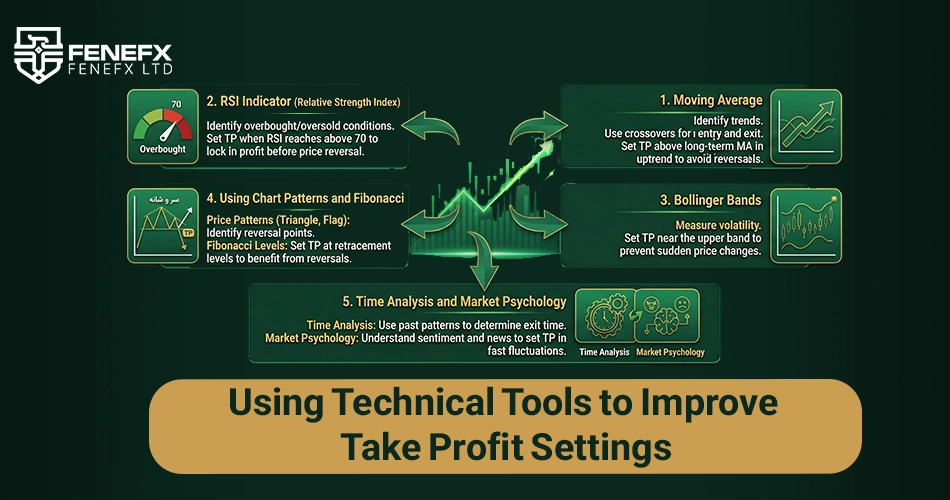
1. Moving Average
Moving averages help identify long term and short term trends. Traders can use moving average crossovers to determine entry and exit points. For example, in an uptrend, take profit can be set above the long term moving average to avoid potential reversals.
2. RSI Indicator (Relative Strength Index)
RSI helps identify overbought or oversold conditions. When RSI reaches levels above 70, it may indicate overbought conditions, and traders can set take profit to lock in profits before a price reversal occurs.
3. Bollinger Bands
Bollinger Bands measure market volatility and can be used as a guide for determining exit points. When the price approaches the upper band, traders can set take profit to protect against sudden market movements.
4. Using Chart Patterns
1. Price Patterns:
Chart patterns such as head and shoulders, triangles, and flags can help identify potential reversal points. Traders can set take profit based on these patterns in order to benefit from potential profits.
2. Fibonacci Levels:
Fibonacci retracements help identify potential price reversal levels. Traders can place take profit at Fibonacci levels to take advantage of possible price reversals.
5. Time Analysis and Market Psychology
1. Time Analysis:
Determining the appropriate time to exit a trade can help improve results. Traders can use past time based patterns to identify suitable moments for setting take profit.
2. Market Psychology:
Analyzing market psychology and understanding trader sentiment can help identify optimal take profit levels. When the market is influenced by news or specific events, traders can adjust their take profit to benefit from rapid market fluctuations.
Using technical tools to set take profit allows traders to operate in the market with greater precision and confidence. These tools provide accurate information about trends, volatility, and price patterns, helping traders make better decisions and maximize their profits. By combining technical analysis with market psychology, traders can improve their strategies and enhance their overall trading performance.
Conclusion
Take profit is one of the most important trade management tools in Forex. When it is set correctly and based on technical analysis, market volatility, and the risk to reward ratio, it can make the difference between an emotional trader and a professional trader. Smart use of TP not only helps lock in profits and reduce stress, but also supports disciplined execution of a trading plan and increases long term profitability. Combining take profit with tools such as stop loss, support and resistance levels, and indicators forms the core foundation of a successful and sustainable trading strategy.
Frequently Asked Questions About Take Profit (TP)
1. What is take profit and what is it used for?
Take profit is an order that automatically closes a trade at a specified price in order to lock in profits.
2. Should profit be fixed or trailing?
Depending on the strategy, a trailing stop is more suitable in trending markets, while a fixed take profit is more effective in ranging markets.
3. What is the best take profit to stop loss ratio?
The standard ratio is usually 1:2 or 1:3, so that profits from winning trades cover losses from losing trades.
4. Is it possible to trade successfully without taking profit?
Yes, but without TP, controlling emotions becomes more difficult and the risk of losing profits increases.
Comments
Fixed TP vs trailing stop — which do you recommend for swing trades? Would love a comparison article with some stats on which performs better.
Never really understood how TP relates to risk-reward ratio until this. The 1:2 example with actual pip values made it click.
I used to remove my TP whenever a trade ran well, telling myself it would keep going. Gave back so much profit that way. Now I set it and walk away from the screen.
Clean explanation, good examples too.
Small tip from experience: set your TP a few pips before the obvious level, not at it. Price often reverses just shy of round numbers and prior highs, and those few pips decide whether you bank or watch profit evaporate.